
Counting Crows – Angels of the Silences
An evening pause: Performed live 1997.
Hat tip Dan Morris.
An evening pause: Performed live 1997.
Hat tip Dan Morris.
Click to see full image.
Some quickie stories worth noting, most provided by stringer Jay:
That picture, cropped to post here, is to the right.
Launch on a SpaceX Falcon Heavy is scheduled for 2024.

On Christmas Eve 1968 three Americans became the first humans to visit another world. What they did to celebrate was unexpected and profound, and will be remembered throughout all human history. Genesis: the Story of Apollo 8, Robert Zimmerman's classic history of humanity's first journey to another world, tells that story, and it is now available as both an ebook and an audiobook, both with a foreword by Valerie Anders and a new introduction by Robert Zimmerman.
The print edition can be purchased at Amazon or any other book seller. If you want an autographed copy the price is $60 for the hardback and $45 for the paperback, plus $8 shipping for each. Go here for purchasing details. The ebook is available everywhere for $5.99 (before discount) at amazon, or direct from my ebook publisher, ebookit. If you buy it from ebookit you don't support the big tech companies and the author gets a bigger cut much sooner.
"Not simply about one mission, [Genesis] is also the history of America's quest for the moon... Zimmerman has done a masterful job of tying disparate events together into a solid account of one of America's greatest human triumphs."--San Antonio Express-News

Roy More, former Republican candidate
for the Senate in Alabama
Pushback: A jury on August 12, 2022 awarded $8.2 million in damages to Roy Moore, who had been the Republican Alabama senate candidate in 2017, declaring that he had been defamed by false accusations of sexual misconduct by a Democratic Party political action committee (PAC).
Jurors found the Senate Majority PAC made false and defamatory statements against Moore in one ad that attempted to highlight the accusations against Moore. The verdict, returned by a jury after a brief trial in Anniston, Alabama, was a victory for Moore, who has lost other defamation lawsuits, including one against comedian Sacha Baron Cohen.
When the accusations were made during the campaign, a close look at the facts made it very clear that they were either false or unreasonably exaggerated. Yet, the leftist press pushed them hard, making no effort to outline their very clear uncertainties. The Democrats then followed up with an aggressive smear campaign.
» Read more

Click for original figure.
Scientists using Juno data of Jupiter’s magnetic field, combined with computer modeling, have now produced a rough map of the gas giant’s internal structure.
The image to the right, figure 2, of their paper, shows that structure. I have annotated the figure to provide some sense of scale. The bold violet line indicates their conclusions about the size of the dynamo that drives Jupiter’s powerful magnetic field, comprising more than 80 percent of the planet’s internal diameter. From the caption:
The gray area depicts the core (0.2 RJ) and the possible dilute core region. The violet area between the dotted lines (0.68 and 0.84 RJ) depicts the [hydrogen-helium] phase separated layer. The top dotted line at 0.95 RJ depicts the depth where the jets decay down to the minimum. The arrows represent possible convection area with unknown origin depth.
While this is a good first hypothesis based on the available data, that data remains quite sparse and uncertain. Thus, the conclusions here must be taken with a great deal of skepticism.

Now available in hardback and paperback as well as ebook!
From the press release: In this ground-breaking new history of early America, historian Robert Zimmerman not only exposes the lie behind The New York Times 1619 Project that falsely claims slavery is central to the history of the United States, he also provides profound lessons about the nature of human societies, lessons important for Americans today as well as for all future settlers on Mars and elsewhere in space.
“Zimmerman’s ground-breaking history provides every future generation the basic framework for establishing new societies on other worlds. We would be wise to heed what he says.” —Robert Zubrin, founder of the Mars Society.
All editions are available at Amazon, Barnes & Noble, and all book vendors, with the ebook priced at $5.99 before discount. All editions can also be purchased direct from the ebook publisher, ebookit, in which case you don't support the big tech companies and the author gets a bigger cut much sooner.
Autographed printed copies are also available at discount directly from the author (hardback $29.95; paperback $14.95; Shipping cost for either: $6.00). Just send an email to zimmerman @ nasw dot org.
In a just published paper, scientists using archive data from the Magellan radar orbiter that circled Venus from 1990 to 1994, combined with data from Europe’s Venus Express that orbited from 2006 to 2015, have detected more evidence of recent volcanic activity in a canyon dubbed Ganis Chasma located in a rift zone called Atla Regio.
From the paper’s conclusion:
The pattern of the radar emissivity in these regions is consistent with relatively young and unweathered materials. The transient IR-bright spots in these regions detected 20 years after Magellan, provide independent corroboration of active volcanism in Ganis Chasma since the 1990’s.
As a possible site of current tectonic and volcanic activity, Atla Regio represents one important science target for the upcoming missions to Venus.
There are presently four missions planned for Venus, Europe’s EnVision orbiter, NASA’s VERITAS and DAVINCI+ probes, and Russia’s Venera-D missoin. All will certainly take a closer look at this region to see if there is active volcanism going on there now.
Two new science papers have just been released detailing results from the Al-Amal (Hope) Mars orbiter that was designed and built by American universities for the United Arab Emirates (UAE).
Both papers used data obtained from the orbiter’s infrared spectrometer, dubbed the Emirates Mars Infrared Spectrometer (EMIRS).

Figure 1 from paper. Click for full image.
First, the instrument tracked the daily changes in the planet’s cloud cover.
A prominent region of clouds that is commonly observed near the equator during Mars’ cold season—known as the aphelion cloud belt—was observed to reach a minimum near midday, with more clouds typically observed in both the morning and afternoon. Distinct differences were found in clouds observed near volcanoes, which tended to reach a minimum before local noon and increase throughout the afternoon.
The figure to the right shows this. In the morning and afternoon (LTST’s 7 and 17), there is a high concentration of clouds in the equatorial region above the Tharsis Bulge where the highest Martian volcanoes are located. During the middle of the day (LTSTs 11 and 13) this cloud cover largely dissipates, with a corresponding increase in cloud cover in Hellas Basin, in the southern hemisphere.
The second paper took a more general look at the data, including the change in temperature depending on elevation as well as dust and water content during the Martian northern spring and summer. From the abstract:
» Read more

Leaving Earth: Space Stations, Rival Superpowers, and the Quest for Interplanetary Travel, can be purchased as an ebook everywhere for only $3.99 (before discount) at amazon, Barnes & Noble, all ebook vendors, or direct from my ebook publisher, ebookit.
If you buy it from ebookit you don't support the big oppressive tech companies and I get a bigger cut much sooner.
"Leaving Earth is one of the best and certainly the most comprehensive summary of our drive into space that I have ever read. It will be invaluable to future scholars because it will tell them how the next chapter of human history opened." -- Arthur C. Clarke
Despite objections by India and an initial refusal by the Sri Lanka government to allow a Chinese military communications/radar ship to dock at one of Sri Lanka’s ports, the ship was finally allowed to dock yesterday.
Sri Lanka, which needs the support of both India and China as it struggles with its worst economic crisis in decades, initially granted the ship permission for a five-day replenishment stay in Hambantota, from Aug. 11.
It later asked China to delay the vessel’s arrival, citing the need for more consultations.
Yuan Wang 5 will now berth for only three days to stock up on fuel, food and other essentials, said an official at the port who declined to be identified as he is not authorised to speak to the media.
The ship is used by China to track satellites, rockets, and missiles, both its own and other nations.
Sri Lanka is caught between a rock and a hard place. The country is bankrupt, its citizens facing starvation due to the previous government’s imposition of numerous green environmental policies that destroyed its agriculture industry. It has also taken aid from both India (providing military hardware) and China (which built the port and holds a 99-year lease to operate it), and neither looks kindly at the other.
Capitalism in space: The merger deal between the Italian orbital tug company D-Orbit and the special purpose acquisition investment company (SPAC) Breeze has been canceled.
The Italian company had hoped to raise $185 million from the deal to expand staff and accelerate investments in ION Satellite Carrier, its orbital transfer vehicle (OTV) that completed its first commercial mission in late 2020.
However, “financial markets have changed substantially” since the deal was announced Jan. 27, Breeze CEO Douglas Ramsey said, amid rising interest rates, soaring inflation, and an ongoing war in Ukraine. “As we look ahead, we remain focused on identifying another value creating opportunity for Breeze shareholders,” Ramsey added.
A SPAC is a shell company designed solely to gather investment capital that is then used to either buy or merge with another company. In the process the company that is taken over goes public, its stock available on the stock market for trade. There have been a number of such takeovers in the space sector in the past few years, but most have turned out poorly for the investors in those SPACs, as noted in the article:
Of the nine space companies that went public through SPAC mergers in 2021, only Rocket Lab’s shares finished the year trading above their price when the merger closed. [Ed: both Virgin Galactic and Astra are examples of these failures.]
Demand for new SPAC deals has also been waning amid declining investor appetite for risk and increasing regulatory scrutiny over how these blank check firms operate. More than 40 SPAC mergers have been canceled so far this year, reported Bloomberg.
To put it more bluntly, investors have found these SPACs to be poor investments, and are bailing from them. This is likely what happened at Breeze, thus forcing the cancellation of the deal with D-Orbit.
An evening pause: This has been going around, but with a French narration that has no translation. The version below overlays a pleasant music track that I think enhances it nicely.
Hat tip Rex Ridenoure.

Click for full image.
Cool image time! The photo to the right, cropped and reduced to post here, was taken on May 7, 2022 by the high resolution camera on Mars Reconnaissnace Orbiter (MRO). It shows what the scientists have labeled as “Cones in Phlegra.”
Cones such as these are one of the prime geological mysteries of Mars’ northern lowland plains. Scientists do not know yet whether they are either mud or lava volcanoes, or even if they are sedimentary mesas that resisted subsequent erosion. In fact, it was hoped by some American scientists that the Chinese would send its Zhurong rover north towards a nearby cone to find out, but alas, the Chinese decided to head south instead.
Zhurong however was on the other side of Mars. The overview map below shows us where these cones are located.
» Read more
From Jay, BtB’s stringer:
As Jay notes, it looks like an obvious knockoff of SpaceX’s Merlin engine.
The army however will continue to build instruments and payloads for satellites, as well as continue to maintain its 1st Space Brigade, which monitors satellite data and health during military deployments.

Minnesota public schools and teachers unions:
dedicated to the new segregation!
“Segregation today, segregation tomorrow, segregation forever!” According to clauses in a new union contract in Minneeapolis, white teachers must be laid off or reassigned first should a layoff be required, and that “educators of color” will be exempt from such layoffs.
“Starting with the Spring 2023 Budget Tie-Out Cycle, if excessing a teacher who is a member of a population underrepresented among licensed teachers in the site, the District shall excess the next least senior teacher, who is not a member of an underrepresented population,” the agreement reads.
According to the United Federation of Teachers, “excessing” means “reducing staff in a particular school when there is a reduction in the number of available positions in a title or license area in that school.”
The agreement adds that non-white teachers, as well as those working in various programs, “may be exempted from district-wide layoff[s] outside seniority order.” The agreement also prioritizes the reinstatement of teachers from “underrepresented populations” over white teachers.

Click for full image.
Click for full image.
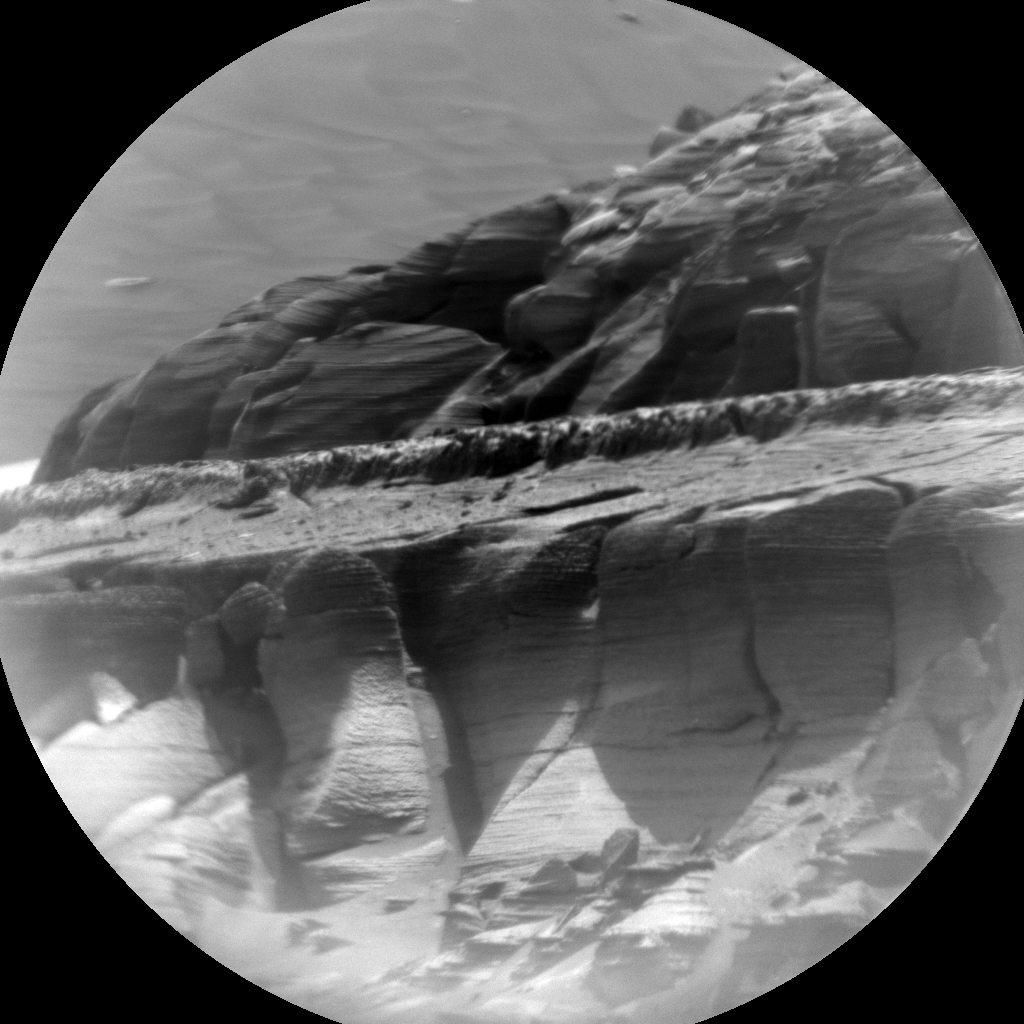
Two cool images arrived today from Curiosity, as it is about to enter the Martian canyon of Gediz Vallis. The mosaic above, cropped, reduced, and annotated to post here, was assembled from photos taken by the rover’s right navigation camera on August 15, 2022. The photo to the right, cropped and reduced to post here, was taken the same day by the rover’s Chemistry camera, normally designed to take very close-up pictures of nearby features. In this case the science team aimed it at a distant cliff face, marked by the arrow in the panorama above, to get a preview of some of the many layers in that mesa.
And has become quite expected from Mars, the number and types and variety of layers is astonishing. The layer that forms the flat bright area at the center of this image is what scientists have dubbed “the marker layer”, since they have found it at similar elevations in many places on the flanks of Mount Sharp. (See the annotated overview map from a post last week.)
Curiosity’s planned route is to head to the right of this mesa, circling around it to get into the upper reaches of Gediz Vallis. First however engineers are going to have to figure out how to get the rover past the somewhat large scattered rocks on the ground directly ahead, without further damaging Curiosity’s already tattered wheels. At first glance there does not appear to be any clear path.
As part of an agreement between the two nations, Russia yesterday announced that it will fly a Tunisian woman to ISS in 2024.
On August 13, Women’s Day in Tunisia, eight women candidates for a space flight were presented. They are currently undergoing medical examination. Six of them will go to Russia for the final stage of pre-qualification to choose two best candidates: one will be a member of the main crew, the other one – of the standby crew.
No longer able to make money selling the spare seats on Soyuz to NASA, and apparently not getting much interest from the private sector inside or outside of Russia to buy these seats, the Putin government is now using them for international diplomacy, just as it did during the Soviet era.

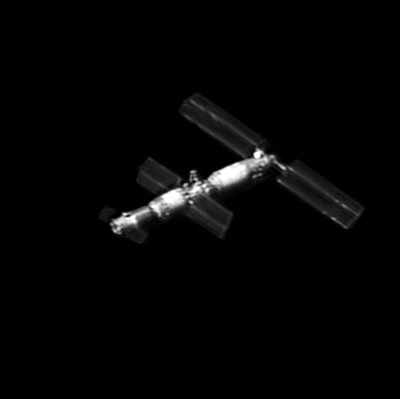
The Russian space agency Roscosmos today unveiled a small tabletop model of the independent Russian space station it proposes to build that will replace its portion on ISS.
The picture to the right shows that model. It shows four large modules, a second docking hub, and a Russian manned Federatsiya (“Federation” in English) capsule (intended to replace Soyuz) docked to the nearest port.
Roskosmos said in a statement that the new space station would be launched in two phases, without giving dates. The first phase would see a four-module space station start operating. That would later be followed by a further two modules and a service platform, it said. That would be enough, when completed, to accommodate up to four cosmonauts as well as scientific equipment.
Roskosmos has said the new station would afford Russian cosmonauts a much wider view of the Earth for monitoring purposes than they enjoy in their current segment. Although designs for some of the new station already exist, design work is still underway on other segments.
Russian state media have suggested that the launch of the first stage is planned for 2025-26 and no later than 2030. Launch of the second and final stage is planned for 2030-35, they have reported.
Russia officials have also said that it will stick with its partnership at ISS until this new station has begun operations.
It will be very revealing how successful Russia is at meeting this timetable. For the past thirty years, since the fall of the Soviet Union and the advent of international cooperation at ISS, its aerospace sector has routinely failed to meet any schedule at all, promising a lot but never delivering, or delivering literally decades late. (For example, Federatsiya has been under development for almost a decade, with no apparent progress.) Forced to go it alone, and in competition with the rest of the world, that sector, now controlled and owned by the government (like the Soviet days), might finally have some incentive to produce.
Or not. The corruption that permeates Russia’s government is deep and widespread. It is entirely possible that a large percentage of the money budgeted for this project ends up in the pockets of its managers instead of used to build anything.
We shall have to wait and see.
Some weekend news from BtB’s top stringer, Jay.
Of the 1,784 objects tracked, 1,132 have burned up in the atmosphere, with the orbits of another 539 to decay in the next three years. The fate of the remaining 113 objects is unclear, but they will clearly be a threat for longer.
We’re here to help you: The Biden administration has now officially announced its plans to formulate new regulations governing in-space commercial activities, such as satellite repair, orbital refueling stations, and removal of space junk, as part of a space strategy workshop statement released last week by the FCC.
The new White House initiative is a follow-on effort [to one started during the Trump administration], aimed at fleshing out the domestic rules, and possibly future regulations, for “non-traditional” space activities that today either fall between jurisdictional cracks or simply are not covered by current law, according to a US government source involved.
Another thrust of the Biden administration effort is to get in front of the governance issues in order to shape future global norms and rules, including for military activities — ahead of China, which also is seeking to be a leader in how humankind expands its reach to the stars.
Kamala Harris announced this new regulatory effort, outlined in this strategy document [pdf], and added that it will be led by the National Space Council, despite the fact that the FCC scooped her by a full week in announcing it. This quote below from her speech announcing this initiative also illustrated her empty-headed, cliche-ridden mentality:
“We will do this work to make sure our nation remains a role model for the responsible use of space,” Harris said in a speech during a visit to the Chabot Space & Science Center in Oakland, Calif. noting that the US “must write new rules to provide the clarity” needed by government and industry for 21st century space operations.
“We must think about where we now stand and where we must go,” she said. “The opportunity of space must guide our work in the 21st century. to do so, must deepen our partnerships with the private sector.”
Despite the vapid content of Harris’s speech, make no mistake she and the federal bureaucracy that is dominated and controlled by the Democratic Party knows exactly where it wants things to go: It wants power and control, and is very unhappy that in the past five years private enterprise has wrested that power and control from it in space. These new regulations will be shaped entirely with the goal of squelching the freedom of private companies so that the government runs things again.
A professional software hacker not only recently succeeded in hacking the terminals SpaceX sells customers to use its Starlink satellite internet service, he first got a bounty from SpaceX for doing so, then made his technique freely available on the web for everyone else.
[Lennert] Wouters is now making his hacking tool open source on GitHub, including some of the details needed to launch the attack. “As an attacker, let’s say you wanted to attack the satellite itself,” Wouters explains, “You could try to build your own system that allows you to talk to the satellite, but that’s quite difficult. So if you want to attack the satellites, you would like to go through the user terminal as that likely makes your life easier.”
The researcher notified Starlink of the flaws last year and the company paid Wouters through its bug bounty scheme for identifying the vulnerabilities. Wouters says that while SpaceX has issued an update to make the attack harder (he changed the modchip in response), the underlying issue can’t be fixed unless the company creates a new version of the main chip. All existing user terminals are vulnerable, Wouters says.
Starlink says it plans to release a “public update” following Wouters’ presentation at Black Hat this afternoon, but declined to share any details about that update with WIRED prior to publication.
Wouters is a researcher at the Belgian university KU Leuven.
While it can certainly help SpaceX to figure this out, by publishing the hack to the world Wouters looks like a blackmailer unsatisfied with his payoff who is now following through with his blackmail threat. One also wonders why SpaceX, as part of its bounty payment, did not require Wouters to sign a non-disclosure agreement.
Embedded below the fold in two parts.
To listen to all of John Batchelor’s podcasts, well worth your time, go here.
» Read more
An evening pause: This short analysis of a spectacular race track crash right at the start of a Formula 1 race illustrates well the sophistication of modern technology, not only in protecting the driver’s life but in providing the information for reconstructing the cause of the accident. And it all happens during an ordinary sports broadcast.
You’ll probably want to watch this more than once to catch how one car gets flipped over on its back.
Hat tip Tom Wilson.