Rocket Lab shifts another launch from Virginia to New Zealand

Foot-dragging by NASA bureaucrats has apparently forced Rocket Lab to shift the launch of its CAPSTONE lunar orbit cubesat from its new launchpad in Wallops Island, Virgina, to its New Zealand launchpad.

CAPSTONE would be the second Rocket Lab mission in recent weeks that shifted from Virginia to New Zealand. The most recent Electron launch July 26 placed into orbit Monolith, a smallsat developed by the Air Force Research Laboratory. Monolith was originally going to launch on the first Electron mission from Virginia.

Rocket Lab said at the time that it shifted the launch of Monolith because of ongoing work by NASA to certify the software for the rocket’s autonomous flight termination system. A NASA spokesman said in July that the agency expected to complete certification of the unit by the end of the year.

Note too that Rocket Lab had originally hoped to launch from Wallops in 2020, but was forced to delay that launch to 2021 then because of NASA’s inability to approve this system. Now it looks like they won’t be able to launch in ’21 either.

This flight termination system is likely the same one that Rocket Lab has successfully used now for four years and more than twenty launches in New Zealand. Why it should take NASA literally years to approve it is shameful. As I wrote in November,

While I have no evidence of this, I cannot help being suspicious of these various government agencies. For years numerous people in the government put fake roadblocks up to slow or stop SpaceX’s first manned launch, merely because it threatened their turfs. This autonomous termination system will make the ground crews at Vandenberg and at Cape Canaveral irrelevant, and I would not be surprised if some of these issues were drummed up to delay or block this system because of that.

I know I am being cynical, but based on history it is not unreasonable to be so.

I think we are seeing evidence now that my cynicism was entirely justified.

11 comments

Scientists: Betelgeuse dimmed because of giant dark spot on surface

The uncertainty of science: A new study by scientists in China now proposes that the dimming of the red giant star Betelgeuse in 2019-2020 was because of a giant dark and cold spot on its surface.

When Betelgeuse was at its dimmest on Jan. 31, 2020, its effective temperature — meaning, the temperature calculated from its emitted radiation — was measured at 3,476 degrees Kelvin (about 5,800 degrees Fahrenheit or 3,200 degrees Celsius.)

But once the star was back to a normal luminosity, measurements indicated an almost 5% temperature rise to 3,646 Kelvin (roughly 6,100 F or 3,370 degrees C.)

…[T]he astronomers … concluded it is unlikely the entire surface cooled temporarily by that amount. Rather, it must have been a sunspot — or rather, a “star spot” — blocking some of Betelgeuse’s radiation from escaping, they said.

This new hypothesis aligns partly with others that say it was a combination of a dark spot and intevening dust that caused the dimming.

None of these hypotheses however “solve” the mystery. Too little concrete information exists at present to do that.

0 comments

Genesis cover

On Christmas Eve 1968 three Americans became the first humans to visit another world. What they did to celebrate was unexpected and profound, and will be remembered throughout all human history. Genesis: the Story of Apollo 8, Robert Zimmerman's classic history of humanity's first journey to another world, tells that story, and it is now available as both an ebook and an audiobook, both with a foreword by Valerie Anders and a new introduction by Robert Zimmerman.

The print edition can be purchased at Amazon or any other book seller. If you want an autographed copy the price is $60 for the hardback and $45 for the paperback, plus $8 shipping for each. Go here for purchasing details. The ebook is available everywhere for $5.99 (before discount) at amazon, or direct from my ebook publisher, ebookit. If you buy it from ebookit you don't support the big tech companies and the author gets a bigger cut much sooner.


The audiobook is also available at all these vendors, and is also free with a 30-day trial membership to Audible.
 

"Not simply about one mission, [Genesis] is also the history of America's quest for the moon... Zimmerman has done a masterful job of tying disparate events together into a solid account of one of America's greatest human triumphs."--San Antonio Express-News

Perseverance’s first sample grab fails

Perseverance's first core sample drill location
Click for full image.

The first attempt by the Mars rover Perseverance to obtain a core sample has apparently failed.

The failure does not appear to be technical. All the hardware appears to have worked. When they inspected the interior of the hollow core drill however no sample was seen inside.

“The sampling process is autonomous from beginning to end,” said Jessica Samuels, the surface mission manager for Perseverance at NASA’s Jet Propulsion Laboratory in Southern California. “One of the steps that occurs after placing a probe into the collection tube is to measure the volume of the sample. The probe did not encounter the expected resistance that would be there if a sample were inside the tube.”

…”The initial thinking is that the empty tube is more likely a result of the rock target not reacting the way we expected during coring, and less likely a hardware issue with the Sampling and Caching System,” said Jennifer Trosper, project manager for Perseverance at JPL. “Over the next few days, the team will be spending more time analyzing the data we have, and also acquiring some additional diagnostic data to support understanding the root cause for the empty tube.” [emphasis mine]

Do the highlighted words remind you of anything? They do for me. The first thing I thought of when I read this was the drilling mole for InSight’s heat sensor. It failed in its effort to drill into the Martian surface because the nature of the Martian soil was different than expected. It was too structurally weak, and would break up into soft dust rather than hold together to hold the mole in place.

In the case of Perseverance, it appears right now (though this is not confirmed) that the drill successfully drilled into the ground, with its core filling with material, but when the core was retracted, that material simply fell out, as if it was too structurally weak to maintain itself inside the core.

The photo above of the drill hole and its thick pile of dust appears to support this hypothesis. Even though they drilled into what looked like bedrock the act of drilling fragmented that bedrock apart.

I am speculating based on limited information, so I am likely wrong. For example, the drill certainly has sensors to detect the density and structural strength of the rock it is drilling into. The engineers will check those numbers during drilling. If the rock doesn’t appear dense enough or structurally strong enough for a core sample, I would expect them to pick a different spot.

If true however it means that obtaining core samples at many locations in Jezero Crater will simply not be possible. This does not mean no samples will be obtained, because there are definitely places on Mars where the ground’s structure is solid enough for this method to work. Curiosity definitely found this to be true, when if found several places on Vera Rubin Ridge where its drill didn’t have the strength to penetrate the rock.

8 comments

Conscious Choice cover

Now available in hardback and paperback as well as ebook!

From the press release: In this ground-breaking new history of early America, historian Robert Zimmerman not only exposes the lie behind The New York Times 1619 Project that falsely claims slavery is central to the history of the United States, he also provides profound lessons about the nature of human societies, lessons important for Americans today as well as for all future settlers on Mars and elsewhere in space.

 
Conscious Choice: The origins of slavery in America and why it matters today and for our future in outer space, is a riveting page-turning story that documents how slavery slowly became pervasive in the southern British colonies of North America, colonies founded by a people and culture that not only did not allow slavery but in every way were hostile to the practice.  
Conscious Choice does more however. In telling the tragic history of the Virginia colony and the rise of slavery there, Zimmerman lays out the proper path for creating healthy societies in places like the Moon and Mars.


“Zimmerman’s ground-breaking history provides every future generation the basic framework for establishing new societies on other worlds. We would be wise to heed what he says.” —Robert Zubrin, founder of the Mars Society.


All editions are available at Amazon, Barnes & Noble, and all book vendors, with the ebook priced at $5.99 before discount. All editions can also be purchased direct from the ebook publisher, ebookit, in which case you don't support the big tech companies and the author gets a bigger cut much sooner.


Autographed printed copies are also available at discount directly from the author (hardback $29.95; paperback $14.95; Shipping cost for either: $6.00). Just send an email to zimmerman @ nasw dot org.

Having an off day

To my readers: This is one of those days where I just cannot get up the oomph to write. First, I am becoming bored by my daily “Today’s blacklisted American” column. It is not that the number of people being ruined and harmed by the oppressive thugs of the left has dropped, it is that I am finding that people are becoming desensitized to the oppression. I get the impression that my posts are being skimmed or ignored, because they are merely repeating the same story over and over again.

“Oh, yeah, big deal, another person lost their job because they dared to express an opinion. Call me when something new happens.”

Such a situation I find so depressing words can’t express it. Makes it very hard to work.

Second, I have a bunch of new cool images to post, but I am either waiting for answers from scientists before posting, or I don’t have the mental energy today to work up a post. Sorry. I think I simply need a real day off.

Unless I get energerized later today, you all will simply have to wait until I return in full force on Monday (though if something exciting pops up on the weekend it might get my writing juices flowing sooner).

35 comments

Leaving Earth cover

Leaving Earth: Space Stations, Rival Superpowers, and the Quest for Interplanetary Travel, can be purchased as an ebook everywhere for only $3.99 (before discount) at amazon, Barnes & Noble, all ebook vendors, or direct from my ebook publisher, ebookit.

If you buy it from ebookit you don't support the big oppressive tech companies and I get a bigger cut much sooner.


Winner of the 2003 Eugene M. Emme Award of the American Astronautical Society.

 
"Leaving Earth is one of the best and certainly the most comprehensive summary of our drive into space that I have ever read. It will be invaluable to future scholars because it will tell them how the next chapter of human history opened." -- Arthur C. Clarke

The trials and tribulations of Blue Origin’s BE-4 engine

Link here. The article tries to provide some explanations for the delays at Blue Origin that have put the BE-4 engine years behind schedule.

The first and most important fact gleaned from the article is that flightworthy versions of this engine will not be ready this summer as promised, and will likely not get delivered to ULA for its Vulcan rocket before the end of the year, causing its inaugural launch to be delayed to the second half of ’22. This also means that Blue Origin’s own orbital rocket, New Glenn, will likely not launch until late next year, at the earliest.

Moreover, the engines that Blue Origin will deliver to ULA will not be fully tested, and might require replacement if tests on other engines reveal more problems.

The article’s most important revelation about the delays however is this:

One of the most persistent problems, sources said, is that the BE-4 engine testing and development program has been relatively “hardware poor” in recent years. Effectively, this means that the factory in Washington has not had enough components to build development engines, and this has led to extended periods during which no testing has occurred on the stands in Texas.

It was surprising to hear this because back in the spring of 2017 Blue Origin stated publicly that its development program was hardware rich. After arriving as CEO in late 2017, however, [Bob] Smith appears to have focused more on a substantial reorganization of Blue Origin’s leadership rather than hardware development. Other programs were prioritized, too, so the BE-4 team did not get all the resources and freedom it needed to proceed at full throttle. [emphasis mine]

To put it more bluntly, Smith decided it was more important to rearrange the deck chairs rather than launch lifeboats into the water. As a result, Blue Origin has essentially wasted the last four-plus years.

There are signs that the company has changed course away from Smith’s focus, but we shall have to wait and see. The childish press release issued by Blue Origin yesterday, claiming its manned lunar lander was far better than SpaceX’s Starship and should have been chosen by NASA, suggests that the course change has not been as thorough as one would hope. The amount of intellectual dishonesty contained in that release is somewhat disturbing, especially coming from a rocket company:

Blue Origin appears to be, at minimum, cherry picking its comparisons. The graphic notes that the Starship-Super Heavy system hasn’t launched yet. Starship has launched six miles into the air on several occasions, but not with its Super Heavy booster. It also points out that SpaceX’s Starship facilities in Boca Chica, Texas have never accommodated an orbital launch. Blue Origin, though has never launched any rocket to orbit from anywhere.

The graphic doesn’t, however, note the cost of the Starship lunar lander. SpaceX’s proposal estimates that it will cost NASA $2.9 billion, while Blue Origin’s gave a price of $5.9 billion. [emphasis mine]

For the management of a rocket company to not recognize the fundamental facts indicated by the highlighted words above, or to make believe they are unimportant, does not bode well for that rocket company. Rather than focusing on getting its rocket finally off the ground, the management appears instead unwilling to face some hard facts, and fix them.

Meanwhile, SpaceX keeps barrelling along, focused not on petty managment issues or whiny complaints, but on actually building rockets that fly.

8 comments

Zhurong travels another 700 feet on Mars

Zhurong's location

According to a new update from China’s state-run press today, since the last update of its Zhurong Mars rover on July 31st, the rover has traveled just over 700 feet, for a total travel distance of about 2,624 feet, just under a half mile.

As of August 6, 2021, the rover has worked on the surface of Mars for 82 Martian days and the orbiter has been in orbit for 379 days. The two are in good condition and functioning properly.

The report provides no other real information.. I have indicated on the map to the right the range in which this travel distance could have taken Zhurong. Hopefully they will release more information soon.

The nominal mission was originally planned for 90 days. Right now it looks like the rover will easily exceed that.

0 comments

SpaceX stacks Starship on top of Superheavy

Superheavy with Starship on top
Click for original image.

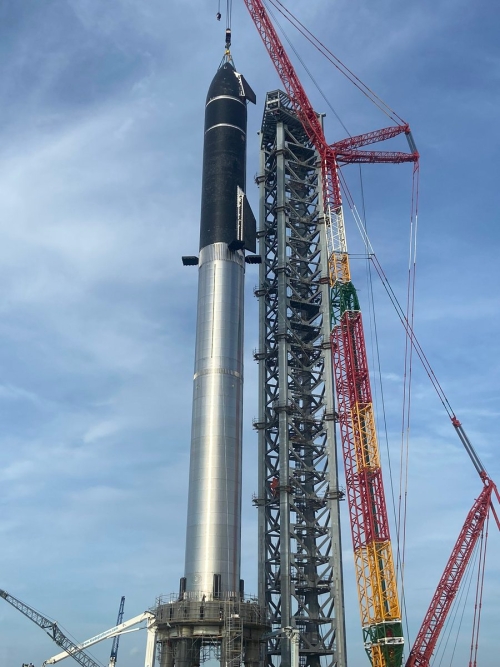
Capitalism in space: Only three days after the company had rolled Superheavy prototype #4 to the launchpad, SpaceX today stacked Starship prototype #20 on top, uniting for the first time the entire rocket.

All told, the rocket is 395 feet high, about 32 feet taller than the Saturn-5.

The photo to the right, reduced slightly to post here, was posted by Elon Musk earlier today. It also makes obvious several things that will be different for this Starship flight compared to the previous suborbital hops. Starship’s dark exterior is because it is covered with thermal tiles designed to protect it as it returns to Earth flying through the atmosphere at orbital speeds.

Note also the grid fins on Superheavy. Apparently they will be open during the entire flight, instead of unfurling shortly after stage separation as is done with Falcon 9.

I am not sure what the vertical attachments near the bottom of Superheavy are for. The plan is for the stage to land in the Gulf of Mexico, so it does not need landing legs. Could these be attachment points for holding the rocket to the launchpad?

I have been predicting a late September/early October date for this rocket’s first orbital launch test. SpaceX is sure working hard to beat that timeline. They still need to do tank tests and static fire tests of the whole assembly, but based on past schedules, they might get this done in only a few weeks. If so, it means they might be able to launch before the end of August.

My god, if only other American rocket companies worked in this manner. Imagine what wonders they all could accomplish.

19 comments

Astra to attempt orbital launch later in August

Capitalism in space: The smallsat rocket company Astra has announced that it will attempt to complete its first successful orbital launch before the end of this month, launching a Space Force satellite.

The U.S. Space Force has booked two missions with Astra, the Bay Area company announced today (Aug. 5). The first flight will launch a test payload for the Department of Defense’s Space Test Program from the Pacific Spaceport Complex in Kodiak, Alaska, during a window that runs from Aug. 27 through Sept. 11.

Astra has two previous test launches that attempted to reach orbit and failed. The second barely missed, because of a fuel mixture issue that had it run out of fuel prematurely.

If successful, this will make Astra the third operational American smallsat rocket company, following Rocket Lab and Virgin Orbit. Four others have promised launches in 2021. By next year the competition in this smallsat launch industry should be quite fierce.

0 comments

Virgin Galactic reopens suborbital ticket sale, raises price, delays next flight

Capitalism in space: Virgin Galactic announced yesterday that it is resuming ticket sales for flights on its reusable SpaceShipTwo spacecraft, raising the price from the old price of $250,000 to a new price of $450,000.

Virgin Galactic is offering customers three options: purchase a single seat, buy several together or book an entire flight on the eight-passenger Unity (or other space planes that come into operation, such as the recently built VSS Imagine). The company also sells seats for microgravity research and professional astronaut training. Those are in a different tier, going for $600,000 apiece, Colglazier said during a call with investors on Thursday afternoon.

The announcement also revealed that they are delaying their next flight until September. That flight has been scheduled for the summer for months. The company is also delaying the start of regular commercial flights until late in ’22, in order to make some upgrades to their spacecraft.

By that time, regular orbital tourist flights will have become almost routine. Moreover, one has the option to experience weightlessness for far less buying a ticket on one of the various companies that fly “vomit comet” airplanes.

One wonders if the demand for these flights will be sustainable. We shall see.

5 comments

China launches military communications satellite

China’s Long March 3B rocket yesterday successfully launched a military communications satellite.

This was China’s eighth government launch since the beginning of July, in a span of only five weeks.

The launch was from an interior spaceport, so the rocket’s strap-on boosters and first stage core landed within China. No word if any landed near or on habitable areas, or if the Chinese were using parachutes or grid fins to control their landing.

The leaders in the 2021 launch race:

26 China
20 SpaceX
12 Russia
3 Northrop Grumman
3 Rocket Lab

The U.S. still leads China 30 to 26 in the national rankings.

1 comment

Ingenuity successfully completes 11th flight

Ingenuity about to land
Click for full image.

Ingenuity has successfully completed its 11th flight, safely touching down at approximately its planned landing spot. From the science team’s tweet:

[Ingenuity] has safely flown to a new location! Ingenuity flew for 130.9 seconds and traveled about 380 meters before landing.

The image to the right, reduced to post here, was taken mere seconds before landing, and shows the helicopter’s shadow directly below it on the ground.

This particular flight was the first that did not push Ingenuity’s abilities, merely flying in a straight line to put it in a good position for later flights and to keep it ahead of Perseverance.

So far they have only released five images from the flight. Expect the rest to be downloaded from Perseverance in the next few days.

1 comment

As thousands of teachers endorse critical race theory, home schooling surges

What apparently Critical Race Theory sees as education for elementary school kids.
What apparently Critical Race Theory sees as education for
elementary school kids.

In the past few months state legislatures across the country have passed resolutions that ban schools from teaching the Marxist and bigoted program dubbed Critical Race Theory (CRT).

Not surprisingly, the leftists who dominate our school systems have fought back. The very leftist Zinn Education Project immediately created a petition calling for teachers to defy such laws and to continue to teach CRT, which teaches children to hate whites and to give minorities privileged status.

In the two months this petition has been on line almost 6,000 teachers have signed it, with many adding comments of defiance. This one is typical:
» Read more

18 comments

Curiosity: Nine years since landing on Mars and the way forward

The way forward for Curiosity
Click for full image.

In today’s Curiosity update written by planetary geologist Abigail Fraeman, she noted this significant fact:

Project scientist Ashwin Vasavada pointed out a great fact at the beginning of planning today: At around 4 o’clock in the afternoon on Sol 3199 (the first sol in the plan we are creating today), Curiosity will begin its 10th Earth year on Mars. In the last nine years, the rover has traveled 26.3 km [16.3 miles], climbed over 460 m [1,509 feet] in elevation, and collected 32 drilled samples of rock.

Her update includes the first image taken by Curiosity upon landing, a view of Mount Sharp using the rover’s front hazard camera. In that picture, the mountain is far away, as the rover was sitting on the flat floor of Gale Crater.

The photo above, cropped and enhanced to post here, was taken yesterday by one of Curiosity’s navigation cameras, and looks out across the rocky mountainous terrain the rover is soon to travel. As Fraeman also notes,
» Read more

9 comments

China’s Long March 6 launches two military technology test satellites

Using its Long March 6 rocket, China yesterday successfully placed two military technology test satellites into orbit, designed to test “new interference suppression technology for Ka-band mobile communications satellites.”

The launch occurred at one of China’s interior spaceports. No word on whether the rocket’s first stage crashed near habitable area.

The leaders in the 2021 launch race:

25 China
20 SpaceX
12 Russia
3 Northrop Grumman
3 Rocket Lab

The U.S. still leads China 30 to 25 in the national rankings.

8 comments

Details on the Russian movie to be shot on ISS in October

Link here. The article provides a lot of details about who will fly, who will do what, and who is slated as back-ups if the primary crew of actress and director fail their training. However, I found the description of the movie to be the most interesting thing:

Shipenko revealed the script is still being fine-tuned, but the plot involves a cosmonaut who suffers a cardiac arrest during a spacewalk and, although he survives, he will require surgery to ensure he can handle the Soyuz return to Earth. A female cardiac surgeon, named Zhenya, has to be sent to the ISS to perform the procedure with only a few weeks to prepare for the trip.

Unlike the American space films like Gravity, this story is incredibly well grounded in reality. The Russians have actually experienced examples of station astronauts getting so sick in space that their missions had to be aborted early. In one case it was a prostate infection. In another it was the mental illness of the entire crew.

This story is also comparable to situations that have occurred in Antarctica, a very similar environment to the station. In the early 2000s the doctor in Antarctica had to perform surgery on herself because she had developed cancer. Then in 2016 Buzz Aldrin had to be evacuated due health issues.

If done right, this could not only make a damn good movie, it will also do so by revealing the true dangers of going to space.

6 comments

Seven Brides for Seven Brothers – Lonesome Polecat

An evening pause: This song, from the 1954 MGM classic musical, was one of the first evening pauses I posted back in 2010. As Diane and I recently rewatched the musical, I think it time to repost it. As I said then,

This haunting song from the movie Seven Brides for Seven Brothers is notable not only because of the beauty of the music and dancing, but because the entire number is shot as one take, no cuts. Everyone, from the actors with their axes to the crew moving the camera on its dolly and crane, had to be right on cue for everything to work.

Having spent almost twenty years in the movie business, I can promise you that this is not easy.

The 2010 evening pause uses the original voice of red-haired Matt Mattox, which was dubbed for the movie.

6 comments
1 551 552 553 554 555 1,770