
January 17, 2020 Zimmerman/Batchelor podcast
Embedded below the fold in two parts.
» Read more
Embedded below the fold in two parts.
» Read more
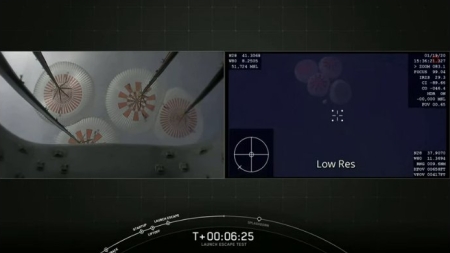
Capitalism in space: SpaceX has successfully completed an unmanned launch abort test of its crew Dragon spacecraft.
Everything took place exactly as planned. The image to the right is a screen capture shortly after the main chutes had become fully deployed. The recovery of the capsule is still ongoing, and will take a bit more than an hour. A press conference has been scheduled at 11:30 eastern, viewable on NASA-TV.
Based on what was seen, it appears that SpaceX is ready to put astronauts on this capsule. It is time to do so.
I have embedded a replay of the entire test, below the fold.
» Read more

On Christmas Eve 1968 three Americans became the first humans to visit another world. What they did to celebrate was unexpected and profound, and will be remembered throughout all human history. Genesis: the Story of Apollo 8, Robert Zimmerman's classic history of humanity's first journey to another world, tells that story, and it is now available as both an ebook and an audiobook, both with a foreword by Valerie Anders and a new introduction by Robert Zimmerman.
The print edition can be purchased at Amazon or any other book seller. If you want an autographed copy the price is $60 for the hardback and $45 for the paperback, plus $8 shipping for each. Go here for purchasing details. The ebook is available everywhere for $5.99 (before discount) at amazon, or direct from my ebook publisher, ebookit. If you buy it from ebookit you don't support the big tech companies and the author gets a bigger cut much sooner.
"Not simply about one mission, [Genesis] is also the history of America's quest for the moon... Zimmerman has done a masterful job of tying disparate events together into a solid account of one of America's greatest human triumphs."--San Antonio Express-News
SpaceX scrubbed today’s launch abort test of its crew Dragon capsule due to weather, rescheduling the test for tomorrow, with a six hour launch window beginning at 8 am (Eastern).
The SpaceX live stream is embedded below the fold.
» Read more
An evening pause: Hat tip Diane Zimmerman.

Now available in hardback and paperback as well as ebook!
From the press release: In this ground-breaking new history of early America, historian Robert Zimmerman not only exposes the lie behind The New York Times 1619 Project that falsely claims slavery is central to the history of the United States, he also provides profound lessons about the nature of human societies, lessons important for Americans today as well as for all future settlers on Mars and elsewhere in space.
“Zimmerman’s ground-breaking history provides every future generation the basic framework for establishing new societies on other worlds. We would be wise to heed what he says.” —Robert Zubrin, founder of the Mars Society.
All editions are available at Amazon, Barnes & Noble, and all book vendors, with the ebook priced at $5.99 before discount. All editions can also be purchased direct from the ebook publisher, ebookit, in which case you don't support the big tech companies and the author gets a bigger cut much sooner.
Autographed printed copies are also available at discount directly from the author (hardback $29.95; paperback $14.95; Shipping cost for either: $6.00). Just send an email to zimmerman @ nasw dot org.
A NASA official today finally admitted that, assuming the launch abort test tomorrow goes well, that first manned Dragon flight to ISS could occur as early as March 2020.
Kathy Lueders, head of NASA’s commercial crew program, told reporters Friday that the Crew Dragon capsule slated to carry Hurley and Behnken into orbit on the so-called “Demo-2” mission could be ready for for flight within a couple of months. “The vehicle will be all ready at the end of February,” Lueders said. “We’re kind of shooting for early March, right now, from a planning perspective. That would be the earliest.”
For years NASA has been reluctant to allow SpaceX to fly at the pace it wishes. Instead, NASA has consistently called for delays and further testing, almost ad infinitum. This admission by Lueders is the first by anyone at NASA that this launch can occur quickly, should tomorrow’s test flight succeed.
There are of course other considerations, such as scheduling the mission at ISS. Regardless, if tomorrow’s flight is a success there will be no justification for any long delays before the manned mission. It will be time to light that candle!

Click for full image.
Cool image time! The image on the right, cropped and reduced to post here, was taken by the high resolution camera on Mars Reconnaissance Orbiter (MRO) on October 7, 2019, and shows a crater on the northern fringe of Arabia Terra, one of the largest transitional regions between the Martian northern lowlands and the southern highlands. It shows a crater with an inlet canyon that makes the entire crater resemble a wiggling tadpole.
This is certainly not first tadpole-resembling crater found on Mars. See for example this press release from February 2018, showing a tadpole crater with the tail being an outlet channel. In today’s image however the channel feeds the crater.
In fact, take a look at the full image. This crater apparently occurred right at the edge of a large mesa cliff, with this impact cutting into the cliff near its bottom. The canyon might have actually existed before the impact, with the crater merely obliterating the canyon’s outlet.
If you look along that escarpment to the east you can see similar southwest-to-northeast flows. One is a canyon flowing downhill through the escarpment, probably resembling what the first canyon might have once looked like before the impact. To the east of this is another tadpole crater. This second tadpole impact however took place on top of the mesa, so the channel flows out from the crater and then down off the mesa, the reverse of the tadpole crater above.
These flow features are consistent with the nature of this transitional zone, a region with many features suggesting it was once the shoreline of an intermittent ocean. That ocean, if it had existed, is long gone, though scattered across the Martian surface are geological ghost features like these that speak of its past existence.
Leaving Earth: Space Stations, Rival Superpowers, and the Quest for Interplanetary Travel, can be purchased as an ebook everywhere for only $3.99 (before discount) at amazon, Barnes & Noble, all ebook vendors, or direct from my ebook publisher, ebookit.
If you buy it from ebookit you don't support the big oppressive tech companies and I get a bigger cut much sooner.
"Leaving Earth is one of the best and certainly the most comprehensive summary of our drive into space that I have ever read. It will be invaluable to future scholars because it will tell them how the next chapter of human history opened." -- Arthur C. Clarke
An experiment raising wolf puppies in close contact with humans has surprisingly found that some of those puppies learn how to play fetch with humans, even strangers.
Playing fetch with your dog isn’t as simple as it seems. Your pooch must be perceptive enough to realize you want the ball back—and social enough to want to play with you in the first place. It’s such an advanced skill, in fact, that many scientists think it could have arisen only over thousands of years of domestication.
But a new study reveals that some gray wolves—the ancestors of dogs—can also play fetch. The work supports the idea that the roots of many of the traits and behaviors we see in domesticated animals, from cats to chickens, may be present in their wild relatives.
…As the pups grew, the scientists noticed that some would retrieve a tennis ball thrown across the room. Intrigued, they tested all the wolves for the ability. When the pups were 8 weeks old, Hansen Wheat brought each one into a large, barren room with someone the animals had never met before. Then she left, and after a few minutes, the stranger threw a tennis ball.
Most of the wolves ignored the ball. But two pups—Lemmy and Elvis—returned the ball twice, the team reports today in iScience. One pup named Sting returned it all three times it was thrown, as seen in the video above. (All the wolves were named after musicians.)
What this study has discovered is likely the very process that produced the first dogs, from wolves. Early humans culled out of the wolf pack the puppies that responded to human behavior, and interbred those puppies to produce a new species that was closely linked to its human masters. And apparently this process can be quicker than some scientists previously believed.
Astronomers have discovered an additional four more weird objects orbiting the supermassive black hole, dubbed Sagittarius A* (pronounced A-star) for a total of six, all of which display behavior that is inexplicable.
Part of a new class called G objects, they look compact most of the time and stretch out when their orbits bring them closest to the black hole. Those orbits range from about 100 to 1000 years. “These objects look like gas and behave like stars,” says Andrea Ghez, director of the Galactic Centre Group at the University of California, Los Angeles (UCLA) and co-author of a paper in the journal Nature.
The new discoveries are known simply as G3 to G6. G1 was discovered by Ghez’s research group back in 2005, and G2 by astronomers in Germany in 2012. “The fact that there are now several of these objects observed near the black hole means that they are, most likely, part of a common population,” says co-author Randy Campbell, from the Keck Observatory in Hawaii.
It is not surprising that the intense gravitational field of Sagittarius A* rips these objects into elongated stretched objects as their orbits bring them close to the black hole. What is very very puzzling is their apparent ability to spring back to compact form as their orbits take them away from the black hole.
Capitalism in space: In a change in plans, SpaceX is no longer having two competitng Starship design teams working in both Florida and Boca Chica, and is now in the process of moving all hardware to Boca Chica.
Though the article is mostly about SpaceX’s fleet of ships, it notes this change in Starship development plans.
Theft by government: According to a lawsuit filed yesterday in federal court against the Drug Enforcement Agency (DEA), Transportation Security Administration (TSA) and officials from both agencies, government officials confiscated the life savings of a 79-year-old man, totaling $82,373, merely because his daughter was transporting the money in cash on an airplane flight.
At 79, he was aging and worried about keeping so much cash on hand, his daughter said, so during one of her visits he asked her to open a joint bank account. Rebecca Brown was catching a flight home from the Pittsburgh airport early the next day and said she didn’t have time to stop at a bank. She confirmed on a government website that it’s legal to carry any amount of cash on a domestic flight and tucked the money in her carry-on.
But just minutes before departure in late August, a Drug Enforcement Administration agent met her at the busy gate and questioned her about the cash, which showed up on a security scan. He insisted Brown put Rolin on the phone to confirm her story. Brown said Rolin, who is suffering mental decline, was unable to verify some details. “He just handed me the phone and said, ‘Your stories don’t match,’ ” Brown recalled the agent saying. ” ‘We’re seizing the cash.’ “
Brown said she was never told she or her father were under suspicion of committing any crime and neither has been charged with anything. A search of her bag turned up no drugs or other contraband. Neither she or her father appear to have criminal records that might raise suspicions.
Brown and Rolin filed a federal, class-action lawsuit Wednesday against the DEA, Transportation Security Administration and agency officials, claiming the agencies violate the Constitution’s ban on unlawful search and seizures by taking cash from travelers without probable cause. The lawsuit claims the only criteria the DEA has for seizing cash is if it finds amounts greater than $5,000.
This is out-and-out theft by these government officials. Not only should the money be returned, every government official involved in this theft should be fired, and possibly face sanctions themselves.
An evening pause: Good comedy never depends on crudeness. Sometimes good timing and a willingness to be silly is all you need.
Has tip Edward Thelen.
Arianespace’s Ariane 5 rocket today successfully placed two communications satellites into orbit, one for the commercial company Eutelsat and the second for India.
This was Arianespace’s first launch in 2020.
UPDATE: China’s smallsat solid rocket, Kuaizhou 1A, operated by a Chinese company dubbed GalaxySpace, also launched a commercial communications satellite today.
The leaders in the 2020 launch race:
3 China
1 SpaceX
1 Arianespace (Europe)
Link here. The article is entirely focused at reviewing only Boeing’s recent aircraft projects (Boeing 787, Boeing 747-8, Boeing KC-46A, Boeing 777X and Boeing 737 MAX), all of which appear to have had a lot of development issues.
The worst of the lot was the KC-46A, with many of the problems shared by our incompetent federal government. Initially proposed in 2001 (that is not a typo), the contract award did not occur until 2010, with delivery of the first 18 planes set for August 2017. The GAO predicted this delivery would be late, and the GAO was right.
Worse, Boeing has had cost overruns on the tanker totaling $3.4 billion above the initial fixed cost development contract of $4.9 billion (that is also not a typo).
The article also cites far too many examples of where Boeing requested waivers in order to meet schedule, even though the waiver allowed serious safety issues to linger, a behavior that reminded me strongly of NASA’s management during the shuttle program, resulting in the loss of two shuttles because the agency preferred to push its schedule rather than deal with serious engineering problems.
When you add the delays, cost overruns, and sometimes absurd mistakes that have occurred during Boeing’s development of SLS, this article is far more disturbing. It gets worse when you consider the issues that have delayed the launch of Starliner, some of which (the parachutes) should not have been an issue considering Boeing’s half century of experience.
All told, these problems portray a company that is akin to our federal government, badly managed and ripe for disaster. While the U.S. aerospace industry would take a deep hit if Boeing went under, that hit however would likely be temporary, especially considering the problems Boeing is having.
Freedom must allow bad businesses to fail so that fresh faces not bogged down by old problems can come to the fore and replace them. If Boeing collapsed I suspect a host of new companies would quickly appear, all likely more capable of producing what the nation’s aerospace industry needs. Because right now, Boeing is certainly not doing the job.
The launch abort test flight of SpaceX’s crew Dragon capsule remains on schedule for launch at 8 am (eastern) on Saturday, January 18, 2020.
NASA has announced that it will provide live coverage. I would assume SpaceX will as well, but there is no indication of that at the NASA announcement or at SpaceX’s website.
I will admit that though I very much would like to watch this live, it will go off at 6 am in Tucson, a bit early for this night owl writer.
Worlds without end: Astronomers think they have found evidence of a second exoplanet orbiting the nearest star, Proxima Centauri.
The planet, a super-Earth called Proxima Centauri c (Proxima c for short), has at least six times more mass than Earth and orbits its star every 5.2 years.
…“Stars like Proxima Centauri are rather restless and continuously present eruptions and spots on their surface, which make the detection of a planetary-induced oscillation very complicated,” says coauthor Fabio Del Sordo (University of Crete and Foundation for Research and Technology-Hellas in Heraklion, Greece). Because the observations span almost two decades, the scientists have confidently ruled out those sources of noise, but they caution that follow-up observations are needed to confirm that the signal comes from a planet.
There is a lot of uncertainty here, requiring an independent confirmation of this result. It would not be surprising if this exoplanet vanished when others took a look, finding it a creation not of a periodic gravitation wobble but of the random fluctuations of the star itself.
If it does exist, it will not likely be a place where life exists. Too far from this very dim red dwarf star to get enough energy. However, as a super-Earth it might someday in the far future be a great mining world.
Capitalism in space: Boeing has released a video showing what it was like to be on its Starliner capsule during its first orbital demo flight on December 20, 2019.
Flying alongside the uncrewed Starliner’s only official passenger — a spacesuit-clad, instrumented dummy (or anthropometric test device) named “Rosie” (after the World War II icon Rosie the Riveter), Snoopy, in plush doll form, served as the vehicle’s “zero-g indicator.” The video shows the doll floating weightless at the end of its “leash” after the Starliner entered Earth orbit.
The video is embedded below the fold. It is relatively boring, which actually is a good thing. The interior of the capsule does not seem much disturbed during each phase of the flight, from launch, separation from launch vehicle, and touchdown.
» Read more
After sixteen years in orbit, NASA will shut down the Spitzer Space Telescope on January 22, 2020,
The telescope is still functional in a somewhat limited manner but NASA wishes to save the annual budget of $14 million to operate it. Moreover, it will become redundant and significantly superseded once the infrared James Webb Space Telescope launches and becomes operational next year.
NASA had hoped a private organization would take over Spitzer’s operation, but apparently got no takers.
Embedded below the fold in two folds.
» Read more
An evening pause: From left to right that Robbie (14), Jonny (10), and Tommy (15) Mizzone, brothers from New Jersey.
Hat tip Tom Biggar.
The Israeli non-profit that built Beresheet-1 has received a $1 million grant in order to pursue building Beresheet-2.
The Blavatnik Family Foundation has provided a one million dollar grant to SpaceIL to support the “Beresheet 2” spacecraft program and advance the goal of landing an unmanned Israeli spacecraft on the Moon. “Beresheet 1”, launched on February 22, 2019, made Israel the 7th country in the world to reach the Moon’s orbit. The new Blavatnik grant will enable SpaceIL to recruit a new CEO to drive plans for “Beresheet 2” forward.
It remains unknown whether Beresheet-2 will ever get built. The money is insufficient to build a new lunar lander. Moreover, several of SpaceIL engineers have left the company and formed their own private space business, partnering with Firefly Aerospace to build their own lunar lander.