
Foundations – Build Me Up Buttercup
An evening pause: Performed live 1993.
Hat tip Diane Zimmerman.
An evening pause: Performed live 1993.
Hat tip Diane Zimmerman.
Courtesy of BtB’s stringer Jay. This post is also an open thread. I welcome my readers to post any comments or additional links relating to any space issues, even if unrelated to the links below.

On Christmas Eve 1968 three Americans became the first humans to visit another world. What they did to celebrate was unexpected and profound, and will be remembered throughout all human history. Genesis: the Story of Apollo 8, Robert Zimmerman's classic history of humanity's first journey to another world, tells that story, and it is now available as both an ebook and an audiobook, both with a foreword by Valerie Anders and a new introduction by Robert Zimmerman.
The print edition can be purchased at Amazon or any other book seller. If you want an autographed copy the price is $60 for the hardback and $45 for the paperback, plus $8 shipping for each. Go here for purchasing details. The ebook is available everywhere for $5.99 (before discount) at amazon, or direct from my ebook publisher, ebookit. If you buy it from ebookit you don't support the big tech companies and the author gets a bigger cut much sooner.
"Not simply about one mission, [Genesis] is also the history of America's quest for the moon... Zimmerman has done a masterful job of tying disparate events together into a solid account of one of America's greatest human triumphs."--San Antonio Express-News

Click for original image.
Cool image time! The picture to the right, cropped, reduced, and sharpened to post here, was taken on August 30, 2025 by the high resolution camera on Mars Reconnaissance Orbiter (MRO).
Dubbed a “channel” by the MRO science team, it shows us a meandering canyon with a floor that seems filled with corroded linear features seen frequently on Earth glaciers. Here, the linear ridges appear broken, in many places missing, and in other places so broken their linear nature disappears.
If this was on Earth and I was a global warming activitist, I would immediately claim that the glacier has been evaporating away due to a warming climate caused by SUVs and Republican intransigence. This however is on Mars, where there are no SUVs or Republicans. So what is going on?
» Read more
The uncertainty of science: New research that attempted to simulate conditions in the ice on Mars has determined that ancient microbes are more likely survive there for very long periods, as much as fifty million years, rather than the red planet’s dry sediments.
The research team, led by corresponding author Alexander Pavlov, a space scientist at NASA Goddard — who completed a doctorate in geosciences at Penn State in 2001 — suspended and sealed E. coli bacteria in test tubes containing solutions of pure water ice. Other E. coli samples were mixed with water and ingredients found in Mars sediment, like silicate-based rocks and clay.
The researchers froze the samples and transferred them to a gamma radiation chamber at Penn State’s Radiation Science and Engineering Center, which was cooled to minus 60 degrees Fahrenheit, the temperature of icy regions on Mars. Then, the samples were blasted with radiation equivalent to 20 million years of cosmic ray exposure on Mars’ surface, vacuum sealed and transported back to NASA Goddard under cold conditions for amino acid analysis. Researchers modelled an additional 30 years of radiation for a total 50-million-year timespan.
In pure water ice, more than 10% of the amino acids — the molecular building blocks of proteins — from the E. coli sample survived the simulated 50-million-year time span, while the samples containing Mars-like sediment degraded 10 times faster and did not survive. A 2022 study by the same group of researchers at NASA found that amino acids preserved in a 10% water ice and 90% Martian soil mixture were destroyed more rapidly than samples containing only sediment.
In other words, if there was ever microbiology on Mars, it is very unlikely Perseverance or Curiosity will ever find any, roving as they are in the dry Martian tropics.
Though this work has many uncertainties, especially in its assumption that it successfully simulated a 50-million-year time span, the result is hardly an earth-shaking discovery. If anything, it confirms the obvious, which is why NASA’s ludicrous claim that Perseverance’s prime mission is to look for life has always been a lie. It is traveling in the wrong place, a fact that was self-evident from the start.
Whether any microbiology might exist in Mars’ ice however is unknown. The odds are very very low, but not zero. If it does, it is even less likely it is living, based on orbital data.

Now available in hardback and paperback as well as ebook!
From the press release: In this ground-breaking new history of early America, historian Robert Zimmerman not only exposes the lie behind The New York Times 1619 Project that falsely claims slavery is central to the history of the United States, he also provides profound lessons about the nature of human societies, lessons important for Americans today as well as for all future settlers on Mars and elsewhere in space.
“Zimmerman’s ground-breaking history provides every future generation the basic framework for establishing new societies on other worlds. We would be wise to heed what he says.” —Robert Zubrin, founder of the Mars Society.
All editions are available at Amazon, Barnes & Noble, and all book vendors, with the ebook priced at $5.99 before discount. All editions can also be purchased direct from the ebook publisher, ebookit, in which case you don't support the big tech companies and the author gets a bigger cut much sooner.
Autographed printed copies are also available at discount directly from the author (hardback $29.95; paperback $14.95; Shipping cost for either: $6.00). Just send an email to zimmerman @ nasw dot org.
China today successfully placed 18 more Spacesail or Qianfan satellites in orbit, its Long March 6A rocket lifting off from Taiyuan spaceport in northeast China. No word on where the rocket’s lower stages crashed inside China.
This was the sixth launch for this internet satellite constellation, intended to provide Chinese citizens service similar to Starlink, but controlled by the Chinese government. At present it has 119 satellites in orbit, out of a planned 648 in the constellation’s first phase. That phase was supposed to be completed by the end of this year, something that now seems very unlikely. The constellation’s final configuration could have as many as 10,000 satellites.
The leaders in the 2025 launch race:
133 SpaceX
62 China
13 Russia
13 Rocket Lab
SpaceX still leads the rest of the world in successful launches, 133 to 103.
An evening pause: Another new sport that harnesses technology for fun. The music Bonsaye by Mirages.
Hat tip Cotour.
Leaving Earth: Space Stations, Rival Superpowers, and the Quest for Interplanetary Travel, can be purchased as an ebook everywhere for only $3.99 (before discount) at amazon, Barnes & Noble, all ebook vendors, or direct from my ebook publisher, ebookit.
If you buy it from ebookit you don't support the big oppressive tech companies and I get a bigger cut much sooner.
"Leaving Earth is one of the best and certainly the most comprehensive summary of our drive into space that I have ever read. It will be invaluable to future scholars because it will tell them how the next chapter of human history opened." -- Arthur C. Clarke
Courtesy of BtB’s stringer Jay. This post is also an open thread. I welcome my readers to post any comments or additional links relating to any space issues, even if unrelated to the links below.

Click for original image.
Cool image time! The picture to the right, cropped, reduced, and sharpened to post here, was taken on August 31, 2025 by the high resolution camera on Mars Reconnaissance Orbiter (MRO).
The science team labels this as “layering”, which surely is an apt description. As the latitude is 9 degrees south, this location is within the dry tropics of Mars, where no near surface ice has yet been found. Thus, the terraced layers of this low 20-foot-high mesa are not indicative of the many glacial climate cycles found in the mid-latitudes.
Instead, we are looking at sedimentary layers of rock or dust, laid down over time and later exposed by erosion.
So what caused the layers? And what is causing them to be exposed, one by one? As always the overview map helps provide a possible explanation.
» Read more

Click for original.
The European Space Agency (ESA) has awarded the Italian company Ingegneria Dei Sistemi (IDS) a contract to build an ocean vessel for recovering the planned reusable test upper stage being built by the Italian rocket company Avio, as shown in the graphic to the right.
In late September, ESA awarded a €40 million contract to Avio for the design of a reusable rocket upper stage. The project scope encompasses preliminary design work, including system requirements and technological solutions, for both the launch system and the ground segment. According to the agency, the project has a number of potential applications, including as an evolution of Avio’s Vega family of rockets.
On 15 October, IDS announced that it had been awarded the contract to design the project’s recovery vessel, which falls under the systems ground segment. The company has subcontracted Italian naval systems consultancy Cetena and Norwegian shipbuilder Vard to assist with the project.
ESA very clearly is trying to encourage the development of reusable rockets by Europe’s private sector, but the nature of this particular program seems badly thought out. Rather than have Avio design the system in its entirety, in order to make it as efficient and profitable as possible, it appears ESA is micromanaging the design process, and thus bringing other subcontractors in who are outside Avio’s control. As a result, the final demo might work, but it is not likely it will be competitive with the private reusable rockets being built in the U.S. and elsewhere. Too many cooks in the kitchen.
According to an article in South Africa yesterday, regulatory red tape and political demands in South Africa will likely block approval of Starlink in that country for years to come, if not forever.
Minister of Communications and Digital Technologies Solly Malatsi gazetted a draft policy direction on the role of EEIPs [Equity Equivalent Investment Programme] in the Information and Communication Technologies (ICT) sector on 23 May 2025. He explained that rules requiring electronic communications service providers to have 30% historically disadvantaged ownership prevented some companies from contributing to the country’s transformation in ways other than traditional ownership.
The Broad-Based Black Economic Empowerment (B-BBEE) Act and the ICT Sector Code supported the use of EEIPs to allow qualifying multinationals to meet empowerment obligations through alternatives. These can include investing in local suppliers, enterprise and skills development, job creation, infrastructure support, research and innovation, digital inclusion initiatives, and funding for small businesses.
However, the Independent Communications Authority of South Africa’s (Icasa) ownership regulations do not provide for EEIPs.
In other words, the laws contradict each other, and to make it possible to issue any licenses for a foreign company like SpaceX, the government needs to resolve this conflict. That is expected to take years of political maneuvering.
Even if this issue is resolved, SpaceX has already said it would not agree to the racial quota system proposed. It has offered to instead provide Starlink for free to 5,000 schools. It is not clear if politicians in South Africa will consider that sufficient.
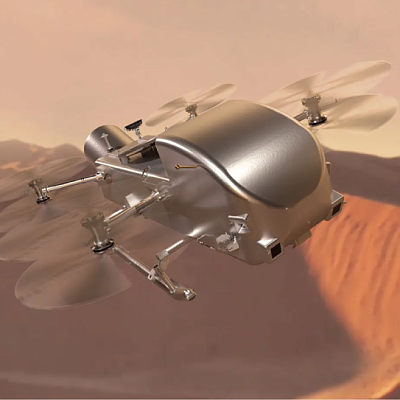
Artist rendering of Dragonfly soaring
over Titan’s surface
Scientists have discovered that, under the very cold conditions on Titan, three normally incompatible substances — methane, ethane and hydrogen cyanide — can mix together in a way that previously was considered impossible.
The background to the Chalmers study is an unanswered question about Titan: What happens to hydrogen cyanide after it is created in Titan’s atmosphere? Are there metres of it deposited on the surface or has it interacted or reacted with its surroundings in some way? To seek the answer, a group at NASA’s Jet Propulsion Laboratory (JPL) in California began conducting experiments in which they mixed hydrogen cyanide with methane and ethane at temperatures as low as 90 Kelvin (about -180 degrees Celsius). At these temperatures, hydrogen cyanide is a crystal, and methane and ethane are liquids.
When they studied such mixtures using laser spectroscopy, a method for examining materials and molecules at the atomic level, they found that the molecules were intact, but that something had still happened. … In their analysis, they found that hydrocarbons had penetrated the crystal lattice of hydrogen cyanide and formed stable new structures known as co-crystals.
Not surprisingly, this result suggests that the alien environment on Titan includes a lot of very unexpected chemistry, some of which we right now cannot predict, or even imagine. While exciting, it also suggests that NASA’s Dragonfly mission to Titan will face challenges that make that mission far more risky. It could quickly fail once it arrives, because of this alien environment.
Such a failure will of course help engineers design later missions, but Dragonfly is a very expensive mission, already overbudget at $3 billion. It might have made more sense to fly a fleet of small and cheaper missions to Titan to begin with, to lower the risks.
Sadly, that is not NASA’s plan.

Click for source.
Thailand’s government has begun a study to find out whether it makes financial and technical sense to establish its own commercial spaceport in that country.
The Geo-Informatics and Space Technology Development Agency (Public Organisation), or GISTDA, organised a seminar titled “Thailand’s Future Opportunities for Spaceport Development” on October 15 at iConsiam. The seminar aimed to establish a platform for exchanging views and gathering suggestions from all sectors regarding the future of a “Spaceport” in Thailand, underscoring a critical juncture for the country to elevate its presence on the global space stage fully.
Pakorn Apaphant, GISTDA Director, revealed that GISTDA is currently conducting a feasibility study for establishing a Spaceport in Thailand, in collaboration with the business consulting firm KPMG Phoomchai Business Advisory Ltd. The comprehensive study covers economic aspects, business strategy, environmental and social impacts, as well as a nationwide survey of potential sites to evaluate the most suitable location for future development.
As the map to the right shows, Thailand’s geography is not perfect. It has plenty of coast, in the country’s south, but at any location the trajectory of most launches would almost have to cross land of Thailand or other countries. Nonetheless, with the advent of reusable lower stages, such considerations will eventually become less of a concern.
The beat goes on. Since yesterday there were three launches, one by China and two by SpaceX.
First, China’s Long March 8A rocket placed the twelfth set of satellites in the Guowang internet constellation, eventually aiming to be 13,000 satellites strong. China’s state-run press did not specify the exact number of satellites. Based on previous launches using the Long March 8A, the number was likely nine, bringing the number of this constellation’s satellites now in orbit to 96.
The launch was from China’s coastal Wenchang spaceport, and had a flight path that dumped the lower stages of the rocket near islands in the Philippines.
Next, SpaceX placed 21 satellites into orbit for the Pentagon, its Falcon 9 rocket lifting off from Vandenberg in California. This was the second launched by SpaceX for this military communication constellation, dubbed Tranche-1, intended to be 158 satellites total. The first stage completed its seventh flight, landing on a drone ship in the Pacific. The fairing halves completed their third and fourth flights respectively.
Finally, SpaceX launched another 28 Starlink satellites, its Falcon 9 rocket lifting off from Cape Canaveral in Florida. The first stage completed its third flight, landing on a drone ship in the Atlantic.
The leaders in the 2025 launch race:
133 SpaceX
61 China
13 Russia
13 Rocket Lab
SpaceX now leads the rest of the world in successful launches, 133 to 102.
The Indian rocket startup Skyroot yesterday signed a partnership agreement with the company Exolaunch to handle the integration and deployment of satellites once its Vikram smallsat rocket begins launching.
Through this agreement, Exolaunch will integrate and deploy customer satellites on Skyroot’s Vikram series of launch vehicles, beginning with the Vikram-1 orbital missions. Exolaunch will provide its flight-proven deployment technologies for Skyroot customers across dedicated and rideshare launches. The partnership also includes the use of Exolaunch’s EXOtube payload stacks, designed to optimize multi-payload rideshare configurations, streamline constellation launches, increase mission flexibility, and enhance vehicle utilization.
While Skyroot has not yet launched, Exolaunch is very well established, having “a decade of flight heritage and 582 satellites launched across 39 missions to date.” Since Skyroot has no experience yet in these matters, having Exolaunch do it makes satellite companies more likely to buy space on its rocket.
Until recently Skyroot had been targeting a first launch before the end of this year. That schedule has now changed. According to the company’s webpage, that first launch is now scheduled sometime in 2026.
Embedded below the fold in two parts.
To listen to all of John Batchelor’s podcasts, go here.
» Read more
An evening pause: Some early American technology, still in use.
Hat tip Wayne DeVette.
Courtesy of BtB’s stringer Jay. This post is also an open thread. I welcome my readers to post any comments or additional links relating to any space issues, even if unrelated to the links below.
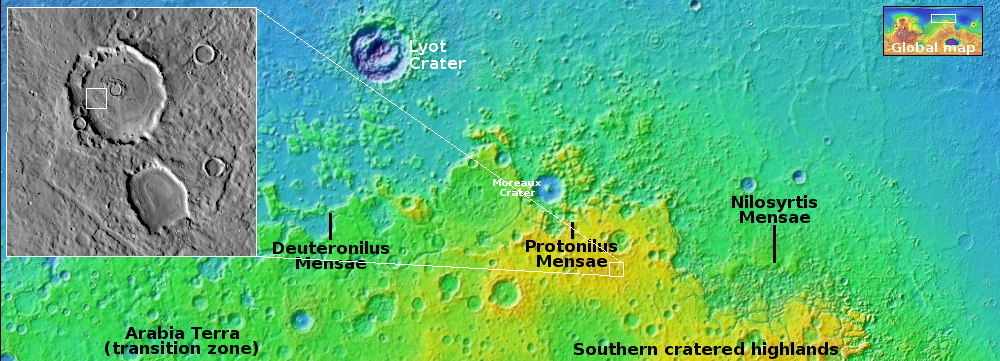

Click for original image.
Today’s cool image takes us once again back to Mars’ glacier country, the 2,000 mile-long mid-latitude strip in the northern hemisphere where almost every image shows glacier features. The picture to the right, cropped, reduced, and sharpened to post here, was taken on September 4, 2025 by the high resolution camera on Mars Reconnaissance Orbiter. It shows a small section of the floor of an unnamed 13-mile-wide crater, highlighting what the science team labels vaguely as “features.”
Those features appear to be glacial debris whose surface alternates between peeling gaps and the unique Martian geology dubbed “brain terrain”, whose formation is not yet understood but is believed to be associated with near surface ice.
The location is indicated by the white rectangle on the overview map above. At 36 degrees north latitude, this crater is deep within that mid-latitude strip where a lot of glacial features are routinely found. If you look at the inset, you can see that all the nearby craters appear to have formed in what appears to be slushy ground, their rims not very pronounced or distorted and their floors shallow, as if the ground melted like ice upon impact but very quickly solidified.
Mars is not a dry place. Future colonists will likely build their first cities around 30 degrees latitude, close enough to the equator to get warmer temperatures, but close enough to the near-surface ice found just a few degrees poleward, in a place such as this.
Click for source.
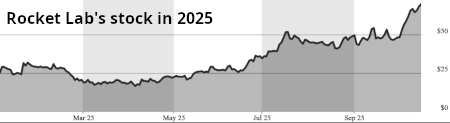
Though Rocket Lab is still not in the black, a new positive analysis of the company this week from Morgan Stanley reflects Wall Street’s generally optimistic view of Rocket Lab during the past year.
Rocket Lab (NASDAQ:RKLB) had its price target raised by equities researchers at Morgan Stanley from $20.00 to $68.00 in a research report issued on Monday, Benzinga reports. The brokerage presently has an “equal weight” rating on the rocket manufacturer’s stock. Morgan Stanley’s price target would suggest a potential upside of 1.63% from the company’s current price.
The article at the link also notes that Morgan Stanley is not alone in giving Rocket Lab a positive report, and in fact in the past year it shows that the recommendations from many analysts to buy its stock have risen considerably. These positive reviews have been reflected in a steady rise in the company’s stock price in 2025, as shown by the graph on the right.
Nor are these reports written in a vacuum. In recent weeks Rocket Lab has signed a bunch of new launch contracts, some extending deals with old customers, some with new customers of some note.
Buying the stock of a startup like Rocket Lab always carries risk, but it appears Wall Street is beginning to see the future of this particular startup as very promising.

Click for original image.
The orbital tug startup Impulse Space, founded by Tom Mueller (one of SpaceX’s first engineers), is now proposing to build its own unmanned lunar lander, with a target for delivering six tons of cargo on two missions, starting in 2028.
Our proposed architecture combines our existing Helios kick stage and a new lunar lander, to be developed by our team in-house. Helios would launch on a standard medium- or heavy-lift rocket. Our lunar lander would ride as a payload on Helios. Once Helios and the lander are deployed in Low Earth Orbit (LEO), Helios serves as a cruise stage, transporting the lander to low lunar orbit within one week. The lunar lander then separates from Helios and descends to the surface of the Moon. By taking advantage of Helios’s high delta-v capabilities, this mission architecture doesn’t require in-space refueling.
This solution can bridge the existing cargo delivery gap by offering direct transportation of the necessary mass to kickstart infrastructure, resource utilization, and economic activities on the Moon. We’ve already begun engine development for our lunar lander solution, and we stand ready to execute as dictated by industry demand and interest.
With this Helios and Impulse-made lander combination, we estimate delivering up to 6 tons of payload mass to the Moon (across two missions) per year starting in 2028 at a cost-effective price point. Each Helios + lander combo would take approximately 3 tons of cargo to the Moon.
It appears the company has identified a need (transporting cargo to the Moon cheaply and quickly) that no one (including NASA) is presently considering. SpaceX will be able to do it with Starship. Blue Origin is also proposing to do it with various versions of its Blue Moon manned lander. Impulse has decided however that both of those spacecraft are too large and tied to SLS and Lunar Gateway, with Starship requiring refueling, that makes their cargo missions more costly than a direct mission. Impulse proposes a simpler option.
This decision is also another indication that the demand for low orbital tugs is not developing as expected. It appears satellite companies and the available rocket companies have worked out ways to get most of their satellites to the orbits they require without tugs.
It will be interesting to watch if this proposal gains traction. If it does, than it will likely encourage other orbital tug as well as the other lunar lander companies to propose their own alternatives.