Hubble spots most distance active comet yet

Comet C/2017 K2

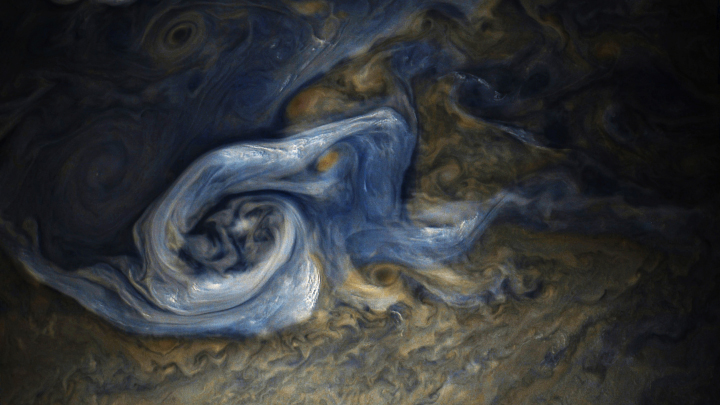
Using the Hubble Space Telescope astronomers have imaged a comet that is sublimating material at a distance from the Sun farther than any previously known comet, out beyond Saturn.

“K2 is so far from the Sun and so cold, we know for sure that the activity — all the fuzzy stuff making it look like a comet — is not produced, as in other comets, by the evaporation of water ice,” said lead researcher David Jewitt of the University of California, Los Angeles. “Instead, we think the activity is due to the sublimation [a solid changing directly into a gas] of super-volatiles as K2 makes its maiden entry into the solar system’s planetary zone. That’s why it’s special. This comet is so far away and so incredibly cold that water ice there is frozen like a rock.”

Based on the Hubble observations of K2’s coma, Jewitt suggests that sunlight is heating frozen volatile gases – such as oxygen, nitrogen, carbon dioxide, and carbon monoxide – that coat the comet’s frigid surface. These icy volatiles lift off from the comet and release dust, forming the coma. Past studies of the composition of comets near the Sun have revealed the same mixture of volatile ices.

The significance here is that by studying the comet’s activity scientists will be able to identify some of these volatile gases, which in turn will tell them something about the make-up of the outermost fringes of the solar system.

1 comment

Genesis cover

On Christmas Eve 1968 three Americans became the first humans to visit another world. What they did to celebrate was unexpected and profound, and will be remembered throughout all human history. Genesis: the Story of Apollo 8, Robert Zimmerman's classic history of humanity's first journey to another world, tells that story, and it is now available as both an ebook and an audiobook, both with a foreword by Valerie Anders and a new introduction by Robert Zimmerman.

The print edition can be purchased at Amazon or any other book seller. If you want an autographed copy the price is $60 for the hardback and $45 for the paperback, plus $8 shipping for each. Go here for purchasing details. The ebook is available everywhere for $5.99 (before discount) at amazon, or direct from my ebook publisher, ebookit. If you buy it from ebookit you don't support the big tech companies and the author gets a bigger cut much sooner.


The audiobook is also available at all these vendors, and is also free with a 30-day trial membership to Audible.
 

"Not simply about one mission, [Genesis] is also the history of America's quest for the moon... Zimmerman has done a masterful job of tying disparate events together into a solid account of one of America's greatest human triumphs."--San Antonio Express-News

Status of Arecibo radio observatory

It appears that, while Puerto Rico itself suffered devastating damage from Hurricane Maria, the Arecibo Observatory came through relatively unscathed.

The surface of the dish was largely unscathed, and the observatory’s most vulnerable component, the instrument platform suspended high above the dish by cables strung from three towers, each more than 80 meters tall, was still in place and seemed undamaged, says Schmelz. She is based at the Columbia, Maryland, headquarters of one of Arecibo’s operators, the Universities Space Research Association, and spoke with staff in Puerto Rico who first used a ham radio and then a single working satellite phone. But the roofs on some observatory buildings were blown off, the sinkhole under the dish was flooded, and other equipment was damaged by rain and fallen trees. Most significantly, a large portion of a 29-meter-long antenna—the 430-megahertz line feed used for studying the upper atmosphere—appears to have broken off and fallen from the platform into the dish. Mathews estimates a bill of several million dollars to replace the line feed alone.

Because of the significant infrastructure damage across the island, there will be significant delays in getting any of this fixed. Since the telescope is already being considered for shut down due to budget issues, these delays could lead to that shut down.

0 comments

Chinese government orders shutdown of all North Korean businesses

The Chinese government has ordered that all businesses run by North Koreans, whether singly or in a joint partnership, must shut down within the next four months.

The order applies to all such businesses in China, as well as any Chinese/North Korean joint ventures abroad. It will exempt nonprofits and “noncommercial infrastructure projects,” whatever that is, and will also allow individual businesses to request a waiver.

0 comments

Conscious Choice cover

Now available in hardback and paperback as well as ebook!

From the press release: In this ground-breaking new history of early America, historian Robert Zimmerman not only exposes the lie behind The New York Times 1619 Project that falsely claims slavery is central to the history of the United States, he also provides profound lessons about the nature of human societies, lessons important for Americans today as well as for all future settlers on Mars and elsewhere in space.

 
Conscious Choice: The origins of slavery in America and why it matters today and for our future in outer space, is a riveting page-turning story that documents how slavery slowly became pervasive in the southern British colonies of North America, colonies founded by a people and culture that not only did not allow slavery but in every way were hostile to the practice.  
Conscious Choice does more however. In telling the tragic history of the Virginia colony and the rise of slavery there, Zimmerman lays out the proper path for creating healthy societies in places like the Moon and Mars.


“Zimmerman’s ground-breaking history provides every future generation the basic framework for establishing new societies on other worlds. We would be wise to heed what he says.” —Robert Zubrin, founder of the Mars Society.


All editions are available at Amazon, Barnes & Noble, and all book vendors, with the ebook priced at $5.99 before discount. All editions can also be purchased direct from the ebook publisher, ebookit, in which case you don't support the big tech companies and the author gets a bigger cut much sooner.


Autographed printed copies are also available at discount directly from the author (hardback $29.95; paperback $14.95; Shipping cost for either: $6.00). Just send an email to zimmerman @ nasw dot org.

One last image from Rosetta

Rosetta's last image

Engineers reviewing the last bits of telemetry that was transmitted back to Earth by Rosetta just before it crashed on Comet 67P/C-G have discovered one last image of the comet’s surface.

That image is on the right. It is slightly blurred because of the limitations of Rosetta’s camera at this short range, and the incompleteness of the data received.

The image covers an area about a meter across, with a resolution of about two millimeters per pixel.

I imagine this surface is relatively soft, since the gravity holding the comet together is so slight. If you wanted to dig down, you would find it easy digging.

2 comments

Leaving Earth cover

Leaving Earth: Space Stations, Rival Superpowers, and the Quest for Interplanetary Travel, can be purchased as an ebook everywhere for only $3.99 (before discount) at amazon, Barnes & Noble, all ebook vendors, or direct from my ebook publisher, ebookit.

If you buy it from ebookit you don't support the big oppressive tech companies and I get a bigger cut much sooner.


Winner of the 2003 Eugene M. Emme Award of the American Astronautical Society.

 
"Leaving Earth is one of the best and certainly the most comprehensive summary of our drive into space that I have ever read. It will be invaluable to future scholars because it will tell them how the next chapter of human history opened." -- Arthur C. Clarke

NASA and Roscomos sign agreement to work together to build lunar orbiting station

Extending the pork: NASA and Roscosmos have signed an agreement agreeing to work together in the construction of what NASA calls a deep space gateway, a space station orbiting the Moon.

The goal here is to garner political support for getting funding to fly a third SLS/Orion mission, which would be its second manned flight. It is also to establish some long term justification for SLS/Orion, which presently has no mission and will disappear after its first manned test flight, presently scheduled for 2022. That single test flight will have taken 18 years and more than 40 billion dollars to build, an absurd timeframe and cost for a single mission that does not bode well for future SLS/Orion missions.

The Russian perspective can be found here. They claim that the station would be finished by 2024-2026, an absurd prediction based on the expected SLS launch rate of one launch every one to two years. For Russia, the hope is that they can use this project to get U.S. money, just like the big American space companies like Lockheed Martin (Orion) and Boeing (SLS).

10 comments

Republican tax plan unveiled

As expected, the Republican leadership has unveiled a new tax proposal that would consolidate the number of tax brackets while increasing the rate of the lowest bracket and increasing the standard deduction.

I admit that I have grown very cynical about these proposals. They never end up simplifying anything. Instead, each time Congress has done this in the past three decades they have only made the tax code more complicated. I see no evidence so far that this Congress and this Republican leadership will do anything different.

Moreover, Congress and Trump continue to make little effort to rein in spending, so I expect the result here will also be a significant increase in the crushing federal debt.

1 comment

Gravitational waves from black hole collision detected

Three Earth gravitational wave observatories have detected the waves coming from the same collision of two black holes.

The collision was observed Aug. 14 at 10:30:43 a.m. Coordinated Universal Time (UTC) using the two National Science Foundation (NSF)-funded Laser Interferometer Gravitational-Wave Observatory (LIGO) detectors located in Livingston, Louisiana, and Hanford, Washington, and the Virgo detector, funded by CNRS and INFN and located near Pisa, Italy.

The detection by the LIGO Scientific Collaboration (LSC) and the Virgo collaboration is the first confirmed gravitational wave signal recorded by the Virgo detector.

Based on the data obtained, they estimate that the two black holes 25 and 31 times the mass of the Sun and are about 1.8 billion light years away.

4 comments

Parts 2 and 3 of “A Niche in Time”

The second and third parts of Doug Messier’s series on the history of aviation and space are now available:

Part 2 describes how the Hindenberg crash ended the lighter-than-air airship industry, while Part 3 describes how the Columbia accident led to the end of the space shuttle. He then compares them both, noting their similarities.

Not surprising to me, the main common thread that sustained both of these failed concepts was the desire of a government to build and fly them, regardless of their cost and practicality. Messier’s comparison between airships and airplanes highlights this well. Airplanes were cost effective and could easily be made profitable. Airships were neither. They existed because Hitler wanted them.

The same can be said for the space shuttles, and for Constellation and SLS/Orion today.

Anyway, read both articles above. They are nicely written, very informative, and provide important lessons about history that we would be wise to educate ourselves about before we attempt to make our own history in the future.

1 comment

UN announces proposed Dream Chaser international mission

Capitalism in space: The Outer Space office of the United Nations has announced an opportunity for member nations to express their interest in doing a science mission using Sierra Nevada’s Dream Chaser reusable spaceship.

The UN announcement states that

The purpose of this Call for Interest (CFI) is to provide a summary of the proposed mission and to solicit information from Member States interested in providing experiments, payloads, or satellites that could be flown on this mission. The CFI also has the objective of gathering information on the interested countries so that UNOOSA may better understand the demand for this type of mission.

The actual call [pdf] roughly describes a mission lasting 2 to 3 weeks and carrying about 20 experiments. This call is designed to give them a better idea of what those experiments might be, what nations wish to participate, and where the funding for the mission might come from. The actual announcement to submit experiment proposals won’t come until March 2018.

Being a UN mission, it is not surprising that it wants to focus on a variety of leftwing “Sustainable Development Goals”:
» Read more

2 comments

Dark energy might not exist

The uncertainty of science: A new model for the universe that omits dark energy produces a better fit to what is know than previous theories that included it.

The new theory, dubbed timescape cosmology, includes the known lumpiness of the universe, while the older traditional models that require dark energy do not.

Timescape cosmology has no dark energy. Instead, it includes variations in the effects of gravity caused by the lumpiness in the structure in the universe. Clocks carried by observers in galaxies differ from the clock that best describes average expansion once variations within the universe (known as “inhomogeneity” in the trade) becomes significant. Whether or not one infers accelerating expansion then depends crucially on the clock used. “Timescape cosmology gives a slightly better fit to the largest supernova data catalogue than Lambda Cold Dark Matter cosmology,” says Wiltshire.

He admits the statistical evidence is not yet strong enough to definitively rule in favour of one model over the other, and adds that future missions such as the European Space Agency’s Euclid spacecraft will have the power to distinguish between differing cosmology models.

Both models rely on a very weak data set, based on assumptions about Type 1a supernovae that are likely wrong. It is thus likely that neither explains anything, as neither really has a good picture of the actual universe.

5 comments

First meeting of National Space Council announced

A Potemkin Village: The White House has announced the date of the first public meeting of the National Space Council, set for October 5 at the Air & Space Museum.

Today, Vice President Mike Pence announced the first meeting of the National Space Council is scheduled for October 5, 2017 at the Steven F. Udvar-Hazy Center in Chantilly, Virginia. The meeting, titled “Leading the Next Frontier: An Event with the National Space Council,” will include testimonials from expert witnesses who represent the sectors of the space industry: Civil Space, Commercial Space, and National Security Space.

What this announcement tells me is that this council isn’t there to discuss and set space policy, but to sell that policy to the public. And right now, I am expecting that sales job will be trying to convince us that we must use SLS/Orion mission to build a new space station orbiting the Moon by 2023. They will use the council to pitch the idea, and then Trump will make the traditional Kennedy-like speech, with lots of astronauts standing behind him, committing this nation to putting a space station around the Moon by such-and-such a date. Whoopie!

Forgive me if I sound a bit cynical. I’ve seen this show many times before. For some reason, the opening act is great, but then it fades always away into nothingness before the second act begins.

4 comments

Rocket Lab preps for 2nd flight of Electron

Capitalism in space: Smallsat rocket company Rocket Lab is preparing for the second test flight of its rocket Electron, now set for October.

The test flight will also carry four commercial nanosats.

Both Planet and Spire — two companies that operate small satellites in orbit — will have payloads on the Electron’s second test flight, dubbed “Still Testing.” The rocket will carry two of Planet’s Dove satellites, designed to image Earth, as well as two of Spire’s Lemur-2 satellites that track weather and ship traffic.

The company also states that if this second flight is successful, they might forego a third test flight and move directly to commercial operations.

0 comments

OSIRIS-REx looks at Earth

NASA has released the images that OSIRIS-REx took as it flew past Earth last week on its way to its 2018 rendezvous with the asteroid Bennu.

The image shows the Pacific Ocean from Australia to California. Its main significance it demonstrates that the spacecraft’s camera and pointing system is working perfectly.

0 comments
1 915 916 917 918 919 1,760