
FAKE Chandrayaan-2 images of the Apollo 11 and 12 landing sites
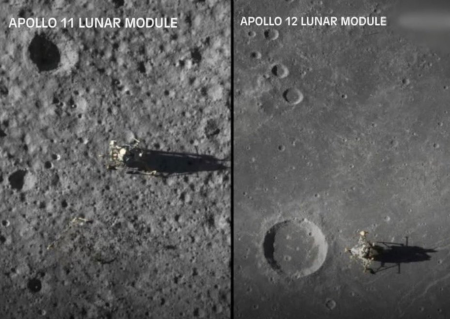
Chandrayaan-2 images of Apollo 11 and Apollo 12 landing sites

The pictures to the right are fake, as are the two stories I had linked to in the now crossed-out post below. Both stories included pictures of the Apollo 11 and Apollo 12 landing sites that were fake and did not match the actual pictures taken earlier by Lunar Reconnaissance Orbiter.

I seem to remember that Chandrayaan-2 had taken pictures of these Apollo landing sites, but I have not been able to find those originals. Either way, the stories below as well as the pictures to the right are fake, and for that reason I have deleted the links to both.

For reasons I don’t understand, two different news outlets in the past two days decided to highlight the 2021 images taken by India’s Chandrayaan-2 lunar orbiter of the Apollo 11 and 12 landing sites, with both outlets claiming these pictures provided third-party verification that those manned lunar landings actually happened.

Those pictures are to the right. They aren’t new, but they are so good I decided they were cool enough to post again.

As for proving the lunar landing happened, that is pure anti-American silliness, sadly too often pushed by ignorant Americans. They should be ashamed. The Apollo landings were possibly the greatest single achievement Americans have ever accomplished. And if not the greatest, the landings rank near the top, and above all they certainly were among our noblest achievement.

9 comments

Could the Apollo 11 lunar module still be orbiting the Moon?

According to one researcher, at least two of the Apollo lunar modules that took astronauts up and down from the Moon could still be in lunar orbit, though their location is presently unknown.

His paper outlining the possible survival of the Apollo 11 LM Eagle can be found here. From his abstract:

The Apollo 11 โ€œEagleโ€ Lunar Module ascent stage was abandoned in lunar orbit after the historic landing in 1969. Its fate is unknown. Numerical analysis described here provides evidence that this object might have remained in lunar orbit to the present day. The simulations show a periodic variation in eccentricity of the orbit, correlated to the selenographic longitude of the apsidal line. The rate of apsidal precession is correlated to eccentricity. These two factors appear to interact to stabilize the orbit over the long term.

More details here.

Hat tip to reader Mike Nelson, who sent me this story today. I am certain I reported it previously, but searching on Behind the Black failed to find it, so I decided to post again. As the researcher concludes:

Wouldn’t it be amazing if we could find this amazing little vessel and bring her back to Earth!!!!

9 comments

Van Johnson – Flim Flam Floo

An evening pause: This song comes from the first full television movie, The Pied Piper of Hamelin, first aired on NBC in 1957, and then subsequently re-aired almost yearly for the next decade. If you want to watch it, it is available on the internet archive here.

I post it today because it is a perfect expression of the hopeful culture of the 1960s that made possible the Apollo 11 lunar landing that occurred fifty-three years ago today. As the song says, “The world is filled with wonderment and magic,” and then insists “You can find the beauty in all you perceive/Just believe that it’s there in view.”

I recently rediscovered this movie of my childhood, and was astonished to discover that though I hadn’t heard this song in more than fifty years, I remembered its message as if I had only watched it yesterday. Its message was what my parent’s generation believed, and tried with all their might to pass on to their children. Their belief made the Apollo 11 landing possible. Sadly, most of my baby boomer generation decided to reject this hopeful vision, thus producing the increasingly gloomy society we have today.

Let us work to recapture that wonder and hope. Only then can our children breathe free to achieve some true wonders of their own.

Thanks to Wayne Devette for clipping this song from the full movie for me.

1 comment

NASA halts sale of Apollo 11 Moon dust, claiming ownership

We’re here to help you: The auction of a tiny amount of Moon dust brought back by Apollo 11 and used in a post-flight experiment using German cockroaches has been canceled because NASA claimed ownership of that dust and demanded its return.

“NASA asserts legal ownership of the materials consisting of the Apollo 11 lunar dust experiment … based upon the information and documentation provided in the description of the lot and evidence regarding NASA’s contemporaneous contracting practices,” an attorney in NASA’s Office of the General Counsel wrote RR Auction in a letter on Wednesday, a week after first reaching out to the firm. “It is clear and undeniable that the materials consisting of the experiment are owned by NASA.”

The lot under contention comprises what remains from the late Marion Brooks’ research into the physiological effects of lunar material on Blattellas germanica, or German cockroaches. The insects had been fed moon dust by NASA scientists in the immediate aftermath of the 1969 Apollo 11 lunar landing mission. After no ill-effects were seen while astronauts Neil Armstrong, Buzz Aldrin and Michael Collins were held in quarantine, the (now dead) cockroaches were handed off to Brooks, an entomologist from the University of St. Paul, for more thorough study.

Included in the auction was a small vial of moon dust that Brooks’ had carefully extracted from the cockroaches’ corpses, as well as three of the remaining (dead) cockroaches and two boxes of tissue slides for microscopic study.

It appears the dust had been in the Brooks family possession for more than forty years, then sold by them at auction in 2010 for $10,000. Under standard adverse possession law, you lose ownership if you don’t claim that right after twenty years. It would thus seem that NASA’s claim is bogus.

But then, NASA as a government agency doesn’t believe the standard laws apply to it. It continues to demand that all Apollo lunar material belongs to it and be returned, no matter what the circumstances it was originally handed out by the agency and no matter how long ago.

5 comments

Apollo 11 lunar ascent stage might still be in orbit around the Moon

New data about the Moon’s interior and gravitational field suggest that the Apollo 11 lunar ascent stage, the part of the LM that carried the astronauts back from the Moon, might still be in orbit around the Moon, rather than have crashed into its surface as long assumed.

Using the GRAIL gravity model and the General Mission Analysis Tool (GMAT) simulator, Meador expected to find the LM’s orbit destabilizing very quickly. What he found โ€“ and was verified by a third party using different methods โ€“ was that the Ascent Stage had a feedback mechanism that caused the orbit to stabilize itself over a period of every 24 days. When he ran the simulation forward, the orbit remained stable until the present day.

The upshot of this is that the Ascent Stage may still be in orbit now and could be observed when it is in the right position in relation to the Earth and the Sun. However, Meador emphasizes that the LM was never intended to be very robust. Designed to operate for only about 10 days, it was also filled with batteries and fuel tanks, which could have exploded years ago, either destroying the craft or sending it off on a new trajectory.

If the stage is in lunar orbit, than it probably is one the most valuable and quickly reachable artifacts from one of space’s most historic missions. While the Apollo artifacts left on the Moon should be left where they are, this piece could be recaptured and returned to Earth for both study and exhibition.

In fact, if it is still in orbit it should be recovered, to preserve it.

This data also suggests that other Apollo ascent stages as well as other past lunar orbiters might also still be in lunar orbit, and should be located.

13 comments

Apollo 11 astronaut Michael Collins has passed away at 90

R.I.P. Michael Collins, the astronaut on Apollo 11 who stayed in lunar orbit while Neil Armstrong and Buzz Aldrin walked on the Moon, passed away today at the age of 90.

Collins was one of the most friendly and personable astronauts I ever met. He was always available and willing to answer questions, sometimes even willing to go an extra mile to provide you more than you asked for.

In many ways his later work as head of the Air & Space Museum was more important than his time as an astronaut. He helped make that museum and the history it documents one of the most popular in the world.

As long as humanity exists, on Earth and in space, Michael Collins will never be forgotten.

9 comments

Midnight repost: A flag in the dust

The tenth anniversary retrospective of Behind the Black continues: This essay was posted originally on July 20, 2010, then reposted on July 20, 2011, to celebrate the anniversary of the Apollo 11 landing on the Moon. It seems fitting to post it again, on this, the 51st anniversary of that landing.

————————–
A flag in the dust

Today, July 20th, is the anniversary of the Apollo 11 landing on the Moon, the first time ever that a human being arrived on another planet. Americans love to celebrate this event, as it symbolizes one of the finest moments in our history, when we set out to achieve something truly great and noble and succeeded far better than we could have imagined. Not only did we get to the Moon as promised, over the next three and a half years we sent another five missions, each with increasingly sophisticated equipment, each sent to explore some increasingly alien terrain. Forty-plus years later, no one has come close to matching this achievement, a fact that emphasizes how difficult it was for the United States to accomplish it.

There is one small but very important detail about the Apollo 11 mission, however, that most Americans are unaware of. » Read more

5 comments

Apollo 11 videotapes sell for $1.82 million

The three original 2″ videotapes showing the astronauts on the lunar surface during Apollo 11, purchased by an engineering student as part of a lot of more than a thousand reels in 1976 for just over $200 have now sold at auction for $1.82 million.

The auction house, Sotheby’s, did not say who purchased the tapes. Hopefully whoever has intends to release the visuals, since it appears the quality is better than what we presently have.

1 comment

July 20, 1969: “We came in peace for all mankind.”

An evening pause: In honor of the fiftieth anniversary.

The astronauts plant the American flag, after they had unveiled a plaque on the lunar module with the words, “We came in peace for all mankind.”

This was an American achievement, accomplished because our free and competitive society gave us the resources and trained talent to make it happen. We did it for all mankind, in good will, but we did it, no one else.

It is time that we as well as everyone else do it again.

3 comments

July 20, 1969: “One small step…”

An evening pause: In honor of the fiftieth anniversary.

Neil Armstrong takes the first steps on the Moon. Note his focus is almost entirely on describing what he sees and experiences. He is doing this for two reasons, first to provide knowledge of the Moon to the world, and second to provide engineers as much information as possible for future missions.

This focus explains why the first thing he does is to get a contingency rock sample, just in case they need to leave the Moon quickly.

Note also that when Buzz Aldrin joins Armstrong on the surface, he is as professional and calm, proving that the way he has been portrayed by some recent movies as as undisciplined jerk is simply a slander. He would not have been picked for this mission if he really behaved that way.

He wanted to be the first, and lobbied to get that chance. After the decision was made he got down to work to make the mission a success.

For a different view of these same events, watch this video.

1 comment

July 20, 1969: “The Eagle has landed”

An evening pause: In honor of the fiftieth anniversary.

Note the calm tone in all the voices, even when something is not quite right. To do really great things, one must not let one’s emotions run the show. You need to be cool-headed and focused on the task at at hand. If only today’s adult generation, especially in the world of politics, would do the same.

Just before Armstrong brings Eagle down, you will hear a voice say “60 seconds,” then “30 seconds.” That is mission control telling him how much time they estimate he has before he runs out of fuel.

Below the fold is the same last few minutes of the landing, produced by the Lunar Reconnaissance Orbiter (LRO) science team using its high resolution images to recreate a simulation of what Armstrong saw in his window. Remember, the view in the original 16mm film was out Aldrin’s window.

» Read more

12 comments

Eagle undocks, Apollo 11, July 20, 1969

An evening pause: In honor of the fiftieth anniversary of Apollo 11, today’s evening pause shows the moment when the lunar module Eagle undocked from the command module Columbia. Though this video includes communications with mission control at the start, the actual undocking occurred on the back side of the moon, when the astronauts were out of touch with the Earth.

Near the end of the video, after they have reacquired communications with the ground, you can hear a recitation of a long string of numbers. This is mission control providing the astronauts the numbers that had to be uploaded into their onboard computer so that it could correctly fire the spacecraft engines at the right time and for the right duration.

7 comments

Apollo 11 First Stage liftoff

An evening pause: This was originally posted as an evening pause in 2016. I think that today, the fiftieth anniversary of the launch of Apollo 11, it is appropriate to repost it. As I wrote then,

Though the video is more than 8 minutes long, the actual events recorded lasted only about 30 seconds, beginning 5 seconds before T minus 0.

What struck me most as I watched this was the incredible amount of complex engineering that went into every single small detail of the rocket and the launch tower and launchpad. We tend to take for granted the difficulty of rocket engineering. This video will make you appreciate it again.

It is also mesmerizing. A lot happens in a very short period of time.

Tonight’s evening pause begins eight days of pauses dedicated to celebrating, and reliving, the Apollo 11 mission. To the Moon!

6 comments

Apollo 11 in real time

Link here. I should have posted this link earlier. As I post this the Saturn 5 has just launched.

Pick your moment. They will be showing the mission in real time over the next week.

Hat tip Steve Golson for prompting me.

Correction: If you go to the link you can either choose to watch from one minute before launch, or click on the “Now” button to see the status at this moment fifty years ago.

2 comments

Apollo landing tapes for sale

An intern who in 1976 purchased more than a thousand surplus 2-inch videotapes from NASA for $218 is now going to auction off three of those reels that show the Apollo 11 moon walk.

Back in 1976, NASA gave 1,150 reels of 2-inch Quadruplex videotape to a government surplus auction. Gary George, a former intern at NASAโ€™s Johnson Space Center, snapped up the lot of them for $218, in the hopes of selling them to news stations to record over for $50 a pop. He never watched them, but because his dad was a space buff, kept three of the tapes marked as โ€œApollo 11 EVAโ€ (aka Extravehicular Activity, better known as a spacewalk). When he eventually watched the tapes, he realized that he had one of three surviving copies of one of the greatest feats of human ingenuity, the July 20, 1969 Moon landing. Now, those videotapes will be auctioned off to the highest bidder when Sothebyโ€™s will mark the 50th anniversary of the moon landing by putting the tapes up for sale on July 20th, at a starting bid of $700,000.

โ€œI had no idea there was anything of value on them,โ€ George said in an interview with Reuters. He started to get suspicious in 2006, after NASA admitted they had lost the tapes, and believed they could have been in the 2,614 boxes of Apollo mission tapes that were sent to a storage facility in late 1969. George got in touch with video archivist David Crosthwait in California, who had the necessary equipment to view the vintage tapes. In December 2008, George played the reels and quickly realized what he had been storing over the last few decades. He contacted NASA about the reels but โ€œan agreement could not be reached,โ€ according to the auction listing, and off to the auction block they go as part of an auction dedicated to Space Exploration.

The saddest part of this story are the tapes George sold to television stations to use to back-up their daily broadcasts. Some of those tapes probably contained historical recordings of the Apollo missions. While I suspect these tapes were not NASA’s only copies, I cannot be sure, which means some of the source material for the Apollo missions was likely lost.

0 comments
1 2