Hugging galaxies

Hugging galaxies
Click for full image.

Cool image time! The Hubble Space Telescope science team today released the photo to the right, cropped and reduced to post here, of the interaction of three galaxies, the larger two of which look like they are hugging each other.

This galaxy triplet is estimated to be about just under 700 million light years away. It was taken as part of a program aimed at producing high quality images of strange looking galaxies.

Using Hubble’s powerful Advanced Camera for Surveys, astronomers took a closer look at some of the more unusual galaxies that volunteers identified. The original Galaxy Zoo project was the largest galaxy census ever carried out and relied on crowdsourcing time from more than 100,000 volunteers to classify 900,000 unexamined galaxies. The project achieved what would have been years of work for a professional astronomer in only 175 days and has led to a steady stream of similar astronomical citizen science projects. Later Galaxy Zoo projects have included the largest ever studies of galaxy mergers and tidal dwarf galaxies, as well as the discovery of entirely new types of compact star-forming galaxies.

If you want to do some real science, you should definitely check out the Galaxy Zoo webpage. Anyone can join in, using images produced by the Victor Blanco 156 inch (4 meter) telescope in Chile to find cool stuff that needs closer examination using better telescopes like Hubble.

7 comments

Gehrels-Swift returns to science operations

The Gehrels-Swift orbiting space telescope has returned to full science operations, after engineers determined the shut down on January 18th was caused by the failure of one reaction wheel and uploaded software allowing the telescope to function using only its remaining five gyroscopes.

In the last two decades satellite engineers have developed a range of software to allow spacecraft to point with acceptable accuracy using as few as two gyroscopes, even one in some circumstances. Thus, Gehrels-Swift has significant margin with five working reaction wheels.

0 comments

Chandra in safe mode

The Chandra X-ray Observatory last week experienced a loss of power that caused engineers to put the science instruments on the space telescope into safe mode while they investigate the problem.

No further information is presently available.

Chandra has been in orbit since 1999, and is now on an extended mission through 2025. It would be a great tragedy if it failed now, just as the infrared Webb telescope is about to begin operations. The two space telescopes are complementary.

0 comments

First image from IXPE

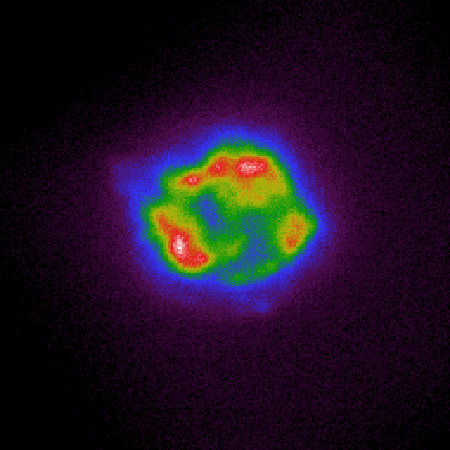
Supernova remnant Cassiopeia A as seen by IXPE

NASA today released the first image produced from its new X-ray space telescope, the Imaging X-Ray Polarimetry Explorer (IXPE).

The photo to the right is that image, showing the intensity of X-rays coming from the supernovae remnant Cassiopeia A. From the caption:

Colors ranging from cool purple and blue to red and hot white correspond with the increasing brightness of the X-rays. The image was created using X-ray data collected by IXPE between Jan. 11-18.

Though Chandra also detects objects in X-rays, IXPE will also detect their polarization, or the way the rays are oriented as they travel through space.

2 comments

Astronomers form lobbying group to block development on Moon’s far side

Lunar zone reserved solely for astronomers
Lunar zone reserved exclusively for radio astronomers

In order to allow them to someday in the future maybe consider the idea of possibly building space-based radio telescopes on the Moon, astronomers have now formed a new lobbying group to advocate the creation of a zone more than a thousand miles wide on the Moon’s far side where all future development will be forbidden.

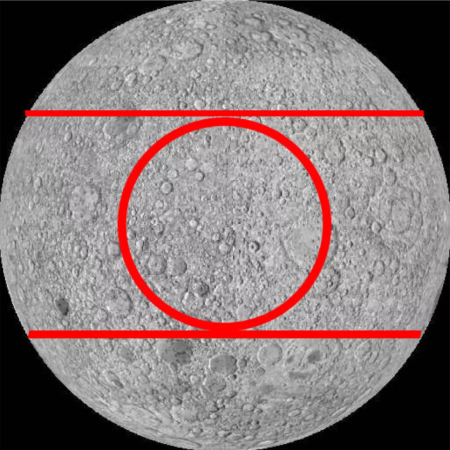
The new committee is chaired by Claudio Maccone, an Italian SETI (search for extraterrestrial intelligence) astronomer, space scientist and mathematician. Maccone supports creation of a Protected Antipode Circle or PAC, a large circular piece of lunar landscape about 1,130 miles (1,820 kilometers) wide that would become the most shielded area of the moon’s far side.

“PAC does not overlap with other areas of interest to human activity,” he said. “PAC is the only area of the far side that will never be reached by the radiation emitted by future space bases located at the L4 and L5 Lagrangian points of the Earth-moon system.”

In view of these unique features, Maccone believes the PAC should be officially recognized by the United Nations as an international protected area, where radio contamination by humans is curbed, now and into the future.

In other words, these astronomers want to be given, for free, full ownership of the region in the center circle on the graphic above for future radio telescopes, even though at present they have no plans or projects to build such things.

Though the idea of creating a region protected from radio signals so that good radio astronomy can be conducted has merit, no one should have the slightest sympathy for this request by astronomers. Why should anyone give them this vast amount of real estate when astronomers have shown so little interest in building any telescopes in space, anywhere?

Only after the astronomical community finally proposes an actual radio telescope for installation at this site should this request be given the slightest attention. Before that, it is merely a stupid power grab by elitists who deserve nothing from nobody.

11 comments

First image from Webb released

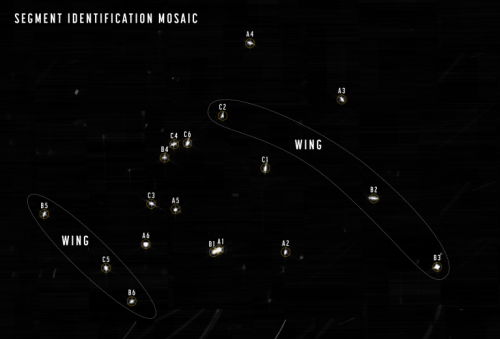
Webb's first released alignment image

It ain’t pretty, nor is it in optical wavelengths, but the first alignment image from the James Webb Space Telescope has been released by NASA.

That image, reduced slightly to post here, is to the right. It shows 18 different near-infrared images of the same star, each image taken by a different segment of Webb’s primary mirror. At the moment the mirrors are not perfectly aligned, so that each segment’s star image shows up at a slightly different place. The goal now will be to adjust those mirror segments so that future images will show only one star, all focused to the same spot.

This alignment process is expected to take about a month.

The image is significant however because it shows that each segment is producing a relatively sharp image, even though the telescope has not yet cooled to its operating temperature. It thus appears that, unlike Hubble, Webb’s mirror segments were ground correctly, and it will be able to take sharp images right off the bat.

4 comments

Earthlike exoplanet in habitable zone detected orbiting nearest star

The uncertainty of science: Astronomers think they have detected an Earthlike exoplanet, in habitable zone, orbiting Proxima Centauri, the nearest star to our solar system.

Astronomer João Faria and his collaborators detected Proxima Centauri d by measuring tiny shifts in the spectrum of the star’s light as the planet’s gravity pulled it during orbit. The team used a state-of-the art spectrograph called ESPRESSO at the Very Large Telescope, a system of four 8.2-metre telescopes at the European Southern Observatory in Cerro Paranal, Chile. The results were published on 10 February in Astronomy & Astrophysics.

This ‘wobble’ technique looks for changes in the star’s motion along the line of sight from Earth, and ESPRESSO can detect variations of just 10 centimeters per second. The total effect of the planet’s orbit, which lasts only five days, is about 40 cm/s, says Faria. “I knew that ESPRESSO could do this, but it was still surprised to see it showing up,” says Faria, who is at the Institute of Astrophysics and Space Sciences in Porto, Portugal.

Though the scientists are very confident about their results, the detection is at present only a candidate planet, as its existence has not been confirmed by an second independent method. Also, the method of detection cannot pin down the exoplanet’s mass very precisely, though it suggests the exoplanet has rocky planet mass, not too different than Earth’s.

2 comments

Have astronomers discovered an asteroid with three moons?

The uncertainty of science: According to a New York Times article published yesterday, astronomers have now discovered an asteroid with three moons, making it the first such asteroid ever discovered.

The asteroid, Electra, was first discovered in 1873, and orbits the Sun in the asteroid belt between Mars and Jupiter. It was already known that it had two moons. The new research thinks it has found a third.

In reading the researchers’ the actual paper describing this research, it appears that the Times is spinning the data, making it sound more certain than it is. This new result comes entirely from new software that was designed to better resolve archival images of the asteroid, and thus carries a lot of uncertainty. From the paper’s conclusion:

[There remain] a lot of uncertainties remain concerning the orbit of S3 [the new asteroid moon]. More data on S2 and S3, as well as a more thorough dynamical study are necessary to solve the problem of the motion of the satellites of Elektra. However, the discovery of the first quadruple asteroid system slightly opens the way for understanding the mechanisms of the formation of these satellites.

In terms of data processing, S3 is barely visible in the data reduced with the standard pipeline and processed with standard halo removal algorithms and it was missed until now.

The paper repeatedly notes that the orbital data for Electra and its moons is presently “poorly constrained” and needs significant refinement in order to confirm this result.

If true, however, these moons are probably pieces that broke off of Electra at some point in the past, and could provide good information about the long term history of asteroids in the asteroid belt.

0 comments

Astronomers organize lobbying group to block satellite constellations

The International Astronomical Union (IAU) has now created an office to lobby governments worldwide to block the coming commercial launch of numerous satellite constellations.

The IAU claims that the first goal of this new office will be to study the effects of these satellites on ground-based astronomy accompanied by an effort to work with industry to mitigate those effects.

That is a lie. This is the office’s real purpose:

Another role for the center will be to create national and international laws and norms for what regulators allow in orbit. “We need to codify these good intentions, to have some backup,” says Richard Green of the University of Arizona’s Steward Observatory. “We’ll take a two-pronged approach: Cooperate and develop legislation to apply if necessary.” IAU and other bodies are working to convince the United Nations’s Committee on the Peaceful Uses of Outer Space of the need for legislation. “We are confident that we will have guidelines that will have to be followed by companies in the near future,” Benvenuti says. Cosmologist Aparna Venkatesan of the University of San Francisco says it would be good if there were laws in the United States and elsewhere that echoed the influential U.S. Clean Air Act: “Many of us dream of a Clean Skies Act.”

Rather than realize that things are changing and Earth-based astronomy is becoming obsolete, the astronomers wish to use the force of law to block progress by others so that they can continue to live in the past.

The time to have moved all cutting edge astronomical research off the planet arrived more than three decades ago. The astronomers refused to recognize this, focusing instead on building giant telescopes on the ground that had less capability than the Hubble Space Telescope and were dogged by political and engineering challenges that hindered their success.

Had astronomers instead focused on building many small orbiting optical telescopes, the threat of satellite constellations now would be minimal. Instead, astronomers would be poised to build the bigger space-based telescopes they need. Instead, they are grounded, with the needed future space-based telescopes possibly decades away.

18 comments

Engineers determine failed gyroscope caused Gehrels-Swift shutdown

Engineers have now determined that the failure of one of the six reaction wheels that point the orbiting Gehrels-Swift Observatory was the cause of its shutdown into safe mode on January 18th, and are now reconfiguring the space telescope to operate with only five gyroscopes.

The team is currently testing the settings for operating the spacecraft using the five operational reaction wheels. After the tests for these settings have been completed, they plan to upload them to the spacecraft next week.

Swift can fully carry out its science mission with five wheels. After careful analysis, the team has determined that the five-wheel configuration will minimally impact the movements necessary for Swift to make science observations. The team expects the change will slightly delay the spacecraft’s initial response time when responding to onboard gamma-ray burst triggers, but this will not impact Swift’s ability to make these observations and meet its original operational requirements.

Only after getting Gehrels-Swift operating again will the engineers then consider trying to recover the failed reaction wheel.

Gehrels-Swift was one of the key space telescopes that made it possible for astronomers to solve the mystery of gamma ray bursts. It is also used today to help identify the source of mysteries like fast radio bursts and other supernovae events. It was designed to quickly begin observing in multiple wavelengths any spot in the sky where a mystery burst or new supernova has occurred, thus getting astronomers the earliest new data possible.

1 comment

Webb mirror alignment begins with first photons detected by instrument

With the detection by one instrument of the first photons traveling through all of the mirrors of the James Webb Telescope the alignment of its many mirror segments begins.

This week, the three-month process of aligning the telescope began – and over the last day, Webb team members saw the first photons of starlight that traveled through the entire telescope and were detected by the Near Infrared Camera (NIRCam) instrument. This milestone marks the first of many steps to capture images that are at first unfocused and use them to slowly fine-tune the telescope. This is the very beginning of the process, but so far the initial results match expectations and simulations.

The article at the link provides a very detailed description of the step-by-step process used by engineers to align the eighteen segments of the primary mirror.

12 comments

Astronomers confirm asteroid discovered in 2020 is an Earth Trojan

Astronomers have now confirmed that an asteroid discovered in 2020, dubbed 2020 XL5, is an orbit that makes it the second Earth Trojan asteroid discovered, orbiting the Sun in the same orbit as the Earth but 60 degrees ahead of us.

In December 2020, 2020 XL5 was spotted by astronomers with the Pan-STARRS 1 survey telescope in Hawaii and added to the International Astronomical Union’s Minor Planet Center database. Amateur astronomer Tony Dunn went on to calculate the object’s trajectory using NASA’s publicly-available JPL-Horizon’s software and found that it orbits L4, the fourth Earth-sun Lagrange point, a gravitationally balanced region around our planet and star. 2010 TK7, the first-confirmed Earth Trojan asteroid, is also at L4.

The confirmation that it is definitely a Trojan was then made using both new observations as well as a review of archival images, allowing the astronomers to not only refine the asteroid’s orbit, but determine that it is a C-type asteroid, dark with lots of carbon. The data also suggests that in about 4,000 years, 2020 XL5 will drift from its Trojan point.

There are certainly more such asteroids, but detecting them is difficult from Earth because they can only be seen in twilight.

7 comments

A galactic starship Enterprise

A galactic starship Enterprise
Click for full image.

Cool image time! The image to the right, cropped and reduced to post here, was taken by cameras on the Hubble Space Telescope. From the caption:

The subject of this image is a group of three galaxies, collectively known as NGC 7764A. They were imaged by the NASA/ESA Hubble Space Telescope, using both its Advanced Camera for Surveys and Wide Field Camera 3. The two galaxies in the upper right of the image appear to be interacting with one another. The long trails of stars and gas extending from them give the impression that they have both just been struck at great speed, thrown into disarray by the bowling-ball-shaped galaxy to the lower left of the image. In reality, interactions between galaxies happen over very long time periods, and galaxies rarely collide head-on with one another. It is also unclear whether the galaxy to the lower left is interacting with the other two, although they are so relatively close in space that it seems possible that they are.

This galaxy group is estimated to be about 425 million light years away, though that number might be different for the galaxy in the lower left.

5 comments

Eta Carinae: The star that proved Hubble was fixed

The Space Telescope Science Institute, which operates both the Hubble Space Telescope and the James Webb Space Telescope, today released a wonderful short video summarizing in images the decades of knowledge that Hubble has gleaned of the massive star Eta Carinae.

I have embedded that video below the fold. What makes Eta Carinae special is that when Hubble was pointed at it shortly after the first repair mission in 1993, that photo proved without a doubt that the telescope’s vision had been fixed. More important, the photo proved that Hubble was going to routinely show us things never before seen. In this case, we got our first sharp and unambiguous view of a massive star exploding.
» Read more

3 comments

Planetary scientists fight back: “Pluto is a planet!”

A group of eminent and active planetary scientists have just published a new peer-reviewed paper documenting how moons and asteroids were routinely referred to as planets from Galileo until 2006 when a very small number of scientists at an International Astronomical Union (IAU) meeting decided arbitrarily that the definition must be changed.

That IAU definition, which required an object to have a solar orbit and the vague ability of the object to clear that orbit, somehow made Pluto a non-planet. It has also never been accepted by planetary scientists, who consider it inconsistent, vague, and useless in their research as well as in teaching students about planetary science. I know this attitude is real because of what planetary scientists have told me consistently in many interviews since 2006.

The new paper appears to be part of a new aggressive campaign by planetary scientists to get that IAU definition dumped, and replace it with the definition planetary scientists have been using forever, which is that if the object is large enough for gravity to shape it into a spherical shape, it is a planet. This is still the definition they routinely use when discussing large moons like the Moon or the large Galilean moons of Jupiter or the larger moons of Saturn or Pluto itself.

It also appears, based on information at the link, that this campaign is beginning to make headway. To that I say, Hallelajuh!

20 comments

Webb successfully inserted in final orbital position at the Sun-Earth Lagrange point

The James Webb Space Telescope today successfully completed a five minute firing of its engines to place it at the Sun-Earth Lagrange point dubbed L2.

Webb’s orbit will allow it a wide view of the cosmos at any given moment, as well as the opportunity for its telescope optics and scientific instruments to get cold enough to function and perform optimal science. Webb has used as little propellant as possible for course corrections while it travels out to the realm of L2, to leave as much remaining propellant as possible for Webb’s ordinary operations over its lifetime: station-keeping (small adjustments to keep Webb in its desired orbit) and momentum unloading (to counteract the effects of solar radiation pressure on the huge sunshield).

Engineers will spend the next three months aligning the segments of Webb’s large primary and secondary mirrors, while they wait for the telescope to cool down to the ambient very cold temperatures required for it to detect the tiny infrared heat emissions from very faint very very very distant objects.

8 comments

Gehrels/Swift space telescope enters safe mode

The Neil Gehrels Swift observatory ceased science observations and entered safe mode on January 18, 2021, when one of its six reaction wheels experienced a failure.

It appears the other five reaction wheels, which function as gyroscopes to point the telescope accurately, are working properly. If engineers can’t recover the lost wheel, the telescope will still be able to operate with no problems.

Swift was launch seventeen years ago in order to solve the mystery of gamma ray bursts, which it did most successful. The man who most made the observatory possible, its principal scientist, Neil Gehrels, passed away in 2017, and to honor his memory the telescope was then named after him.

5 comments

Astronomers detect interstellar object invading another distant solar system

Using the Atacama Large Millimeter/submillimeter Array (ALMA) and the Jansky Very Large Array (VLA) astronomers think they have detected for the first time an interstellar object that has invaded another distant solar system and disturbed material in its protoplanetary accretion disk.

From the paper’s abstract:

A point source ~4,700 au [astronomical unit, equal to about 100 million miles] from the binary has been discovered at both millimetre and centimetre wavelengths. It is located along the extension of a ~2,000 au streamer structure previously found in scattered light imaging, whose counterpart in dust and gas emission is also newly identified. Comparison with simulations shows signposts of a rare flyby event in action.

This data further confirms that interactions between interstellar objects occur with reasonably frequency, and can thus act to influence the formation of solar systems.

2 comments

A tumbling 1,100-foot-wide asteroid

Nereus tumbling on December 10th close approach
Click for full image.

Using the Goldstone radio antenna in California, scientists have been able to take some of the highest resolution radar images of the 1,100-foot-wide asteroid Nereus during its close approach to Earth on December 10, 2021.

The montage to the right, cropped to post here, shows twelve images from the 39-image sequence, which can also be viewed as an animation here.

During the asteroid’s close approach, an image resolution of about 12.3 feet (3.75 meters) per pixel was possible, revealing surface features such as potential boulders and craters, plus ridges and other topography. Asteroid Nereus’ previous approach in 2002 was near enough to Earth to reveal the asteroid’s size and overall shape, but too distant to show surface features. The new observations will also help scientists better understand the asteroid’s shape and rotation while providing them new data to further refine its orbital path around the Sun.

The asteroid will not make a similar close-approach again until 2060.

5 comments

An oblong exoplanet?

The uncertainty of science: Astronomers, using a variety of space telescopes, have concluded that the shape of an exoplanet in the constellation Hercules is deformed by tidal forces imposed on it by its star.

On the planet WASP-103b, tides are much more extreme. The planet orbits its star in just one day and is deformed by the strong tidal forces so drastically that its appearance resembles a rugby ball. This is shown by a new study involving researchers from the Universities of Bern and Geneva as well as the National Centre of Competence in Research (NCCR) PlanetS, published today in the scientific journal Astronomy & Astrophysics.

The data also suggests that the nearby heat of its star has also caused the exoplanet to be inflated in size.

Need I add that this result is uncertain? It requires the scientists to make many assumptions based on only a tiny bit of data, something they admit to near the end of the press release, where the releases notes that this result needs to be confirmed by future observations.

1 comment
1 29 30 31 32 33 113