A galaxy with swirling arms

A galaxy with swirling arms
Click for full image.

Cool image time! The picture to the right, cropped and reduced to post here, was released yesterday by the science team that operates the Hubble Space Telescope. It captures a galaxy about 520 million light years away that appears to have been reshaped due to a galaxy merger.

That merger somehow distorted the disk of the inner galaxy, the brightest area, while also producing two sweeping spiral streams in the surrounding periphery.

Despite its unusual shape, astronomers did not choose to study this galaxy. From the caption:

This observation is a gem from the Galaxy Zoo project, a citizen science project involving hundreds of thousands of volunteers from around the world who classified galaxies to help scientists solve a problem of astronomical proportions: how to sort through the vast amounts of data generated by telescopes. A public vote selected the most astronomically intriguing objects for follow-up observations with Hubble. CGCG 396-2 is one such object, imaged here by Hubble’s Advanced Camera for Surveys.

7 comments

NASA announces the targets picked for Webb’s first science images

NASA today announced the astronomical targets scientists have chosen for the first infrared science images taken by the James Webb Space Telescope which will be unveiled on July 12, 2022.

  • Carina Nebula. The Carina Nebula is one of the largest and brightest nebulae in the sky, located approximately 7,600 light-years away in the southern constellation Carina. Nebulae are stellar nurseries where stars form. The Carina Nebula is home to many massive stars, several times larger than the Sun.
  • WASP-96 b (spectrum). WASP-96 b is a giant planet outside our solar system, composed mainly of gas. The planet, located nearly 1,150 light-years from Earth, orbits its star every 3.4 days. It has about half the mass of Jupiter, and its discovery was announced in 2014.
  • Southern Ring Nebula. The Southern Ring, or “Eight-Burst” nebula, is a planetary nebula – an expanding cloud of gas, surrounding a dying star. It is nearly half a light-year in diameter and is located approximately 2,000 light years away from Earth.
  • Stephan’s Quintet: About 290 million light-years away, Stephan’s Quintet is located in the constellation Pegasus. It is notable for being the first compact galaxy group ever discovered in 1877. Four of the five galaxies within the quintet are locked in a cosmic dance of repeated close encounters.
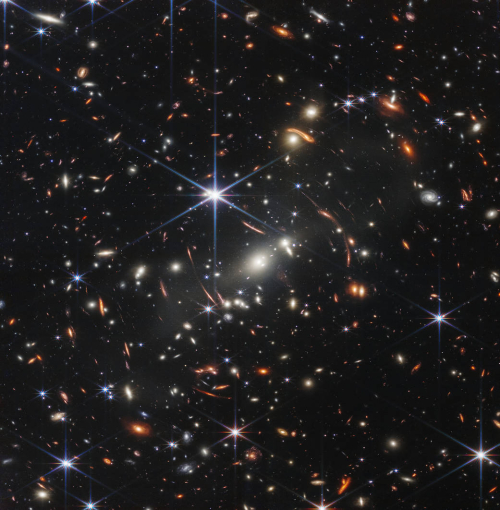
  • SMACS 0723: Massive foreground galaxy clusters magnify and distort the light of objects behind them, permitting a deep field view into both the extremely distant and intrinsically faint galaxy populations.

That only the last image is focused on distant deep space cosmology, the scientific research that Webb’s infrared instruments are optimized for suggests that NASA wishes to highlight the telescope’s other observational possibilities.

The images will be released one by one during a press conference beginning at 10:30 am (Eastern) on July 12th. It is once again important to note that though the images are likely to be spectacular, they will be false color infrared images measuring the heat produced by the objects, not optical images that we could see with our eyes.

1 comment

Scientists: Impacts on rubble-pile asteroid are different than on planets

Landslide on Bennu from impact
Click for full image.

Using data collected by OSIRIS-REx at the asteriod Bennu, scientists have determined that the ejecta from impacts on a rubble-pile asteroid behaves in a very different manner than on planets with higher gravity.

Instead of flying away at about the same speed as the impactor and escaping into space, as expected in the weak gravity, the material is lifted up at a very slow speed, falls back down, and then rolls downhill like a landslide. The graphic to the right from the press release, reduced and enhanced to post here, illustrates what the scientists think happened when one of Bennu’s larger craters was created.

[M]ost of that material, called ejecta, returned to the surface and slid down the face of the asteroid, starting a wide avalanche that slowly rolled toward Bennu’s equator. Perry said the only way this could happen on a small object like Bennu, which is less than 500 meters (1,640 feet) in diameter and has low gravity, is if the dust had low or next to no cohesion.

“Because Bennu is so small, its escape velocity is less than a few tenths of a mile per hour, so any particle ejected faster than that would leave the surface,” he said. “These slow speeds are possible only if Bennu’s surface is weaker than we thought, even weaker than very loose, dry sand. This extremely low surface strength also means material on a slope is easily disturbed, and that’s what led to the landslide.”

In other words, the low cohesion prevents the impact’s energy from being transferred efficiently to the asteroid’s particles. They move, but only slowly, and thus end up sliding away more or less along the asteroid’s surface.

This discovery helps explain how these rubble-pile asteroids accumulate material, despite their low gravity.

9 comments

Mirror comparable to Hubble’s ready for JPL balloon astronomy mission

engineers attach panels to the mirror's support structure.
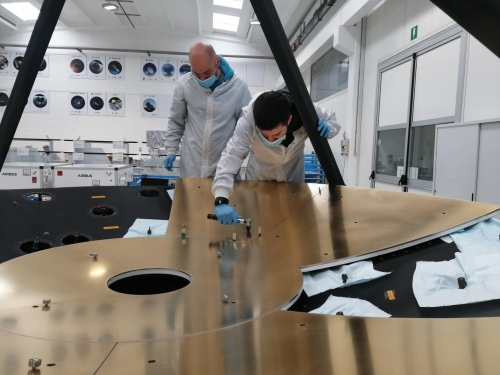
Engineers attach mirror panels to the mirror’s support structure.

An Italian optics company, Media Lario, has now completed construction of the primary mirror — at 2.5 meters width slightly larger than Hubble’s primary mirror — to be used on a JPL balloon astronomy mission dubbed ASTHROS, targeting a December 2023 launch.

The ASTHROS primary mirror features nine panels, which are significantly easier to fabricate than a one-piece mirror. The bulk of the mirror panels consist of lightweight aluminum, formed into a honeycomb structure that reduces its total mass. The panel surfaces are made of nickel and coated with gold, which improves the mirror’s reflectivity at far-infrared wavelengths.

Once launched, the balloon will circle the south pole for up to four weeks, taking data on the gas distribution in several galaxies.

While that data will be worthwhile, the mission’s real goal is to test these technologies for future space-based astronomy missions. If this mission works, it will reduce significantly the cost and time necessary to make big telescope mirrors, while enhancing the robotic capabilities of such telescopes.

0 comments

Astronomers: A supermassive black hole rotates far slower than expected

Quasar as seen across multiple wavelengths
Click for full image.

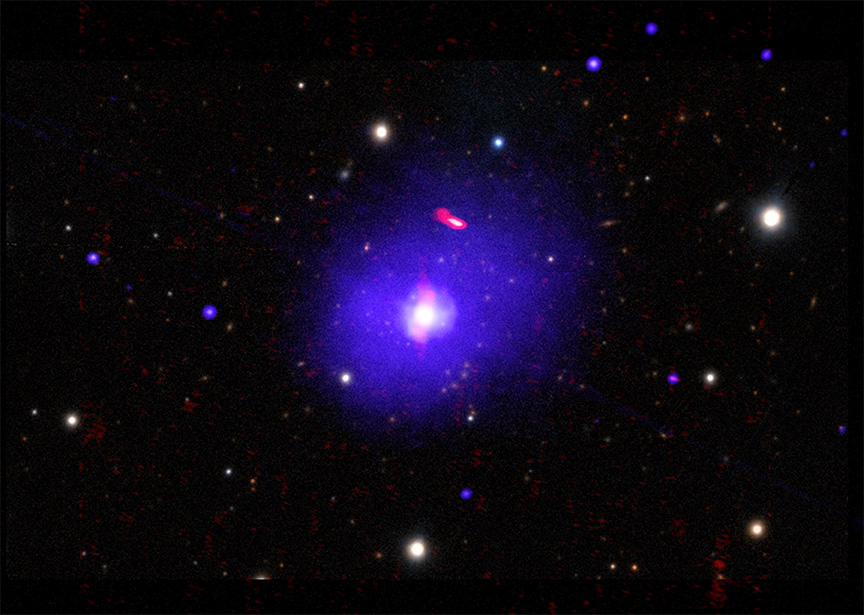
The uncertainty of science: Using Chandra astronomers have measured the rotation of a supermassive black hole in a distant quasar about 3.4 billion light years away and found that it spins at about half the speed of other less massive black holes.

Because a spinning black hole drags space around with it and allows matter to orbit closer to it than is possible for a non-spinning one, the X-ray data can show how fast the black hole is spinning. The spectrum — that is, the amount of energy as a function wavelength — of H1821+643 indicates that the black hole is rotating at a modest rate compared to other, less massive ones that spin close to the speed of light. This is the most accurate spin measurement for such a massive black hole.

The black hole, thought to weigh between 3 to 30 billion times more than the Sun and is the heaviest such object measured in this way, rotates at about half the speed of light. Why that rotation is less than other smaller black holes remains a question not yet answered, though astronomers suspect it is related to its formation history.

The image above is a composite showing this quasar across multiply wavelengths. X-rays are shown in blue, radio in red, and optical in white.

1 comment

A telescope using a liquid mirror about to become operational

Link here. The telescope, located in the Himalayas, is “an international collaboration between institutions in India, Belgium, Poland, Uzbekistan and Canada.”

The mirror works by rotating it so that its thin layer of liquid mercury forms a parabola.

The tradeoff is that the [telescope]is fixed in a single position, so it only observes one strip of the night sky as the Earth rotates below it. But since the telescope will be hyper-focused on just one area, it’s well-suited for spotting transient objects like supernovas and asteroids.

It appears the scientists will use it to study this same strip of sky over five years, hoping to detect changes in that time period.

This telescope is more a technology test than an actual observatory. Eventually the best place to put such a telescope — and much larger — will be on the Moon, and to do that requires some construction and testing beforehand.

6 comments

Kitt Peak telescopes undamaged from wildfire

Firefighters have so far been able to protect the telescopes on Kitt Peak in Arizona from being damaged by a fast burning wildfire that began a week ago.

In a statement, NOIRLabs, which manages Kitt Peak Observatory for the National Science Foundation, said a crew of firefighters are working on the summit with multiple engines. Hydrants have been tested, and fire hoses deployed to defend the observatory’s buildings, they said, adding firefighters are dropping “large amounts” of fire retardant on the southern end of the observatory in an effort to slow the fire’s advance.

On Thursday, firefighters cleared a line of trees and brush below the peak’s southern ridge, an effort that was “mostly complete” by the evening, said NOIRLabs. Firefighters also cleared the area around individual domes, as well around “critical infrastructure,” and around flammable propane tanks. In some places, ground crews started backfires to create fuel breaks, officials said.

Firefighters are continuing to remove brush on the slopes, and have spotters watching for hot-spots.

That this point it appears the telescopes are safe, as the fire teams allow the fire to burn out.

5 comments

Wildfire reaches Kitt Peak National Observatory

A wildfire has crested the peak and reached the Kitt Peak National Observatory, threatening a number of telescopes there.

Around 2:00 a.m. MST Friday morning the fire, contrary to the expectations of the firecrews, crested the southwest ridge where the Hiltner 2.4-meter Telescope, McGraw-Hill 1.3-meter Telescope, Very Long Baseline Array Dish and UArizona 12-meter Telescope are located. Because of the ongoing nature of the situation, it is currently not possible to assess whether any damage to the structures has occurred. We will report any damage as soon as possible.

Based on this report, however, it does appear that officials expect several of these telescopes to be damaged by the fire.

2 comments

TESS discovers solar system of rocky super-Earths only 33 light years away

Astronomers, using the space telescope TESS, have discovered two rocky super-Earths orbiting a red dwarf star HD 260655, only 33 light years away.

Both planets are “super-Earths” – terrestrial worlds like ours, only bigger. Planet b is about 1.2 times as big around as Earth, planet c 1.5 times. In this case, however, neither world is likely to support life. The temperature on planet b, nearest to the star, is estimated at 816 degrees Fahrenheit (435 Celsius), [while] planet [has a temperature of] c 543 Fahrenheit (284 Celsius), though actual temperature depends on the presence and nature of possible atmospheres.

The star’s nearness as well as the fact that these planets transit across its face means further study can not only determine if they have atmospheres, it can also roughly measure the atmospheres’ make-up.

0 comments

Russian scientists defy Rogozin, will not reactivate German instrument on Spektr-RG telescope

It appears that the Russian astronomers who use their instrument on the Spekr-RG space telescope are refusing to follow the orders of Dmitry Rogozin to reactivate the German instrument — dubed eROSITA — which the Europeans shut down in response to the Russian invasion of the Ukraine.

[T]he head of the Russian Space Research Institute, Lev Matveevich Zelenyi, spoke out against the unauthorized activation of eROSITA to Gazeta: “Our institute – all the scientists – categorically object to this. This objection is both for political and technical reasons.”

“This is not a Russian device. I can’t judge how realistic this whole thing is, I don’t know if our specialists have processing codes… But even if they have, it will be simply impossible to publish this data – no journal will accept it and will do it right,” he added.

Rogozin however appears adamant about taking over eROSITA. But then again, Rogozin blusters a lot, with many of this worst blusters having no bite behind them.

1 comment

An eccentric debris disk circling a nearby star

Eccentric debris disk around star.

Using the Atacama Large Millimeter/submillimeter Array (ALMA) in Chile, astronomers have discovered that the debris disk surrounding a star about 60 light years away, discovered in 2006 by the Hubble Space Telescope, is not circular, but instead forms an eccentric ring about the star.

The photo to the right combines the Hubble data (the blue background) and the ALMA data (the orange-yellow ring). The star is the bright spot in the ring, not in its center but at one of the ellipse’s two foci.

This level of eccentricity, MacGregor said, makes HD 53143 the most eccentric debris disk observed to date, being twice as eccentric as the Fomalhaut debris disk, which MacGregor fully imaged at millimeter wavelengths using ALMA in 2017. “So far, we have not found many disks with a significant eccentricity. In general, we don’t expect disks to be very eccentric unless something, like a planet, is sculpting them and forcing them to be eccentric. Without that force, orbits tend to circularize, like what we see in our own Solar System.”

In other words, there must be at least one hidden planet, maybe more, orbiting the star, its gravity forcing the disk into this shape.

2 comments

Chinese scientists detect a fast radio burst that defies the theories

The uncertainty of science: Using their large FAST radio telescope, Chinese scientists revealed this week that they have detected a new fast radio burst (FRB) whose behavior and location does not fit the present tentative theories for explaining these mysterious deep space objects.

The FRB was an exception from the beginning as it flared again and again in observations recorded by the Five-hundred-meter Aperture Spherical radio Telescope (FAST), which nestles among the hills of China’s Guizhou province. The multiple flares put the source among the few percent of FRBs that repeat. But unlike most repeaters, this one doesn’t have any apparent cycle of bursting and quiescence.

“FRB 20190520B is the only persistently repeating fast radio burst known so far, meaning that it has not been seen to turn off,” Li says.

In addition, whatever made the FRB is also emitting a constant buzz of radio waves. Astronomers have found an association with a persistent radio source in only two other FRBs, and for one of these the low-level radio waves seem to come from ongoing star formation in the host galaxy. For FRB 20190520B, though, the radio source is far more compact, and Li’s team thinks the radio waves probably come from the FRB source itself.

The data also suggests the location does not fit the theories, and even suggests that FRBs might not all come from magnetars, as presently proposed.

0 comments

Webb gets its first large micrometeoroid impact

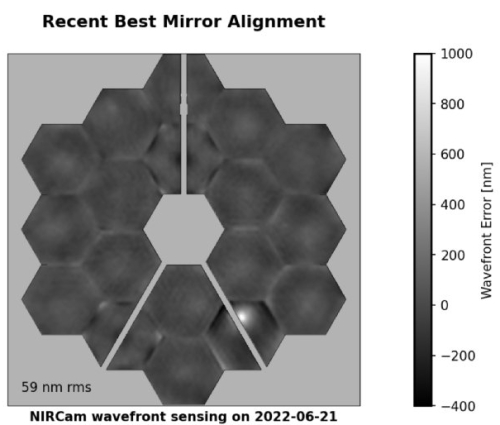
In a carefully worded press release this week, NASA revealed that one segment of the primary mirror of the James Webb Space Telescope had been hit by a micrometeoroid.

Between May 23 and 25, NASA’s James Webb Space Telescope sustained an impact to one of its primary mirror segments. After initial assessments, the team found the telescope is still performing at a level that exceeds all mission requirements despite a marginally detectable effect in the data. Thorough analysis and measurements are ongoing. Impacts will continue to occur throughout the entirety of Webb’s lifetime in space; such events were anticipated when building and testing the mirror on the ground.

The reason such events were expected is because — unlike most telescopes (including Hubble) — Webb’s mirrors are not enclosed in a tube for protection. To do so would have made the telescope far too expensive to build or launch.

After describing in great detail all the work done prior to launch to anticipate such hits and deal with them, the press release then mentioned this fact almost as an aside:

This most recent impact was larger than was modeled, and beyond what the team could have tested on the ground.

Localized damage to the primary mirror of any telescope is not unusual. With ground-based telescopes such issues are not infrequent and easily worked around. The same applies to Webb. The engineers will calculate how to calibrate this particular segment to minimize distortion from the impact.

However, that the telescope experienced a hit larger than ever modeled, so soon after launch, suggests that those models were wrong, and that larger and more frequent hits can be expected. If so, this could be very worrisome, as over the long run it could shorten the telescope’s life in space significantly.

9 comments

Russia to take control of German telescope on space orbiter

Dmitry Rogozin, the head of Roscosmos, revealed today that he has issued orders for the scientists running the Spektr-RG telescope to figure out how to take over operations of the German instrument on the telescope.

“I gave instructions to start work on restoring the operation of the German telescope in the Spektr-RG system so it works together with the Russian telescope,” he said in an interview with the Rossiya-24 TV channel.

The head of Roscosmos said the decision was necessary for research. “They – the people that made the decision [to shut down the telescope] don’t have a moral right to halt this research for humankind just because their pro-fascist views are close to our enemies,” he said.

The Europeans had shut down operations when it broke off all of its space partnerships with Russia, following the Ukraine invasion and the decision of Russia to confiscate 36 OneWeb satellites rather than launch them as it was paid to do.

22 comments

Astronomers used Japanese weather satellite to monitor the dimming of Betelgeuse

Belelgeuse as seen by weather satellite
From Figure 1 of the paper. Click for full image and caption.

In a paper published on May 30th, astronomers described how they used the Japanese weather satellite Himawari-8 to monitor the dimming of Betelgeuse that occurred in 2019 and 2020.

“We saw a tweet stating that the moon was in its images,” Daisuke Taniguchi, a Ph.D. student in astronomy at the University of Tokyo and first author of the paper, told Space.com. “I chatted with [third author] Shinsuke Uno on the usage of meteorological satellites for astronomy, found Betelgeuse is in the field of view of Himawari-8 and realized that maybe the Great Dimming of Betelgeuse could be investigated.”

Himawari-8 has been positioned 22,236 miles (35,786 kilometers) above Earth’s equator since 2015 to study weather and natural disasters (including the eruption of the Hunga Tonga-Hunga Haʻapai volcano on Jan. 15). Although the satellite is up there to image Earth every 10 minutes, the edges of its images include stars.

Taniguchi and his colleagues were able to see Betelgeuse in images taken throughout Himawari-8’s lifetime and measured its brightness roughly every 1.7 days between January 2017 and June 2021.

The scientists were lucky that the star’s unexpected dimming happened to occur during this time period. The image above is Figure 1 from their paper (which you can read here).

They note that their observations appeared to confirm the theory that the dimming was caused by a dust cloud crossing in front of the star, not the theory that it was caused by a dark spot on the star’s surface. Moreover, their data suggests that dust was relatively close to the star, and could even been created by a burst from the star.

0 comments

Webb to release first science images July 12th

The science team for the James Webb Space Telescope announced today that the first infrared science images from the telescope will be released on July 12, 2022.

The first images package of materials will highlight the science themes that inspired the mission and will be the focus of its work: the early universe, the evolution of galaxies through time, the lifecycle of stars, and other worlds. All of Webb’s commissioning data – the data taken while aligning the telescope and preparing the instruments – will also be made publicly available.

In many ways this first release will likely mirror the first release of images from the Hubble Space Telescope in 1993, after its serious focus problem had been solved. Then, the science team and NASA picked images for the press conference that, to them, would pass what they called the “grandmother test,” whereby an ordinary person not familiar with space objects would still instantly recognize the object imaged.

The result of that criteria was that some of Hubble’s best ground-breaking first images were not included, such as its first sharp picture of the exploding star Eta Carinae. While the images shown were beautiful, they did not immediately demonstrate what Hubble was going to accomplish. The Eta Carinae picture did however.

Hopefully this time the scientists will be more daring, and have a greater respect for the general public, and include some infrared images that are not familiar to non-scientists. It is such data that is almost always the most exciting.

1 comment

Astronomers discover pulsar with slowest rotation rate of any known neutron star

The uncertainty of science: Using the MeerKAT radio telescope in South Africa, astronomers have discovered a pulsar with the slowest rotation rate of any known neutron star, completing each rotation every 76 seconds.

According to the press release:

Neutron stars are extremely dense remnants of supernova explosions of massive stars. Scientists know of about 3,000 of these in our Galaxy. However, the new discovery is unlike anything seen so far. The team think it could belong to the theorised class of ultra-long period magnetars – stars with extremely strong magnetic fields.

From the paper’s abstract:

With a spin period of 75.88 s, a characteristic age of 5.3 Myr and a narrow pulse duty cycle, it is uncertain how its radio emission is generated and challenges our current understanding of how these systems evolve. The radio emission has unique spectro-temporal properties, such as quasi-periodicity and partial nulling, that provide important clues to the emission mechanism. Detecting similar sources is observationally challenging, which implies a larger undetected population. Our discovery establishes the existence of ultra-long-period neutron stars, suggesting a possible connection to the evolution of highly magnetized neutron stars, ultra-long-period magnetars and fast radio bursts.

Essentially, a pulsar with this length rotation was not expected, and its existence throws a wrench into present theories about their formation and evolution. That its existence might provide a link between neutron stars, magnetars, and the as-yet unexplained fast radio bursts, however, is very intriguing.

1 comment

Another grand galaxy imaged by Hubble

NGC 3631
Click for full image.

Cool image time! The photo to the right, reduced to post here, was released today and is one in what has become a steady string of recent and quite spectacular galaxy images produced by scientists using the Hubble Space Telescope. From the caption:

This image from NASA’s Hubble Space Telescope features the Grand Design Spiral, NGC 3631, located some 53 million light-years away in the direction of the constellation Ursa Major. The “arms” of grand design spirals appear to wind around and into the galaxy’s nucleus.

Close inspection of NGC 3631’s grand spiral arms reveals dark dust lanes and bright star-forming regions along the inner part of the spiral arms. Star formation in spirals is similar to a traffic jam on the interstate. Like cars on the highway, slower moving matter in the spiral’s disk creates a bottleneck, concentrating star-forming gas and dust along the inner part of their spiral arms. This traffic jam of matter can get so dense that it gravitationally collapses, creating new stars (here seen in bright blue-white).

This spiral follows the classic shape of these whirlpool galaxies. The Milky Way, though also a spiral, is now thought to be a barred spiral, whereby the galaxy’s whirlpool shape is distorted by a large straight bar of stars crossing its center.

Scientists also released today a second photo from Hubble of a different spiral galaxy, which you can check out here.

0 comments

Astronomers: Shut down satellite companies so we don’t have to adapt!

The Hubble Space Telescope
Space-based astronomy, a concept apparently alien to astronomers

In an article published today in Nature, the astronomy community continued its crybaby complaining of the last three years about the interference posed to their ground-based telescopes by the tens of thousands of small satellites scheduled for launch in the next few years.

These quotes typify the apparent attitude of astronomers:

“This is an unsustainable trajectory,” says Meredith Rawls, an astronomer at the University of Washington in Seattle. “At the moment, our science is fine. But at what point will we miss a discovery?”

…“It’s really quite horrifying,” says Samantha Lawler, an astronomer at the University of Regina in Canada.

…The growing threat of satellite constellations adds to other degradations of the night sky such as light pollution, says Karlie Noon, a PhD candidate in astronomy and an Indigeneous research associate at Australian National University in Canberra. “In the same way that our lands were colonized, our skies are now being colonized,” she says. “And this isn’t just Indigenous people.” She points out that companies have launched satellites without necessarily consulting the scientific community. [emphasis mine]

Oh the horror. Scientists weren’t consulted! The nerve of these companies!

In response, astronomers have decided their only solution is to enlist the UN to shut down these satellite companies.
» Read more

12 comments

Scientists: Plow the solar system through a dense-enough interstellar cloud and the heliosphere would no longer protect the Earth

The Earth's orbit outside the heliosphere

The uncertainty of science: Using a computer simulation, scientists have determined that if the solar system had two million years ago passed through one of the known nearby interstellar clouds within the relatively empty Local Bubble of space, it would have shrunk the Sun’s heliosphere enough so that the Earth would no longer be inside it, thus exposing the planet to interstellar space.

The image to the right comes from that simulation, and is figure 1 of the scientist’s paper [pdf]. The red line marks the Earth’s orbit (tilted sideways slightly to make it obvious), the yellow blob the shrunken heliosphere.

From the paper’s abstract:

There is overwhelming geological evidence from 60Fe and 244Pu isotopes that Earth was in direct contact with the ISM [interstellar medium] 2 million years ago, and the local ISM is home to several nearby cold clouds. Here we show, with a state-of the art simulation that incorporate all the current knowledge about the heliosphere that if the solar system passed through a cloud such as Local Leo Cold Cloud, then the heliosphere which protects the solar system from interstellar particles, must have shrunk to a scale smaller than the Earth’s orbit around the Sun (0.22).

Using a magnetohydrodynamic simulation that includes charge exchange between neutral atoms and ions, we show that during the heliosphere shrinkage, Earth was exposed to a neutral hydrogen density of up to 3000cm-3. This could have had drastic effects on Earth’s climate and potentially on human evolution at that time, as suggested by existing data.

This model is just one possible explanation of the presence of 60Fe and 244Pu isotopes on Earth. Another popular hypothesis is that a supernova occurred about 30 light years away, close enough to expose the Earth to interstellar space but not so close as to cause the total extinction of life.

With both theories, the event could also be an explanation for the significant climate changes two million years ago — such as the beginning of the most recent and now-ending ice age (no SUVs required) — as well as major evolutionary changes that occurred at that time among the ancestor species of humanity.

All is uncertain however. The scientists have no evidence the Earth actually entered a local dense cloud two million years ago. All they are doing is postulating that if such a thing happened, the dense cloud could shrink the heliosphere so much the Earth would be exposed to the interstellar medium.

Since we also do not yet have evidence of a specific nearby supernovae event either, neither theory can be favored. In fact, both could have been happened at different times in the past. Or neither.

Hat tip to reader Phil Berardelli, author of Phil’s Favorite 500: Loves of a Moviegoing Lifetime.

9 comments
1 27 28 29 30 31 113