
G2 survives Milky Way center fly by

The uncertainty of science: The gas cloud, dubbed G2, that was going to be eaten by the supermassive black hole at the center of the Milky Way as it did a close fly-by this summer has instead turned out to be a massive star formed when the star’s of its binary system merged.

G2 survived the fly-by, produced no big fireworks which were what was predicted if it has been a gas cloud. The data now suggests that the object is instead a very big star formed when two stars merged.

Massive stars in our galaxy, [astronomer Andrea Ghez] noted, primarily come in pairs. When the two stars merge into one, the star expands for more than one million years “before it settles back down,” Ghez said. “This may be happening more than we thought; the stars at the center of the galaxy are massive and mostly binaries. It’s possible that many of the stars we’ve been watching and not understanding may be the end product of a merger that are calm now.”

Be warned that this new hypothesis about G2 has its own uncertainties. Better data might eventually find it to be something else again.
0 comments

Rosetta gets in position to release Phalae

Rosetta has successfully maneuvered into position prior to releasing Philae on November 12 for landing on Comet 67P/C-G.

The thruster burn took place starting at 02:09:55 UTC (03:09:55 CET), ran for 90 seconds and, based on an initial analysis of spacecraft radiometric data, delivered a delta-v – change in speed – of 9.3 cm/sec, as confirmed by the Rosetta Flight Dynamics team. It was the second and final of two ‘deterministic’ (i.e. direction and thrust are prepared in advance) manoeuvres that moved Rosetta onto the planned lander delivery orbit, now at a height of about 30 km, which will be maintained right up until the pre-delivery manoeuvre at two hours before separation at 08:35 UTC (09:35 CET) on the morning of 12 November.

…[T]he next planned orbit-changing manoeuvres will occur on the 12th at (a) 2 hours before separation and (b) about 40 minutes after, in between which Philae will be released. The pre-delivery manoeuvre will shift Rosetta’s trajectory so that the orbiter would be on a path so as to pass over the comet at a distance of 5 km, while the separation will occur at 08:35 UTC on board the spacecraft about 22 km (the confirmation signal will arrive on Earth at 09:03 UTC).

Since Philae is a passive lander, firing no thrusters but simply being thrown gently at the comet by Rosetta, the last two burns are crucial. The first literally puts Rosetta on the same collision course as Philae so that when the lander is released it is on a course to hit the comet. The second takes Rosetta out of that collision course, since no one wants it to hit the comet also.

0 comments

Avalanches on an asteroid

A new analysis predicts that when the asteroid Apophis flies past the Earth in 2029, the close fly-by will cause avalanches on the asteroid.

If asteroids pass close to Earth, they begin to experience the effects of our planet’s gravity. Just like the moon pushes and pulls the oceans, creating the tides, asteroids are susceptible to tidal forces from our planet. To judge what effect this will have on Apophis, scientists need to know what it’s made of. Their best guess is based on photos taken by a Japanese spacecraft named Hayabusa, which took detailed pictures of an Apophis-sized asteroid named Itokawa. Those images revealed that the asteroid wasn’t a solid mass of rock spinning through space, but rather a giant clump of debris held together loosely by gravity. “You look at the [Hayabusa] pictures and you’re like, ‘Uh, that’s a pile of rocks, dude.’ It’s very likely that Apophis is similar,” says astrophysicist Derek Richardson of the University of Maryland, College Park.

To show that Earth’s gravity could cause some of these rocks to tumble, Richardson and his colleagues developed a computer model that allowed them to place virtual sand piles across the surface of a model asteroid with roughly the same dimensions as Apophis. By factoring in the gravity from the asteroid, the tidal force from Earth, centrifugal force caused by the asteroid’s rotation, inertial forces, and other effects, the team was able to predict how the particles on the surface of the asteroid would behave on approach. The results confirm that Earth’s tidal forces would be strong enough to cause tiny avalanches on the asteroid, the team reported online ahead of print in Icarus.

Need I note that there are a lot of uncertainties here? Because they are using what is known about a different asteroid, all of their assumptions about Apophis’s properties in their computer model could be very wrong.

Still, this is interesting, because it does demonstrate that an asteroid could be significantly disturbed simply by flying past a planet.

1 comment

Comet 67P/C-G smells!

Instruments on Rosetta have determined that the various molecules coming off Comet 67P/C-G have a strong aroma.

You might expect a rock that spends all its time in a vacuum to be fairly inoffensive, but in fact exposure to sunlight is causing it to give off quite an aroma: hydrogen sulfide, ammonia, formaldehyde, hydrogen cyanide, and other caustic gases would make it smell “suffocating,” like a cross between a filthy barn, an embalming room, and a rotten egg.

0 comments

Increasing activity at Comet 67P/C-G

Data from Rosetta in the past month has been showing a steady and gradual increase in dust emissions from the surface.

While images obtained a few months ago showed distinct jets of dust leaving the comet, these were limited to the ‘neck’ region. More recently, images obtained by Rosetta’s scientific imaging system, OSIRIS, show that dust is being emitted along almost the whole body of the comet. Jets have also been detected on the smaller lobe of the comet. “At this point, we believe that a large fraction of the illuminated comet’s surface is displaying some level of activity,” says OSIRIS scientist Jean-Baptiste Vincent from the Max Planck Institute for Solar System Research (MPS) in Germany.

The last two images at the link compare the same location with one image overexposed to make the jets visible. What is interesting is that the source of the jet is not evident in the other normally exposed image. It is almost as if surface material is simply heating up and then using that extra energy to simply throw itself off the surface. Why that then forms jets however is puzzling.

More info here.

0 comments

Titan’s atmosphere is unexpectedly unbalanced

The uncertainty of science: New data from the ground-based telescope ALMA suggest that certain organic molecules in Titan’s atmosphere are not evenly distributed through the atmosphere as expected.

At the highest altitudes, the pockets of organic molecules were shifted away from the poles. These off-pole concentrations are unexpected because the fast-moving, east-west winds in Titan’s middle atmosphere should thoroughly mix the molecules formed there. The researchers do not have an obvious explanation for these findings yet.

I would not take these results too seriously, as the data are very sketchy. With better data many of these questions will vanish, replaced by new questions that are better based on reality.

0 comments

Mars Reconnaissance Orbiter photographs Comet Siding Spring

During Comet Siding Spring’s flyby of Mars on Sunday Mars Reconnaissance Orbiter was able to capture an image of the comet’s nucleus.

Prior to its arrival near Mars astronomers estimated the nucleus or comet’s core diameter at around 0.6 mile (1 km). Based on these images, where the brightest feature is only 2-3 pixels across, its true size is shy of 1/3 mile or 0.5 km.

0 comments

G2 survives fly-by of Milky Way’s supermassive black hole

The uncertainty of science: The mysterious object G2, thought by astronomers to be either a cloud or a star, has survived its close fly-by of Sagittarius A* (pronounced A-star), the supermassive black hole at the center of the Milky Way, without telling scientists whether it is a cloud or a star.

Not only do astronomers still not know clearly what G2 is, the Milky Way’s supermassive black hole continues to behave in ways that baffle them.

0 comments

New measurements cut dark matter in Milky Way by half

The uncertainty of science: New more robust measurements by Australian astronomers has shown that the amount of dark matter in the Milky Way galaxy is about half of what previous measurements had estimated.

Without doubt something is causing the outer stars in galaxies to orbit their galaxies at much greater speeds than they should. The answer that astronomers have posited since the late 1950s is that there is additional unidentified mass, dubbed dark matter, lurking as a halo around each galaxy, pulling on those outer stars and making them move faster.

The problem remains that no one has as yet detected this unidentified dark matter. Moreover, there are enormous uncertainties in the measurements of the motions of stars. This result helps narrow those uncertainties.

8 comments

A pulsar that’s eating a galaxy

The uncertainty of science: Astronomers have discovered a pulsar emitting energy at a rate far greater than ever predicted and which is believed caused by the very fast in-fall of matter into the neutron star.

Astronomers have found a pulsating, dead star beaming with the energy of about 10 million suns. This is the brightest pulsar – a dense stellar remnant left over from a supernova explosion – ever recorded. The discovery was made with NASA’s Nuclear Spectroscopic Telescope Array, or NuSTAR. “You might think of this pulsar as the ‘Mighty Mouse’ of stellar remnants,” said Fiona Harrison, the NuSTAR principal investigator at the California Institute of Technology in Pasadena, California. “It has all the power of a black hole, but with much less mass.”

More here. The galaxy where this pulsar resides, M82, has been known for decades to be one of the most interesting, with evidence of vast explosions tearing it apart. This pulsar is at its center, and appears to be sucking in matter at a rate previously believed impossible, suggesting that the supermassive black holes found at the center of many galaxies could form much faster that any theory predicted.

0 comments

Ground-breaking ceremony for Thirty Meter Telescope cancelled because of protesters

A ground-breaking ceremony on Mauna Kea, which would have included a blessing from native Hawaiians, was cancelled Tuesday when protesters showed up trying to block the telescope’s construction.

There were also small numbers of protesters at other locations that are also connected to the telescope project.

With previous similar protests of other telescope projects, the protesters seem to always disappear when the projects agree to give them money. Makes me wonder if their religious fervor is much shallower than the news stories of this protest would lead us to believe.

2 comments

A giant black hole in a tiny galaxy

The uncertainty of science: Astronomers have unexpectedly discovered a supermassive black hole in the center of a nearby tiny galaxy, comprising almost 18% of the galaxy’s entire mass.

To weigh the beast, the researchers measured the velocity of stars whipping about the galaxy’s centre using an infrared spectrometer on the Gemini North telescope atop Mauna Kea in Hawaii. The high velocity of the stars is best explained by a central black hole that tips the scales at 21 million times the Sun’s mass, concluded Seth’s team. That is more than five times heavier than the black hole at the centre of the Milky Way — even though M60-UCD1 has an estimated diameter of about one-six-hundredth that of our home galaxy.

Previously astronomers had believed that the size of a galaxy would predict the size of its central black hole, and that a galaxy this small would not house such a supermassive object. This find upsets those theories.

1 comment

Dawn’s arrival at Ceres delayed one month

Though engineers have solved the problems caused when a radiation blast disabled Dawn’s ion engine and put it into safe mode for a week, the fix will cause a one month delay in its arrival at the asteroid Ceres.

Controllers discovered Dawn was in safe mode Sept. 11 after radiation disabled its ion engine, which uses electrical fields to “push” the spacecraft along. The radiation stopped all engine thrusting activities. The thrusting resumed Monday (Sept. 15) after controllers identified and fixed the problem, but then they found another anomaly troubling the spacecraft.

Dawn’s main antenna was also disabled, forcing the spacecraft to send signals to Earth (a 53-minute roundtrip by light speed) through a weaker secondary antenna and slowing communications. The cause of this problem hasn’t been figured out yet, but controllers suspect radiation affected the computer’s software. A computer reset has solved the issue, NASA added. The spacecraft is now functioning normally.

1 comment

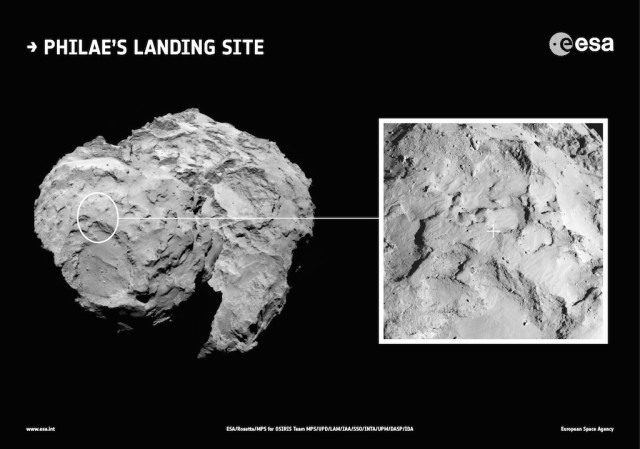
Philae’s landing site chosen

Philae's primary landing site

The Rosetta science team has chosen the primary landing site on Comet 67P/C-G for its Philae probe.

Site J is on the ‘head’ of the comet, an irregular shaped world that is just over 4 km across at its widest point. The decision to select Site J as the primary site was unanimous. The backup, Site C, is located on the ‘body’ of the comet. The 100 kg lander is planned to reach the surface on 11 November, where it will perform indepth measurements to characterise the nucleus in situ, in a totally unprecedented way.

This site is, located in the outside center of the nucleus’s smaller lobe, was picked unanimously because it appears to be the easiest to reach while also providing good science.

The descent to the comet is passive and it is only possible to predict that the landing point will place within a ‘landing ellipse’ typically a few hundred metres in size.

A one square kilometre area was assessed for each candidate site. At Site J, the majority of slopes are less than 30º relative to the local vertical, reducing the chances of Philae toppling over during touchdown. Site J also appears to have relatively few boulders, and receives sufficient daily illumination to recharge Philae and continue science operations on the surface beyond the initial battery-powered phase.

Provisional assessment of the trajectory to Site J found that the descent time of Philae to the surface would be about seven hours, a length that does not compromise the on-comet observations by using up too much of the battery during the descent.

I have put a close-up of the landing site below the fold.
» Read more

0 comments

Universal Big Bang lithium deficit confirmed

The uncertainty of science: New data from a globular cluster in nearby dwarf galaxy has confirmed that the deficit of lithium that astronomers have found in the Milky Way also exists in other galaxies.

According to the Big Bang theory, the amount of lithium in the universe should be two or three times more than it is. This result shows that the deficit exists outside the Milky Way, which suggests strongly that something significant is wrong with the Big Bang theory.

14 comments
1 71 72 73 74 75 114