Another flying car gets FAA approval for flight testing

Aska-5 flying car
The Aska-5 flying car

The FAA has approved another flying car for flight testing, this time for a flying car designed to also be able to do vertical take-offs if necessary.

The Aska A5 … has four wheels and four seats. Like the Klein Vision [another flying car proposal], it can take off on a runway if there’s one available. Unlike the Klein Vision, it can also takeoff on a very short runway, or indeed no runway at all, thanks to an electric VTOL [vertical take-off and landing] system that folds out at the touch of a button. And unlike, say, the Xpeng AeroHT [a different flying car proposal], it’s capable of transitioning to efficient, winged cruise mode to expand its range.

The A5 will look fairly ridiculous driving down the road, all propellers and struts, a clog with a dishrack full of cutlery piled on top. But when the main rear wing and canard fold out, it all makes a lot more sense. There are six large propellers, four at the back, two at the front, and in VTOL operations these will lift the Aska off the ground and allow it to hover. For forward flight, the two inner rear propellers can tilt forward, allowing horizontal thrust in cruise mode with the rest of the props switched off and the car’s weight supported by its wings.

The proposed price tag for the Aska-5 is presently just under $800K, though it will be a while before you can buy one. The company says it is doing both driving and flight testing, but provided no images or data of it in the air. Thus, a lot of work remains before you could climb in, drive from your home to an airport and take off.

The company says it has $50 million in preorders. If so, at least 50 people think this might be the real deal.

10 comments

Boeing gets NASA contract to develop new airplane wing design

In its effort to reduce fossil fuel use and thus save us from being burned to death by global warming in only a decade, NASA has now awarded Boeing a contract to develop new airplane wing design that it predicts will lower fuel use by up to 30%.

The X-66A is the X-plane specifically aimed at helping the United States achieve the goal of net-zero greenhouse gas emissions by 2050. To build the X-66A, Boeing will work with NASA to modify an MD-90 aircraft, shortening the fuselage and replacing its wings and engines. The resulting demonstrator aircraft will have long, thin wings with engines mounted underneath and a set of aerodynamic trusses for support. The design, which Boeing submitted for NASA’s Sustainable Flight Demonstrator project, is known as a Transonic Truss-Braced Wing.

While developing a more efficient wing design is certainly worthwhile, having skepticism about this project is certainly reasonable. First of all, it seems somewhat strange to award Boeing such a contract at this time, considering NASA own experience with the company with Starliner, as well as that company’s problems with other government contracts for the military.

Secondly, the press release makes a big deal about the project getting an X-plane designation, an entirely superficial and PR related title that if anything suggests there is very little steak to this sizzle.

Third, it is unclear the nature of this contract. Is is cost-plus, or fixed price? The press release says NASA will “invest $425 million over seven years, while the company and its partners will contribute the remainder of the funding, estimated at about $725 million.” If cost-plus, this means nothing. Boeing will use any excuse to go over budget in order to get more money from NASA.

Finally, half a billion dollars to develop and test a new airplane wing design, using an already existing airplane, seems incredibly exorbitant. And to require seven years to build it seems ridiculously long.

All in all, I suspect the real goal of this project is to funnel tax dollars to Boeing to help keep it afloat, not to build a new green airplane.

5 comments

Intelsat develops airplane WiFi antenna that can access both Intelsat and OneWeb satellites

Intelsat has now completed flight tests of a new airplane WiFi antenna designed to access both Intelsat and OneWeb satellites during flight.

By using the Intelsat and OneWeb satellite networks together, Intelsat can offer the benefits of LEO’s low latency along with the redundancy GEO provides to address network hotspots that LEO networks on their own cannot address. Whether aircraft are flying polar regions or over the most populated cities in the world, the ESA antenna will offer seamless coverage from takeoff to touchdown.

At just 90 pounds and with no moving parts, the new antenna stands just 3.5 inches tall on the top of the aircraft. The terminal’s low profile has the lowest drag of any product Intelsat has ever offered.

With this antenna, Intelsat keeps itself in the game. Airlines can provide more complete coverage by using it and signing deals with both OneWeb and Intelsat to provide WiFi to passengers.

0 comments

Last 747 rolls off assembly line

Boeing earlier this week completed assembly of its very last 747 airplane, the 1,574th such plane built in the past half century.

Still in its iridescent green protective coating, the giant aircraft was towed out of the widebody aircraft factory in a low-key exercise without any fanfare. Once the 747 has been cleared, it will be flown to another Boeing facility where it will be painted in the Atlas Air livery in anticipation of final delivery to the customer next year.

The 747 was born out of a failed bid by Boeing to market a large jet transporter to the US military in the 1960s. That contract for what became the C-5A Galaxy eventually went to Lockheed, but Boeing was convinced that its basic design, with its high-bypass turbofan engine, could be reworked for the civilian market, which was booming at the time.

On January 9, 1969, the first 747 prototype took to the skies over Washington state. It was a staggering 225 feet (68.5 m) long, had a wing area larger than a basketball court, and the tail was as high as a six-story building.

Without question the 747 was one of the safest and well designed airplanes ever built. It was years after that first flight before one was involved in an accident, and that was not due to a failure of the plane itself. It also flew like a dream, its large size making it look like it was lumbering slowly in the air. Its retirement is almost entirely related to fuel cost-savings, since the 747 has four engines and thus more fuel than more modern planes.

5 comments

Flying car gets approved by FAA

Samson Switchblade

A small airplane that quickly converts to a three-wheel car has now been approved for airworthiness by the FAA, paving the way for the first flight tests.

After 14 years of development, the Samson Switchblade – a fast, street-legal three-wheeler that converts at the touch of a button into a 200-mph (322-km/h) airplane – has been approved for airworthiness by the FAA. The team is now preparing for flight tests.

The Switchblade is named after the knife-like way its wings swing out from beneath its two-seat cabin when it’s time to fly. The tail, too, swings out from where it’s stowed behind the large pusher prop, then unfolds into a generous T shape. Samson says the entire push-button conversion from street-legal trike to aircraft takes less than three minutes, and while it’s yet to demonstrate the entire process on a physical prototype, it looks like it’ll be a pretty spectacular process.

The goal is to create something you can drive from your garage to the nearest small runway, take off to fly to another nearby airport, and then quickly drive to your destination, without ever having to get out of your seat.

More information can be found at the company’s website, which also says it is “only months away from first flight”, and expects to sell its first kits for customers 18 months later. The company also says it has 1,500 customers who have already placed reservations to buy it.

21 comments

Mentour Pilot – SAS flight 751-the Gottröra Miracle

An evening pause: Hat tip Björn Larsson a.k.a. LocalFluff. who adds,

This stuff is more complicated than I thought. You could pick your favourite(!) airplane crash. The fantastic Hudson river landing for example. My favourite is this one, with a happy ending, because it crashed near to where I lived as a kid back then. The crash site, a potato field, was then locally called The Gottröra International Airport. Someone even put up a sign with that name at the bus stop nearby.

5 comments

Drop in aviation during COVID lockdowns caused no change in high cirrus clouds, contrary to predictions of climate models

The uncertainty of climate science: In the twenty-five years since I became a science journalist, I cannot count the number of high profile press releases and scientific papers that I’ve read claiming that the increase in aviation and the resulting contrails from airplanes was going to be a major contributor to human-caused global warming. According to the models, the increase in contrails was increasing the high altitude cirrus cover, and thus in a variety of ways acting to warm the planet.

Well, a paper just published in Geophysical Research Letters took a look at the effect the sudden and almost complete cessation of aviation during the 2020 COVID lockdowns had on high altitude cirrus clouds. If the models were right, the lack of air traffic should have caused a reduction in cirrus clouds, thus demonstrating the models were correct.

The models were wrong, once again. From the abstract:

We find that, despite the very large reduction in air traffic, neither cirrus cover nor temperature ranges changed by enough to be detectable relative to the year-to-year variability of natural cirrus. Comparing the satellite observations to previous model-simulated aviation cirrus, we determine that any aviation-induced change in cirrus would have a much smaller magnitude than would be inferred from climate model simulations. These results suggest that the warming effect of cirrus clouds produced by aircraft may be smaller than previously believed. [emphasis mine]

In other words, air traffic apparently has no impact on the high altitude cloud cover. The models that said this traffic was a contributor to global warming were 100% wrong. It apparently is not.

Of course, there remains some uncertainty even with this result, as it is for only one year. The effect of air traffic on clouds could have been disguised in 2020 by the natural fluctuations normally seen from year to year, though the paper’s authors think not.

Assuming this data is confirmed, the authors also concede that the plans to mitigate contrails by rerouting planes so that they do not all fly along the same routes could be very counter-productive. It will cause those detours to burn more fossil fuels, while changing nothing in the cloud cover in the upper atmosphere.

Ah, the law or unintended consequences once again rears its ugly head. Too bad global warming activists never seem to admit it exists, even though it constantly bites them in the rear, time after time after time after time after time….

69 comments

John Woodfield RC Gliders

An evening pause: Seems appropriate with Ingenuity flying about on Mars. From the youtube webpage:

This was the maiden flight of my latest design. It was a bit of a mash-up, using existing wings and tail from old models. It weighs 1.5kg and was flying in about 7-10mph of wind. I feel it will be happier in about 5mph. The all-moving tail needs changing slightly as it developed some serious flutter if I picked up too much airspeed.

Hat tip Cotour.

5 comments

Video of Ingenuity’s flight, taken by Perseverance

JPL yesterday released a short one minute long video created from images taken by the high resolution mast camera on Perseverance.

You can view the animation here.

Stitched together from multiple images, the mosaic is not white balanced; instead, it is displayed in a preliminary calibrated version of a natural-color composite, approximately simulating the colors of the scene as it would appear on Mars.

6 comments

Ingenuity flies!

Ingenuity takes off!
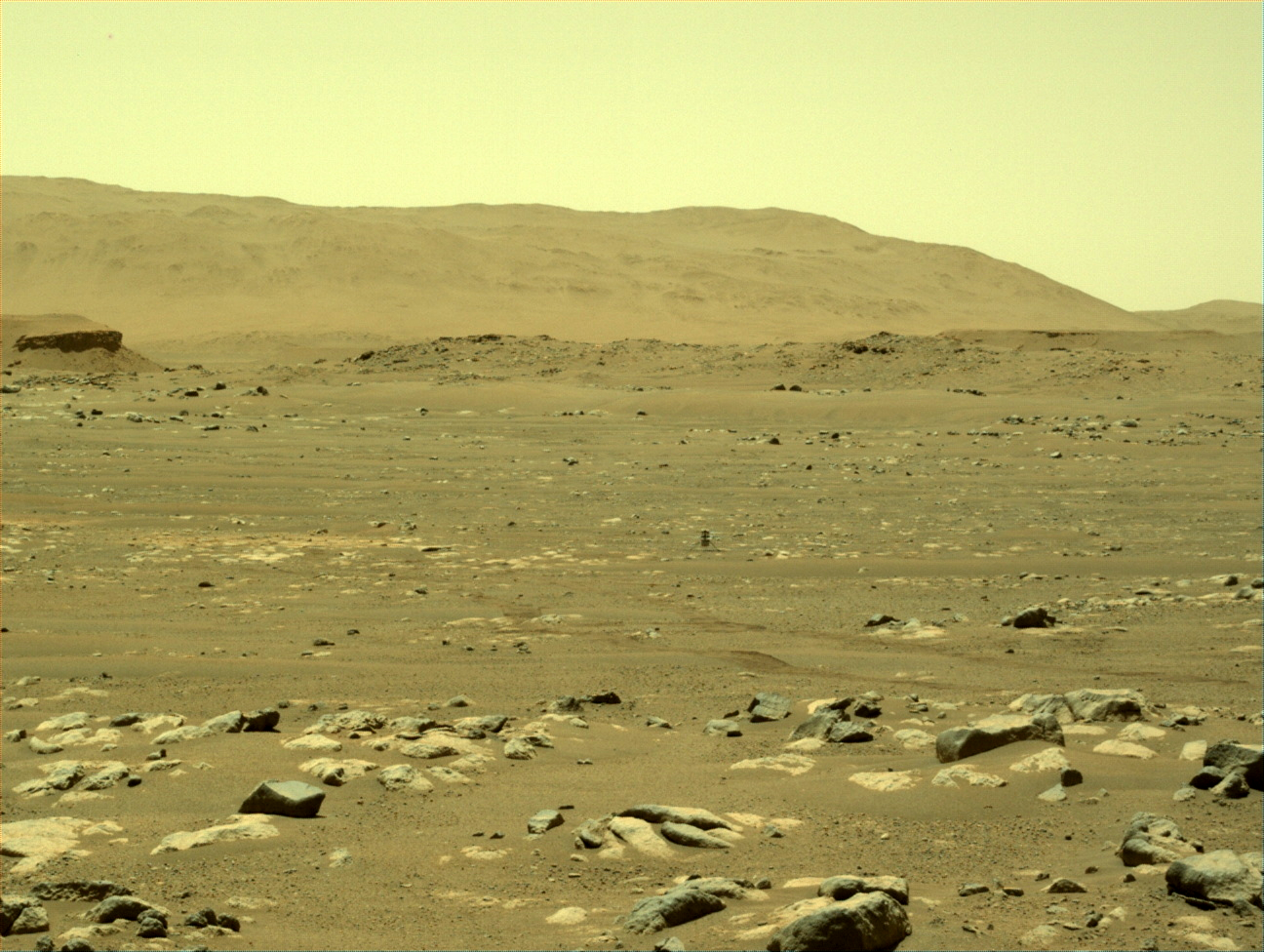
For full images go here and here.

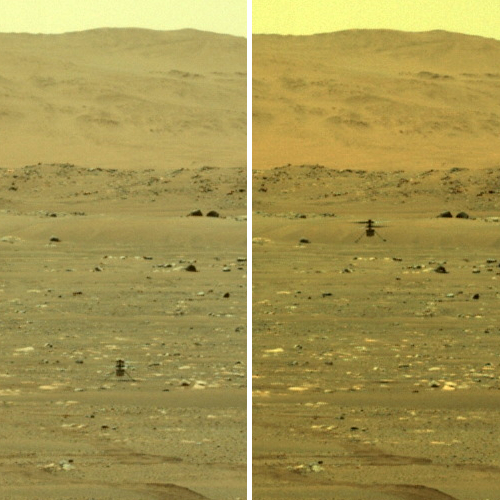
The first autonomous flight of the helicopter Ingenuity on Mars successfully took place early this morning, according to JPL engineers.

NASA has pulled off the first powered flight on another world. Ingenuity, the robot rotorcraft that is part of the agency’s Perseverance mission, lifted off from the surface of Mars on 19 April, in a 40-second flight that is a landmark in interplanetary aviation. “We can now say that human beings have flown a rotorcraft on another planet,” says MiMi Aung, the project’s lead engineer at the Jet Propulsion Laboratory (JPL) in Pasadena, California.

As shown by the two images taken by Perseverance above, the first flight was very simple. The helicopter simply rose about 10 feet, hovered for about 30 seconds as it swiveled 90 degrees, and then carefully descended back down. I have also embedded the video that JPL scientists have created compiling by high resolution Perseverance images below the fold.

Four more flights will next be attempted in the coming weeks.

Four further flights, each lasting up to 90 seconds, are planned in the coming weeks. In these, Ingenuity is likely to rise up to 5 metres [16 feet] above the surface and travel up to 300 metres [1000 feet] from the take-off point. Each successive flight will push Ingenuity’s capabilities to see how well the drone fares in Mars’s thin atmosphere, which is just 1% as dense as Earth’s.

» Read more

16 comments
1 2 3 4 13