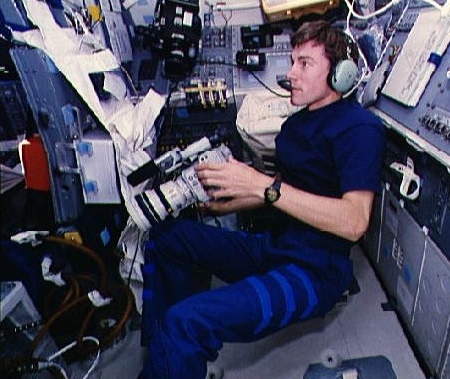
NASA awards new spacesuit contracts

NASA yesterday issued two relatively small spacesuit contracts to the two companies it already has hired to develop different spacesuits, one for the Moon (Axiom) and the other for orbital spacewalks (Collins).

The new contract awards provides each company $5 million to begin design work for adapting their suits for the other tasks, with the goal aimed at having two different suits for Moonwalks and spacewalks, from two different companies. For the companies, having suits that work both in orbit and the Moon will enhance their product. For Axiom, it will also allow it to develop its own suit it can use on its own space station.

The original contracts awarded Axiom $228.5 million for its Moonsuit, and Collins $97.2 million for a new orbital suit. NASA has previously spent about a billion dollars and fourteen years trying to build its own new orbital spacesuit, and had failed to create anything.

2 comments

Orbex to expand facilities in Scotland and Denmark

The British rocket startup Orbex today announced that it is expanding its factory and office space in its facilities in Scotland and Denmark, the former at its facility it leases at the new spaceport in Sutherland.

The company is adding an extra 1,500 square metres of factory and office space to its existing 4,750 square metre estate in Forres, Scotland and Copenhagen, Denmark. The additional space will increase the companyโ€™s launch vehicle production and propulsion system manufacturing capacity and add an extra software laboratory and an avionics clean room space with ISO 8 and ISO 9 sections. The additional capacity in Forres is just 3km from its test site at Kinloss, allowing for quick turnaround between the two sites, as Orbex ramps up its testing in the countdown to launch.

The press release doesn’t give any information about the expansion in Denmark. I wonder if it is occurring as a hedge against the kind of bureaucratic delays in the UK that destroyed Virgin Orbit. Orbex’s Prime rocket is presently under construction in Scotland, with its first launch planned for this year out of Sutherland. Whether it can get a launch permit promptly is doubtful, based on the fifteen months it took Britain’s Civil Aviation Authority (CAA) to approve Virgin Orbit. Orbex applied for the launch license in February 2022 (seventeen months ago) and so far there is no word from CAA about its approval.

Other Scandinavian spaceports are under construction in Sweden and Norway, which suggests establishing facilities in Denmark could strengthen Orbex’s ties to these new spaceports, especially in Sweden as both Sweden and Denmark are members of the European Union. Norway meanwhile as strong trades ties to the EU. Orbex has also signed a deal with Arianespace to launch ESA payloads, and it could be those launches could occur in French Guiana.

It seems wise if Orbex prepares for launch problems in the UK. Today’s announcement could be signalling that preparation.

2 comments

ISRO to transfer ownership of its smallsat SSLV rocket to a private company

India’s space agency ISRO has now announced that it is planning to transfer full ownership of its new smallsat SSLV rocket to a private company, with that transfer conducted through open bidding.

The Indian Space Research Organisation (ISRO) will soon transfer its Small Satellite Launch Vehicle (SSLV) to the private sector, after conducting two development flights of the rocket that seeks to provide on-demand services to put satellites weighing up to 500 kg in a low-earth orbit. The space agency has decided to opt for the bidding route to transfer the mini-rocket to the industry, a senior official said. “We will be transferring the SSLV completely to the private sector. Not just the manufacturing, but full transfer,” the official said.

The article does not provide a source, so this story is at present unconfirmed. It does fit with the overall policy of the Modi government, but it also clashes with the power structure in India’s vast bureaucracy that is resisting that policy. It is very possible that the story has been leaked as part of that struggle, likely by bureaucracy to gin up opposition prior to the transfer being implemented.

Up to now under the Modi government’s efforts to force ISRO to give up power, the assets of ISRO that have been used to generate commercial profits — such as its rockets — have generally been transferred to a new separate bureaucracy created by ISRO dubbed NSIL. NSIL supposed to operate like a private company, but it is wholly owned by the government, and is thus structured to retain control within that government.

If this news story is correct, the Modi government is about to bypass NSIL and force ISRO to sell off SSLV. If so this is excellent news, though the devil will certainly be hidden in the final details of the sale.

0 comments

SpaceX launches 22 Starlink satellites using a first stage for 16th time

SpaceX tonight successfully launched 22 Starlink satellites, its Falcon 9 rocket lifting off from Cape Canaveral using a first stage for a record sixteenth time, all achieved with a period of just over three years.

The stage successfully landed on its drone ship in the Atlantic. In addition, the two fairing halves each successfully completed its ninth flight.

In those three years this one first stage flew almost as many times as all of the launches of Russia (24), ULA (20), and Europe (20). Somehow, with those sixteen launches I think SpaceX has fully gotten its full value for what it spent building and refurbishing that stage.

To understand how routine SpaceX has made all this, when that first stage landed tonight there were no cheers at SpaceX, at all. There was just routine silence, as the launch crew proceeded with what has become an entirely routine procedure.

The leaders in the 2023 launch race:

46 SpaceX
25 China
9 Russia
5 Rocket Lab

American private enterprise still leads China in launches 52 to 25, and the entire world combined 52 to 43, with SpaceX by itself leading the rest of the world, excluding American companies, 46 to 43.

14 comments

SpaceX launches another 48 Starlink satellites

Using its Falcon 9 rocket, SpaceX today successfully launched another 48 Starlink satellites, lifting off from Vandenberg Space Force Base.

The first stage completed its twelfth flight, landing softly on a drone ship in the Pacific. The two fairing halves completed their fourth and seventh flights respectively.

The leaders in the 2023 launch race:

45 SpaceX
24 China
9 Russia
5 Rocket Lab

In successful launches, American private enterprise now leads China 51 to 24 in the national rankings, while SpaceX by itself leads the entire world combined, excluding American companies, 45 to 42.

8 comments

Taiwan wants and needs Starlink, but local law is blocking a deal

After three years of discussions, negotiations between Taiwan and SpaceX to provide Starlink to that nation broke off in 2022 because of a local Taiwanese law that requires local ownership of at least 51%.

SpaceX would not agree to these conditions, and ended the negotiations. In response, Taiwan has been struggling to get its own communications satellite into orbit, with limited success.

To address that vulnerability, the Taiwan Space Agency (TASA) intends to launch its first self-made low-Earth orbit communication satellite in 2026 and at least one more by 2028, Director General Wu Jong-shinn said. Taiwan also will have rockets capable of carrying payloads weighing over 100 kilograms, he added in an interview.

Since the country doesn’t yet have those rockets, this plan remains dependent on foreign launchers. Moreover, to be effective in low-orbit will require not two satellites but a constellation of 20 to 30. Taiwan is years from being to launch such a constellation.

It seems Taiwan is cutting off its nose to spite its face by not changing this ownership law. Its entire internet access is dependent on 14 undersea cables, and China has already demonstrated the ability to destroy these cables when it cut two in February. No foreign operation is going to give up its ownership to make a deal in Taiwan.

7 comments

Students complete first suborbital launch from new Nova Scotia spaceport

Students today completed the first suborbital launch from the new Nova Scotia spaceport being run by Maritime Launch Services.

The launch was completed by Arbalest Rocketry, a rocketry team from Ontarioโ€™s York University. It in turn is part of a nationwide Canadian student program called Launch Canada involving “over 1000 students nationwide from over 25 universities and colleges.”

Maritime hopes to offer both a launchpad and a rocket to satellite companies. It has deals with rocket startups in both the Ukraine and the United Kingdom, whereby satellite companies can come to Martitime and get full launch services.

1 comment

Update on preparations at Boca Chica for next Starship/Superheavy test launch

Link here. The article provides an excellent review of the extensive work SpaceX is doing, especially in repairing and upgrading the Superheavy launch facility.

Overall, SpaceX is moving fast, suggesting that Elon Musk’s prediction that it will be ready technically to launch in August quite believable. I remain doubtful that launch will happen in August, however, as I fully expect the FAA and the Biden administration will not issue a launch license on time, but will delay it.

8 comments

Another flying car gets FAA approval for flight testing

Aska-5 flying car
The Aska-5 flying car

The FAA has approved another flying car for flight testing, this time for a flying car designed to also be able to do vertical take-offs if necessary.

The Aska A5 … has four wheels and four seats. Like the Klein Vision [another flying car proposal], it can take off on a runway if there’s one available. Unlike the Klein Vision, it can also takeoff on a very short runway, or indeed no runway at all, thanks to an electric VTOL [vertical take-off and landing] system that folds out at the touch of a button. And unlike, say, the Xpeng AeroHT [a different flying car proposal], it’s capable of transitioning to efficient, winged cruise mode to expand its range.

The A5 will look fairly ridiculous driving down the road, all propellers and struts, a clog with a dishrack full of cutlery piled on top. But when the main rear wing and canard fold out, it all makes a lot more sense. There are six large propellers, four at the back, two at the front, and in VTOL operations these will lift the Aska off the ground and allow it to hover. For forward flight, the two inner rear propellers can tilt forward, allowing horizontal thrust in cruise mode with the rest of the props switched off and the car’s weight supported by its wings.

The proposed price tag for the Aska-5 is presently just under $800K, though it will be a while before you can buy one. The company says it is doing both driving and flight testing, but provided no images or data of it in the air. Thus, a lot of work remains before you could climb in, drive from your home to an airport and take off.

The company says it has $50 million in preorders. If so, at least 50 people think this might be the real deal.

10 comments

SpaceX launches Europe’s Euclid space telescope

SpaceX this morning successfully launched Europe’s Euclid space telescope, designed to map the spatial distribution of several billion galaxies across one third of the sky.

The first stage successfully completed its second flight, landing on a drone ship in the Atlantic. The two fairing halves completed their first flight.

This ESA science mission would have normally been launched on an Arianespace rocket, but Europe’s ability to launch anything now is nil, as it is about to retire its Ariane-5 rocket (with one launch left) and has so failed to get its replacement, Ariane-6, operational. As such, SpaceX got the business, since it is the cheapest and most reliable alternative.

The leaders in the 2023 launch race:

44 SpaceX
24 China
9 Russia
5 Rocket Lab

In the national rankings, American private enterprise now leads China in successful launches 50 to 24, and the entire world combined 50 to 41, with SpaceX by itself leads the entire world, excluding other American companies, 44 to 41.

7 comments

Dragon cargo freighter safely splashes down in Atlantic

After three months docked to ISS, one of SpaceX’s reusable Dragon cargo freighters safely splashed down today off the coast of Florida in the Atlantic.

This was SpaceX’s 28th cargo mission to ISS, all successful except for one launch failure not caused by the capsule itself, which post-failure analysis suggested that if it had been equipped to release parachutes it might have landed in the ocean undamaged.

This capsule brought back 3,600 pounds from the station, including some experiments that had been on the station for six years.

2 comments
1 179 180 181 182 183 676