Space startups get their SVB assets back when Feds move in

Because of the decision of the federal government to guarantee all deposits at the failed Silcon Valley Bank (SVB), even those above the $250K limit set by the FDIC law, several space rocket startups are no longer threatened with failure, for now.

Astra for example is now seeking to move as quickly as it can its assets, equaling about 15% of the company, to other financial institutions.

I would expect this incident will cause every company to make sure their assets are distributed more widely, as a hedge against the failure of one bank.

19 comments

Relativity scrubs launch today again

Relativity today was once again unable to complete the first launch of its Terran-1 prototype rocket.

The failure to launch was not for want of trying. The first countdown was first put on hold at T-1:10 when a boat entered the range. Once removed, the launch team picked up the count from that point without any recycle, but at T-0 the rocket’s internal computer sensed an issue and aborted the launch.

The launch team then reassessed, adjusted that issue, and tried again for a launch at the last second of the launch window, essentially duplicating the circumstances of an instantaneous launch window. The count this time got down to T-45 seconds when once again the rocket’s internal computer sensed an issue and aborted the launch.

No word yet on when the company will try again. If anything, Relativity’s launch team is getting a lot of practice and training with each launch attempt, critical knowledge needed for future launches.

5 comments

Some space startups threatened by Silicon Valley Bank failure

Link here. The companies mentioned in the article are Astra, BlackSky, Planet, Redwire, Rocket Lab, and Space Perspective.

Rocket Lab has about 8% of its cash assets now trapped by the closure. All the companies had loans from Silicon Valley Bank, some of which were paid off prior to the crash. This quote suggests the situation is critical for some space startups:

โ€œItโ€™s a very serious situation,โ€ said a space sector entrepreneur who asked not to be identified. โ€œOur balance is suddenly only $450. There has been no communication from SVB even after the event became known. Our primary SVB liaison, who has been very attentive in the past, is unreachable by any means. Itโ€™s appalling.โ€

20 comments

Live stream of the first launch attempt of Relativity’s Terran-1 rocket

I have embedded below the live stream of the first launch attempt of Relativity’s Terran-1 rocket, presently scheduled with a three hour launch window that opens at 1:00 pm (Eastern). The live stream will go live at noon.

The first launch of a new rocket is exceedingly challenging, and almost never succeeds. The key however is the data obtained that can be used to make the next launch attempt a success.

A lot rides on this launch. Relativity already has obtained $1.2 billion in launch contracts plus more than $1 billion in private investment capital, despite having never launched anything. Moreover, the Terran-1 rocket is really a prototype for its larger Terran-R rocket, which is intended to compete directly for the larger payloads that companies like SpaceX and ULA launch.

» Read more

0 comments

March 10, 2023 Quick space links

Courtesy of BtB’s stringer Jay.


  • Chinese pseudo-company Laser-Starcom, a startup of space laser communication, “raises 10s of millions of Chinese Yuan in round A”


0 comments

SpaceX successfully launches 40 OneWeb satellites

SpaceX today successfully launched another 40 OneWeb satellites, using its Falcon 9 rocket lifting off from Cape Canaveral.

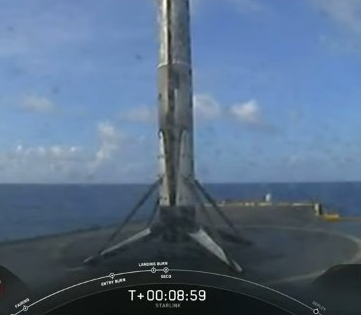
This was SpaceX’s third launch for OneWeb, helping to replace the Russians who broke its contract with OneWeb after its invasion of the Ukraine. The first stage completed its thirteenth flight, landing safely on a landing pad at Cape Canaveral. As amazing as this record is, it is not a record for the most reflights, which presently stands at fifteen. The fairings completed their sixth flight.

As of posting not all of OneWeb’s satellites have been deployed.

The 2023 launch race:

16 SpaceX
7 China
3 Russia
1 Rocket Lab
1 Japan
1 India

American private enterprise now leads China 17 to 7 in the national rankings, and the entire world combined 17 to 12. SpaceX alone leads the entire world combined, including American companies, 16 to 13.

11 comments

Another orbital tug & servicing company raises investment capital

Starfish Space, a new entrant into the orbital tug & servicing industry, has successfully raised $14 million in new investment capital, in addition to the $7 million it had raised in a previous fund-raising round.

The company hopes to launch a test satellite later this year, dubbed Otter Pup, which will undock from the orbital tub of another company, Launcher Space, do maneuvers, and then redock.

Starfishโ€™s plan calls for Otter Pup to be sent into orbit this summer as a rideshare payload on SpaceXโ€™s Transporter-8 mission. The spacecraft will be deployed from Launcher Spaceโ€™s Orbiter space tug, and then will execute a series of maneuvers with a xenon-fueled electric propulsion system to move away from the tug.

If all goes well, the Otter Pup will return to the vicinity of the Orbiter, and then use an electrostatic-based capture mechanism to latch onto a docking target on the space tug. It could take months to test out the Otter Pupโ€™s systems and tweak them as necessary for its test hookups.

Though the company says it will offer tug services once operational, it appears it is mostly aiming for the satellite robotic servicing market. It, like Astroscale, has developed its own docking capture device, which it will try to convince satellite companies to attach to their satellites. It will then use this to dock and service those satellites. Since these capture devices are proprietary, the number that each company gets onboard satellites will determine that company’s future sales.

This orbital servicing industry appears to be growing very quickly, now that launch costs have come down by about 90% since the arrival of SpaceX. For example, the orbital tug company Momentus is getting ready to launch its third mission.

0 comments

Space Force assigns launchpads to four smallsat rocket startups

The Space Force has assigned launchpad space at Cape Canaveral to four different new smallsat rocket startup companies, ABL Space Systems, Stoke Space, Phantom Space, and Vaya Space, none of which have yet launched.

There are currently four active launch complexes on the Eastern Range; Launch Complex 37 for ULA Delta rockets; Launch Complex 40 for SpaceX Falcon 9 rockets; Launch Complex 41 for ULA Atlas rockets; and Launch Complex 39A, which is owned by NASA.

ABL Space Systems, which has the RS1 rocket, has been allocated property at Space Launch Complex 15. ABLโ€™s first orbital attempt in January failed. Stoke Space was allocated property at SLC 14. The launcher is based in Washington state and working to develop a fully reusable rocket. And Phantom Space and Vaya Space were allocated space at SLC 13. Phantom Space is developing the Daytona Launch System and executed a successful hot fire test in November.

This article provides a nice overview of the four companies, of which Vaya is the newest entrant into the smallsat rocket industry.

Space Force officials have made it clear they want to maximize use of their facility at the Cape, while helping to energize this private commercial market.

1 comment

Relativity scrubs launch attempt today

After several countdown recycles Relativity’s launch team finally decided to scrub today’s first launch of its 3D-printed Terran-1 rocket.

At one point the countdown got to T-1:10, but was aborted at that point because the temperatures in the oxygen tank were not within acceptable values.

The launch window was three hours long, and it appeared they simply ran out of time. As of posting more details have not yet been released. The link above goes to the live stream.

1 comment

Watching the first launch attempt of Relativity’s Terran-1 rocket

I have embedded below the live stream of the first launch attempt by the rocket startup Relativity today of its 3D-printed Terran-1 smallsat rocket, with a launch window of three hours beginning at 1 pm (Eastern). The live stream begins about an hour before launch.

The first launch of a new rocket is exceedingly challenging, and almost never succeeds. The key however is the data obtained that can be used to make the next launch attempt a success.

A lot rides on this launch. Relativity already has obtained $1.2 billion in launch contracts plus more than $1 billion in private investment capital, despite having never launched anything. Moreover, the Terran-1 rocket is really a prototype for its larger Terran-R rocket, which is intended to compete directly for the larger payloads that companies like SpaceX and ULA launch.
» Read more

0 comments
1 198 199 200 201 202 676