Spinlaunch signs deal to build its spin launch facility on island in Alaska

Spinlaunch prototype launcher

Spinlaunch has now confirmed that it has signed a deal to build its spin launch facility on Adak island in the far western extent of the Alaskan island chain.

The facility will be a scaled up version of its spin launch test facility in New Mexico, shown to the right, that was used for tests back in 2022, hurling payloads 35,000 feet into the sky up by spinning them up.

Since then the company changed its leadership and shifted focus to building a satellite constellation that will at least initially will be launched by conventional rockets. This new agreement, actually signed in October 2024 but kept secret until now, suggests that it has not yet abandoned its spin launch technology.
» Read more

7 comments

ULA scrubs 2nd Kuiper constellation launch due to technical issue

ULA today scrubbed its second Atlas-5 launch to place 27 more of Amazon’s Kuiper constellation satellites into orbit due to “an engineering observation of an elevated purge temperature within the booster engine.”

At the moment no new launch date has been scheduled.

So far Amazon has only placed 27 operational Kuiper satellites into orbit, on a single Atlas-5 launch in April. According to its FCC license, it must have 1,600 satellites in orbit by July 2026. Though it has contracts to launch these satellites 46 times on ULA rockets (8 on Atlas-5 and 36 on Vulcan), 27 times on Blue Origin’s New Glenn, 18 times on ArianeGroup’s Ariane-6, and 3 times on SpaceX’s Falcon-9, except for SpaceX all these companies have had problems getting off the ground.

Whether Amazon can meet the FAA licence requirement by next year is becoming increasingly questionable.

7 comments

Axiom manned flight to ISS rescheduled; NASA attempts to clarify ISS leak situation

In a NASA update today, it announced a new launch date of June 19, 2025 for Axiom’s fourth manned flight to ISS while also attempting to clarify ISS leak situation that caused this last and more extended delay.

On June 12, NASA and Axiom Space delayed the mission as the agency continued to work with Roscosmos to understand the most recent repair efforts to seal small leaks. The leaks, located in the aft (back) most segment of the International Space Station’s Zvezda service module, have been monitored by flight controllers for the past few years.

Following the most-recent repair, pressure in the transfer tunnel has been stable. Previously, pressure in this area would have dropped. This could indicate the small leaks have been sealed. Teams are also considering the stable pressure could be the result of a small amount of air flowing into the transfer tunnel across the hatch seal from the main part of space station. By changing pressure in the transfer tunnel and monitoring over time, teams are evaluating the condition of the transfer tunnel and the hatch seal between the space station and the back of Zvezda.

It appears, though NASA doesn’t say so directly, that the Russians did not wish to change the situation at ISS with another docking — even if it was a docking on the American half of the station — while it was evaluating these leak repairs. It now appears they have gotten enough data to allow NASA to set a new launch date later this week.

If the repairs have managed to stop the leaks this is excellent news. At the same time, it doesn’t reduce the risks of a catastrophic failure of Zvezda, since the existence of these numerous stress fractures in its hull suggest a chronic long term failure that can only worsen with time.

The sudden delay of Axiom’s AX-4 last week also indicates poor coordination between NASA and Roscosmos. It was as if NASA had no idea the repair work was occurring, either because it wasn’t paying attention to what the Russians were doing or because the Russians had kept this work secret until it was completed. In either case, this is not how such a partnership should operate.

8 comments

SpaceX launches 23 more Starlink satellites

SpaceX this morning successfully placed 23 Starlink satellites into orbit (including 13 with phone-to-satellite capabilities), its Falcon 9 rocket lifting off from Cape Canaveral in Florida.

The first stage completed its 21st flight, landing on a drone ship in the Atlanta.

The leaders in the 2025 launch race:

74 SpaceX
33 China
8 Rocket Lab
6 Russia

SpaceX now leads the rest of the world in successful launches, 74 to 54.

0 comments

French startup The Exploration Company launches its own recovery ship

The French startup, The Exploration Company, has now launched its own ship designed to recover its next prototype test cargo capsule, set to launch on a Falcon 9 on June 21, 2025.

In an 11 June update, The Exploration Company announced that the recovery vessel tasked with retrieving the Mission Possible capsule after splashdown had departed the previous day from a harbour in Alaska. The vessel, named Makushin Bay, is a 40-metre salvage and rescue ship owned and operated by US-based maritime logistics company Resolve Marine. Two members of The Exploration Company’s team will accompany the vessel on its mission. Over the next week, it will make its way to the expected splashdown zone in the central Pacific Ocean. According to The Exploration Company, current weather conditions appear favourable for both splashdown and recovery operations.

The company aims to provide cargo to the commercial space stations under development using its proposed Nyx capsule. As part of its own development program it has flown a smaller prototype already on the first launch of Europe’s Ariane-6 rocket, but was unable to test its re-entry capability because of a failure in that rocket’s upper stage. This second larger prototype will try again, and this time has a better shot at completing its test because it if flying on SpaceX’s very reliable Falcon 9. Thus, the launch of this recovery vessel.

0 comments

Voyager Technologies raises nearly $400 million in first public stock offering

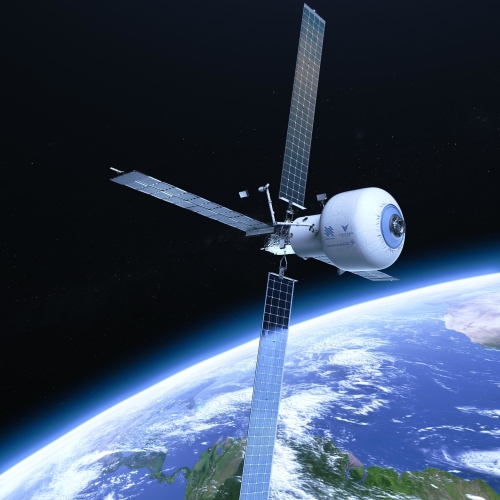
Starlab design in 2025
The Starlab design in 2025. Click
for original image.

The space station startup Voyager Technologies has now raised $383 million during its first public stock offering this week, with the possibility of more investment capital to come.

The six-year-old provider of mission-critical space and defense technology solutions sold 12.35 million shares at $31 each, pricing above the $26–$29 range it marketed last week. The Denver-based company had initially planned to offer 11 million shares.

Underwriters also have a 30-day option to purchase up to 1.85 million additional shares of the company’s Class A common stock, up from 1.65 million, trading under the ticker symbol VOYG.

Of the four private commercial space stations under development, Voyager is the only one to have so far built nothing. Its station, dubbed Starlab, is conceived as a single large module launched on SpaceX’s Starship/Superheavy rocket. Though the company has obtained a $217.5 million development grant from NASA, and is partnering with Airbus, Northrop Grumman, and the European Space Agency, it has focused so far all of its work on design.

We must assume the company intends to use this additional public capital to begin some construction. It likely needs to if it is to have any chance of winning NASA’s major contract for building the station itself, since all of its other competitors are doing so. My present rankings for these four projects:

  • Haven-1, being built by Vast, with no NASA funds. The company is moving fast, with Haven-1 to launch and be occupied in 2026 for an estimated 30 days total. It hopes this actual hardware and manned mission will put it in the lead to win NASA’s phase 2 contract, from which it will build its much larger mult-module Haven-2 station..
  • Axiom, being built by Axiom, has launched three tourist flights to ISS, with a fourth to launch momentarily, carrying passengers from India, Hungary, and Poland. Though there have been rumors it has cash flow issues, development of its first module has been proceeding more or less as planned.
  • Orbital Reef, being built by a consortium led by Blue Origin and Sierra Space. Overall, Blue Origin has built almost nothing, while Sierra Space has successfully tested its inflatable modules, including a full scale version, and appears ready to start building its module for launch.
  • Starlab, being built by a consortium led by Voyager Space, Airbus, and Northrop Grumman, with an extensive partnership agreement with the European Space Agency. It recently had its station design approved by NASA, but it has built nothing. The company however has now raised $383 million in a public stock offering, which in addition to the $217.5 million provided by NASA gives it the capital to begin some construction.
5 comments

Two spaceports in Alaska sign partnership agreement

Alaska spaceports

The Alaska Aerospace Corporation, which runs the Kodiak spaceport in Alaska, has now signed a five year partnership agreement with University of Alaska’s Geophysical Institute in Fairbanks, which runs the Poker Flat suborbital spaceport, to upgrade the latter for commercial orbital launches.

Though the terms of that agreement are highly technical, Gov. Mike Dunleavy’s draft budget for the corporation indicates that the university plans to seek a FAA spaceport license for the university’s Poker Flat Research Range, which has been flying sounding rockets — smaller rockets used for research — into the upper atmosphere since March 1969, including some earlier this spring.

An FAA license could allow Poker Flat to launch larger rockets, and for commercial purposes, not just scientific ones. Making Poker Flat a “licensed vertical orbital spaceport” could take up to two years, the budget documents state.

The map to the right shows the location of each spaceport. You can read the text of the agreement here [pdf].

Kodiak has been used recently by several orbital rocket startups, most often by Astra. Poker Flat in turn has only done suborbital launches (mostly for universities), and its interior location suggests it would have a very limited capability to do orbital launches. The lower stages of any orbital rocket would crash either in Alaska or Canada, something that neither the U.S. or Canada has previously allowed.

The deal however allows both spaceports to coordinate their effort, which might bring more business to both, for different purposes.

3 comments

Europe approves SES purchase of Intelsat

The European Commission has now approved the purchase of the long established satellite communications company Intelsat by the long established Luxembourg satellite communications company SES for about $4 billion.

This decision follows an approval by the government of the United Kingdom. It now appears the only remaining regulatory hurdle is approvals by the FCC and the Department of Justice in the U.S.

This buy-out follows similar mergers by other old established satellite companies, such as the merger of Viasat with Imarsat and OneWeb with Eutelsat. All are occurring because these older companies, which mostly launched large geosynchronous satellites, have been under heavy competitive pressure from the low orbit constellations like Starlink and OneWeb.

Whether these older companies can compete following these mergers however remains uncertain. To succeed they need to have a product customers want, and at the moment it isn’t clear they have one.

0 comments

Axiom’s fourth commercial manned mission scrubbed due to leak

Axiom and SpaceX have scrubbed the launch tomorrow of Axiom’s fourth commercial manned mission to ISS due to an oxygen leak detected during the standard prelaunch static fire test.

NASA, Axiom Space, and SpaceX are standing down from the launch opportunity on Wednesday, June 11, of Axiom Mission 4 to the International Space Station to allow additional time for SpaceX teams to repair a liquid oxygen leak identified during post-static fire Falcon 9 rocket inspections. A new launch date for the fourth private astronaut mission will be provided once repair work is complete, pending range availability.

There a number of launches already scheduled for Florida in the next few days, so it could be that the launch of Ax-4 could be delayed by more than a few days.

3 comments

Mexican officials demand investigation into Starship/Superheavy debris on its beaches

Mexican officials of the border state adjacent to Texas are now demanding an investigation into Starship/Superheavy debris that has been found recent on its coast, claiming SpaceX is “polluting Mexican beaches.”

Karina Lizeth Saldivar, the head of the Tamaulipas Secretariat for Urban Development and Environment, recently announced that they would be requesting that federal authorities in Mexico investigate the damages and potential damages that rocket fragments could cause.

According to Saldivar, the rocket pieces could pose a potential danger to locals and claimed that her agency would request a formal investigation by Mexican federal environmental agencies. It remains unclear if Mexico’s government could do anything about the issue.

Saldivar is a typical government apparachik. Rather than try to develop the beach area in Mexico that is close to Boca Chica and thus provides a great tourist spot for viewing launches, she instead can only whine and demand the government shut things down.

Meanwhile, the article notes that ordinary Mexicans aren’t complaining. Instead, they have been collecting the rocket pieces enthusiastically, with some making money by selling them as collector’s iten on social media.

4 comments
1 62 63 64 65 66 677