How to Watch NASA’s Comet Tempel 1 Flyby
How to watch Stardust’s Comet Tempel 1 flyby tonight.
While politicians argue budgets here on Earth, the NASA probe Stardust is zooming in on its flyby of Comet Tempel 1 tonight.
On Monday Stardust did a final mid-course correction in anticipation of its February 14 fly-by of of Comet Tempel 1.
The SOHO spacecraft, in space monitoring the Sun since 1995, has discovered its 2000th comet!
An asteroid discovered more than 100 years ago is actually an extinct comet. And it is coming back to life!
A dark Jupiter may haunt the edge of the solar system.
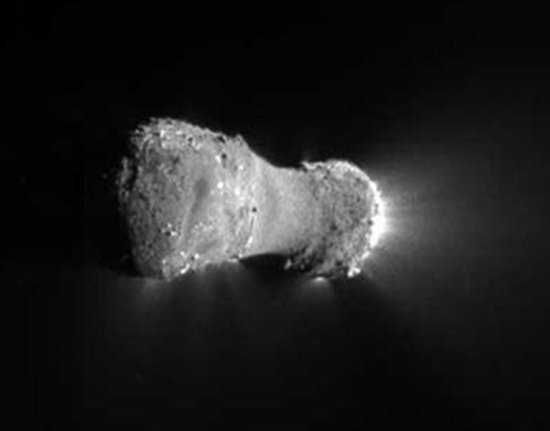
Almost literally, the probe Deep Impact flew through a snowstorm when it flew past Comet Hartley 2 on November 4. Below is one of the best pictures from the moment. More images can be found here. Key quote:
[The images] revealed a cometary snow storm created by carbon dioxide jets spewing out tons of golf-ball to basketball-sized fluffy ice particles from the peanut-shaped comet’s rocky ends. At the same time, a different process was causing water vapor to escape from the comet’s smooth mid-section. This information sheds new light on the nature of comets and even planets.
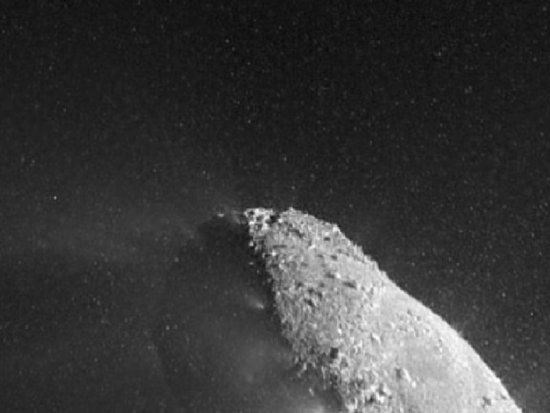
Note that all the close-up images taken by Deep Impact are going to be slightly out of focus, as the camera was launched with a defect.

The comet is carbonated!
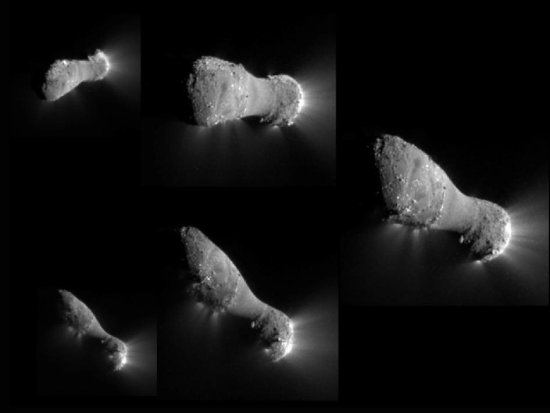
Here are the first images of Deep Impact’s flyby of Comet Hartley 2. The first is a montage, the sequence in time going clockwise. The second is a close-up of the second image.


The feature that I find most intriguing is the narrow smooth waist of the comet’s dogbone shape. The whole thing looks almost like a piece of taffy that’s being pulled apart.
First close-up photos of Comet Hartley 2 reveal a space peanut.
Deep Impact gets its first look at its next target, Comet Hartley 2. The closest approach is set for November 4.
For the third time in the last year, Jupiter has been hit by a large previously unknown object.
Astronomers have concluded that the high levels of carbon monoxide that they have detected in the upper layers of Neptune’s atmosphere are the leftover fingerprint of a cometary impact some 200 years ago.