
Tommy Emmanuel – My Life As A One-Man Band
An evening pause: A nice way to start the weekend. As Emmanuel says, “Life is not a rehearsal, so you better get on with it.”
Hat tip Mike Nelson.
An evening pause: A nice way to start the weekend. As Emmanuel says, “Life is not a rehearsal, so you better get on with it.”
Hat tip Mike Nelson.
Your privacy belongs to us! Facebook and Ray-Ban have teamed up to create sunglasses that the wearer can use to discreetly to take pictures of their surroundings.
The Ray-Ban Stories eyewear features two 5-MP front-facing cameras for 2,592 x 1,944-pixel photos or 1,184 x 1,184-pixel videos at 30 frames per second.
A capture button is pushed to snap photo memories of what you see on your stroll through the city on a hot and sunny day, or record 30-second video clips to post online to such platforms as Facebook, Instagram, Twitter and TikTok via a new Facebook View app for iOS and Android. The app also allows content to be edited or enhanced before upload, and saved to the phone’s memory, though the smart glasses do have enough built-in storage for more than 500 photos or 30 video clips. Or users can opt to for hands-free operation via Facebook Assistant voice commands.
The article describes several features that supposedly address the questions of privacy, such as led lights that glow when a picture is taken, but in the end these glasses are essentially a voyeur’s dream.
Without question such products have their legitimate uses, such as by undercover journalists or criminal investigators. To market them to the general public however means that both Facebook and Ray-Ban are willing to ignore concerns of right and wrong and the likelihood that their product will be badly misused for entire immoral reasons. All they care about is profit.
Or maybe the two companies are really developing this product to sell a more secretive version to their allies in the government. One does wonder.
It appears that both Virgin Galactic and Richard Branson might have violated SEC regulations when they sold more than $800 million in stock this summer without notifying buyers of the FAA investigation into the anomaly on Branson’s July 11th suborbital flight that has now grounded all SpaceShipTwo flights.
On July 12, Virgin Galactic announced in a Securities and Exchange Commission filing that it was selling $500 million worth of common stock. The filing did not mention that during its edge-of-space flight the day before, its aircraft deviated from its air-traffic-control clearance, a mishap that would ultimately trigger a Federal Aviation Administration investigation and lead to the indefinite grounding of its space-tourism operation.
The FAA began investigating on July 23, a spokesperson told Insider. On August 11, the agency grounded Virgin Galactic’s rocket plane.
In an August 13 SEC filing, Richard Branson, the English billionaire who founded Virgin Galactic in 2004, said that in the previous three days, he had sold roughly 10.5 million personal shares, a stake worth about $300 million.
Let’s review the timeline.
July 11: The flight occurs, with high winds forcing it outside its planned flight path.
July 12: Virgin Galactic sells $500 million in stock, without mentioning the anomaly.
July 16: By this date the company was required to inform the FAA of any anomalies during the flight.
July 23: The FAA initiates its investigation..
August 11: The FAA grounds Virgin Galactic.
August 13: SEC filing reveals Branson had sold $300 million in stock without mentioning the anomaly.
September 1: New Yorker article reveals investigation of anomaly.
Though no investigation had been started, Virgin Galactic must have known about the flight anomaly when it sold its $500 million in shares on July 12, right after the flight.. By August, when Branson sold his $300 million in shares, that investigation was on-going. Yet he also failed to mention the anomaly.
As I have said before, Branson has all the markings of a conman. He has very carefully been selling stock, reducing his share in the company in the past two years from 51% to 18%, with each stock sale carefully timed to take advantage of some event that pumped up the stock’s price.
All in all, the pattern by Branson suggests he really does not have much faith in Virgin Galactic’s future.
Capitalism in space? Rocket Lab reported this week that not only has its income been slashed because of New Zealand’s draconian lockdowns in fear of COVID-19, the company has had to cut its planned launches for the fourth quarter of 2021 by more than half.
“Operations have experienced disruptions due to some of the most restrictive COVID-19 measures globally, including current stay-at-home orders which prevent launch operations from taking place,” said Peter Beck, chief executive of Rocket Lab, of New Zealand’s current restrictions. “Indications are that the current lockdown restrictions may ease by the end of September with the delta cases dropping in New Zealand, but this, of course, is subject to change.”
Those restrictions have delayed plans by Rocket Lab to perform three dedicated Electron launches of BlackSky satellites that had been scheduled to begin in late August. It could also affect the launch of NASA’s CAPSTONE lunar cubesat, which had been scheduled for no earlier than late October on another Electron from Launch Complex 1 in New Zealand.
Adam Spice, chief financial officer, said that the company has five Electron launches manifested for the fourth quarter of the year, but is assuming only two launches in its financial projections. While those five launches would produce more than $40 million in revenue, the company is forecasting only $17-20 million in revenue for the fourth quarter.
Meanwhile, the company has not been able to launch from its new launchpad at Wallops Island in Virginia because NASA — after almost two years! — has apparently still not approved the company’s flight termination system, used to destroy a rocket that has gone out of control. NASA’s refusal to approve this system is very puzzling and very suspicious, especially because Rocket Lab has launched 21 times with it from New Zealand, and even used it several times to successfully destroy failing rockets.
An evening pause: In Russian, written by Vladimir Martynov. The English words can be found here.
Hat tip Daniel Morris.
Capitalism in space: Roscosmos last week announced that the actress and director who plan to fly to ISS in October to film scenes for a science fiction movie are fit to fly.
Director Klim Shipenko and actor Yulia Peresild got the thumbs-up after a meeting of the Chief Medical Commission at the Yuri Gagarin Cosmonaut Training Center near Moscow, Russia’s federal space agency Roscosmos announced last week.
Cosmonaut Anton Shkaplerov, who is scheduled to launch toward the orbiting lab with Shipenko and Peresild aboard a Russian Soyuz spacecraft on Oct. 5, also got final medical clearance. So did the backups for the mission: cosmonaut Oleg Artemyev, director Alexey Dudin and actor Alena Mordovina.
The movie script itself, about an astronaut who gets a heart attack while on a spacewalk and then has to have surgery in space before returning to Earth, actually sounds quite good and — most refreshing — well grounded in reality. American space films tend to go in absurd directions, often because the filmmakers are ignorant and have no interest in learning anything about the subject they are writing about.
So far, the schedule of upcoming space tourist flights appears on track to happen, as announced:
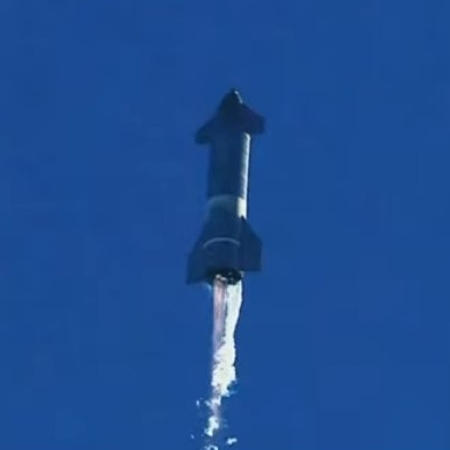
Modern rocketry soaring under freedom
Capitalism in space: In the last two days there have been so many stories about different space companies winning new contracts I think it is important to illustrate this in one essay, rather than in multiple posts. Below is the list:
Just another contract that illustrates SpaceX’s growing market dominance in the larger satellite and payload business. The company already gets about 90% of the launches for lunar probes. It now appears that for the big comercial satellites, SpaceX’s lower prices are allowing its market share to approach that same number.
This contract is for the launch of 25 satellites, and thus solidifies Rocket Lab’s market share as many other smallsat rocket companies arrive to compete with it.
This press release suggests that Kanematsu will be the another customer for the private space station that Sierra Space is planning to build and launch.
This deal illustrates the growing strength of the satellite industry that feeds the growing launch industry. The OneWeb/ATT partnership is aimed at making the OneWeb satellite constellation available to more customers more quickly.
This German startup has not yet launched anything, but it has raised a lot of capital as it develops its Spectrum rocket for a planned first launch in ’22. This contract is for “multiple launches.”
The last two stories are possibly the most significant, because both show that the shift in space from government-built to privately-built, as I advocated in my 2017 policy paper, Capitalism in Space, is spreading to other countries. » Read more
An evening pause: Performed by the Danish National Orchestra in 2017. It appears that in 2017 and in 2018 this orchestra did these movie-themed concerts a lot.
Hat tip Mike Nelson.
Capitalism in space: The first planned orbital Superheavy booster, prototype #4, has been moved back to the orbital launch site, this time with all of its 29 engines fully installed.
It appears SpaceX engineers are about to begin an extensive test campaign of this booster and its engines. They need to test the fueling of all 29 engines. They need to test fire the engines as a unit. And they need to do a full static fire of them all to see if they will work together as planned.
All these tests, which based on SpaceX’s past pace, will likely take about three to four weeks, which means that the orbital test flight cannot occurr before the end of September, as previously guessed. More likely they will not be ready to fly before the end of October, at the soonest.
That schedule is also impacted by the FAA’s bureaucracy, which still needs to approve the environmental assessment required before any Starship orbital flight. That approval process has been ongoing, but could still take several more months, especially if the effort by some fearful environmentalists to stop the flight gains political momentum.
Capitalism in space: Firefly this past weekend confirmed that its September 2nd launch failure was caused when one of the Alpha rocket’s first stage engines shut down almost immediately after liftoff.
On Sunday (Sept. 5), the company announced the proximate cause of the failure: One of Alpha’s four first-stage Reaver engines shut down unexpectedly about 15 seconds after liftoff. “The vehicle continued to climb and maintain control for a total of about 145 seconds, whereas nominal first-stage burn duration is about 165 seconds. However, due to missing the thrust of 1 of 4 engines, the climb rate was slow, and the vehicle was challenged to maintain control without the thrust vectoring of engine 2,” Alpha representatives wrote in a Twitter thread on Sunday.
“Alpha was able to compensate at subsonic speeds, but as it moved through transonic and into supersonic flight, where control is most challenging, the three-engine thrust vector control was insufficient and the vehicle tumbled out of control. The range terminated the flight using the explosive Flight Termination System (FTS). The rocket did not explode on its own,” they added.
The engine apparently did not fail or explode, it merely closed its main propellant valves so the engine was no longer being fed fuel. Though they obviously they need to find out why this happened, the nature of the failure is actually encouraging. It suggests a relatively easy fix (with a strong emphasis on the word “relatively”).
An evening pause: Hat tip Daniel Morris.
An evening pause: Performed by the Danish National Symphony Orchestra in 2018.
Hat tip Phill Oltmann.
An evening pause: Performed live on television, c1966. The sound on this video has been remastered using the studio recording, in a manner that really enhances the live performance in every way. (The original is available, but the sound was not great, and was partly drowned out by the audience.)
Hat tip Dan Steele.
Probably in response to the revelation of the flight issue, not an actual safety issue, the FAA has grounded Virgin Galactic from any further flights pending the resolution of the investigation of the July flight, which drifted out of its planned flight path due to high winds.
This will likely delay their planned next manned flight, which had been tentatively scheduled for September-October.
Posted on the way to Nevada.
An interesting essay published earlier this week in The Space Review raises the coming dilemma that both NASA and Congress will soon have to face once Starship is operational and launching large cargoes and crews to orbit, both near Earth and to the Moon.
That dilemma: What do about SLS and Lunar Gateway once it becomes ridiculously obvious that they are inferior vessels for future space travel?
I think this quote from the article more than any illustrates the reality that these government officials will soon have to deal with in some manner:
[When] the Lunar Starship ever docks with Gateway, the size comparison with Gateway will appear silly and beg the question as to whether Gateway is actually necessary. Does this even make sense? Couldn’t two Starships simply dock with each other and transfer propellant from one to another. Is there really a need for a middleman?
The author, Doug Plata, also notes other contrasts that will make SLS and Lunar Gateway look absurd, such as when two Starships begin transferring fuel in orbit or when a Starship launches 400 satellites in one go, or when a private Starship mission circles the Moon and returns to Earth for later reuse.
All of these scenarios are actually being planned, with the first something NASA itself is paying for, since the lunar landing Starship will dock with Lunar Gateway to pick up and drop off its passengers for the Moon.
The bottom line for Plata is that the federal government needs to stop wasting money on bad programs like SLS and Lunar Gateway and switch its focus to buying products from commercial sources like SpaceX. They will get far more bang for the buck, while actually getting something accomplished in space.
Though he uses different words, and has the advantage of recent events to reference, Plata is essentially repeating my recommendations from my 2017 policy paper, Capitalism in Space [free pdf]. Plata draws as his proof for his argument the recent developments with Starship. I drew as my proof a comparison between SLS and what private commercial space was doing for NASA, as starkly illustrated by this one table:
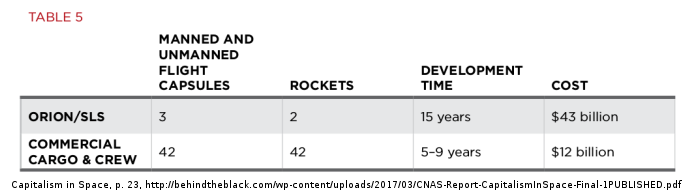
The government has got to stop trying to build things, as it does an abysmal job. It instead must buy what it needs from private commercial vendors who know how to do it and have proven they can do it well.
If the government does this, will not only save money, it will fuel an American renaissance in space. As we see already beginning to see happen now in rocketry and the unmanned lunar landing business.
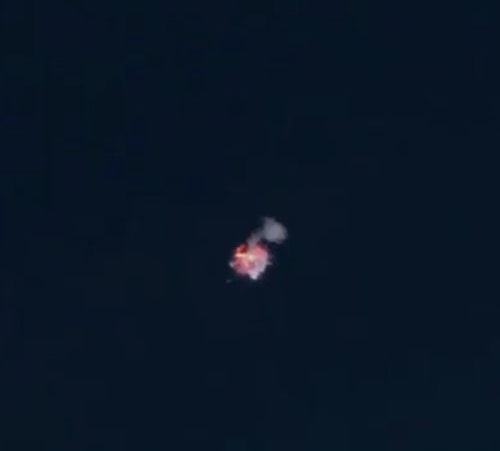
Screen capture from Everyday Astronaut live stream.
Capitalism in space: Firefly’s first attempt to launch its Alpha rocket to orbit failed at T+2:30 minutes, shortly after it went supersonic and just before first stage engine cut-off and stage separation.
The screen capture to the right shows that explosion.
Lift-off procedures went very well, though the rocket itself appeared to reach supersonic speeds later than their timeline predicted, suggesting it was underpowered.
In fact, the whole operation reminded me of SpaceX’s early attempts to launch its Falcon-1 rocket. Just as happened in one of those early SpaceX launches, there was a launch abort at liftoff, the launch team quickly figured out what happened, recycled the rocket, and successfully lifted off an hour later. Kudos to that team!
The failure is unfortunate, but to repeat the cliche, this is rocket science. They will try again.
An evening pause: Hat tip Phill Oltmann.
Capitalism in space: If all goes right, Firefly Aerospace will attempt its first orbital launch today from Vandenberg Space Force Base in California, using its Alpha rocket to place a test payload of science experiments in space.
The launch window is from 6 pm to 10 pm Pacific.
If you wish to watch, I have embedded the live stream below. That stream however have been very poor. The stream is working better here.
Note: They had a launch abort right at launch, and appear to be recycling to try again.
Capitalism in space: According to a New Yorker story today, the suborbital flight of Richard Branson in July experienced several flight anomalies that the article suggests should have caused it to end early before reaching space.
The rocket motor on Virgin Galactic’s ship is programmed to burn for a minute. On July 11th, it had a few more seconds to go when a red light also appeared on the console: an entry glide-cone warning. This was a big deal. I once sat in on a meeting, in 2015, during which the pilots on the July 11th mission—Dave Mackay, a former Virgin Atlantic pilot and veteran of the U.K.’s Royal Air Force, and Mike Masucci, a retired Air Force pilot—and others discussed procedures for responding to an entry glide-cone warning. C. J. Sturckow, a former marine and nasa astronaut, said that a yellow light should “scare the [“#$%#] out of you,” because “when it turns red it’s gonna be too late”; Masucci was less concerned about the yellow light but said, “Red should scare the crap out of you.” Based on pilot procedures, Mackay and Masucci had basically two options: implement immediate corrective action, or abort the rocket motor. According to multiple sources in the company, the safest way to respond to the warning would have been to abort. (A Virgin Galactic spokesperson disputed this contention.)
Aborting at that moment, however, would have dashed Branson’s hopes of beating his rival Bezos, whose flight was scheduled for later in the month, into space. Mackay and Masucci did not abort.
Virgin Galactic’s response, including the FAA’s statement, can be found here. The company noted that the flight deviation occurred because of unexpected high altitude winds. The FAA’s comment I think provides some reasonably perspective:
» Read more
An evening pause: Hat tip Diane Zimmerman.