
Ambosspolka
An evening pause: Hat tip Jim Malamace, who correctly notes that “The ‘electric cords’ on the hammers are hilarious and fitting because the hammer impacts actually caused sparks.”
An evening pause: Hat tip Jim Malamace, who correctly notes that “The ‘electric cords’ on the hammers are hilarious and fitting because the hammer impacts actually caused sparks.”
Capitalism in space: Engineers at Washington State University have developed a new design for a collapsible fuel bladder for spaceships using as its basis the Japanese art of origami.
Washington State University researchers have used the ancient Japanese art of paper folding to possibly solve a key challenge for outer space travel – how to store and move fuel to rocket engines. The researchers have developed an origami-inspired, folded plastic fuel bladder that doesn’t crack at super cold temperatures and could someday be used to store and pump fuel.
The advantages of a fuel tank that will shrink as it empties are numerous. It appears that nothing that has been tried so far has worked as well as this new design. If proven viable, it will change radically how interplanetary spaceships are designed. It will also make interplanetary missions more practical.
An evening pause: Fun bubblegum music from the 1960s.
Hat tip Roland.
Capitalism in space: SpinLaunch, the private launch startup that proposes to fling payloads into orbit rather than launch them in a rocket, has announced that it will be expanding its operations at Spaceport America in New Mexico.
The company already built a $7 million, 10,000-square-foot facility at the Spaceport after announcing plans last year to conduct all testing there on its new technology. Now, the company is doubling down, with plans to hire an additional 59 people and invest another $46 million over 10 years. The state Economic Development Department will support the expansion with $4 million in Local Economic Development Act funding, said EDD Secretary Alicia J. Keyes.
…Under its expansion, the company plans to actually build the centrifuge launch system at the spaceport, with test launches to start next year. “We expect by next summer to begin flight test operations at the spaceport, and we expect to continue to test new flight designs there for the foreseeable future,” Yaney told the Journal. “We see it as a permanent facility for us.”
The idea is fascinating, but I have some doubts. First, the accelerations will be so high that it might limit the company’s customer base, since many satellites will likely not be able to withstand those forces.
If it works, however, the company will have found a truly clever way to eliminate entirely the need for a first stage, and maybe even the second stage.
The European Space Agency (ESA) has now committed 33 million euros for ArianeGroup to develop a prototype vertical landing hopper dubbed Themis that would begin testing first stage landings by ’23.
ArianeGroup and its collaborators in Belgium, Switzerland, France and Sweden offer critical technical knowhow gained through the development of Europe’s next-generation engine – Prometheus – which will power Themis.
ESA’s Prometheus is a highly versatile engine capable of providing 1000 kN of variable thrust and is reignitable which makes it suitable for core, booster and upper stage application. An onboard computer handles engine management and monitoring in real time – a crucial feature for reusability.
ArianeGroup is the private consortium led by Airbus and Safran that is building Ariane 6. This deal suggests that ESA amd ArianeGroup has finally recognized that Ariane 6, built without reusability, is a lemon and is not attracting customers. This new contract starts the process of developing a reusable first stage.
They still might be too late. They will only begin testing the Themis prototype in ’23, with no clarity on when a full scale version will follow. Meanwhile, it is very likely that SpaceX’s fully reusable Starship/Super Heavy will be flying orbital missions by then, and likely charging far less than they presently do for their Falcon 9.
An evening pause: This week is Hannukkah. Three songs to celebrate the lit candle that did not burn out.
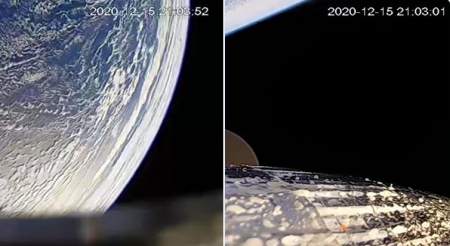
UPDATE: The rocket came up slightly short of orbit. From Eric Berger:
Rocket was 0.5 km/s short of orbit. With a better fuel mixture in the upper stage it would have orbited. Apogee of 390km. Rocket 3.3 will carry a payload, and there will be no hardware or software changes.
Original post:
——————————
Capitalism in space: According to the company’s Twitter feed, the second launch attempt today by Astra of its rocket appears to have reached orbit.
The images to the right were taken by their rocket, which is unimaginatively dubbed Rocket 3.2. I hope they now give this vehicle a more striking name.
If they have succeeded, they will have joined Rocket Lab as one of only two private commercial smallsat startups to launch a rocket to orbit. Two Chinese pseudo-private companies, Galactic Energy and ExSpace, have accomplished this, but I do not count them as real private companies. They might have worked independent of the government and raised investment capital, but nothing they do happens without close government supervision.
We will have to wait for full flight data from the company, but assuming they reached orbit that will be 40th American launch in 2020, the first time the U.S. has topped 40 launches in a single year since 1969, when the country achieved 46 successful orbital launches.
Capitalism in space: According to this report, SpaceX is now in preliminary negotiations with investors prior to beginning another big fundraising round, even though the company just raised $1.9 billion in private investment capital in August.
The talks are still in early phases, and exact pricing for the fundraising round has not yet been determined, one of the people said. Terms could still change, and it could take several weeks to decide and firm up allocations, the person added. SpaceX also may not be able to convince investors to give it the lofty valuation it desires. Allocations refer to which investors will be authorized to buy shares and how much they will pay for those shares.
“It’s a pretty big shock to me, honestly,” one of the people said. “What company jumps to double its valuation in six months? I don’t care at what scale you’re operating, it’s kind of crazy,” they added. “If you look at the series, every single valuation is a 10 to 20% bump.”
It appears that the company is trying to leverage its successes with Dragon, Starship, and Starlink to obtain more funding. The story also suggests that SpaceX now has a better sense of what it will cost to get Starship built, and thus is looking to obtain those funds now, when they are in a good position to get them.
Capitalism in space: Rocket Lab early today successfully launched an Japanese radar satellite using its Electron rocket.
This was the company’s sixth successful launch in 2020, matching the count it had predicted at the start of the year it would reach. And this despite one launch failure. The rocket also sported a new and larger faring, giving Rocket Lab the ability to launch larger payloards or more satellites with each launch.
The leaders in the 2020 launch race:
33 China
24 SpaceX
14 Russia
6 ULA
6 Rocket Lab
The U.S. now leads China 39 to 33 in the national rankings.
An evening pause: Hat tip Tom Biggar.
Capitalism in space: SpaceX today successfully launched a new commercial radio satellite for Siruis.
The first stage was making its seventh flight, the fifth in 2020. It successfully landed on the drone ship. The fairings were also both previously flown.
The leaders in the 2020 launch race:
33 China
24 SpaceX
13 Russia
6 ULA
5 Rocket Lab
5 Europe (Arianespace)
The U.S. now leads China 38 to 33 in the national rankings. The U.S. has also completed the most launches in a single year since 1968. Unlike 1968, all the launches this year were flown by private companies, either for commercial customers or for the government, with rockets owned by the companies. In 1968 almost all the launches were for the government, and the rockets were controlled by the government, even if built by private companies.
Note that this very successful year occurred during a year when many businesses were forced to shutdown due to the Wuhan panic. It appears many rocket companies decided this was not a reason to cease operations.
Capitalism in space: Virgin Galactic’s first attempt to launch its SpaceShipTwo Unity suborbital spacecraft from its New Mexico spaceport ended almost immediately after the ship was released from WhiteKnightTwo when its engines did not ignite.
All appeared normal during the flight’s early phases. VSS Unity was carried into the air by its twin-fuselage mothership, known as WhiteKnightTwo VMS Eve, and was released to fly free at an altitude of more than 40,000 feet.
A webcast provided via NASASpaceflight.com showed the flash of the plane’s hybrid rocket motor lighting up, but only for a second. After the flame-out, Test pilots Dave Mackay and C.J. Sturckow brought Unity back down to the spaceport for a gliding landing.
I wish Virgin Galactic well, but at this point consider the company a backwater in the drive to develop a commercial space tourism industry. It took them too long to get to this point. Even if they should start flying tourists next year, they will be competing with orbital tourist flights by SpaceX, and the contrast is stark. I simply no longer see a viable customer base for Virgin Galactic, unless they get a lot of government subsidies.
Capitalism in space: Indonesia has been in discussions with SpaceX and Elon Musk about establishing a SpaceX launch site in that country.
President Joko Widodo discussed the idea with SpaceX founder Elon Musk during a phone call on Friday, the Coordinating Ministry for Maritime and Investment Affairs said in the statement. Musk intends to send a team to Indonesia in January to study partnership opportunities, it said.
Makes sense for Musk to consider such a move, especially if the U.S. and Texas governments start to turn the screws on his Boca Chica launch site. Furthermore, it is his intention to eventually launch Starship/Super Heavy from a floating launch platform. Establishing arrangements with other foreign nations for putting it in their waters gives the company more flexibility.
People always migrate toward freedom. For two hundred and fifty years, that meant they moved to the United States. This now is changing, as the U.S. culture is signaling its increased hostility to this most important founding principle. Expect more stories like this in the coming decades.
It appears from the 24-hour live stream provided by LabPadre that the ninth Starship prototype tipped over inside the assembly building to rest against one wall. You can see it happen at about 8 seconds into the video below:
No word on whether anyone was hurt, nor any information about the cause. My guess is that it occurred during the operations to move this prototype to the launchpad.
UPDATE: It appears no one was hurt, but there is damage to the fins, which might also mean damage to the hull. This in turn might make it unsafe to fly this prototype, as the hull forms the walls of the methane/oxygen tanks.
The day has not been good for SpaceX. Earlier they had to scrub the launch of a commercial communications satellite at T-30 seconds for reasons that they did not provide. High altitude winds had delayed the launch an hour or so, but it appears this was not the reason. According to SpaceX’s website, “SpaceX is standing down from Friday’s launch attempt of the SXM-7 mission to perform additional ground system checkouts.” They are targeting Sunday for the next launch attempt.
Boeing and NASA yesterday announced that they now plan to fly the second unmanned demo flight of Starliner in late March, rather in January as last scheduled.
Though there have been hints for awhile that a launch close to the start of the new year was no longer likely, this announcement confirms those hints. This means that it will have taken Boeing more than a year to fix the software issues that forced the first demo mission to abort its docking with ISS and come back early.
Whether this will delay the manned mission, which they are still targeting for as early as the summer of ’21, remains unclear. I think it will all depend on how well that the demo mission goes.
Capitalism in space: After a several month delay, ULA’s Delta-4 Heavy tonight successfully launched a reconnaissance satellite for the National Reconnaissance Office.
The leaders in the 2020 launch race:
33 China
23 SpaceX
13 Russia
6 ULA
5 Rocket Lab
5 Europe (Arianespace)
The U.S. now leads China 37 to 33 in the national rankings. The U.S. launch total this year matches the number of launches achieved in 1969, and is the most launches by the U.S. in a single year since then.
An evening pause: This might my favorite version ever of this song.
Hat tip Jim Mallamace.
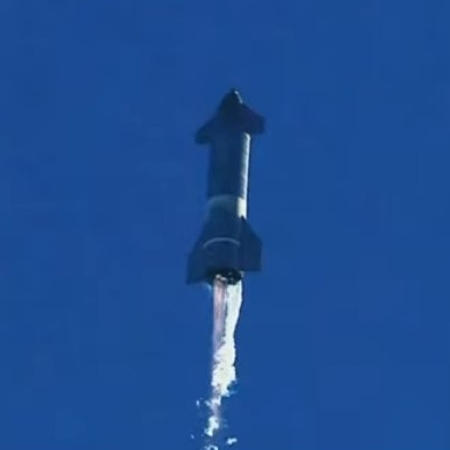
Yesterday’s truly epic first flight of SpaceX’s giant Starship rocket illustrated several truths that bear repeating, in clear and forceful language.
SpaceX succeeded because its company philosophy is open-minded, fearless, and thus free.
The open-mindedness culture comes from Elon Musk’s insistence that they never settle on any design if they can find a better way to do it. It is this approach that drives the company’s developmental process. The first Falcon 1 rocket made orbit, but despite that triumph Musk quickly abandoned it for the Falcon 9 when it was clear that it wasn’t powerful enough to garner enough satellite business.
The Falcon 9 that first launched in 2008 was a very different rocket from the Falcon 9 that launches today, as shown by the two pictures below. In the 2008 Falcon 9 the engines were configured differently and it had no legs. The modern Falcon 9 has landing legs, a different engine arrangement, and much of the innards have been redesigned to give the rocket more oomph.
» Read more
Capitalism in space: ULA will today try once again, after numerous scrubbed and aborted attempts in August and September, to launch its Delta-4 Heavy rocket carrying a National Reconnaissance Office spy satellite.
The mission is set to take off at 6:15 p.m. EST (2315 GMT) Thursday from pad 37B at the newly-renamed Cape Canaveral Space Force Station in Florida. Forecasters predict near-ideal weather with a 90% chance of favorable conditions during the launch window Thursday evening.
Many of the launch problems earlier this year were due to issues in the launch pad. The article at the link describes the major refurbishing that ULA has done since then to fix them.
I have embedded their live stream of the launch, below the fold. It is set to go live at 5:55 pm (Eastern).
Note also that the next few days will be very busy for the American rocket industry. Tomorrow (Friday) both SpaceX and Astra have launches scheduled, with the latter making its second attempt to complete its first orbital launch. Then Rocket Lab has another Electron launch from New Zealand scheduled for the next day (Saturday).
That’s four launches in three days. If just two succeed, it will raise the total U.S. launches in 2020 to 38, which would be the most American launches in a single year since 1969, the year the country put men on the Moon.
» Read more
Capitalism in space: The smallsat rocket startup Obex of the United Kingdom today announced that it has raised $24 million in private investment capital to support the development of its Prime rocket.
Conceived and developed as an environmentally sustainable launch system, the Orbex Prime rocket uniquely uses bio-propane, a renewable biofuel that cuts CO2 emissions by 90% compared to traditional kerosene-based rocket fuels. Designed to be recoverable and re-usable, Orbex Prime is intended to leave no debris in the ocean or in orbit around the Earth. The company is constructing the rocket vehicle at factories in Forres, near Inverness in Scotland, and Copenhagen in Denmark.
…Orbex has already confirmed six commercial satellite launch contracts, with the first launches expected in 2022. The company’s preferred launch site will be the Sutherland spaceport on the northernmost coast of Scotland, which was granted planning permission in mid-August 2020.
Whether the Sutherland spaceport happens however remains uncertain. Though it still appears to be moving forward, there is a lot of local opposition to it, some with clout. It appears however that Orbex is aware of this reality, and is developing Prime to allow it to launch from other sites.
That the company is trying to build this rocket as reusable right from the beginning is encouraging. It shows that the rocket industry is finally accepting the new paradigm established by SpaceX. For them to achieve this by ’22 however will be quite challenging.