
Mati Ventrillon – Making sweaters from the softest wool
An evening pause: She will soon be able to ship these sweaters into space, from Shetland’s own spaceport.
Hat tip Cotour.
An evening pause: She will soon be able to ship these sweaters into space, from Shetland’s own spaceport.
Hat tip Cotour.
The new colonial movement: South Korea’s new Nuri rocket, that country’s first homegrown rocket, failed during launch early today when the payload did not reach its proper orbit.
It appears that the third stage shut down prematurely.
They plan to try again in May ’22.
For a first launch attempt this was actually a large success. Getting the first and second stages to work properly is generally the hardest part of any rocket launch.
Capitalism in space: The Russian actress Yulia Peresild and her director Klim Shipenko — who spent twelve days on ISS filming scenes for a science fiction movie — gave a press conference yesterday, describing their experience and what they accomplished.
They shot more than 30 hours worth of footage which will later be edited down to about 30 minutes. “We’ve shot everything we planned,” Shipenko said from the Yuri Gagarin Cosmonaut Training Center outside Moscow.
The 38-year-old US-educated film director said cinema was ready to conquer space. “Cinema is looking for new forms. The cosmos is also ready to welcome various experimentalists,” said Shipenko.
He said his stint on the ISS was full of professional discoveries and added that he would never have been able to shoot on Earth what he had shot in space.
Both regretted that their work scheduled on ISS was so busy that they did not have enough time to look at the views out the station’s windows.
When this movie is finished I wonder if it will get a distribution deal in the west. I certainly would like to see it, and I am certain many other Americans will feel the same.
Capitalism in space: In its next launch in mid-November, Rocket Lab will attempt another recovery of the first stage of its Electron rocket.
Rocket Lab USA, Inc (“Rocket Lab” or the “Company”) (Nasdaq: RKLB) has today revealed it will attempt a controlled ocean splashdown and recovery of the first stage of an Electron rocket during the company’s next launch in November. The mission will be Rocket Lab’s third ocean recovery of an Electron stage; however, it will be the first time a helicopter will be stationed in the recovery zone around 200 nautical miles offshore to track and visually observe a descending stage in preparation for future aerial capture attempts. The helicopter will not attempt a mid-air capture for this mission but will test communications and tracking to refine the concept of operations (CONOPS) for future Electron aerial capture.
The eventual goal is for the helicopter to snatch the stage by its parachutes as it descends, and then bring it back to deposit it gently on land. This next launch will likely provide the company the data it needs to make that maneuver more safely and with a greater chance of success on a future launch.
The November splashdown recovery will follow two previous successful such recoveries. In addition, the company has also done a test whereby one helicopter dropped a dummy first stage, its parachutes opened, and a second helicopter successfully grabbed it. With the addition of the helicopter on this launch it will likely be poised to attempt a full recovery out of the air.
Boeing has decided to take apart the Starliner capsule intended for its second unmanned demo flight to ISS to do a close inspection of two of the troublesome valves that caused the launch in August to be scrubbed.
The current guess at what caused the valve issue involves moisture that accumulated near some of the valves’ Teflon seal. But without any clear culprit, the company now plans to ship two of the valves to a NASA center in Huntsville, Ala., for a forensic CT scan, using machines similar the ones used on humans to detect diseases.
This action now means that the next launch attempt will likely be delayed until the middle of ’22.
The delay is costing Boeing money, not NASA, as the contract is fixed price and Boeing will not get paid additional money until it meets its next milestone, which is a successful demo flight to ISS.
Capitalism in space: The FAA yesterday conducted its first of two virtual public hearings to allow public comment on its proposed environmental assessment that would allow SpaceX to launch orbital Starship missions from Boca Chica, Texas>
According to the story at the link, the comments were dominated by supporters, interspersed with the typical small number of anti-development environmental activists.
Over the course of more than three hours on Monday, members of the public who had registered in advance were given three minutes each to deliver their oral public comments on Starship and the draft. Most were in favor of SpaceX, though many positive comments appeared to originate from outside of Texas. A smaller number of people also voiced concerns about impacts on local ecosystems and species near Boca Chica.
The second hearing is scheduled for tomorrow.
Capitalism in space: Rocket Lab has now announced that it has delayed its next two launches from mid-October to mid-November.
A two-week window is planned for the first launch — from Nov. 11 to Nov. 24 —when its Electron rocket will deploy two satellites into low-Earth orbit. The company aims to deploy two more satellites in the second launch for the mission after Nov. 27.
Both launches are scheduled to take place at the Rocket Lab Launch Complex 1 on New Zealand’s Māhia Peninsula.
The announcement does not provide an explanation for this delay. However, Rocket Lab had originally scheduled these launches for August/September, but lockdown restrictions in New Zealand due to its panic over COVID-19 had forced it to trim its launches there by half for the rest of the year. Rather than do five as planned, the company is only going to do two, and it appears those two are the launches now set for November.
Click for full image.
According to a NASA proposal to observe and measure the temperatures on Starship’s thermal protection during its return to Earth from orbit, that flight is now tentatively scheduled for March ’22.
The graphic to the right highlights the pertinent language in the poster presentation.
It must be noted that the poster might not be telling us when Starship will first launch, but when the designers of the camera system will be ready to film. The two are different. Still, the slowdown in flight testing at Boca Chica by SpaceX since July suggests there may be some truth to this date. That date also seems more reasonable now in connection with the FAA’s regulatory pace, which still needs to provide the final approval of SpaceX’s environmental reassessment of its Boca Chica launch site.
It also seems to me that the March ’22 date would be very convenient for NASA, as it almost certainly guarantees that Starship will reach orbit after SLS, thus avoiding for the agency a very big public relations embarrassment. I would not be surprised at all if the Biden administration and NASA’s top administrators, led by Bill Nelson, are purposely pressuring the FAA to make sure that Starship orbital flight is delayed until after the first SLS test flight, now expected in the January/February time frame.
There is also the possibility that SpaceX’s targeted launch dates were unrealistically optimistic. The company had a lot of work it needed to do prior to launch on its orbital launch facility at Boca Chica, and that work could not go forward while test flights and static fire tests were taking place. Pausing those tests has allowed the launch facility work to move forward aggressively.
Capitalism in space: Monaco’s government announced this week that it has created a Bureau of Space Affairs, aimed at encouraging commercial space operations within the country.
By setting up a ‘one-stop-shop’ for aerospace-related matters, and reporting to the Digital Platforms and Resources Department (under the authority of the Minister of State), the Principality is taking its first steps towards supporting the growth and development of these companies by streamlining administrative procedures, and will also act as the welcome office for any prospective aerospace-related businesses looking to set up in Monaco.
At the international level, the Office of Space Affairs will represent the Princely Government in the relevant international organizations, in co-operation with the Department of External Relations and Cooperation. The Office of Space Affairs will interact with its counterparts in other countries for knowledge sharing, to foster economic cooperation, and to benefit Monegasque companies in aerospace and related fields.
Such government agencies are popping up in third world countries worldwide, with almost all having goals focused on helping and encouraging the booming private commercial marketplace and attracting it to their countries. This is great news.
That these countries are also competing worldwide for this business is also great news. It will discourage them from trying to take control, as government agencies are wont to do and as NASA did in the U.S. in the 1970s. Instead, the competition will force them all to keep their bureaucracies as streamlined as possible, so as to attract as many businesses as possible.
Capitalism in space: A Russian Soyuz capsule safely returned three Russian astronauts to Earth today, including the two filmmakers that spent the last twelve days filming scenes on ISS for a movie.
Russian actress Yulia Peresild and producer Klim Shipenko landed with cosmonaut Oleg Novitskiy of the Russian federal space corporation Roscosmos on Sunday (Oct. 17). The three descended aboard the Soyuz MS-18 spacecraft to a touchdown at 12:35 a.m. EDT (0435 GMT or 10:35 a.m. local time) on the steppe of Kazakhstan.
The landing concluded 191 days in space for Novitskiy, who wrapped up his stay on the station by playing a bit part in the movie Peresild and Shipenko were there to film. A joint production of Roscosmos, the Russian television station Channel One and the studio Yellow, Black and White, “Вызов” (“Challenge” in English) follows the story of a surgeon (Peresild) who is launched to the station to perform emergency surgery on a cosmonaut (Novitskiy).
ULA’a Atlas-5 rocket early this morning successfully launched the Lucy asteroid probe on a 12 year mission to study eight Trojan asteroids over a period from 2025 to 2031. One tidbit about the mission is especially creative:
Scientists named the Lucy mission after the fossilized remains of a human ancestor, called Lucy by the scientists who discovered her in Ethiopia in 1974.
The leaders in the 2021 launch race:
36 China
23 SpaceX
17 Russia
4 Northrop Grumman
4 ULA
The U.S. and China are once again tied in the national rankings, at 36 each.
The thrusters on the Soyuz capsule to be used to return the two filmmakers and one Russian astronaut back to Earth on October 17th would not stop firing when they were supposed to during routine testing in preparation for undocking.
From the NASA announcement, which by the way buried this event in the announcement’s eighth paragraph:
At 5:02 a.m. EDT today, Russian flight controllers conducted a scheduled thruster firing test on the Soyuz MS-18 spacecraft that is scheduled to return to Earth Saturday night with three crew members aboard. The thruster firing unexpectedly continued after the end of the test window, resulting in a loss of attitude control for the International Space Station at 5:13 a.m. Within 30 minutes, flight controllers regained attitude control of the space station, which is now in a stable configuration. The crew was awake at the time of the event and was not in any danger.
Flight controllers are continuing to evaluate data on the station’s brief attitude change due to the thruster firing. NASA and Roscosmos are collaborating to understand the root cause.
According to the first link, the thrusters tilted the entire station 57 degrees from its correct orientation.
Not only do they not know why the thrusters did not shut down when commanded, they do not know why they eventually stopped firing. They suspect it was because the thrusters ran out of fuel, but this is not yet confirmed.
The Russians still plan to use this Soyuz to return the film crew in two days. The story does not say whether these thrusters are needed in any way to deorbit the capsule.
That’s the second uncontrolled thruster firing from a Russian spacecraft docked to ISS in less than three months. Yet, no such thing had occurred for many decades prior to this. In fact, the last such events that I can remember occurred in the 1960s.
Why such events are suddenly occurring now with such frequency is very concerning, to put it mildly. It brings to my mind the drilled hole in an earlier Soyuz capsule, a hole that was clearly drilled in Russia when the capsule was on the ground and then covered up so it was not detected until the capsule was docked to ISS. The Russians investigated, said they solved the mystery, but have never told anyone what that solution was.
To paraphrase Shakespeare, something is very rotten in Roscosmos.
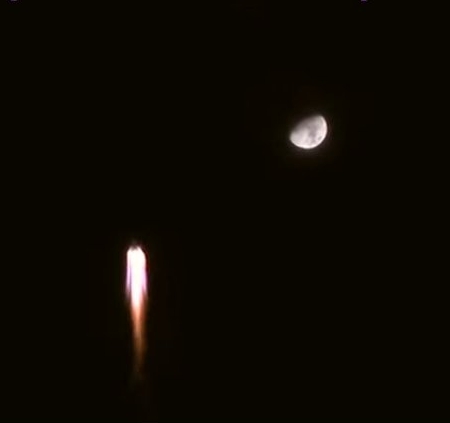
The new colonial movement: China today successfully used its Long March 2F rocket to place three astronauts into orbit to begin a six month mission to that country’s new space station.
The image to the right is a screen capture from the live stream, mere seconds after launch.
It appeared to me that the rocket’s first stage might have had grid fins to control its reentry, but I am not certain. Either way both it and the four strap-on boosters will crash in China.
The Shenzhou capsule will dock with the station in a few hours.
The leaders in the 2021 launch race:
36 China
23 SpaceX
17 Russia
4 Northrop Grumman
China has now moved ahead of the U.S. in the national rankings, 36 to 35.
Capitalism in space: The FAA today announced the details for attending its public hearings about the new environmental assessment it wishes to issue for SpaceX’s Starship/Superheavy operations in Boca Chica, Texas.
The hearings will be on Monday, October 18, 2021, 5:00 p.m. (Central Time) and Wednesday, October 20, 2021, 5:00 p.m. (Central Time). Both will be virtual. If you want to participate you need to register first and follow these instructions:
VIRTUAL PUBLIC HEARING REGISTRATION: Please register to attend a virtual public hearing and indicate if you would like to provide an oral comment:
http://spacexbocachicapublichearings.eventbrite.com/?s=144095269
VIRTUAL PUBLIC HEARING INSTRUCTIONS: Connect using the Zoom link below. https://us02web.zoom.us/j/88394232774 Password: FAA2021 Please only use the telephone number provided below if you are not going to connect using the Zoom Link. 1-833-548-0276 Meeting ID: 883 9423 2774 Meeting Password: 4300505
ONLINE MEETING TIPS: Prior to the meeting, please access the Zoom link above and download any needed software. This may take a few minutes, so it is best to download software in advance of the meeting. When logging-on to the meeting, please indicate your organization name in parentheses after your last name, if you represent one. If you registered to speak, this is how you will be identified during the meeting. Please also provide your email address. All lines will be muted during the meeting. To hear audio when connecting through the Zoom link, please make sure the volume on your computer speakers is on and that you do not have any programs with audio features (e.g., Skype, Spotify, YouTube) open that may interfere with the online meeting audio.
Capitalism in space: The Florida-based high altitude tourist balloon company, Space Perspective, has successfully secured $40 million in investment capital funding, which the company says will be sufficient for them to begin flights by 2024.
Unlike other space-tourism companies, Space Perspective isn’t relying on rockets to send passengers to space. Instead, it will use a balloon to carry its roomy pressurized “Spaceship Neptune” capsule up to 100,000 feet before gently coming back down to Earth and splashing down in the Gulf of Mexico.
Each trip is expected to last about six hours with about two hours at the 100,000-foot mark.
They say their ticket price will be $125,000, which is far less than the suborbital space missions of Blue Origin or Virgin Galactic, but significantly more than the $50,000 that the other U.S. high altitude balloon company, Arizona-based Worldview, says it will charge for similar flights.
Nonetheless, the company’s CEO says they have already booked 25 flights.
I have embedded the live stream of today’s launch of three astronauts to China’s space station, presently being assembled in orbit. This crew’s mission is planned for six months. More details here. From China’s state-run press is this description of the planned tasks during the mission, including two or three spacewalks as well as the addition of two more large modules to the station.
Liftoff is set for 12:23:44 p.m. (Eastern).
Capitalism in space: Virgin Galactic announced today that it is delaying its next Unity suborbital manned flight until next year so that it can first complete a planned maintenance inspection and overhaul of both Unity and its carrier airplane WhiteKnightTwo.
The company said Oct. 14 that it decided to move directly intended a planned maintenance period after a recent lab test of materials used on the vehicles “flagged a possible reduction in the strength margins of certain materials used to modify specific joints” that “requires further physical inspection.”
…That decision means that the company will delay Unity 23, a mission for the Italian Air Force that had been scheduled for as soon as mid-October, until after the maintenance period is completed next year. That flight had been previously scheduled for late September or early October but postponed to look into a potential manufacturing defect with a component in a flight control actuation system.
The endless delays at Virgin Galactic, stretching out now for almost fifteen years, threaten this company’s competitive standing. With Blue Origin now apparently able to fly commercially and regularly, one wonders why anyone would risk flying on Unity. Of course, people will, once the ship is cleared for commercial flights, but right now the price will likely have to be less than what Blue Origin is charging to garner business.
China today launched eleven satellites using its Long March 2D rocket, with the primary payload a solar observation telescope, designed to observe the Sun in the hydrogen-alpha wavebands.
The hydrogen-alpha wavelength is deep red and is centered at 656.28 nanometers – for comparison, visible light runs from 400 to 700 nanometers. Observing the Sun at the hydrogen-alpha wavelength can reveal structures, evolution, and dynamic processes associated with solar flares and filaments. Hydrogen-alpha observations can also reveal solar wave phenomena, which are precursors to coronal mass ejections, and the dynamics of activity in the Sun’s lower atmosphere.
The rocket’s first stage was also equipped with grid fins similar to those used on SpaceX’s Falcon 9. Their goal at this time is simply to more precisely guide that expendable first stage back to its drop zone in the interior of China, thereby preventing it from crashing into habitable areas.
The leaders in the 2021 launch race:
35 China
23 SpaceX
17 Russia
4 Northrop Grumman
The U.S. and China are now tied at 35 successful launches in the national rankings. With three more launches expected in the next three days, one by China and two by the U.S., expect these numbers to rise quickly.
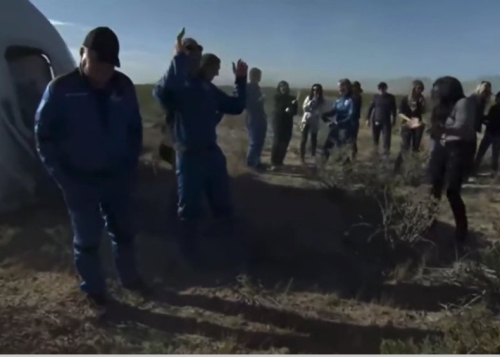
Shatner, on the left, turns away from Bezos and the spray of champagne.
Capitalism in space: The profound, emotional, and thoughtful reaction of William Shatner to his short suborbital flight yesterday on Blue Origin’s New Shepard space capsule contrasted starkly with the crass, rude, and shallow response of his co-passengers and Jeff Bezos.
You can watch Shatner’s comments right after landing at the video at the link. Watch how he tries to express his thoughts to Bezos immediately, and is almost ignored as Bezos and the others instead want to spritz champagne at each other. Shatner turns away, almost in disgust. The screen capture to the right shows him turning away, not because he doesn’t want to be hit by champagne but because he doesn’t want that shallowness to steal from him the emotions he now feels.
Eventually Bezos realizes Shatner is going to say his peace, and that he better pay attention. Shatner, almost in tears, struggles to note how shocked he was at the relative thinness of the atmosphere. To him, the rocket so quickly zipped out of a blue sky into blackness. As he said,
“This air, which is keeping us alive, is thinner than your skin. It’s a sliver. It’s immeasurably small when you think in terms of the universe.
…”What you have given me is the most profound experience I can imagine. I’m so filled with emotion about what just happened … it’s extraordinary. I hope I never recover, that I can maintain what I feel now. I don’t want to lose it. It’s so much larger than me and life.”
Shatner is an actor. For him, the emotion is the most important thing, as that is what he has specialized in expressing on screen to others for his entire life. At this moment, however, he was not expressing the emotions of a imaginary character he was creating on screen, but his own personal emotions. He managed to do it, in the best way possible. God speed William Shatner. We shall miss you when you are gone.
That Bezos was so unprepared for this moment from Shatner was very unfortunate. It made him look very shallow and foolish, which is a shame because, as Shatner so correctly noted, Bezos was the one who made that moment possible.
Shatner, at ninety years of age, is of a different more civilized generation that believed strongly in applying thought to one’s emotions, rather than letting those emotions rule. The contrast between him and all the younger people in this clip gives us a clear snapshot of an America now gone, replaced by the thoughtless emotional America of today.
A Russian Soyuz-2 rocket today successfully launched 36 more OneWeb satellites, raising the total of the satellite constellation in orbit to 358.
The launch was from Russia’s new spaceport Vostochny. As with all launches from Russia, the expendable first stage core and strap-ons landed inside Russia within designated drop zones. And as usual, no word from Russia on whether they landed on anyone’s head.
The leaders in the 2021 launch race:
34 China
23 SpaceX
17 Russia
4 Northrop Grumman
The U.S. still leads China in the national rankings, 35 to 34. With launches scheduled by both countries (two by the U.S. and one by China) over the next three days, these numbers will continue upward.