Astroscale’s ADRAS-J test spacecraft continues successfully maneuvers around abandoned rocket upper stage

abandoned upper stage, taken by ADRAS-J
Click for original image.

The Japaneses orbital tug startup Astroscale has revealed that its ADRAS-J test spacecraft has successfully completed more complicated autonomous proximity maneuvers around an abandoned H2A rocket upper stage that it rendezvoused with in March 2024.

Astroscale announced July 9 that its Active Debris Removal by Astroscale-Japan (ADRAS-J) spacecraft conducted a “fly around” maneuver, going part way around the H-2A upper stage it has been inspecting for the last few months. ADRAS-J used sensors to maintain a distance of just 50 meters from the stage.

However, about one third of the way through the maneuver, ADRAS-J encountered what the company called an “unexpected attitude anomaly” that triggered an automatic abort. The spacecraft moved away from the stage as designed to avoid any risk of a collision. “The abort maneuver implemented during the fly-around operation demonstrated that ADRAS-J can maintain safety even while performing close approach observations of non-cooperative objects,” the company said in a statement, adding that engineers had found the cause of the anomaly and were preparing for another close approach to the stage.

The picture to the right is of that upper stage, taken shortly after ADRAS-J arrived near the stage in the spring. According to the company, the stage is in remarkably good condition despite fifteen years in orbit, and also is flying in a very stable manner, tumbling almost not at all. This data suggests a mission to grab it and de-orbit it safely would be relatively easy.

0 comments

Webb: An exoplanet in the habitable zone with a possible nitrogen/CO2 atmosphere and water ocean

Using the Webb Space Telescope, astronomers have obtained new transiting spectroscopy of a “mini-Neptune-sized” exoplanet that circles in the habitable zone a red dwarf star about 48 light years away and have concluded that it appears to have a nitrogen/carbon dioxide atmosphere and even a water ocean.

While it is still only a tentative result, the presence of a nitrogen-rich atmosphere on LHS 1140 b would suggest the planet has retained a substantial atmosphere, creating conditions that might support liquid water. This discovery favors the water-world/snowball scenario as the most plausible.

Current models indicate that if LHS 1140 b has an Earth-like atmosphere, it would be a snowball planet with a vast “bull’s-eye” ocean measuring about 4,000 kilometers in diameter, equivalent to half the surface area of the Atlantic Ocean. The surface temperature at the centre of this alien ocean could even be a comfortable 20 degrees Celsius [68 degrees Fahrenheit]. [emphasis mine]

You can read the preprint of the paper here [pdf].

The highlighted phrase must be noted. These results contain a lot of uncertainties and assumptions. However, the data is tantalizing, to say the least, and justify more observations using Webb. The scientists argue in their paper that because there are only about eight transits of the exoplanet per year — requiring several years of observations to pin down this data more precisely — and because Webb has a limited life expectancy as an infrared observatory, this star should get observational priority.

2 comments

Europe at last launches Ariane-6

Ariane-6 seconds after liftoff

Arianespace, the commercial rocket arm of the European Space Agency (ESA) today successfully completed the first launch of its new Ariane-6 rocket, lifting off from French Guiana in South America carrying nine cubesats plus two re-entry test capsules.

As of posting, the nine cubesats have been deployed. Of the remaining payloads, one is a smallscale version of the return cargo capsule being built by the French company The Exploration Company. It will test the re-entry technology for that capsule.

UPDATE: There was an issue restarting the upper stage later in the flight that prevented the last payloads from being released. The bigwigs at the press conference at this link repeatedly insisted the flight was a complete success, but this failure of the upper stage is not a good thing, but hardly a disaster. It is similar to problems Firefly had on some of its early flights, which the company was able to overcome.

If all goes as planned, Arianespace and Arianegroup (the private company that builds and owns the rocket) hope to ramp up launches over the next three years, doing one more in 2024, six in 2025, eight in 2026, and ten in 2027. It says the rocket has contracts for thirty launches, eighteen of which are for launching Amazon’s Kuiper internet constellation.

I expect Ariane-6 to face heavy competitive pressure over that time period, not only from SpaceX but from the new European rocket startups that should begin launching at far less cost. The pressure should make the future of Ariane-6 somewhat dim, unless the European Union steps in and mandates its use by European satellite companies. If the latter happens, expect Europe’s entire space industry to suffer badly.

This was Europe’s first launch in 2024, so the leader board in the 2024 launch race has not changed:

71 SpaceX
30 China
8 Russia
8 Rocket Lab

American private enterprise still leads the world combined in successful launches, 83 to 46, while SpaceX by itself still leads the entire world, including other American companies, 71 to 58.

4 comments

A jumble of blocks in the middle of a Martian flood lava plain

A jumble of blocks on Mars
Click for original image.

Cool image time! The picture to the right, cropped, reduced, and sharpened to post here, was taken on March 18, 2024 by the high resolution camera on Mars Reconnaissance Orbiter (MRO).

This is one of what I like to call “What the heck?” images. The broken up blocks resemble ice floes on the edge of the Arctic ice cap that have broken off and have begun floating away.

The problem with this theory is many fold. First, this is on Mars and not on Earth. Second the “sea” these blocks are supposedly “floating” in is actual solid lava. There is no water or ice here, on the surface or even underground. This is in the dry tropics of Mars, where little or no near-surface ice has so far been detected.

The overview map below provides some context, and possibly an explanation.
» Read more

3 comments

Japan dithers about capitalism in space

Despite its government creating in November 2023 a new “Space Strategic Fund” worth more than $6 billion designed to encourage capitalism in space and handing it to Japan’s space agency JAXA to administer, JAXA officials continue to dither on how to use that money to encourage private enterprise in space.

Japan’s space agency is seeking industry proposals for technologies that could contribute to future commercial space stations as the government studies what role it would play in supporting efforts to replace the International Space Station.

…That work will inform plans by Japan on how it can participate in commercial space stations being developed by American companies in partnership with NASA. “We are discussing how we will join NASA’s Commercial LEO Destination program,” said [Yasuo Ishii, senior vice president of JAXA]. “Our responsibility is not clear yet, but, of course, commitment at the government level is essential to commercial operations.” [emphasis mine]

The highlighted phrases above reveal the underlying motives of JAXA, which is not to encourage private independent space companies and reduce its involvement. Just the opposite. And it appears Japan’s government is a partner in this. While Japan gave that money to its space agency, which seems to be searching for ways to hold onto its power, both Europe and India instead quickly took power and funding away from their government agencies (Arianespace and ISRO respectively) to encourage independent private space companies to flourish.

This dithering will only put Japan further behind these countries as well as China, a reality that has become increasingly embarassing for the island nation.

1 comment

Watch the first launch of Europe’s Ariane-6 rocket

Europe’s Ariane-6 rocket, first proposed in 2014 and about four years behind schedule, will finally make its first launch at 2 pm (Eastern) today.

I have embedded the live stream below.

The rocket was conceived by the European Space Agency (ESA) as an attempt to compete with SpaceX’s Falcon 9 rocket. It failed to do this from day one, since the rocket was from day one designed to be expendable. By the 2020s it became clear to European satellite companies and government agencies that its launch cost would be far higher that the Falcon 9, and these companies and agencies have therefore resisted signing launch contracts with ArianeGroup. In fact, if Amazon had not decided in ’22 to give the Ariane-6 a contract for 18 launches to put up its Kuiper satellites, the rocket would have almost no launches in its manifest.

This situation was made even more starkly evident at the end of June, when the European governent weather company Eumetsat cancelled its Ariane-6 contract and switched to the Falcon 9.

Though the unelected bureaucrats and apparatchiks in the European Union are trying to require the use of Ariane-6, ESA and Europe’s rocket future resides in the independent rocket startups (Rocket Factory Augsburg, Isar Aerospace, Hyimpulse, PLD). Because they are in competition with each other as well as SpaceX, and are not saddled with heavy government interference, they can focus on innovating to lower cost. Expect them to quickly begin launching in the next three years, with reusability soon to follow.

» Read more

1 comment

$243.6 million plea deal allows Boeing to avoid a criminal trial

The Justice Department and Boeing have made a plea deal so that the company can avoid a criminal trial for breaking its previous plea deal over 737-Max plane crashes that killed 346 people.

Under the agreement, Boeing will plead guilty to a criminal fraud charge stemming from the fatal crashes in Indonesia in October 2018 and in Ethiopia less than five months later that killed a combined 346 people.

Boeing must also pay the hefty fine [$243.6 million], invest at least $455 million in compliance and safety programs, and have an independent monitor oversee Boeing’s safety and quality procedures for three years

The company had made similar deal in 2021 with Justice when it became clear it had deceived FAA regulators about the software on new 737-Max planes that caused these crashes. This new deal is because the company apparently violated that 2021 deal, and allows it to avoid a criminal trial.

A judge still has to approve this new plea deal. Many families of the deceased oppose it, demanding instead that company managers be put on trial. Even if the judge accepts it, Boeing will still be liable for other more recent incidents.

All in all, Boeing comes off as a morally corrupt and incompetent company that was willing to cut corners, lie about it, thus allow more planes to crash because of its actions.

No wonder everyone wants to blame Boeing for every single incident that has recently occurred on various commercial jets, even though in many cases the blame resides more with the maintenance departments of the airlines that had purchased the planes. And no wonder no one believes the claim that the astronauts that flew up to ISS in June are not “stuck” there. They probably aren’t, but why believe anyone from such a compny.

10 comments

SpaceX launches Turkey’s first homebuilt geosynchronous communications satellite

SpaceX today successfully launched Turkey’s first homebuilt geosynchronous communications satellite, its Falcon 9 rocket lifting off from Cape Canaveral.

The first stage completed its fifteenth flight, landing on a drone ship in the Atlantic. The fairings on this flight completed their tenth and sixteenth time, respectively.

The leaders in the 2024 launch race:

71 SpaceX
30 China
8 Russia
8 Rocket Lab

American private enterprise now leads the world combined in successful launches, 83 to 45, while SpaceX by itself still leads the entire world, including other American companies, 71 to 57.

In just over half a year, SpaceX has now exceeded the annual record of 70 launches by the entire United States, set in 1966 and held until 2022.

3 comments

SpaceX releases new video of the fourth Starship/Superheavy test flight in June

SpaceX on July 4, 2024 released a new compliation video of the fourth Starship/Superheavy test flight in June, showing some footage not previously released.

I have embedded it below. As is the policy now of many rocket companies as well as many space agencies worldwide, SpaceX added a pounding music score to the event. While sometimes this is fun, I must admit that I am finding it increasingly annoying. This is not a movie, it is real life. If anything, I think the music robs this particular event some of its magnificence by trivializing it.

But then, what do I know?

At the end, SpaceX teased a launch tower capture of Superheavy on the next flight, but I still think this is not going to happen because of the delays it would cause getting FAA approval.

» Read more

10 comments

A drainage gully on Mars?

A drainage gully on Mars?
Click for original image.

Overview map

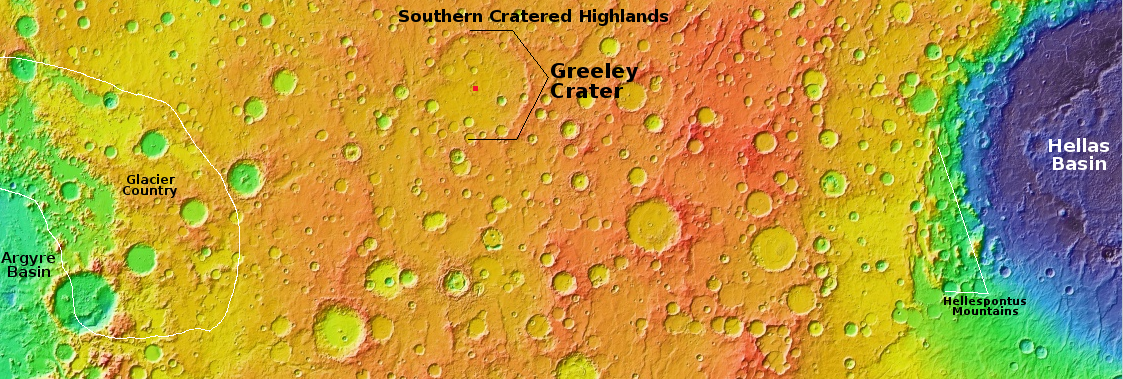
Cool image time! The picture above, cropped, reduced, and sharpened to post here, was taken on April 18, 2024 by the high resolution camera on Mars Reconnaissance Orbiter (MRO). It shows a gully that cuts down from the western rim of a 21-mile-wide unnamed crater in the southern cratered highlands of Mars.

The small rectangle on the overview map to the right marks the location, with the inset providing a close-up of this crater, with the white bar indicating the area covered by the photo above. The overall elevation loss from the rim on the left down to the crater floor on the right is about 3,800 feet.

The first high resolution picture of this gully was taken in 2016, with subsequent pictures taken in 2021 and 2022. In comparing the newest picture above with the 2016 photo I can detect no changes, but I am not looking a the highest resolution available. In addition, both of these pictures were taken during the Martian spring. The 2021 and 2022 pictures were taken during the Martian summer, and in both the north-facing wall where the gully is beginning to narrow seemed brighter.

It is likely the researchers are looking to see if any frost — either ice or dry ice — appeared during the winter and then sublimated away in the summer. Such a change could cause some of the erosion that produced this gully.

0 comments

European Parliament member demands cancellation of launch deal with SpaceX

Christophe Grudler, a member of the European Parliament (MEP) has written a letter to the government-run weather satellite company Eumetsat, demanding that it cancel its decision on June 26, 2024 to use a Falcon 9 rocket rather than the Ariane-6 on its next launch.

In a letter headlined “Request to reconsider launch decision in favour of European strategic interests”, Grudler disputes the decision of EUMETSAT, the intergovernmental European Organisation for the Exploitation of Meteorological Satellites, to choose America rather than Europe for launching its new satellite. He argues it goes against the principle of giving preference to Europe, something the organisation denies.

“I am writing to urgently request that you reconsider the recent decision to allocate the MTG-S1 satellite launch to a non-EU launch provider, and instead await the results of the inaugural launch of Ariane-6, which was your first choice for this satellite,” the Liberal member of Parliament wrote in a letter to the board.

…Grudler’s requests are threefold: “Cancel the last Council decision regarding a specific launcher solution, Await the inaugural launch of Ariane-6 before making any final decisions for MTG-S1; Reaffirm your dedication to European strategic autonomy by supporting European launch solutions”.

Eumetsat’s decision was clearly a financial one. SpaceX charges much less than Ariane-6, and its Falcon 9 rocket is proven and launching routinely. Ariane-6 won’t have its first launch until next week, on July 9th.

Grudler’s demands are purely political, but since the EU has generally been run top-down, letting politics and power determine its policy, he could force a cancellation of the contract. In the short term this will help ArianeGroup, a partnership of the aerospace companies Airbus and Safran that own Ariane-6, while hurting Europe’s weather satellite capabilities. In the long run it however might aid the growth of Europe’s new competing rocket startups, as it will provide them a guaranteed market. At the same time, having a guaranteed market by government fiat tends to limit competition and thus raise costs.

It appears that some politicians in Europe are still not sold on capitalism and freedom.

17 comments

Kazakhstan joins China’s lunar base project

Kazakhstan today became the twelth nation to join China’s International Lunar Research Station (ILRS) project, and the first besides Russia with a real viable space industry.

The agreement appears to also include language allowing both nations to use each other’s spaceports. Since Kazakhstan’s main area of participation in space is its Baikonur spaceport, built during the Soviet days and up to now used exclusively by the Russians, this agreement could be a big deal. As the article notes,

China is currently working to boost pad access for emerging commercial launch service providers. The Baikonur cosmodrome was set up by the Soviet Union in Kazakhstan. It is leased to Russia until 2050. The country also hosts the Sary Shagan Test Site. Kazakhstan shares a border with Xinjiang, in China’s west.

“Kazakhstan will need to diversify away from Russia if it wants to have a big future in space,” Bleddyn Bowen, an associate professor specializing in space policy and military uses of outer space at the University of Leicester, told SpaceNews.

This deal indicates once again the foolishness of Russia’s invasion of the Ukraine. It highlighted to all of its neighbors that they need to form alliances with others to strengthen their hand should Russia turn its aggressive eye in their direction. Kazakhstan has now done so, to Russia’s long term detriment.

China’s twelve partner nations are Azerbaijan, Belarus, Egypt, Kazakhstan, Nicaragua, Pakistan, Russia, Serbia, South Africa, Thailand, Turkey, and Venezuela. In addition, about eleven academic or governmental bureaucracies have signed on along with several other countries (Bahrain and Peru) who have not signed on but are involved in other ways.

8 comments
1 197 198 199 200 201 1,352