New analysis of Chandrayaan-1’s lunar orbital data might explain its detection of widespread surface hydrogen on the Moon

The Earth's magnetic field, shaped by the solar wind
The Earth’s magnetic field, shaped by the solar wind

One of the significant finds coming from India’s first lunar orbiter, Chandrayaan-1, was the detection of hydrogen in many places across the entire lunar surface, in places where it seemed impossible for hydrogen to be there, even if it was locked in a molecule like water.

Researchers in Hawaii now think they have found an explanation by linking that data to the Earth’s long magnetotail, formed by the solar wind pushing against the Earth’s magnetic field. The graphic to the right illustrates that process. The scientists focused on the kind of weathering processes that occurred both when the Moon was inside that tail, and when it was not.

Li and co-authors analyzed the remote sensing data that were collected by the Moon Mineralogy Mapper instrument onboard India’s Chandrayaan 1 mission between 2008 and 2009. Specifically, they assessed the changes in water formation as the Moon traversed through Earth’s magnetotail, which includes the plasma sheet.

“To my surprise, the remote sensing observations showed that the water formation in Earth’s magnetotail is almost identical to the time when the Moon was outside of the Earth’s magnetotail,” said Li. “This indicates that, in the magnetotail, there may be additional formation processes or new sources of water not directly associated with the implantation of solar wind protons. In particular, radiation by high energy electrons exhibits similar effects as the solar wind protons.”

In other words, the evidence suggests that the hydrogen signal seen by Chandrayaan-1 might have been a very temporary implacement of that hydrogen by the solar wind, which ceases during the Moon’s periodic passages through the magnetotail. The Moon’s harsh environment then causes that hydrogen to vanish, only to reappear when it is once again exposed to the solar wind.

None of this is confirmed, so some skepticism is required. If true, however, it would provide further evidence that the hydrogen signal seen at the lunar poles that scientists hope is evidence of ice in the permanently shadowed craters might be nothing of the sort, and we shall find little ice there.

7 comments

Russia launches 3 astronauts to ISS

Russia today used its Soyuz-2 rocket to launch three astronauts to ISS, one American and two Russians, lifting off from Baikonur in Kazakhstan.

At posting the Soyuz capsule had still not docked with ISS, but should do so shortly.

The leaders in the 2023 launch race:

64 SpaceX
42 China
13 Russia
7 Rocket Lab
7 India

American private enterprise still leads China in successful launches 75 to 42, and the entire world combined 75 to 68. SpaceX by itself still trails the rest of the world combined (excluding American companies) 64 to 68.

0 comments

Firefly completes second orbital launch

The launch startup Firefly tonight successfully completed its second orbital launch, and the first that reached its intended orbit, its Alpha rocket lifting off from Vandenberg Space Force Base in California and placing a Space Force payload on a mission to prove the satellite could be shipped to the launchpad, stacked on the rocket, and launched within sixty hours.

As this was Firefly’s first launch in 2023, the company does not enter the leader board for the 2023 launch race:

64 SpaceX
42 China
12 Russia
7 Rocket Lab
7 India

American private enterprise now leads China in successful launches 75 to 42, and the entire world combined 75 to 67. SpaceX by itself still trails the rest of the world combined (excluding American companies) 64 to 67.

0 comments

Polygons and scallops in the high mid-latitudes of the Martian lowland plains

Polygons and scallops in the high mid-latitudes of Mars
Click for original image.

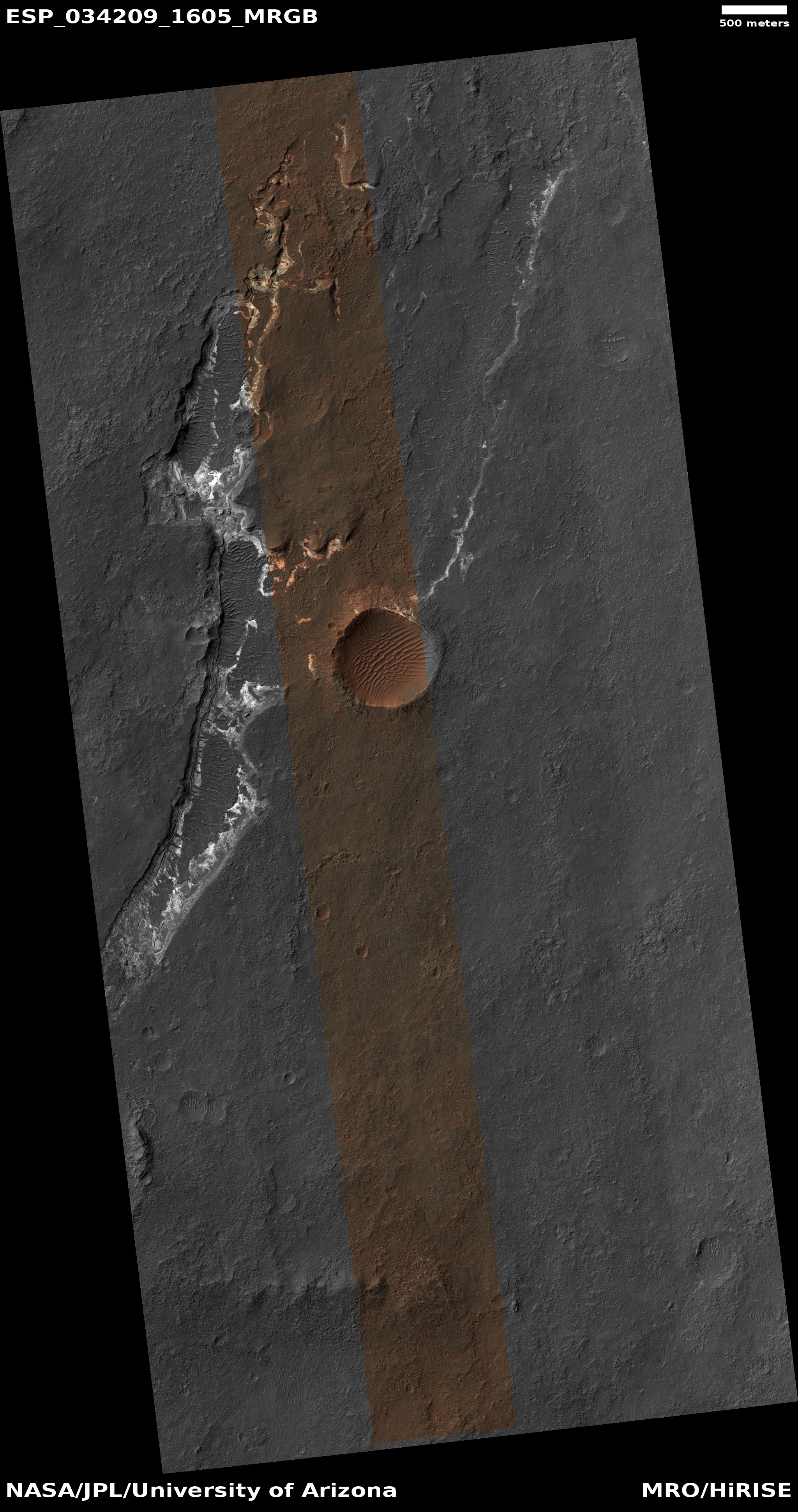
Cool image time! Only yesterday I posted an image of polygons in the dry equatorial regions of Mars, where little evidence of near-surface ice is found and are thought to be the remnants from a long-dried lakebed.

Today we take a look at some polygons in the mid-latitudes of the icy northern lowland plains, where near-surface ice appears ubiquitous and as it sublimates away with the changing seasons causes all kinds of strange formations, including polygons.

The picture to the right, cropped, reduced, and sharpened to post here, is a good example, centered on a 0.6-mile-wide bright crater that appears to be filled with glacial ice. The image was taken on June 22, 2023 by the high resolution camera on Mars Reconnaissance Orbiter (MRO), and is located at 44 degrees north latitude on the western edge of Utopia Basin. As noted by the MRO science team in 2006 for a different MRO picture with similar features:
» Read more

0 comments

Webb captures new infrared image of bi-polar jets shooting from baby star

HH 211 as seen by Webb
Click for original image.

Using the Webb Space Telescope, astronomers have taken a new infrared image of the baby star Herbig-Haro 211 (HH 211), known best for the bi-polar jets that shoot out in opposite directions at very great speeds.

That picture is to the right, reduced and sharpened to post here, and has about 5 to 10 times the resolution of previous infrared images.

The image showcases a series of bow shocks to the southeast (lower-left) and northwest (upper-right) as well as the narrow bipolar jet that powers them. …. The inner jet is seen to “wiggle” with mirror symmetry on either side of the central protostar. This is in agreement with observations on smaller scales and suggests that the protostar may in fact be an unresolved binary star.

Earlier observations of HH 211 with ground-based telescopes revealed giant bow shocks moving away from us (northwest) and moving towards us (southeast) and cavity-like structures in shocked hydrogen and carbon monoxide respectively, as well as a knotty and wiggling bipolar jet in silicon monoxide. Researchers have used Webb’s new observations to determine that the object’s outflow is relatively slow in comparison to more evolved protostars with similar types of outflows.

The team measured the velocities of the innermost outflow structures to be roughly 48-60 miles per second (80 to 100 kilometers per second). However, the difference in velocity between these sections of the outflow and the leading material they’re colliding with — the shock wave — is much smaller. The researchers concluded that outflows from the youngest stars, like that in the center of HH 211, are mostly made up of molecules, because the comparatively low shock wave velocities are not energetic enough to break the molecules apart into simpler atoms and ions.

The baby star at the center of these jets, about a 1,000 light years away, is estimated to be only a few ten thousand years old, and presently has a mass less than a tenth of the Sun. With time it will accrete more matter and become a full-sized star.

1 comment

German govenment blocks Chinese takeover of startup satellite company

The German govenment today blocked the completion of a stock deal that would have transferred almost complete ownership of the startup satellite company KLEO Connect to a Chinese firm.

The cabinet agreed a decision by the economy ministry not to let Shanghai Spacecom Satellite Technology, which already has 53% of the company, acquire the 45% minority stake of German company EightyLeo, according to the sources.

KLEO Connect wants to establish a network of more than 300 small, low earth orbit satellites to be fully operational by 2028 along with the ground infrastructure to provide global communications services – similar to SpaceX with its project Starlink. [emphasis mine]

It appears this decision might be a bit late, considering that this Chinese pseudo-company, undoubtably working under the supervision of the Chinese communists, already owns a majority stake. That lateness however appears to be part of the German government’s decision in the last year to toughen its stance on China.

0 comments

Starship/Superheavy 2nd test launch likely delayed until next year by federal bureaucracy and White House

Starship stacked on Superheavy, September 5, 2023
Starship stacked on Superheavy, September 5, 2023,
when Elon Musk said it was ready for launch

They’re coming for you next: While answering questions from reporters at a conference yesterday on when SpaceX might get its next Starship/Superheavy launch license, FAA acting chief Polly Trottenberg said she hoped that license will be awarded by October, but then slipped in one minor additional detail that had not previously mentioned or required:

SpaceX would still need a separate environmental approval from the U.S. Fish and Wildlife Service before a launch. Trottenberg did not say how long that might take.

Not surprisingly, the story from Reuters buries this detail, spinning the story to make it seem that the FAA is eager to help SpaceX launch. Similarly, this NasaSpaceFlight.com story (a space news outlet which has also tried to spin things to make the delays appear the fault of SpaceX) fails to even mention this detail.

SpaceX is now destacking Starship from Superheavy (live stream here).

I predicted in the spring that intransigence from the federal bureaucracy, controlled by the Biden administration, would likely delay this launch well past August, and likely into next year. I also said I would be thrilled if my cynical prediction turned out to be wrong.

Sadly, it looks like that prediction will be correct, and in fact might have actually been conservative. » Read more

24 comments

Moon’s south pole permanently shadowed regions are younger than expected

Map of Moon's south pole, with permanently shadowed regions indicated
Click for original image.

A new long range model of the Moon’s orbit and rotational tilt now suggests that the permanently shadowed regions (PSRs) in its south polar regions are much younger than previous predicted, which reduces the likely amount of ice that has been preserved there.

The map of the south pole region to the right, reduced, sharpened, and annotated to post here, shows the locations of those shadowed regions, with their predicted ages indicated by the colors (Gyr = billion years). Note that the Nova-C lander, planned for launch in mid-November, will land somewhat near some relatively young PSRs, as indicated by the red cross. From the press release:

“We calculated the lunar spin axis orientation and the extent of PSRs based on recent advances for the time evolution of the Earth-Moon distance,” he said. Early in its history, the Moon (which is 4.5 billion years old) was bombarded by comets and volcanism released water vapor from its interior, but continuously shadowed areas started to appear only 3.4 billion years ago. By that time these processes had started to die down, so most of the water that was delivered to the Moon or outgassed from its interior could not have been trapped in the polar regions. Any ice in the polar regions today must have a more recent origin.

“We have been able to quantify how young the lunar PSRs really are,” Schorghofer said. “The average age of PSRs is 1.8 billion years, at most. There are no ancient reservoirs of water ice on the Moon.”

Since other data suggests the presence of ice, it is possible that these reserves are regularly renewed by the arrival of impacts. It also suggests however that there might be less ice available than hoped. Above all, the red colored regions appear to be the most valuable real estate to explore first.

Note: The landing sites for both India’s Vikram lander and Russia’s Luna-25 lander were well beyond the map’s upper right edge, far outside the region where any permanently shadowed craters are located. The news outlets that talked about finding water or ice on either mission were simply illustrating their ignorance and sloppy reporting.

6 comments

The drying out of Mars’ tropics

The drying out of Mars
Click for original image.

Cool image time! The picture to the right, cropped, reduced, and sharpened to post here, was taken on June 26, 2023 by the high resolution camera on Mars Reconnaissance Orbiter (MRO). The science team calls the features surrounding these small 20 to 60 foot high hills “polygon features,” an apt description and a geological feature that is seen in many places on Mars.

When these features are found in the icy higher latitudes, it is believed they are formed in connection to the freeze-thaw cycle that causes cracks in the near surface ice. When found in the dry equatorial regions, where these polygons are located, they are usually thought to be ancient evidence of past standing water that left behind these cracks, much like the cracks seen in mud after the water has evaporated away on Earth.

The formation of these tiny hills is a bit more complex.
» Read more

0 comments

Chandra: New X-ray composite images of galaxies and supernovae remnants

Chandra image
Click for original image.

The science team for the Chandra X-Ray observatory today released five new composite images of two galaxies, two supernovae remnants, and the center of the Milky Way, combining data from multiple telescopes looking in radio, infrared, optical, and X-ray wavelengths.

The image to the right, reduced and sharpened to post here, is one of those pictures. From the press release:

As the galaxy moves through space at 1.5 million miles per hour, it leaves not one — but two — tails behind it. These tails trailing after ESO 137-001 are made of superheated gas that Chandra detects in X-rays (blue). ESO’s Very Large Telescope shows light from hydrogen atoms (red), which have been added to the image along with optical and infrared data from Hubble (orange and cyan).

The inset shows just the Hubble optical image, reduced by about 50%, to get a clearer sense of the galaxy itself. It appears to be a jelly-fish galaxy, flying through space at right angles to its plane and with tendrils of stars trailing off below.

The other four images are as interesting. The full set, including separate images in the individual wavelengths prior to combination, can be found here.

0 comments

Update on the status of Vulcan, Ariane-6, and New Glenn

Link here. This excellent article is focused on whether these three new rockets, none of which has yet completed its first test flight, will be able to meet their launch contract obligations with Amazon, which needs to launch at least 1,600 satellites of its Kuiper broadband constellation by July 2026 to meet its FCC license requirements. Those requirements also obligate Amazon to have the full constellation of about 3,200 satellites in orbit by July 2029.

The launch contracts to these three untried rockets was the largest such contract ever issued, involving 83 launches and billions of dollars.

To sum up where things stand in terms of the first test launch of each rocket:
» Read more

4 comments

New Shepard remains grounded, a year after launch failure

More than five months after completing its mishap investigation of the New Shepard launch failure one year ago, Blue Origin’s suborbital spacecraft remains grounded, with no clear indication when it will fly again.

In March, Blue Origin announced the results of its anomaly investigation: The nozzle on the first stage’s single BE-3PM engine suffered a “thermo-structural failure,” which caused a thrust misalignment and brought the mission to a premature end.

In its March 24 announcement, Blue Origin said that it had begun implementing some corrective actions, “including design changes to the combustion chamber and operating parameters, which have reduced engine nozzle bulk and hot-streak temperatures.” The company also stressed that it expected to return to flight “soon,” with a re-launch of those same 36 research payloads.

Almost six months later, that “soon” has translated into “someday.” It seems the slow pace of everything Blue Origin does has now taken over its one successful operational product. It has released no information about a new flight schedule, or even the present status of the spacecraft.

The result? Even though Blue Origin was flying commercial suborbital flights regularly about two years earlier that Virgin Galactic, the latter company has now completed more flights. This slow pace is not how a commercial company driven to earn profits and compete successfully operates. In the end it drives away customers, while ceding market share to competitors.

3 comments
1 286 287 288 289 290 1,352