A frozen underground ocean on Charon?

Data from New Horizons of the surface of Pluto’s moon Charon now suggests that the satellite once had an underground ocean that is now frozen.

Charonโ€™s outer layer is primarily water ice. When the moon was young this layer was warmed by the decay of radioactive elements, as well as Charonโ€™s own internal heat of formation. Scientists say Charon could have been warm enough to cause the water ice to melt deep down, creating a subsurface ocean. But as Charon cooled over time, this ocean would have frozen and expanded (as happens when water freezes), pushing the surface outward and producing the massive chasms we see today.

0 comments

Apollo 11 First Stage liftoff in Ultra Slow Motion

An evening pause: This footage was taken on July 16, 1969 at 500 frames per second, and shows only what happened at the base of the launch tower as the engines of the Saturn 5 rocket ignited and lifted the rocket into the air. Though the video is more than 8 minutes long, the actual events recorded lasted only about 30 seconds, beginning 5 seconds before T minus 0.

What struck me most as I watched this was the incredible amount of complex engineering that went into every single small detail of the rocket and the launch tower and launchpad. We tend to take for granted the difficulty of rocket engineering. This video will make you appreciate it again.

It is also mesmerizing. A lot happens in a very short period of time.

Hat tip Kyle Kooy.

1 comment

India okays its own LIGO detector

The Indian government today approved construction of LIGO-India, using some duplicate components already available from the American LIGO gravitational wave detector.

“We have built an exact copy of that instrument that can be used in the LIGO-India Observatory,” says David Shoemaker, leader of the Advanced LIGO Project and director of the MIT LIGO Lab, “ensuring that the new detector can both quickly come up to speed and match the U.S. detector performance.” LIGO will provide Indian researchers with the components and training to build and run the new Advanced LIGO detector, which will then be operated by the Indian team.

What this new instrument will accomplish is to give astronomers more information when a gravitational wave rolls past the Earth. By having detectors half a world apart, they will be able to better triangulate the direction the wave came from, which in turn will help astronomers eventually pinpoint its source event.

6 comments

Bureaucrats fight over the regulation of commercial space

Battle of bureaucrats: The FAA’s office that regulates commercial space (AST) and the National Transportation Safety Boad (NTSB) are fighting over the procedures AST should use to control and manage the work of private space companies.

The issues deal with how the FAA inspects the work of space companies, prompted by the NTSB’s investigation into the Virgin Galactic SpaceShipTwo crash in 2014. The kerfuffle also illustrates the absurdity of the regulatory responsibilities that Congress forced on AST when it amended the commercial space act in 2004. Somehow it is expected that bureaucrats in Washington will know better how to make sure a private company’s new space designs are safe than the very engineers who are building them. The disagreement here is merely about how the bureaucrats keep watch. The NTSB wants AST’s bureaucrats to hover over them like a worried mother. AST wants to hover from a little farther away, like a proud father.

In either case, the hovering will accomplish little to make the cutting edge engineering more safe except create fake jobs in the government for hovering bureaucrats, while squelching risky innovation since such risks go against the instincts of every bureaucrat.

Though Congress has recently revised the law to ease its regulations, they didn’t really do much to remove them. Expect these kerfuffles to get bigger in the coming years as the Washington bureaucracy moves to impose its will on this industry while simultaneously manipulating the press and Congress to create more useless jobs for themselves.

If they succeed, we should also expect them to succeed in making innovative commercial development in space become increasingly impossible.

12 comments

Ukraine’s aerospace industry in collapse

The Russian government’s takeover of its entire aerospace industry, plus its war in the Ukraine, has caused an 80% crash in Ukraine’s aerospace industry.

The two largest enterprises are the Yuzhnoye Design Bureau and the PA Yuzhmash manufacturing company, which work closely together on Ukrainian launch vehicles. Yuzhmash produces the first stages of the Zenit and Antares boosters and a fourth stage for Europeโ€™s Vega launch vehicle. The company is also involved in the conversion of retired ballistic missiles into Dnepr satellite launchers as part of a joint program with Russia.

However, Russia is phasing out use of the Zenit and Dnepr launchers. Russia is shifting over to using Angara and Soyuz-2.1v, newer rockets the nation produces domestically. Russia is also switching to domestic manufacturers for space components to reduce their dependence on foreign suppliers.

This destruction by Russia of its neighbor’s aerospace industry doesn’t necessarily bode well for Russia’s own aerospace industry. Consolidated as it is into one giant entity, with no competition, it is very likely it will not produce much that is very innovative or creative at a reasonable cost. Russia was better off with the competition.

0 comments

LISA Pathfinder’s cubes floating free

More gravitational wave news: LISA Pathfinder’s two gold-platinum 46mm cubes have been released and are now floating free inside their spacecraft.

After a week of further testing, they will stop controlling the cube’s positions with electrostatic force. They will then watch them very precisely with lasers to test whether the equipment is capable of detecting distance shifts small enough for a future version, made up of three such spacecraft, to detect gravitational waves. The idea is that, as a wave rolls by, the cubes will shift positions at slightly different times, just as different beach balls will do so on ocean waves.

0 comments

The first geology map of Pluto

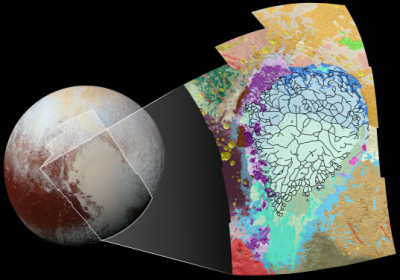
Geology map of Pluto

The New Horizons science team has now released the first geology map of a portion of Pluto, seen by the spacecraft during its fly-by last year.

It is definitely worth your while to take a look at the full image, along with the legend explaining the different surface features. Most of the geological terms are merely descriptive, but the careful breakdown still provides a much deeper understanding of what is there.

1 comment

A toy replicator for kids!

Mattel is bringing back an old toy, Thingmaker, but the new version will be a 3D printer for kids.

After wirelessly linking the 3D printer to a mobile device running the ThingMaker Design App for iOS or Android, users decide whether they want to create a toy figure or jewelry, with the option to print ready-designed toys, or mix and match from hundreds of parts which can be popped together after printing thanks to ball and socket joints. After designing their creation, users simply push a button to start printing.

Features of the ThingMaker 3D printer which make it more suitable for children than your typical 3D printer include it being simple to use, and having an auto-locking door. This will stay shut until your toy is at a safe temperature and the hot print head has retracted into a recess, so that it can’t burn eager little fingers.

Simplicity is applicable to adults as well. This gives us a hint where all 3D printing is heading.

And though the article describes as a negative the fact that it will routinely take 12 hours for each toy to print, I consider this irrelevant. I would have loved to have this thing as a kid, and would have gladly tried out a new design each day, just for fun. The toys themselves are what is irrelevant, not the creation process.

5 comments

The first music video in zero gravity

Update: The music video itself has been pulled from youtube for copyright reasons that I don’t quite understand. However, the making of video is still available, and that will give you a pretty good feel for some of the stuff in the original piece.

I was going to make this an evening pause, but then decided it shouldn’t wait. This music video, by OK-Go, is unique and somewhat historic, as it I think is the first to have been done in zero gravity, using an airplane to fly parabolic arcs. It demonstrates clearly the fantastic and as present almost unimaginable possibilities of dance in weightlessness, as it also might be the first time that professional dancers, the two women, are given a chance to do moves in microgravity.

Be sure to also watch the making of video below the fold. And go here for the story behind the video.


» Read more

4 comments

SpaceX loses a launch payload

In the heat of competition: Because of delays, a satellite company has shifted its launch vehicle from SpaceX’s Falcon Heavy to Arianespace’s Ariane 5

The company, ViaSat, still has a contract with SpaceX to use Falcon Heavy to launch later satellites, but they decided they could no longer wait and needed to get the satellite in orbit by 2017, something that SpaceX could no longer guarantee. They had to pay more to fly on Ariane 5, but it appears they were able to negotiate a price break with Arianespace to close the deal.

0 comments

The graffiti inside Apollo 11

An effort to create a 3D model of the inside of the Apollo 11 capsule on display at the National Air & Space Museum has revealed previously undocumented notes and scribbles that the astronauts put on the capsule’s walls.

Needell and his team also decided that they would provide access to the lower equipment bay, the area located below the astronauts’ seats, which housed the ship’s navigation sextant, telescope and computer. “No one from the Smithsonian, as far I knew โ€” not as long as I’ve been the curator for 20 years, has ever been below there to document the conditions or any of the aspects of the lower equipment bay,” said Needell. “We’ve been able to sort of see above the seats, but that’s about all.”

So, for the first time, the curators removed from the lower bay the large bag that held the Apollo 11 crew’s pressure garment assemblies โ€” in other words, their spacesuits โ€” as well as several helmet bags and a checklist pocket that command module pilot Michael Collins used while orbiting the moon alone.

And then they saw it, the literal writing on the wall.

They have located at least one post-landing image that shows some of the writing, which indicates that in 1969 no one considered this important enough to note. Then the capsule was put on display, and no one was allowed in it for decades.

0 comments

The final search for Philae

This review of the journey of Rosetta’s lander Philae, now dead on the surface of Comet 67P/C-G, includes information about the science’s team upcoming last effort to locate the lander.

The cometโ€™s level of activity is now decreasing, allowing Rosetta to safely and gradually reduce its distance to the comet again,โ€ says Sylvain Lodiot, ESAโ€™s Rosetta spacecraft operations manager. โ€œEventually we will be able to fly in โ€˜bound orbitsโ€™ again, approaching to within 10โ€“20 km โ€“ and even closer in the final stages of the mission โ€“ putting us in a position to fly above Abydos close enough to obtain dedicated high-resolution images to finally locate Philae and understand its attitude and orientation.โ€

โ€œDetermining Philaeโ€™s location would also allow us to better understand the context of the incredible in situ measurements already collected, enabling us to extract even more valuable science from the data,โ€ says Matt Taylor, ESAโ€™s Rosetta project scientist.

They intend to try to re-establish communications with the lander, but do not have much expectations that it is able to function.

0 comments
1 604 605 606 607 608 821