
Russian engineers develop an ATV capable of going anywhere
I want! For a mere $65K you can buy your own Sherp ATV, a Russian-built amphibious vehicle capable of going anywhere. And it can even swim! Video below the fold.
» Read more
I want! For a mere $65K you can buy your own Sherp ATV, a Russian-built amphibious vehicle capable of going anywhere. And it can even swim! Video below the fold.
» Read more
The science team from the Laser Interferometer Gravitational-wave Observatory (LIGO) announced today that on September 14, 2015 they made the first direct detection of a gravitational wave, produced by the merging of two distant black holes.
Based on the observed signals, LIGO scientists estimate that the black holes for this event were about 29 and 36 times the mass of the sun, and the event took place 1.3 billion years ago. About three times the mass of the sun was converted into gravitational waves in a fraction of a second — with a peak power output about 50 times that of the whole visible universe. By looking at the time of arrival of the signals — the detector in Livingston recorded the event 7 milliseconds before the detector in Hanford — scientists can say that the source was located in the Southern Hemisphere.
According to general relativity, a pair of black holes orbiting around each other lose energy through the emission of gravitational waves, causing them to gradually approach each other over billions of years, and then much more quickly in the final minutes. During the final fraction of a second, the two black holes collide at nearly half the speed of light and form a single more massive black hole, converting a portion of the combined black holes’ mass to energy, according to Einstein’s formula E=mc2. This energy is emitted as a final strong burst of gravitational waves. These are the gravitational waves that LIGO observed.
Because of the faintness of the wave signal, I suspect that the scientists involved have spent the last four months reviewing their data and the instrument very carefully, to make sure this was not a false detection. That they feel confident enough to make this announcement tells us that they think the detection was real.
Recently ESA launched Lisa Pathfinder, a prototype space-based gravitational wave detector designed to test the technology for building a larger in-space observatory that would be far more sensitive that LIGO. Funding for that larger detector has dried up, Today’s announcement will likely help re-energize that funding effort.
More information here.
The discovery of mold in two clothing bags being packed for a Cygnus freighter launch to ISS has caused NASA to delay the launch by at least two weeks.
The source of the mold, a common fungal growth in humid climates like Florida’s, is under investigation by NASA and Lockheed Martin, which prepares NASA cargo for launch aboard two commercial carriers, Orbital ATK and privately owned SpaceX. An Orbital Cygnus cargo ship was more than halfway packed for the launch, scheduled for March 10, when the mold was found during routine inspections and microbial sampling, NASA spokesman Daniel Huot said.
The mold did not present any serious health threat should it have arrived at ISS, but it is definitely preferred to not fly it there if possible.
The competition heats up: ULA successfully completed its second launch in five days with the Delta 4 launch of a military spy satellite today.
In the heat of competition: Because of SpaceX’s delays in launching the SES-9 communications satellite, the company has modified the launch profile of its Falcon 9 rocket, abandoning a land vertical landing and reducing the odds for a successful barge landing, in order to get the satellite to its proper orbit sooner.
SES will thus be able to generate income from the satellite at about the same time it would have had their launch not been delayed. SpaceX meanwhile will still try to recover the first stage, but will face much more difficult odds.
One industry official familiar with the SES-9 mission said Hawthorne, California-based SpaceX has not abandoned hope of recovering the first stage after a landing on an offshore platform positioned for the mission. But the chances of success are much less given the launch trajectory agreed to with SES to reduce the time to arrival at its operating position.
Third time the charm? Japan will launch on Friday a new X-ray telescope, the third time they have attempted to put this type of observatory into orbit.
Astro-H, which according to Japanese custom will be renamed upon successful launch, will collect the X-ray spectra for large deep space objects like galaxy clusters. An American scientist, Richard Kelley, has been trying to get this kind of instrument launched since 1984. First his instrument was dropped from Chandra because of cost. Then, two attempts to launch it by Japan failed, one when the rocket failed during launch and the second when the spacecraft itself failed soon after reaching orbit.
U.S. Defense officials stated today that the satellite that North Korea launched on Sunday is now tumbling in orbit and is useless.
Do not take comfort from this failure. North Korea has demonstrated that it can put payloads in orbit. From this achievement it is a very short leap to aiming those payloads to impact any continent on Earth. They might not be able to aim that impact very accurately, but if you want to ignite an atomic bomb somewhere, you don’t have to be very accurate.
In the heat of competition: SpaceX and SES have announced that they are aiming for a February 24 date for the launch of the SES-9 communications satellite.
This will be the second launch of the upgraded Falcon 9, delayed since December following that rocket’s first launch. That they have scheduled it means they have likely smoothed out the kinks detected on that first flight.
North Korea today launched a rocket that has apparently put an object into orbit.
An evening pause: Hat tip Danae.
The competition heats up: Even as SpaceX upgrades its Falcon 9 rocket as a result of tests of the returned first stage, the company said this week that it plans to increase its production and launch rate significantly in 2016.
“We’ve had the luxury in years past of having to build only a few rockets a year,” [Company official Gwynne Shotwell] said, “so we really weren’t in a production mode.” Last year would have been the first to require a high production rate of the rocket, she said, had it not been for the June launch failure that halted flights for nearly six months. “Now we’re in this factory transformation to go from building six or eight a year to about 18 cores a year. By the end of this year we should be at over 30 cores per year,” she said. “So you see the factory start to morph.”
Those changes, she said, include doubling the number of first stages that can be assembled at one time from three to six. The company is also working to accelerate production of the Merlin engines that power the Falcon 9 since, at the higher production rates planned for this year, the company will need to build hundreds of engines a year.
She also said that they hope to reach a cadence of a launch every two to three weeks.
We shall see. While I have confidence in SpaceX’s ultimate ability to achieve these promises, much can change as they ramp up their effort. For example, Shotwell noted that they had hoped to achieve this launch rate in 2015, but were stopped after the June launch failure.
The competition heats up: ULA has opened its 2016 launch schedule with the successful launch of an Air Force GPS satellite.
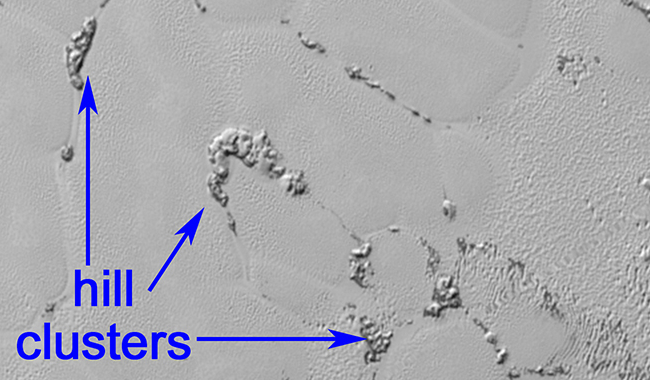
The New Horizons science team has released a new image of Pluto’s smooth heart-shaped area, dubbed Sputnik Planum, focusing this time on the mountains of water ice that pop up through the plain and are apparently floating on the nitrogen sea, having broken off from the shoreline.
Because water ice is less dense than nitrogen-dominated ice, scientists believe these water ice hills are floating in a sea of frozen nitrogen and move over time like icebergs in Earth’s Arctic Ocean. The hills are likely fragments of the rugged uplands that have broken away and are being carried by the nitrogen glaciers into Sputnik Planum. ‘Chains’ of the drifting hills are formed along the flow paths of the glaciers. When the hills enter the cellular terrain of central Sputnik Planum, they become subject to the convective motions of the nitrogen ice, and are pushed to the edges of the cells, where the hills cluster in groups reaching up to 12 miles (20 kilometers) across.
I have significantly cropped the image to show it here. Be sure and check out the full version, because there is a wealth of fascinating details in it.
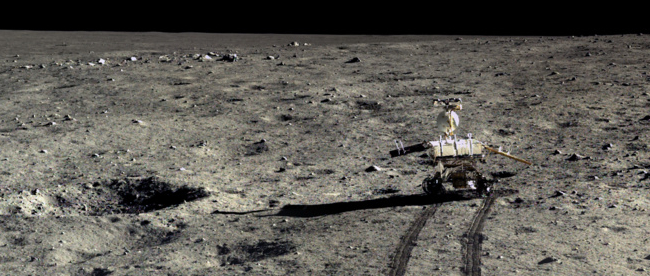
China has made available a new batch of very cool images taken by its Chang’e 3 lander and Yutu rover, and Emily Lakdawalla at the Planetary Society has figured out how to view them.
In a recent guest blog post, Quanzhi Ye pointed to the Chinese version of the Planetary Data System, and shared the great news that Chang’e 3 lander data are now public. The website is a little bit difficult to use, but last week I managed to download all of the data from two of the cameras — a total of 35 Gigabytes of data! — and I’ve spent the subsequent week figuring out what’s there and how to handle it.
So, space fans, without further ado, here, for the first time in a format easily accessible to the public, are hundreds and hundreds of science-quality images from the Chang’e 3 lander and Yutu rover. I don’t usually host entire data sets (PDS-formatted and all) but I made an exception in this case because the Chinese website is a bit challenging to use.
The image above is a cropped version of Yutu, taken by the lander. Be sure and go to the link to see the full image as well as others.
Curiosity’s science team has finished its work at Namib Dune and has decided to move on, even though they are still analyzing an unspecified issue with the rover’s scoop instrument.
So far, in the week since they first had a problem while sifting sand from the dune, they have not described in any way what the problem is. All they have said is this:
Unfortunately, the CHIMRA behaved in an unexpected way during processing of the third scoop on Sol 1231, which prevented completion of the arm activities planned for last weekend.
The robot arm functions, and they used it yesterday to get some extreme close-ups of the sand, but it appears they cannot use the scoop at this time.
The Rosetta science team has determined that Comet 67P/C-G has no voids or large caverns in its interior, and that its low density is because its dust and water ice have mixed to produce a “fluffy” density.
In a new study, published in this week’s issue of the journal Nature, a team led by Martin Pätzold, from Rheinische Institut für Umweltforschung an der Universität zu Köln, Germany, have shown that Comet 67P/Churyumov-Gerasimenko is also a low-density object, but they have also been able to rule out a cavernous interior. This result is consistent with earlier results from Rosetta’s CONSERT radar experiment showing that the double-lobed comet’s ‘head’ is fairly homogenous on spatial scales of a few tens of metres.
The most reasonable explanation then is that the comet’s porosity must be an intrinsic property of dust particles mixed with the ice that make up the interior. In fact, earlier spacecraft measurements had shown that comet dust is typically not a compacted solid, but rather a ‘fluffy’ aggregate, giving the dust particles high porosity and low density, and Rosetta’s COSIMA and GIADA instruments have shown that the same kinds of dust grains are also found at 67P/Churyumov-Gerasimenko.
The Juno spacecraft, heading for a July 4 rendezvous with Jupiter, when it will go into orbit around the giant planet, successfully completed a mid-course correction engine burn on Wednesday.
Below the fold is Tuesday’s podcast of my appearance on the John Batchelor show. In addition to discussing Falcon Heavy, Ariane 6, and the question of rocket re-usability, I also lambasted the glacially slow pace of NASA’s Orion project, producing four capsules for a mere $17 billion in only 19 years! And speaking of glaciers, I also noted in the science segment the stonewalling at NOAA that prevents scientists from analyzing the rational behind their “adjustments” to their climate data, all of which cool the past and warm the present.
» Read more
North Korea today revealed plans to place a satellite in non-geosynchronous orbit sometime in the next two weeks.
News of the planned launch between Feb. 8 and Feb. 25 drew fresh U.S. calls for tougher U.N. sanctions already under discussion in response to North Korea’s nuclear test. State Department spokesman John Kirby said the United Nations needed to “send the North Koreans a swift, firm message.”
Pyongyang has said it has a sovereign right to pursue a space programme by launching rockets, although the United States and other governments worry that such launches are missile tests in disguise.
It is horrifyingly hilarious to read the bluster put forth by Obama administration officials about this new North Korean effort to develop ICBMs that, as the article says, “could reach the U.S. West Coast.” Besides wanting to send “a swift, firm message,” they call the North Korean launch announcement a “slap in the face”, “another destabilizing provocation,” and “an egregious violation.” They then say they are working “cooperatively and effectively with the Chinese to counter this threat.”
It is laughable, but terrifying at the same time. North Korea, led by the worst kind of power-mad tyrant, is developing the ability to launch nuclear weapons to any place on Earth, and all our leaders can do is whine how mean they are.
The competition heats up: Blue Origin expects to do about one launch per month of its New Shepard rocket in the next two years leading up to commercial space tourism flights in 2018.
Reports from the meeting quoted [Blue Origin executive Brett] Alexander as saying there would be a couple of dozen such test flights over the course of the next two years – which works out to an average of one flight per month. Alexander also told the gathering that it’s still too early to announce the ticket price for passenger flights.
