
Webb telescope reaches launchpad on Ariane 5 + how to watch launch

The James Webb Space Telescope, stacked on top of Arianespace’s Ariane 5 rocket, has finally reached its launchpad in French Guiana after twenty years of development costing 20 times its original budget.

The launch itself is now scheduled for December 25, 2021 at 7:20 am (Eastern). It will be live streamed by both NASA (in English) and Arianespace (with options in English, French, or Spanish).

I have embedded below NASA’s feed. As always, expect NASA to pump you with lots of propaganda during its live stream.

When all is said and done, Webb has the chance to show us things about the universe we’ve never seen before. Optimized for deep space cosmology, it will provide us a window into the earliest moments of the universe’s existence. And is infrared capabilities will allow it to peer into many nearer places obscured by dust with a resolution unmatched by previous telescopes.

Keep your fingers crossed all goes as planned.
» Read more
20 comments

ESA delays Webb launch one day due to weather

The European Space Agency (ESA) announced late yesterday that, due to “adverse weather conditions” in French Guiana, it has delayed the launch of the James Webb Space Telescope on an Ariane 5 rocket one day to December 25th.

The announcement also stated that the final launch readiness review also approved the launch, though no update has yet been issued on the ground control communications problem that had caused a two day delay last week.

Meanwhile, this story and its headline encapsulates the terror I think many astronomers presently feel about this telescope:

Why Astronomers Are “Crying and Throwing Up Everywhere” Over the Upcoming Telescope Launch

The sense is one of helpless panic among astronomers who want to use Webb. They know it will do really cutting edge science, but they also know that many things can go wrong, and the history of the telescope (ten years late and 20x overbudget) will likely make replacing it impossible.

And many things can go wrong. Below is NASA’s video showing the telescope’s complex unfolding, step-by-step, after launch.
» Read more

7 comments

Scientists discover underground reservoir of hydrogen, likely ice, near Martian equator

Detection of underground hydrogen in Valles Marineris
Click for full image.

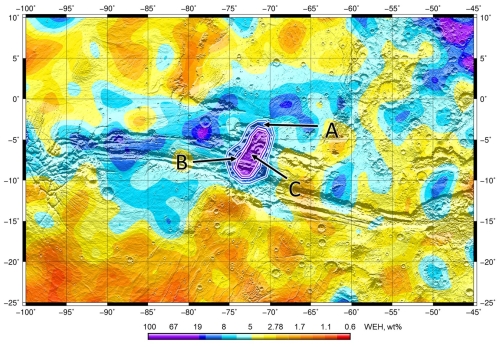
In what could be a very significant discovery, scientists using Europe’s Trace Gas Orbiter (TGO) have discovered a surprisingly large underground reservoir of hydrogen, likely ice, near Martian equator and inside the solar system’s largest known canyon, Valles Marineris.

The map to the right, reduced to post here, provides all the important data. From its caption:

The coloured scale at the bottom of the frame shows the amount of ‘water-equivalent hydrogen’ (WEH) by weight (wt%). As reflected on these scales, the purple contours in the centre of this figure show the most water-rich region. In the area marked with a ‘C’, up to 40% of the near-surface material appears to be composed of water (by weight). The area marked ‘C’ is about the size of the Netherlands and overlaps with the deep valleys of Candor Chaos, part of the canyon system considered promising in our hunt for water on Mars.

What the caption does not note is the latitude of this hydrogen, about 3 to 10 degrees south latitude. Assuming the hydrogen represents underground ice, this would be the first detection on Mars below 30 degrees latitude, and the very first in the equatorial regions. Data from orbit has suggested that Mars has a lot of water ice, found near the surface more and more as you move into higher latitudes above 30 degrees and making Mars much like Antarctica. Almost no ice however had until now been detected below 30 degrees latitude. As the European Space Agency’s press release noted,
» Read more

6 comments

Arianespace launches two Galileo GPS-type satellites

Capitalism in space: Using a Russian Soyuz-2 rocket, Arianespace successfully launched two Galileo GPS-type satellites from its spaceport in French Guiana tonight.

The leaders in the 2021 launch race:

45 China
27 SpaceX
20 Russia
6 Europe (Arianespace)

China still leads the U.S. 45 to 42 in the national rankings. This launch tonight was 116th successful launch in 2021, which is the most launches completed in a year since 1988. Based on the number of planned launched over the next three weeks, there is an outside chance that the global total will top 127, making this the second most active year ever in the history of space. Even if the numbers end up in the mid-120s, 2021 will be among the top eight years ever.

And I expect next year to easily top this year.

4 comments

Mars Express successfully relays data from Zhurong to Earth

The European Space Agency’s Mars Express orbiter has successfully been used to relay data from China’s Zhurong Mars rover to Earth and then to China.

In November, ESA’s Mars Express and CNSA’s Zhurong teams carried out a series of experimental communication tests in which Mars Express used this ‘in the blind’ mode to listen for signals sent to it by the Zhurong Rover.

The experiments culminated in a successful test on 20 November. “Mars Express successfully received the signals sent by the rover, and our colleagues in the Zhurong team confirmed that all the data arrived on Earth in very good quality.” says ESA’s Gerhard Billig.

Apparently, normal communications would first involve “handshake” communications between the two, but that requires communications frequencies Zhurong does not use. Mars Express instead had to grab the data on the blind. The test was a success, which means the ESA will likely act as another communications relay for Zhurong, in addition to China’s Tianwen-1 orbiter, as the rover’s mission on Mars continues.

0 comments

Engineers: Webb undamaged by “incident”, ready for December 22nd launch

Arianespace engineers have confirmed after testing that the James Webb Space Telescope was undamaged by “incident” that occurred during stacking, and have okayed the resumption of the telescope’s preparation for launch.

On Wednesday, Nov. 24, engineering teams completed these tests, and a NASA-led anomaly review board concluded no observatory components were damaged in the incident. A “consent to fuel” review was held, and NASA gave approval to begin fueling the observatory. Fueling operations will begin Thursday, Nov. 25, and will take about 10 days.

The launch is now set for December 22nd.

3 comments

Europe’s Solar Orbiter to make last flyby of Earth

Solar Orbiter, the European Space Agency’s (ESA) probe to work in tandem with NASA Parker Solar Probe in studying the inner regions surrounding the Sun, will make last flyby of Earth on November 27, 2021, thus putting it into its planned science orbit.

While the press release gives a good overview of the mission, it focuses on the risk during that fly-by of the spacecraft hitting something during its close approach.

Solar Orbiter’s Earth flyby takes place on 27 November. At 04:30 GMT (05:30 CET) on that day, the spacecraft will be at its closest approach, just 460 km above North Africa and the Canary Islands. This is almost as close as the orbit of the International Space Station.

The manoeuvre is essential to decrease the energy of the spacecraft and line it up for its next close pass of the Sun but it comes with a risk. The spacecraft must pass through two orbital regions, each of which is populated with space debris.

The first is the geostationary ring of satellites at 36 000 km, and the second is the collection of low Earth orbits at around 400 km. As a result, there is a small risk of a collision. Solar Orbiter’s operations team are monitoring the situation very closely and will alter the spacecraft’s trajectory if it appears to be in any danger.

While there is a risk, it seems to me that ESA is taking advantage of the recent news outburst in connection with the Russian anti-sat test and the space junk it created to sell this mission. The risk of impact during this fly-by is very low, especially in the geostationary ring.

0 comments

Italy switches from Arianespace to SpaceX for launch contract

Capitalism in space: Because of the two recent launch failures of Arianespace’s Vega rocket (built mostly in Italy), the Italian space agency (ASI) has decided to take the launch of an Earth observation satellite from Arianespace and award the launch contract instead to SpaceX.

The article at the link describes in detail the history and politics that make this decision significant. Essentially, because Arianespace in the past decade has failed to meet the challenge of SpaceX, so that its launches continue to be more expensive, this government-subsidized business has tried to force nations in the European Space Agency (ESA) to use Arianespace rockets via political agreements.

With this decision Italy is defying that pressure, which in turn is going to increase the pressure on Arianespace to finally step up its game, or die from lack of business. For example, when the ESA agreed to have Arianespace build its next generation rocket, the Ariane 6, it failed to require it to be reuseable. The Ariane 6 rocket was therefore designed as an expendable rocket, which meant that right from the start it could not compete with SpaceX’s Falcon 9. It has therefore failed to win launch contracts.

Expect the Ariane 6 to continue to fade as the years pass, simply because the bureaucrats in ESA and Arianespace refused to take their competition seriously.

6 comments

Arianespace successfully completes first Ariane 5 launch in almost a year

Arianespace today successfully completed its first Ariane 5 launch since August 2020, placing in orbit two commercial communications satellites.

The long gap in launches occurred because of a vibration issue discovered during that August 2020 launch durng the release of the rocket’s two fairing halves.

Engineers introduced modifications to the Ariane 5’s payload fairing, or nose cone, to reduce vibrations imparted on the satellites during separation of the shroud, which protects payloads during the first few minutes of flight through the atmosphere. Ground teams will analyze data from the rocket to make sure the changes reduced the vibrations.

Another launch is scheduled for September, followed next by the launch of the James Webb Space Telescope in either November or December. The results from today’s launch as well as the one in September will determine if the Webb launch will go forward on time.

These issues with Ariane 5, delays imposed by the company in fear of the Wuhan flu, and other launch problems with Arianespace’s Vega rocket, has meant that this is only its second launch in 2021, a pace that is below its pace for most of the last decade. Whether the company can recover and pick up the pace before the end of the year will depend on what they learn during today’s launch.

With only two launches total, Europe’s Arianespace remains off the leader board in the 2021 launch race:

24 China
20 SpaceX
12 Russia
3 Northrop Grumman
3 Rocket Lab

The U.S. lead over China in the national rankings remains 30 to 24.

3 comments

Ariane 6 inaugural launch date appears to be delayed again

It appears that officials at the European Space Agency (ESA) have begun preparing the public for a further delay in the first launch of its new Ariane 6 rocket, from the second quarter of 2022, as announced in October 2020, to the third quarter of 2022, at the earliest.

Josef Aschbacher, director general of the European Space Agency, at the Paris Air Forum [described the creation of] “a small group” … to make an independent assessment of the schedule for the final development phase of the Ariane 6 rocket. The goal of this task force will be to ensure that Europe does everything it needs to do launch on time.

…In referring to an “on time” launch, Aschbacher said he meant next year, before the European Space Agency’s Ministerial Council meeting that is typically held in October or November. This is a high-level meeting where representatives from each member nation of the space agency gather to set policy. The European Space Agency’s budget is provided, in varying amounts, by member nations. “This is a must,” Aschbacher said of launching before the 2022 meeting, “because we need good news, and good success, for our politicians to see that Europe performs, that Europe delivers, and therefore it is worth investing in space in the ministerial conference.”

It appears from these statements that the development of Ariane 6 is now faced with delays that might make a launch by the third quarter in ’22 difficult, and this new independent committee is being put together to try to forestall that possibility. What makes this even more significant for Ariane 6 is that it continues to have trouble winning contracts from the nations within ESA, as it remains far more expensive that SpaceX’s Falcon 9. If that first launch is delayed past that important fall ’22 high-level meeting, those politicians at that meeting might decide to consider serious new alternatives to it, or even more drastically decide to replace it entirely.

0 comments

Europe to fly mission to Venus to study its volcanoes

The European Space Agency yesterday announced that it will fly an orbiter to Venus in 2031, dubbed EnVision, to study the estimated million volcanoes on the surface of that hellish planet.

EnVision will use an infrared spectrometer to seek out hot spots on the surface that could indicate active volcanoes. It will use radar to map the surface, looking for signs of lava flows. Ultraviolet and high-resolution infrared spectrometers will then look for water vapor and sulfur dioxide emissions, to see whether smoldering volcanoes are driving cloud chemistry today.

This data will help determine exactly geologically active Venus’s volcanoes are. Several studies in the past decade using archival data (see here, here, and here) have suggested as many as 37 of those volcanoes are active, but this data remains uncertain.

10 comments

German smallsat rocket startup wins launch contract

Capitalism in space: The German smallsat rocket startup company Isar Aerospace has won its first launch contract, to place an Airbus Earth observation satellite using its new Spectrum rocket.

Isar is one of three new German rocket companies competing for the smallsat market that all hope to launch for the first time next year.

Along with Rocket Factory Augsburg and HyImpulse Technologies, the three startups are competing as part of the German Space Agency DLR’s microlauncher competition.

The competition, which is being run in conjunction with ESA [European Space Agency], will award one of the three startups with 11 million euros ($13 million) in funding later this year. The funding is to be used to support a qualification flight that will carry a payload for a university or research institution for free. A second prize of 11 million euros in funding will then be awarded in 2022 as the final stage of the competition.

In evaluating the three startups, the DLR panel of judges will examine the technical aspects and commercial feasibility of each launcher. As a result, each startup’s success in securing funding and signing launch contracts will play a role in their chance of winning the competition.

Rocket Factory has also won a launch contract, with that commercial launch set for 2024.

Note how ESA is shifting its approach. Previously it focused its commercial effort entirely within the government-controlled Arianespace company. Now it is awarding competitive contracts to independent private companies. It appears that the ESA, like NASA, is adopting the recommendations put forth in my policy paper Capitalism in Space. It no longer wants to be the company but is instead acting as a customer looking for a product to buy.

Hopefully more than one of these three German companies will succeed, so that the competition will increase. That in turn will force prices down while encouraging greater innovation.

0 comments
1 15 16 17 18 19 22