ArianeGroup chosen by Europe to develop reusable rockets

The new colonial movement: The European Commission, which makes the major decisions for the European Space Agency, has chosen the European commercial company ArianeGroup to run two programs designed to produce that continent’s first reusable rocket.

From the press release [pdf]:

The SALTO project will facilitate the first flight tests of the Themis reusable stage demonstrator in Kiruna, Sweden. The ENLIGHTEN project will speed up the development and introduction of reusable engine technologies.

The main goal of SALTO will be to develop the kind of vertical landing technology that SpaceX now does routinely. ENLIGHTEN in turn will develop rocket engines using either methane or hydrogen as the fuel. The total budget allocated for both is just under 50 million euros, which seems quite small. The press release also made no mention of a schedule for accomplishing these tasks.

3 comments

Ariane-6 rocket delayed again

Capitalism in space: The first launch of ArianeGroup’s new rocket, Ariane-6, has been delayed again, and will not launch this year as planned.

The new delay appears mostly related to getting the rocket’s ground systems up and running.

The rocket, being built for the European Space Agency’s commercial division, Arianespace, had originally been scheduled for launch in 2020. Initially the rocket struggled to find customers, because it is not reusable and is thus more expensive. That changed in the past few months with the Ukraine War eliminating Russian rockets as a competitor combined with a new gigantic launch contract from Amazon to launch a large number of its Kuiper satellites using Ariane-6.

0 comments

Russia proposes restart of ExoMars partnership with ESA

Russia’s aerospace corporation Roscosmos has proposed to the European Space Agency (ESA) that its partnership to launch and land ESA’s Franklin rover on Mars be renewed, despite the Ukraine War and Roscosmos’ confiscation of 36 OneWeb satellites.

[According to Roscosmos head Dmitry Rogozin] the equipment and Kazachok landing platform for the mission have the potential for launch in 2024. “ESA colleagues promised to make requests to their patrons, who are ESA member states. If they cooperate and give their consent, the mission may be implemented,” Rogozin said.

He estimates the likelihood of this scenario to be at about 708%. [sic] Roscosmos plans to get the response in late June. [emphasis mine]

It would not be surprising if ESA made this deal, despite its stupidity. Roscosmos’ actions recently, especially related to OneWeb, prove the people running it are very untrustworthy business partners. Yet Europe’s historic willingness to deal with the devil for short term gain — eventually and repeatedly leading to overall disaster — is legendary.

4 comments

ESA successfully tests controlling a robot on Earth from orbit

The European Space Agency (ESA) has successfully completed a test program, proving that an astronaut in orbit on ISS can control and operate a small robot on Earth.

Astronaut Luca Parmitano aboard the ISS [in 2019] operated the gripper-equipped ESA Interact rover in a mock lunar environment inside a hangar in Valkenburg, the Netherlands to survey rocks and collect samples. The two-hour space-to-ground test was a success, overcoming a two-way signal delay averaging more than 0.8 seconds and a data packet loss rate of 1% plus.

The value of this test is obvious. It shows that astronauts will be able to use small rovers and robots in remote operations, such as sending a probe down to the surface before landing themselves, or once on the planet sending that probe into dangerous terrain as a scout, while the astronaut stays back in safety.

At the same time, the robot used and the tasks it completed were all relatively simple. Moreover, the “mock lunar environment” was hardly realistic. A lot more work is needed before such a robot is functional in a real planetary environment.

5 comments

Europe removes its science instruments from future Russian lunar missions

The Europe Space Agency (ESA) yesterday announced that because of Russia’s invasion of the Ukraine it will no longer fly any science instruments on three upcoming Russian unmanned lunar probes.

ESA will discontinue cooperative activities with Russia on Luna-25, -26 and -27. As with ExoMars, the Russian aggression against Ukraine and the resulting sanctions put in place represent a fundamental change of circumstances and make it impossible for ESA to implement the planned lunar cooperation. However, ESA’s science and technology for these missions remains of vital importance. A second flight opportunity has already been secured on board a NASA-led Commercial Lunar Payload Services (CLPS) mission for the PROSPECT lunar drill and volatile analysis package (originally planned for Luna-27). An alternative flight opportunity to test the ESA navigation camera known as PILOT-D (originally planned for Luna-25) is already being procured from a commercial service provider.

In other words, Europe is switching to the many private American companies that are developing lunar landers for NASA science instruments. It has also signed onto a Japanese lunar mission. All have payload space, and all are willing to take the cash of a new customer.

Meanwhile, this is how Dmitry Rogozin responded to this decision:

“Good riddance! One less European dame off our backs, so Russia should go far with a lighter load,”

To sum this all up, when it comes to space, the Ukraine invasion has been Russia’s loss, and everyone else’s gain. Even if the invasion were to end today, it will take at least a decade to re-establish Russia’s business ties with the west.

Unfortunately, the invasion will cost the Ukraine as well. In making the above announcement ESA officials also said that it is looking for alternatives to the Ukrainian rocket engines used in its Vega-C upper stage.

At the news conference, ESA also discussed the future of its small Vega rocket, which relies on Ukraine-built engines in its upper stage. The engines are manufactured by the Ukrainian company Yuzhmash, which is based in the tech city of Dnipro. Although Dnipro has been under heavy bombardment, there have been no official reports so far about damage to Yuzhmash. It is, however, clear that ESA doesn’t expect to continue its partnership with the company in the future. “We now have sufficient engines for 2022 and 2023,” Aschbacher said. “We are working on options for 2024 and onwards based on different technologies.”

Daniel Neuenschwander, ESA’s director of space transportation, added: “We are working on engine opportunities within Europe and outside of Europe, which are either tested or, even better, already existing and fully qualified.”

Whether ESA completely breaks off its partnership with the Ukraine however is not certain. Should the war continue to favor the Ukraine, then it could be that partnership will continue. Only time will tell. Right now, it is simply prudent for ESA to look for more stable alternatives.

7 comments

Europe to put instrument on Japanese rover being launched and landed on the Moon by India

The new colonial movement: The European Space Agency (ESA) has signed an agreement with Japan’s space agency JAXA to put a science instrument on a Japanese rover that will be launched by India to the Moon and landed there on an Indian lander.

Under the deal, ESA would provide instruments for the Japanese rover, which would be used in the exploration of the Moon’s south pole under the mission targeted for 2024. … The lunar endeavour between the Indian Space Research Organisation (ISRO) and JAXA is called the Lunar Polar Exploration Mission (LUPEX) which aims to launch an Indian lander and a Japanese rover to the Moon.

In the next three years a lot of landers and rovers are planning to land on the Moon, most built by private American companies flying NASA and private payloads, but also joined by probes being sent by Russia, China, and now this Japanese-Indian-European mission. Even if only half succeed, the exploration of the lunar surface will still be quite busy.

0 comments

Europe’s deep space communications network to support India’s next two missions beyond Earth orbit

The new colonial movement: Based upon a 2021 agreement, the European Space Agency (ESA) today outlined how its deep space communications network of antennas will support India’s next two missions beyond Earth orbit.

ESA’s global deep-space communication antennas will provide essential support to both missions every step of the way, tracking the spacecraft, pinpointing their locations at crucial stages, transmitting commands and receiving ‘telemetry’ and valuable science data.

In June 2021, ESA and the Indian Space Research Organisation (ISRO) signed an agreement to provide technical support to each other, including tracking and communication services to upcoming Indian space missions via ESA’s ground stations.

The first missions to benefit from this new support agreement will enable India look to the Sun and the Moon with the Aditya-L1 solar observatory and Chandrayaan-3 lunar lander and rover, both due to launch in 2022 from the Satish Dhawan Space Centre in Sriharikota Range (SDSC SHAR), India.

Though scheduled for launch this year, ISRO (India’s space agency) has not yet announced firm launch dates for either.

This arrangement signals an effort by India and Europe to remain independent of the American Artemis program, which is NASA’s central program for manned missions beyond Earth orbit. To partner with NASA for such missions the Trump administration had demanded nations sign the Artemis Accords, though that requirement might have been eased by the Biden administration for deep space communications.

Regardless, this agreement gives both India and ESA flexibility for remaining outside the accords, at least for now. Neither India nor most of the partners in the ESA have signed, with France and Germany the most notable European nations remaining outside the accords.

0 comments

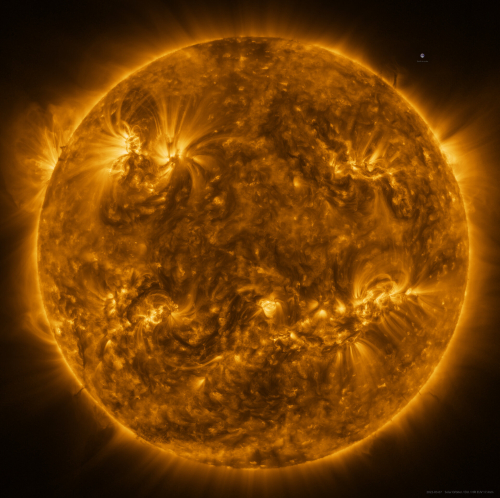
Solar Orbiter takes closest image of Sun so far

Solar Orbiter's closest image of the Sun, so far
Click for full interactive image, where you can zoom in, a lot.

Cool image time! The European Space Agency (ESA) yesterday released several new images from its Solar Orbiter probe, taken when the spacecraft made its most recent closest approach of the Sun.

One of the images, taken by the Extreme Ultraviolet Imager (EUI) is the highest resolution image of the Sun’s full disc and outer atmosphere, the corona, ever taken.

Another image, taken by the Spectral Imaging of the Coronal Environment (SPICE) instrument represents the first full Sun image of its kind in 50 years, and by far the best one, taken at the Lyman-beta wavelength of ultraviolet light that is emitted by hydrogen gas.

The images were taken when Solar Orbiter was at a distance of roughly 75 million kilometres, half way between our world and its parent star. The high-resolution telescope of EUI takes pictures of such high spatial resolution that, at that close distance, a mosaic of 25 individual images is needed to cover the entire Sun. Taken one after the other, the full image was captured over a period of more than four hours because each tile takes about 10 minutes, including the time for the spacecraft to point from one segment to the next.

The photo to the right, reduced to post here, is the EUI photo.

Solar Orbiter has been in its science orbit since November, though that orbit over time will slowly be adjusted to swing the spacecraft into a higher inclination so that it can make the first close-up observations of the Sun’s polar regions. It is also working in tandem with the Parker Solar Probe, which observes the Sun from even closer distances using different instruments.

3 comments

ESA: ExoMars launch in ’22 “very unlikely” due to Russian invasion of the Ukraine

In a statement yesterday condemning Russia’s invasion of the Ukraine and responding to the Russians’ decision to suspend cooperation with Arianespace in French Guiana, the European Space Agency (ESA) also admitted, almost as an aside, that the ExoMars launch in ’22 to Mars is now “very unlikely.”

That mission is a partnership with Russia, where the Russians provide the rocket and the lander that will put Europe’s Franklin rover on the surface.

For the scientists running ExoMars, this delay only adds to their frustration, as the mission has already been delayed several times, most recently from a ’20 launch because the lander parachutes — being built by ESA — were not ready.

12 comments

ESA dithers, forming committee to study concept of building its own manned capsule

My heart be still! The European Space Agency (ESA) has decided to create a committee to study the concept of building a European manned capsule so that it will no longer be dependent on either the U.S. or Russia to get its astronauts into space.

Aschbacher said a draft mandate for the new advisory group will be presented to ESA members at a March meeting of the ESA Council, with the goal for the group to start working immediately thereafter. The committee will prepare an interim report in time for the ministerial meeting in November, with a final report by next spring.

“It is clear that this group has to be independent and comprising mostly non-space experts,” he said, “because we really would like to look at various aspects of society from an economic point of view, a historical point of view, a geopolitical point of view.” That means including people such as artists and philosophers in the group to look at various aspects of exploration beyond science and technology. [emphasis mine]

The highlighted words illustrate the empty PR nature of this committee. It will not result in any European manned spacecraft at all. Instead, it will spend more than a year talking a lot about the wonders of space, and then produce a report repeating how wonderful space is and how Europe must be there.

The result? ESA will have wasted a year and not gotten itself one iota closer to having its own manned spacecraft.

If this hollow effort was the exception to the rule for Europe, there might be hope some political pressure could get the committee reformed and actually include engineers to develop a real design. That hope is in vain, however, because this is how Europe and ESA does everything. By the time ESA produces the first designs of this capsule, probably five to six years hence, it will be so out-of-date that building it would be a joke.

In a larger sense, this absurd committee and the top management at ESA and in the European Union that proposed it illustrate the overall bankruptcy of modern civilization’s entire management class. The people running governments worldwide are generally all do-nothing idiots, who talk a lot, waste a lot of money for their own aggrandizement, impose taxes and regulations on everyone else that makes the lives of ordinary people a misery, and fail in almost every project they undertake. We need only look at their panicked, dishonest, and failed global response to the Wuhan flu in the past two years for a prime example.

The official intellectual class that is running our governments worldwide are bankrupt. They need to be fired.

5 comments

ESA selects Ariane-6’s first payloads

The European Space Agency (ESA), ArianeGroup, and Arianespace today announced the payloads that will fly on the first launch of its new Ariane-6 rocket.

The payloads are a variety of cubesats and science experiments, none heavier than 175 pounds with a total payload weight less than one ton. These secondary payloads will either be deployed from or kept attached to a dummy mass that will simulate a large primary satellite payload.

The press release makes no mention of a launch date, as has been the pattern in the last few Ariane-6 press releases. The last release to mention a launch date was in October 2020, which then predicted a launch in the second quarter of ’22. That this date is no longer being mentioned suggests the date has been pushed back, though for how long remains a mystery.

1 comment

Lockheed Martin wins NASA contract to build Mars rocket

Capitalism in space: NASA yesterday awarded Lockheed Martin a $194 million contract to build the Mars rocket that will lift Perseverance’s samples into orbit for return to Earth.

Set to become the first rocket fired off another planet, the MAV [Mars Ascent Vehicle] is a crucial part of a campaign to retrieve samples collected by NASA’s Perseverance rover and deliver them to Earth for advanced study. NASA’s Sample Retrieval Lander, another important part of the campaign, would carry the MAV to Mars’ surface, landing near or in Jezero Crater to gather the samples cached by Perseverance. The samples would be returned to the lander, which would serve as the launch platform for the MAV. With the sample container secured, the MAV would then launch.

Once it reaches Mars orbit, the container would be captured by an ESA (European Space Agency) Earth Return Orbiter spacecraft outfitted with NASA’s Capture, Containment, and Return System payload. The spacecraft would bring the samples to Earth safely and securely in the early- to mid-2030s.

According to this project’s webpage, the European Space Agency (ESA) is building that they call a “fetch rover” which will be deployed from the rover to get the samples and bring them back to the MAV.

There are a lot of uncertainties in this scenario. It has been decades since Lockheed Martin built rockets. ESA has not yet built an operational Mars rover. It is also unclear who will build NASA’s lander and capture/return payload. Thus, do not expect this mission to launch “as early as ’26,” as the press release says. I predict it will launch at least five, maybe ever ten years, later.

4 comments
1 14 15 16 17 18 22