Astronomers discover two exoplanets as dense as cotton candy

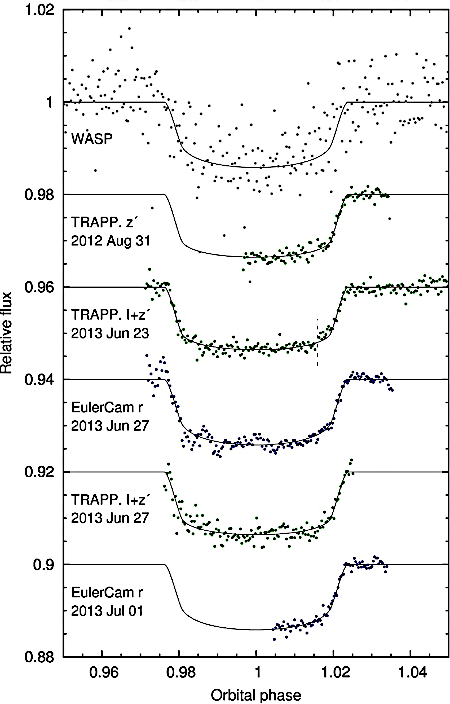
The observed transits of TOI-791 c by different telescopes
during its 232 day orbit. Figure 9 from the paper.
Using a combination of ground- and space-based telescopes, astronomers have now discovered two exoplanets in the same solar system that have a deas dense as cotton candy.
You can read their paper here. From the NASA press release:
Data from NASA’s TESS (Transiting Exoplanet Survey Satellite) mission has revealed two new “super-puff” planets, giant worlds so light that their density is comparable to cotton candy. Scientists calculate that these Jupiter-sized planets—named TOI-791 b and TOI-791 c—are the “puffiest” worlds ever found.
The planets orbit a Sun-like star named TOI-791 that is approximately 1,113 light years away from Earth. The TESS mission first detected the planets by watching for repeated dips in TOI-791’s brightness, a telltale sign that a planet is transiting, or passing in front of, a star. Further study revealed two large planets with unusual features.
TOI-791 b is nearly the same size as Jupiter but contains just 3.0 percent of Jupiter’s mass. TOI-791 c is even larger than Jupiter but contains just 5.9 percent of Jupiter’s mass.
The data for determining both planet’s density came from follow-up observations using a telescope based in Antarctica. Both planets have long orbits, 139 and 232 days respectively, so these observations took place over a period of eight years, in order to capture multiple orbital transits.
One interesting tidbit: Though the data suggests both planets are spherical, this is not confirmed with certainty. Overall, the nature of such puffy planets is not really understood at this time.