Webb makes its first detailed survey of an exoplanet’s atmosphere

Astronomers have now completed the first detailed survey of an exoplanet’s atmosphere using the Webb Space Telescope, looking at a gas giant about one third the mass of Jupiter about 700 light years away.

Using three of its instruments, JWST was able to observe light from the planet’s star as it filtered through WASP-39b’s atmosphere, a process known as transmission spectroscopy. This allowed a team of more than 300 astronomers to detect water, carbon monoxide, sodium, potassium and more in the planet’s atmosphere, in addition to the carbon dioxide. The gives the planet a similar composition to Saturn, although it has no detectable rings.

The team were also surprised to detect sulfur dioxide, which had appeared as a mysterious bump in early observation data. Its presence suggests a photochemical reaction is taking place in the atmosphere as light from the star hits it, similar to how our Sun produces ozone in Earth’s atmosphere. In WASP-39b’s case, light from its star, slightly smaller than the Sun, splits water in its atmosphere into hydrogen and hydroxide, which reacts with hydrogen sulfide to produce sulfur dioxide.

The data also suggested the clouds in the atmosphere are patchy, and that the planet’s formation process was not exactly as predicted.

These observations are part of a program to study 70 exoplanets during Webb’s first year of operation, using its infrared capabilities to get spectroscopy not possible in other wavelengths.
0 comments

Astronomers discover an exoplanet with the density of a marshmallow

Using ground-based telescopes to gather more data about an exoplanet discovered by the orbiting TESS telescope, astronomers have found that it has the density of a marshmallow.

The planet orbits a red dwarf star, the most common star in the universe, and is the “fluffiest” yet seen around this type of star.

Red dwarf stars are the smallest and dimmest members of so-called main-sequence stars — stars that convert hydrogen into helium in their cores at a steady rate. Though “cool” compared to stars like our Sun, red dwarf stars can be extremely active and erupt with powerful flares capable of stripping a planet of its atmosphere, making this star system a seemingly inhospitable location to form such a gossamer planet.

Astronomers remain puzzled how such a large fluffy planet could have formed around such a dim small star.

3 comments

TESS enters safe mode

The science team for TESS (Transiting Exoplanet Survey Satellite) revealed yesterday that the spacecraft had entered safe mode on October 10th.

The spacecraft is in a stable configuration that suspends science observations. Preliminary investigation revealed that the TESS flight computer experienced a reset. The TESS operations team reported that science data not yet sent to the ground appears to be safely stored on the satellite. Recovery procedures and investigations are underway to resume normal operations, which could take several days.

TESS has been in orbit since 2018, where it has been repeatedly taking survey images of the entire sky. Astronomers then compare these images to see if they can spot exoplanet transits (as well as any other new phenomenon). So far 250 exoplanets have been identified.

0 comments

Webb gets first direct infrared image of exoplanet

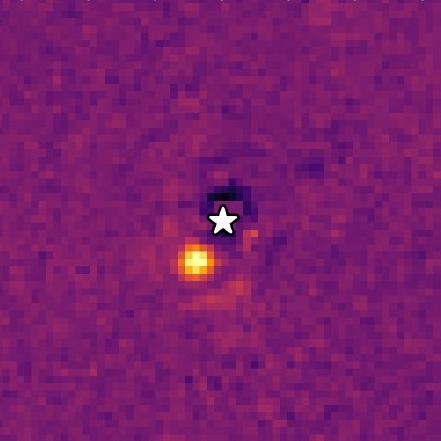
Exoplanet as seen in the infrared by Webb

Using the Webb Space Telescope, scientists have obtained that telescope’s first direct infrared image of an exoplanet, covering four different wavelengths.

The image to the right is from the wavelength image with the least distortion (formed by Webb’s own optics and the shape of its mirror and indicated by the faint ring surrounding the planet). The star indicates the masked location of the star itself.

The planet is about seven times the mass of Jupiter and lies more than 100 times farther from its star than Earth sits from the sun, direct observations of exoplanet HIP 65426 b show. It’s also young, about 10 million or 20 million years old, compared with the more than 4-billion-year-old Earth.

You can download the full research paper here.

1 comment

Webb obtains first direct infrared images of exoplanet

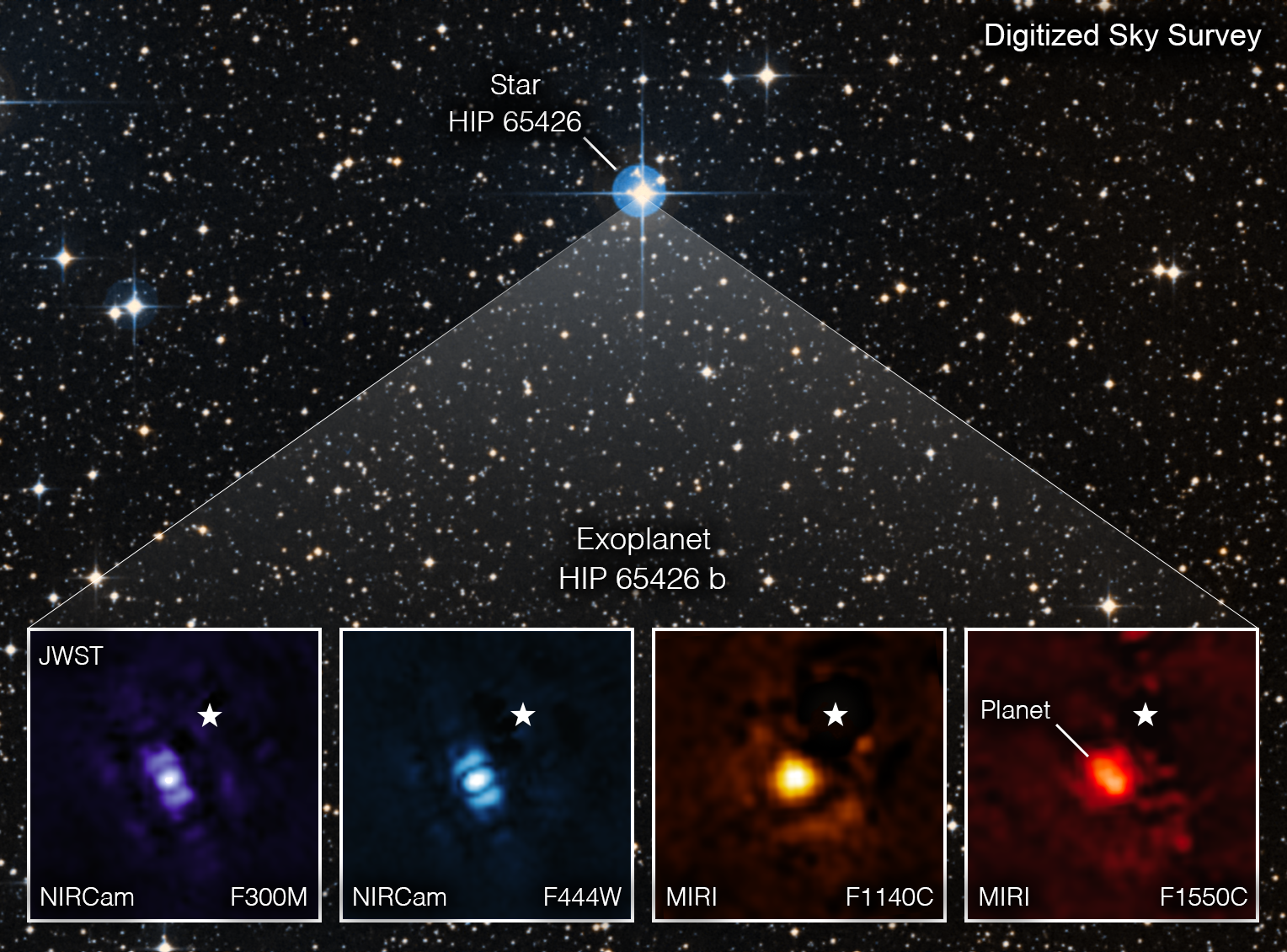
Webb's first infrared images of an exoplanet
Click for original image.

Using four different infrared instruments on the James Webb Space Telescope, astronomers have obtained the first infrared images of a gas giant with a mass about six to twelve times larger than Jupiter and circling about 100 times farther from its sun.

The montage to the right shows these four images. The white star marks the location of this star, the light of which was blocked out to make the planet’s dim light visible. The bar shapes on either side of the planet in the NIRCam images are artifacts from the instrument’s optics, not objects surrounding the planet.

This is not the first direct image of an exoplanet, as the Hubble Space Telescope has already done so, and done it in the visible spectrum that humans use to see. However, Webb’s infrared images provide a great deal of additional detail about this planet and its immediate surroundings that optical images would not. For example, the MIRI images appear to show us the outer atmosphere of this gas giant.

1 comment

Webb detects carbon dioxide in atmosphere of exoplanet

Scientists using the James Webb Space Telescope have detected carbon dioxide in the atmosphere of a hot gas giant exoplanet about 700 light years away.

WASP-39 b is a hot gas-giant with a mass roughly one-quarter that of Jupiter (about the same as Saturn) and a diameter 1.3 times greater than Jupiter. Its extreme puffiness is partly related to its high temperature (about 900° Celsius or 1170 Kelvin). Unlike the cooler, more compact gas giants in our solar system, WASP-39 b orbits very close to its star – only about one-eighth the distance between the Sun and Mercury – completing one circuit in just over four Earth-days. The planet’s discovery, reported in 2011, was made based on ground-based detections of the subtle, periodic dimming of light from its host star as the planet transits or passes in front of the star.

Previous observations from other telescopes, including the Hubble and Spitzer space telescopes, revealed the presence of water vapour, sodium, and potassium in the planet’s atmosphere. Webb’s unmatched infrared sensitivity has now confirmed the presence of carbon dioxide on this planet as well.

This is only the beginning. Astronomers have told me repeatedly that the most important area of research in astronomy in the next few decades will be the study of known exoplanets and their make-up. Webb is now a new tool in that effort. Combined with other telescopes looking at other wavelengths scientists will be able to identify a whole range of molecules in the atmospheres of these transiting exoplanets. We will begin to get our first glimpse into what other solar systems are like.

1 comment

TESS discovers solar system of rocky super-Earths only 33 light years away

Astronomers, using the space telescope TESS, have discovered two rocky super-Earths orbiting a red dwarf star HD 260655, only 33 light years away.

Both planets are “super-Earths” – terrestrial worlds like ours, only bigger. Planet b is about 1.2 times as big around as Earth, planet c 1.5 times. In this case, however, neither world is likely to support life. The temperature on planet b, nearest to the star, is estimated at 816 degrees Fahrenheit (435 Celsius), [while] planet [has a temperature of] c 543 Fahrenheit (284 Celsius), though actual temperature depends on the presence and nature of possible atmospheres.

The star’s nearness as well as the fact that these planets transit across its face means further study can not only determine if they have atmospheres, it can also roughly measure the atmospheres’ make-up.

0 comments

Astronomers directly image the orbital motion of Jupiter protoplanet 531 light years away

AB Aurigae B's motion over thirteen years
Click for original image.

Astronomers, using a number of ground- and space-based telescopes, have now directly photographed the orbital motion of a Jupiter protoplanet orbiting a star 531 light years away over a thirteen year time span.

The image to the right, cropped to post here, shows images produced by two Hubble instruments. The caption:

Researchers were able to directly image newly forming exoplanet AB Aurigae b over a 13-year span using Hubble’s Space Telescope Imaging Spectrograph (STIS) and its Near Infrared Camera and Multi-Object Spectrograph (NICMOS). In the top right, Hubble’s NICMOS image captured in 2007 shows AB Aurigae b in a due south position compared to its host star, which is covered by the instrument’s coronagraph. The image captured in 2021 by STIS shows the protoplanet has moved in a counterclockwise motion over time.

From the paper’s abstract:

Using the Subaru Telescope and the Hubble Space Telescope, we find evidence for a Jovian protoplanet around AB Aurigae orbiting at a wide projected separation (~93 au), probably responsible for multiple planet-induced features in the disk. Its emission is reproducible as reprocessed radiation from an embedded protoplanet.

The accretion disk around AB Aurigae happens to lie face on to our line of sight, which facilitates these observations. The data also shows two additional potential proto-planets farther from the star.

0 comments

Have astronomers found an exoplanet with raining metal and gems?

The uncertainty of science: Using data from the Hubble Space Telescope, astronomers think they have detected on a hot Jupiter exoplanet 880 light years away the formation of clouds and rain made up metals and gems.

The exoplanet is tidally locked so that one side always faces its star, which also means the temperature difference between the two hemispheres is gigantic, 5,400 degrees Fahrenheit on the dayside and about 2,600 degrees on the nightside.

Previous Hubble data showed signs of metals including iron, magnesium, chromium and vanadium existing as gasses on the planet’s dayside. But in this study, the researchers have found that on the planet’s nightside, it gets cold enough for these metals to condense into clouds.

And, just as the strong winds pull water vapor and atoms around the planet to break apart and recombine, metal clouds will blow to the planet’s dayside and evaporate, condense back on the nightside and so on.

But metal clouds aren’t the only strange phenomenon these researchers spotted on this hot Jupiter. They also found evidence of possible rain in the form of liquid gems.

While tantalizing and alien, these results have many uncertainties. What the data suggests might not be the reality. To find out more, the astronomers hope to use the James Webb Space Telescope to do more infrared observations, once it becomes operational.

1 comment

Astronomers detect interstellar object invading another distant solar system

Using the Atacama Large Millimeter/submillimeter Array (ALMA) and the Jansky Very Large Array (VLA) astronomers think they have detected for the first time an interstellar object that has invaded another distant solar system and disturbed material in its protoplanetary accretion disk.

From the paper’s abstract:

A point source ~4,700 au [astronomical unit, equal to about 100 million miles] from the binary has been discovered at both millimetre and centimetre wavelengths. It is located along the extension of a ~2,000 au streamer structure previously found in scattered light imaging, whose counterpart in dust and gas emission is also newly identified. Comparison with simulations shows signposts of a rare flyby event in action.

This data further confirms that interactions between interstellar objects occur with reasonably frequency, and can thus act to influence the formation of solar systems.

2 comments

An oblong exoplanet?

The uncertainty of science: Astronomers, using a variety of space telescopes, have concluded that the shape of an exoplanet in the constellation Hercules is deformed by tidal forces imposed on it by its star.

On the planet WASP-103b, tides are much more extreme. The planet orbits its star in just one day and is deformed by the strong tidal forces so drastically that its appearance resembles a rugby ball. This is shown by a new study involving researchers from the Universities of Bern and Geneva as well as the National Centre of Competence in Research (NCCR) PlanetS, published today in the scientific journal Astronomy & Astrophysics.

The data also suggests that the nearby heat of its star has also caused the exoplanet to be inflated in size.

Need I add that this result is uncertain? It requires the scientists to make many assumptions based on only a tiny bit of data, something they admit to near the end of the press release, where the releases notes that this result needs to be confirmed by future observations.

1 comment

Astronomers detect 70 to 170 free floating exoplanets

The uncertainty of science: Astronomers today announced that they think they have detected from 70 to 170 exoplanets in a nearby star-forming region that are apparently free-floating, unattached to any star or solar system.

The astronomers also combined the vast number of images available in public astronomical archives with the new deep wide-field observations obtained with the best infrared and optical telescopes on the ground and in space. Using over 80,000 wide-field images adding up to around 100 terabytes and spanning 20 years, they identified at least 70, and up to as many as 170 of these Jupiter-sized planets, as members of the Upper Scorpius association among the background stars and galaxies.

If confirmed, this discovery more than doubles the number of free-floating planets known.

The discovery was made by first using the motion of the stars to pinpoint which ones belonged to the Upper Scorpius star-forming region. The astronomers then compared this data with past archival telescopic images.

Though intriguing, a great deal of skepticism of this discovery is required. The press release is very vague about some points. For example, no explanation is given on how they measured the mass of these objects to determine they were Jupiter-sized.

0 comments

Evidence from nearby white dwarfs suggest rocky exoplanets are alien to Earth

The uncertainty of science: Evidence from 23 white dwarfs, all located less than 650 light years from Earth, suggest that the make-up of rocky exoplanets are likely very alien to Earth, with minerals and chemistry that is found nowhere in our solar system.

They found that these white dwarfs have a much wider range of compositions than any of the inner planets in our solar system, suggesting their planets had a wider variety of rock types. In fact, some of the compositions are so unusual that Putirka and Xu had to create new names (such as “quartz pyroxenites” and “periclase dunites”) to classify the novel rock types that must have existed on those planets.

“While some exoplanets that once orbited polluted white dwarfs appear similar to Earth, most have rock types that are exotic to our solar system,” said Xu. “They have no direct counterparts in the solar system.”

Putirka describes what these new rock types might mean for the rocky worlds they belong to. “Some of the rock types that we see from the white dwarf data would dissolve more water than rocks on Earth and might impact how oceans are developed,” he explained. “Some rock types might melt at much lower temperatures and produce thicker crust than Earth rocks, and some rock types might be weaker, which might facilitate the development of plate tectonics.”

The data from the white dwarfs is believed to be the leftover material of exoplanets that were absorbed by the star, sometime in the far past.

First, this result should not be a surprise. To even think for a second that planets in other solar systems would be similar to the planets in our solar system is unrealistic. Even in our solar system we have found that practically every single body — planets, moons, asteroids, comets — is remarkably unique. Other solar systems are sure to be even more alien.

Second, the result here is somewhat uncertain. The scientists were not gathering data of actual exoplanets, but what is believed to be the remains that had been swallowed by the stars. The scientists then extrapolated backwards to come up with these alien rock types. The result, while very suggestive, must be taken with some skepticism.

4 comments

Water and carbon monoxide detected in exoplanet’s atmosphere

Astronomers, using both the Hubble Space Telescope and the ground-based Gemini Telescope, have detected water and carbon monoxide in the atmosphere of an exoplanet 320 light years away.

Previously hydrogen, helium, hydrogen cyanide, iron, and magnesium have been detected in the atmospheres of a variety of exoplanets. In other cases scientists found exoplanets that were devoid of water.

This detection of water and carbon monoxide is a first for these two materials, and is somewhat significant as it is the first detection that suggests an exoplanet atmosphere that might have similarities to Earth.

0 comments

First exoplanet detected in another galaxy?

The uncertainty of science: Using the Chandra X-ray Observatory, astronomers think they may have detected the first exoplanet ever found in another galaxy, the Whirlpool Galaxy, 28 million light years away.

This new result is based on transits, events in which the passage of a planet in front of a star blocks some of the star’s light and produces a characteristic dip. Astronomers using both ground-based and space-based telescopes — like those on NASA’s Kepler and TESS missions — have searched for dips in optical light, electromagnetic radiation humans can see, enabling the discovery of thousands of planets.

Di Stefano and colleagues have instead searched for dips in the brightness of X-rays received from X-ray bright binaries. These luminous systems typically contain a neutron star or black hole pulling in gas from a closely orbiting companion star. The material near the neutron star or black hole becomes superheated and glows in X-rays.

Because the region producing bright X-rays is small, a planet passing in front of it could block most or all of the X-rays, making the transit easier to spot because the X-rays can completely disappear. This could allow exoplanets to be detected at much greater distances than current optical light transit studies, which must be able to detect tiny decreases in light because the planet only blocks a tiny fraction of the star.

The team used this method to detect the exoplanet candidate in a binary system called M51-ULS-1, located in M51. This binary system contains a black hole or neutron star orbiting a companion star with a mass about 20 times that of the Sun. The X-ray transit they found using Chandra data lasted about three hours, during which the X-ray emission decreased to zero. Based on this and other information, the researchers estimate the exoplanet candidate in M51-ULS-1 would be roughly the size of Saturn, and orbit the neutron star or black hole at about twice the distance of Saturn from the Sun.

While this is a tantalizing study, more data would be needed to verify the interpretation as an extragalactic exoplanet. One challenge is that the planet candidate’s large orbit means it would not cross in front of its binary partner again for about 70 years, thwarting any attempts for a confirming observation for decades. [emphasis mine]

As the press release says, this data is tantalizing, but it is really insufficient to prove that an exoplanet has been found. What is known is that for some reason the X-ray emissions from the X-ray binary system disappeared for about three hours. An exoplanet could be one explanation. So could many other things.

4 comments

For the first time astronomers measure the rotation of exoplanets

The uncertainty of science: Using the Keck Telescope in Hawaii astronomers for the first time have measured the rotation of several exoplanets orbiting the star HR8799, about 129 light years away.

Using the state-of-the-art Keck Planet Imager and Characterizer (KPIC) on the Keck II telescope atop Hawaiʻi Island’s Maunakea, astronomers found that the minimum rotation speeds of HR 8799 planets d and e clocked in at 10.1 km/s and 15 km/s, respectively. This translates to a length of day that could be as short as three hours or could be up to 24 hours such as on Earth depending on the axial tilts of the HR 8799 planets, which are currently undetermined. For context, one day on Jupiter lasts nearly 10 hours; its rotation speed is about 12.7 km/s.

As for the other two planets, the team was able to constrain the spin of HR 8799 c to an upper limit of less than 14 km/s; planet b’s rotation measurement was inconclusive.

These results are somewhat uncertain, as are any conclusions theorists try to draw from them. Even if confirmed, the sample is so small it doesn’t tell us anything yet about overall trends in planet formation or the expected spin rate of planets as they form.

Nonetheless, the detection appears valid and thus a scientific triumph. Astronomers have been telling me for years that figuring out ways to find out more about exoplanets is going to become the next hot subject in astronomy. This result illustrates this.

1 comment

Astronomers detect for the first time an accretion disk around an exoplanet

The exoplanet and its accretion disk
Click for full image.

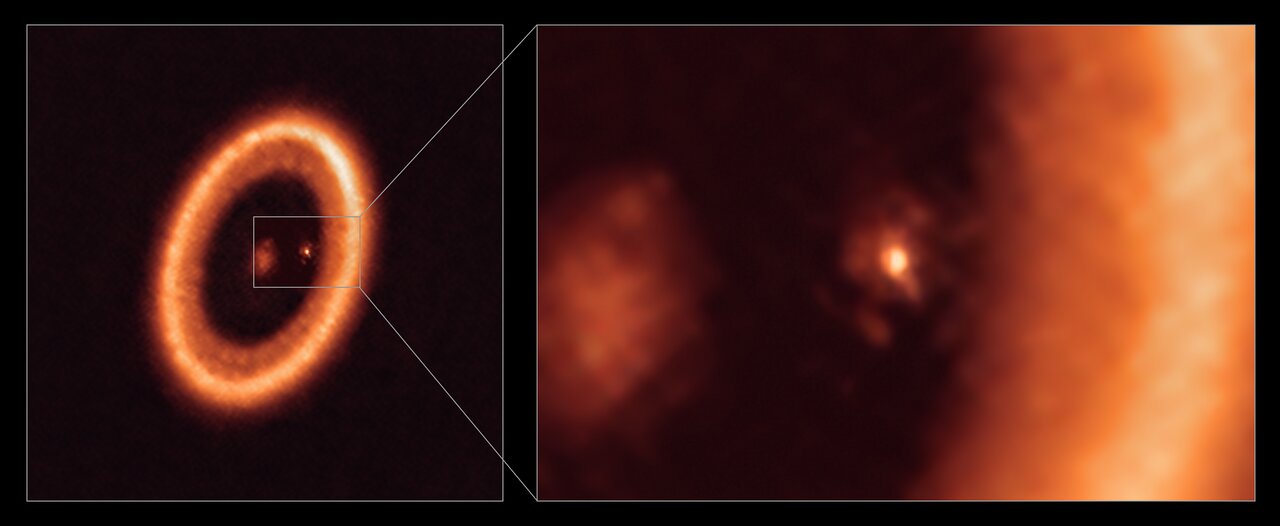
Using the Atacama Large Millimetre/submillimeter Array (ALMA) in Chile, astronomers have made the first confirmed images of a moon-forming accretion disk around another a very young exoplanet.

The photo to the right shows this, with the top image the wide view showing the exoplanet in its orbit around the star, in an area inside the star’s own accretion disk (the larger ring) that the planet has apparently cleared of debris as it gathered itself. The bottom image zooms into the planet to show its own disk of material.

From the press release:

The disc in question, called a circumplanetary disc, surrounds the exoplanet PDS 70c, one of two giant, Jupiter-like planets orbiting a star nearly 400 light-years away. Astronomers had found hints of a “moon-forming” disc around this exoplanet before but, since they could not clearly tell the disc apart from its surrounding environment, they could not confirm its detection — until now.

In addition, with the help of ALMA, Benisty and her team found that the disc has about the same diameter as the distance from our Sun to the Earth and enough mass to form up to three satellites the size of the Moon.

The exoplanet’s disk is thus very large compared to our solar system, but that isn’t surprising considering the difficulty of observing it at such distances. Disks comparable in size to our solar system and the Earth-Moon system are simply too small for any telescope to yet image in this way.

The new data also found this interesting fact: The other known Jupiter-like exoplanet in this system does not have its own accretion disk or any visible debris orbiting it. Why one planet still has such debris and the other does not is a mystery related to the formation of solar systems that is at present not understood.

3 comments

2,000 nearby stars found that see the Earth cross in front of the Sun

Astronomers have identified 2,134 nearby stars that at some point in the past, present, or future are properly positioned along the solar system’s ecliptic so that the Earth can be seen transiting in front of the Sun.

From their paper’s abstract:

[W]e report that 1,715 stars within 100 parsecs from the Sun are in the right position to have spotted life on a transiting Earth since early human civilization (about 5,000 years ago), with an additional 319 stars entering this special vantage point in the next 5,000 years. Among these stars are seven known exoplanet hosts, including Ross-128, which saw Earth transit the Sun in the past, and Teegarden’s Star and Trappist-1, which will start to see it in 29 and 1,642 years, respectively. We found that human-made radio waves have already swept over 75 of the closest stars on our list. [emphasis mine]

I like the detail highlighted. Of the stars that could definitely identify the Earth by transits, 75 are also now close enough to have also heard our radio broadcasts. Should any of those stars also have a sufficiently advanced alien civilization, they could know of our existence. These same stars in turn make for very good targets of study for us to see if there is alien life there.

17 comments

Possible exoplanet detected in habitable zone around Alpha Centauri A?

The uncertainty of science: Scientists have detected faint evidence that suggests the existence of a Neptune-sized exoplanet circling the sunlike star Alpha Centauri A.

After analyzing 100 hours of data gathered by NEAR in May and June of 2019, the scientists detected a thermal fingerprint in the habitable zone of Alpha Centauri A. The signal potentially corresponds to a roughly Neptune-size world orbiting between 1 and 2 astronomical units (AU) from the star, study team members said. (One AU, the average Earth-sun distance, is about 93 million miles, or 150 million kilometers.)

But that planet has not yet been confirmed, so it remains a candidate for now.

This result is very uncertain at this moment, so we should constrain our enthusiasm. If true, however, it would signal the possibility of more exoplanets circling the stars of the nearest stellar system. Alpha Centauri is actually three stars, a binary of two sunlike stars circled at great distance by the red dwarf Proxima Centauri. Scientists already think there are exoplanets circling Proxima, with one about the size of Earth.

What makes this particular interesting, if true, is that the exoplanet was detected not by the slight wobble its gravity caused in the star, or by a transit across the face of the star, but by its own light. If the detection is real, this would be I think the first time that an exoplanet has been seen directly, even if that detection comprises a few tiny pixels of light.

4 comments
1 2 3 4 5 14