FCC approves new spectrum rules to give new constellations more capacity

The Federal Communications Commission (FCC) yesterday approved new spectrum rules proposed by SpaceX that will increase the capacity of all the new low-Earth-orbit constellations by as much as seven times.

The commission introduced the new rules earlier this month before approving them at a Thursday meeting. The revamp targets the Equivalent Power Flux Density (EPFD) rules, which were developed in the late 1990s and limited the amount of energy satellite systems could transmit to and from ground equipment. The regulations were also designed to prevent radio signal interference between higher-orbiting geostationary satellites and lower-orbiting systems. But during the vote, Carr said the decades-old existing rules were “holding back” newer satellite internet offerings.

“Modern satellite designs make it far easier to share spectrum than what yesterday’s regulations assumed. We can do a lot better,” he said. Carr touted the 7x increase when the commission found the revamped rules could enable “eight satellites to provide service simultaneously in a given geographic area and frequency band, instead of being effectively limited to one satellite under current EPFD limits.”

The FCC was sold on this change after SpaceX conducted its own tests in orbit, using Starlink satellites, to demonstrate it could work. The rule change will benefit all the new constellations, which is why Amazon’s Leo constellation supported the change as well.

The speed in which the FCC acted on this matter must also be noted. It did not bother with long studies of its own. It quickly reviews SpaceX’s work, realized it made sense, and scheduled the vote at its very next meeting. This constrasts starkly with the FCC during the Biden administration, which routinely slow-walked or even opposed such suggestions.

The FCC’s agenda at its next meeting includes an item for “Weird Space Stuff”

FCC logo

In releasing its agenda for its upcoming March 26, 2026 open meeting, the Federal Communications Commission (FCC) included one very intriguing item entitled “Spectrum Abundance for Weird Space Stuff.”

In reviewing the fact sheet [pdf] for this particular agenda item, it appears the commission is focused on finding ways to maximize the use of some communications spectrum for more than one purpose. The commission wants to do this because it is anticipating a lot of new demand coming from what it calls “emergent space activities or emergent space operations.” As the fact sheet then notes:

In the geopolitical race to commercialize and dominate the Final Frontier, historic levels of private investment have paved the way for the engineering marvels and daring endeavors that now take place in outer space. Once the province of science fiction, American companies are now upgrading, relocating, and servicing satellites; 1. manufacturing pharmaceuticals in space; 2. building private inhabitable spacecraft; 3. and conducting private robotic missions to the surface of the Moon. 4. Emergent space operations like these depend on the use of radiocommunications for their spacecraft, but they are not the type of communications satellites that have traditionally commanded much of the Commission’s regulatory attention.

Spectrum is a critical component of all space operations. Even for spacecraft that do not provide radiocommunications services to the public, reliable spectrum access is mandatory for safety functions like telemetry, tracking, and command (TT&C) to control spacecraft in orbit. American innovators, however, currently face an acute shortage of usable and readily accessible spectrum for TT&C, and that spectrum crunch threatens to delay — or even prevent — the growth of domestic space technologies and jeopardize U.S. leadership in the booming global space economy. [emphasis mine]

In other words, the FCC is trying to find other spectrum, allocated for other purposes but available at other times, that can be provided to these new in-space operations for this telemetry, tracking, and command functions. To do this it appears it will need to rewrite some of its regulations, and this agenda item raises the issues involved in doing so.

And most interestingly, it is even considering allowing the marketplace solve the problem, by allowing licensees to lease their allocated spectrum to others. The FCC would limit such actions to the spectrum the FCC determines best for these multiple uses, but it is considering setting up rules to allow such freedom.

What an idea! Let free enterprise find a way to use the electromagnetic spectrum in the most efficient way possible.

No decision has been made, and we should expect the Democrats on the commission to oppose this, simply because. Nonetheless, it is a refreshing policy proposal.

Hat tip to reader Steve Golson, who notes quite correctly, “It’s good to see FCC trying to help rather than hinder.” Amen to that.

Blue Origin files FCC application for its own 51,600 data center satellite constellation

Blue Origin yesterday filed with the Federal Communications Commission (FCC) an application to launch 51,600 satellites, dubbed Project Sunrise, aimed at creating its own data center constellation in orbit.

The proposed constellation includes up to 51,600 satellites operating in sun-synchronous orbits at altitudes ranging from 500 to 1,800 kilometers. To manage data traffic, the system will primarily use optical links and mesh backhaul networks, supplemented by Ka-band spectrum for telemetry, tracking, and command operations. The spacecraft will utilize multiple antenna variations to maintain efficient coverage across various orbital planes.

You can read the full application here [pdf].

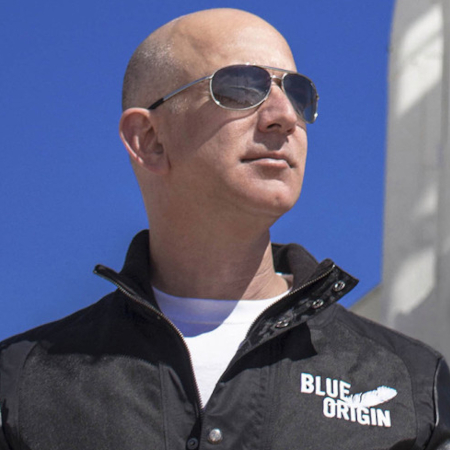
Jeff Bezos
Jeff Bezos, maybe the world’s leader in chutzpah.

Blue Origin also requests several waivers from the FCC’s normal new satellite license requirements, including what I think is a request to waive the FCC’s normal requirement that the applicant launch half its constellation within six years of license approval and complete the constellation three years later. Failure to do so results in financial penalties. The rules were created to prevent companies from getting licenses to grab spectrum from competitors with no intent to launch.

That this Jeff Bezos company is requesting this waiver is what in Yiddish is called chutzpah! Bezos’ other company, Amazon, is clearly going to fail to meet its own license timetable in launching its Leo internet constellation, and was recently lambasted by FCC chairman Brenden Carr for doing so. For Blue Origin to now request this waiver truly is an example of unbelievable gall. I can’t imagine the FCC will do so.

Either way, the competition to put up a lot of satellites continues to grow, with SpaceX and Blue Origin in the best position to make their constellations profitable, because both have their own launch vehicles.

Real change at the FCC?

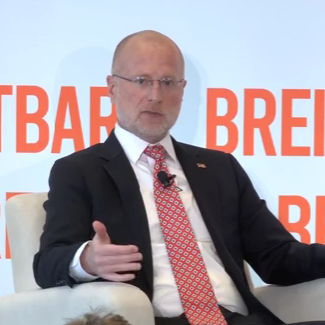
Brendan Carr during Breitbart interview

FCC chairman Brendan Carr this week didn’t simply make a public statement yesterday against Amazon, as I reported earlier today. The day earlier, on March 10th, he did an hour-long interview with Breibart News, providing a more complete summary of the FCC’s overall agenda since the change of administrations from Joe Biden to Donald Trump.

You can watch that interview here. To put it mildly, the shift in policy and approach at the FCC is significant, and appears to be generally moving in the right direction.

To understand the context, we need to first review the FCC’s approach during the Biden administration. My regular readers will remember the many stories during that time describing the FCC’s aggressive effort to expand its regulatory power, in many cases in areas completely exceeding its fundamental statutory authority. For example, it proposed new regulations designed to tell satellite companies how and when to de-orbit their satellites. It also wanted to its own bureaucracy for imposing those regulations, and went ahead and created it without any congressional approval. It also under Biden attempted to limit satellite operations that the astronomy community opposed, an action that was once again outside its statute authority.

Overall, the goal of the FCC under Biden was to expand the power of the administrative state, in as many areas as possible. And though there was push back from Congress, as long as a Democrat was president it was clear that this power-grab was going to grow exponentially.

After the 2024 election, however a Democrat was no longer president. Trump quickly moved in 2025 to squash the FCC’s power grab, with a stated public goal to instead streamline FCC regulations and speed license approvals.

Carr’s interview earlier this week essentially gave us an update on that Trump policy, and it appears this new anti-regulatory policy is moving forward, with a goal to eliminate ten regulations for every one regulation added. According to Carr:
» Read more

FCC chairman blasts Amazon and its Leo satellite constellation

FCC logo

Brendan Carr, the chairman of the Federal Communications Commission, yesterday harshly criticized Amazon for filing papers opposing SpaceX’s application to place a million new satellites into orbit while failing to meet its own FCC license requirement to get 1,600 Amazon Leo satellites in orbit by July 2026.

Amazon should focus on the fact that it will fall roughly 1,000 satellites short of meeting its upcoming deployment milestone, rather than spending their time and resources filing petitions against companies that are putting thousands of satellites in orbit.

To put it mildly, Carr’s point is well taken. In legally protesting SpaceX’s proposed constellation while failing to launch on time as promised, Amazon is following what appears to be standard Jeff Bezos’ practice, epitomized by his rocket company Blue Origin. When customers begin favoring others because the Bezos company either submits a poor bid or fails to meet schedules, the Bezos companies routinely go to court in an attempt to squelch that better competition.

Carr is demanding Amazon stop this, and focus instead on getting its own job done for once. Carr is also signaling the FCC’s position on both SpaceX and Amazon. It is likely going to reject Amazon’s filing and give its okay to SpaceX’s million-satellite constellation, in one form or another.

Carr is also telling Amazon that it faces some push back for failing to launch the required number of Amazon Leo satellites on time. Though it is extremely unlikely the FCC will cancel Amazon’s Leo license, the FCC might fine it heavily. Or it could impose new limits on the constellation. Carr is also indicating the FCC will treat future Amazon license applications much more stringently.

A new American satellite constellation gets FCC approval

The satellite startup Logos has won approval from the Federal Communications Commission (FCC) for its proposed 4,178 satellite internet constellation.

The Federal Communications Commission partially granted the Redwood City, California-based venture’s constellation proposal Jan. 30, clearing operations in K-, Q- and V-band spectrum under certain conditions while deferring and denying parts of its higher-frequency requests. The satellites would operate across seven orbital shells ranging from 870 kilometers to 925 kilometers above Earth, with inclinations spanning 28 to 90 degrees.

Under FCC rules, Logos must deploy and operate half of the constellation within seven years, with the remainder in place by Jan. 30, 2035.

The company last year raised $50 million in private investment capital, and hopes to launch its first satellite by 2027.

It seems this constellation is coming to the game very late.

Amazon asks FCC for time extension for launching its Leo constellation

Amazon yesterday submitted a request to the Federal Communications Commission to extend the July deadline on its license for its Leo internet satellite constellation, which presently requires it to have 1,616 satellites in orbit by that date.

At present Amazon has 181 satellites in orbit, all launched in the last ten months. At that pace there is no chance the company can meet its FCC requirement. From its FCC submission:

While Amazon Leo will meet the deadline for full deployment of its constellation established by its license and the Commission’s rules, launch delays will cause it to fall short of the interim milestone requirement to deploy half of its originally authorized constellation by July 30, 2026. The Commission’s rules provide for extension of such milestones where, as here, delay arises from unforeseeable circumstances beyond an operator’s control or overriding public interest considerations favor an extension.

Because it meets both criteria, Amazon Leo respectfully requests a 24-month extension of its 50% milestone to July 30, 2028, or alternatively, a waiver of this interim requirement.

In its submission Amazon claims the delay is entirely the fault of the rocket companies it was relying on to launch the satellites, but that is a bogus claim. It initially choose to depend almost entirely on three new rockets (Blue Origin’s New Glenn, ULA’s Vulcan, and Arianespace’s Ariane-6), all of which had not launched and were still under development. To expect these to launch on time was absurd.

Furthermore, its ULA contract also called for launches using company’s already operational Atlas-5 rocket, which Amazon claims were delayed because of “unexpected anomalies and delays caused by issues with its vehicle fairings and solid rocket boosters.” I don’t buy it, and suspect the real cause was that Amazon was unable to produce the satellites on time.

Faced with these delays and a stockholder lawsuit, Amazon subsequently signed SpaceX to do three launches, which that company did quickly, in less than four months. If Amazon had truly wanted to get its Leo satellites in orbit on time, it would have given SpaceX more launches and gotten it done.

Nonetheless, it is likely the FCC will agree to Amazon’s extension request. The company has now shown it is committed to the process and intends to get its constellation in orbit. It is not sitting on its license doing nothing. I would not be surprised however if the FCC imposes some new requirements in an effort to force Amazon to launch more satellites more quickly.

FCC approves SpaceX request to expand Starlink by 7,500 satellites

The Federal Communications Commission (FCC) yesterday approved SpaceX’s request to both expand its Starlink constellation by 7,500 satellites as well as use additional bands of spectrum.

The Federal Communications Commission on Friday approved SpaceX’s request to launch an additional 7,500 of its Starlink Gen2 satellites, bringing the total allowed Gen2 constellation to 15,000. The agency also granted the company’s request to operate in additional spectrum bands and to operate at higher power in other bands between 10.7-30 GigaHertz (GHz), pending the completion of an existing FCC rulemaking where the question is being considered.

…The order also allows SpaceX satellites to use lower orbits, down to 340 kilometers, and provide direct-to-cell service. The company is seeking approval for a separate 15,000-satellite constellation that would provide upgraded direct-to-cell service using spectrum it’s purchasing from EchoStar.

The article notes that under the Trump administration has also revamped the FCC’s grant program, that under Biden canceled an $886 million grant, claiming absurdly that Starlink did not provide service to rural areas. Under the new program “SpaceX is set to serve the most locations of any ISP under the $42.45 billion Broadband Equity, Access, and Deployment program after new Trump administration rules that made it easier for satellite providers to compete for funding.”

Not that SpaceX or any of the other constellations need this government grant. Trump would serve the country better to shut the program down.

FCC eliminates red tape for both satellite companies and space stations

The Federal Communications Commission (FCC) this week announced [pdf] that it has changed a number of regulations to streamline its licensing in connection with satellite constellations, ground stations, and new space stations.

Today’s reforms intend to boost the nascent Ground-Station-as-a-Service (GSaaS) business model that allows multiple satellite systems to share the same ground station. The new rules eliminate needless paperwork and clear regulatory barriers to GSaaS, a business model that gives satellite operators—especially startups and emerging growth companies—the ability to send and receive signals without having to build their own ground infrastructure.

…The Order establishes a new process for ground station operators to receive a baseline license without first identifying a specific satellite point of communication. For each new point of communication, only a simple FCC notification will be needed. This one change would eliminate approximately 49% of earth station modification applications.

Today’s action further streamlines and expedites the application process for space stations and earth
stations by moving away from regulations that require FCC approval for making even the smallest
changes to a satellite system.

The direction of regulation has shifted 180 degrees since Trump’s election. Under Biden, federal agencies were constantly tasked to increase oversight so that it often took years to get approvals. Under Trump, those same agencies are now beginning to eliminate regulation across the board.

Elections matter. Anyone who says all politicians are the same is either ignorant or lying.

Senate passes bill that gives NASA and Commerce responsibility for removing space junk

The Senate on October 31, 2023 passed a bill that requires NASA to develop several space junk removal projects while giving the Commerce department the responsibility of identifying what space junk needs to be removed.

The central part of the bill would direct NASA to establish an active debris removal program. Tnat includes creating “a demonstration project to make competitive awards for the research, development, and demonstration of technologies leading to the remediation of selected orbital debris.” It would also require NASA to enter into a partnership to fly a demonstration mission to remove debris.

The debris that could be removed by those demonstrations would come from a list developed by the Department of Commerce to identify debris “to improve the safety and sustainability of orbiting satellites and on-orbit activities.” The Department would also lead work on best practices for space traffic coordination. The bill directs the National Space Council to lead an update of the federal government’s Orbital Debris Mitigation Standard Practices.

Though unstated, this bill appears to be a direct slap at the FCC’s effort under the Biden administration to claim the power to regulate space junk, despite its lack of statutory authority to do so. In fact, the Senate underlined that slap in the face by also passing a bill that demanded the FCC streamline its regulatory overreach rather than expand it.

Neither bill is law yet, and it is unclear whether the House will agree to either. The Senate has sent the space junk bill to the House previously without passage.

FAA and FCC now competing for the honor of regulating commercial space more

Two stories today illustrate again the growing appetite of federal alphabet agencies to grab more power, even if that power is not included in their statutory authority.

First, the Federal Aviation Administration (FAA) proposed new rules governing the de-orbiting of the upper stages of rockets by commercial launch companies.

The FAA is proposing a new rule requiring commercial space companies to dispose of their rocket upper stages to limit the creation of more space debris. Five disposal methods are allowed: a controlled or uncontrolled deorbit within certain time limits, putting the stage into a less congested orbit or sending it into an Earth-escape orbit, or retrieving it. A 90-day public comment period will begin once the proposed rule is published in the Federal Register.

Though this “appears to implement the updated U.S. Orbital Debris Mitigation Standard Practices issued in 2019,” it upgrades it from a “practice” that the government requests companies to follow to a “rule” they must follow. It also expands the power of the FAA to regulate commercial rocket companies, setting a new precedent of control that I guarantee with time will expand further.

Not to be outdone in this power grab, the Federal Communications Commission (FCC) added its own new satellite rules to the satellite licenses of two constellations run by the companies Iceye and Planet. The rules however have nothing to do with regulating the use of the electromagnetic spectrum, which is the FCC’s sole purpose according to the law that created it:
» Read more

Senate approves Biden’s FCC nominee, giving him a Democrat majority on FCC

FCC: now controlled by Democrats
The FCC, now controlled by the
power-hungry Democratic Party

Failure theater: The Senate yesterday voted 55 to 43 to approve Biden’s Federal Communications Commission (FCC) nominee, Anna Gomez, thus giving the Democrats a 4 to 3 majority on the Commission.

This was Biden’s second nominee to the commission, with the first withdrawn when it was clear the Senate opposed the nominee.

Biden tried again in May with the nomination of Gomez, a State Department digital policy official who was previously deputy assistant secretary at the US National Telecommunications and Information Administration (NTIA) from 2009 to 2023. A lawyer, Gomez was vice president of government affairs at Sprint Nextel from 2006 to 2009 and before that spent about 12 years at the FCC in several roles.

Gomez got through the confirmation process with relative ease, though most Republicans voted against her. Both parties seem to expect the FCC to reinstate net neutrality rules now that Democrats will have a majority.

Imposing net neutrality is essentially socialism/communism for the internet. It will squash competition, cost a fortune, and eventually be used as well to squelch dissent online (which translates into silencing conservatives).

From the perspective of space, the majority on the FCC is likely very bad news as well, for several reasons. » Read more

Senate committee approves Biden’s FCC nominees

Despite apparent opposition to the Biden nominees by Republicans, the Senate committee involved has approved the three FCC nominees and moved that the process proceed to a vote in the full Senate.

The article also includes these paragraphs, describing absurdities that could only occur in Congress:

[Ted] Cruz [R-Texas] moved that all the nominations, including Damelin and a nominee for the National Transportation Safety Board plus a list of Coast Guard promotions, be favorably reported. There were no objections and the motion was agreed to.

Immediately thereafter, however, Cruz and other Republicans asked to be recorded as no on Gomez and/or Starks and two Democrats as no on Carr. It’s not possible to discern from the webcast who was speaking in all instances, but the bottom line is that all the nominations were approved and now can go to the floor for a vote by the full Senate. The requests to be recorded as no are a signal that the rest of the confirmation process will not be easy.

Cruz moves the nominees should be “favorably” reported, but then announces he and others are against some.

All in all, this appears to be another example of Republican failure theater. Make it sound like you are trying to block Biden’s policies, but then do whatever is necessary to let them to go into effect. Considering that the Democratic Party appointees at the FCC have been pushing for regulatory power beyond the commission’s statutory authority, it seems absurd for any Republican senator (or Democrat senator for that matter) to okay any Biden nominees who would continue that power grab. And yet, the Republicans appear willing to go along.

New bill imposes new and odious regulation on private space stations and satellites

Congress and the FCC to private space: Nice business you got here.
Congress and the FCC to private space: “Nice business you
got here. Shame if something happened to it.”

On December 8, 2022, two bills, sponsored by both a Democrat and a Republican, were introduced in the House to give the Federal Communications Commission (FCC) the power to regulate and even block the launch of commercial private space stations, while also giving that agency the power to require companies to meet its arbitrary regulations on de-orbiting defunct satellites and stations.

House Energy and Commerce Committee Chairman Frank Pallone, Jr. (D-N.J.) and the ranking member, Rep. Cathy McMorris Rodgers (R-Wash.), said their legislation is needed to modernize the FCC for the rapidly changing space industry. Their two bills — the Satellite and Telecommunications Streamlining Act and Secure Space Act — seek to update regulations covering foreign ownership, space sustainability, license processing timelines, and satellite spectrum sharing.

The key language in the first bill [pdf] is this:
» Read more

Several major rocket companies to the FCC: stay out!

In response to the proposal by managers at the Federal Communications Commission (FCC) that it regulate satellite operations despite having no actual legal authority to do so, a cohort of major rocket companies as well as others have responded in firm opposition.

Major space companies, including SpaceX and Relativity, are urging the U.S. Federal Communications Commission (FCC) to stick to its purview — spectrum usage — as it looks to potentially update its rules for in-space servicing, assembly and manufacturing (ISAM) missions.

There is plenty that the FCC could — and should do — to support ISAM missions that sit squarely within its regulatory bounds, the companies said. SpaceX and others, as well as startups like Orbit Fab, which wants to build refueling depots in space, and Starfish Space, which is developing a satellite servicing vehicle, submitted recommendations related to spectrum and ISAM. The commission also heard from Blue Origin, Lockheed Martin, United Launch Alliance and other space companies and industry groups.

…Relativity Space and the industry association Commercial Spaceflight Federation separately argued that the FCC’s involvement in issues outside of those related to spectrum could result in duplicative approvals processes. These could be especially challenging for smaller startups and newer space entrants to navigate.

It is likely that if the FCC tries to impose regulations outside of its legal authority, one or more of these companies are going to sue to nullify those regulations, and will likely win. In the process nothing will be gained, and much lost. Thus, this advice from the industry makes great sense, and the FCC and the Biden administration should stop playing empire-building games and focus on what it is legally supposed to do.

FCC decides to expand its power in space

FCC: Now in charge of everything in space

The Federal Communications Commission (FCC) today voted to initiate what it calls a “Notice of Inquiry” to begin a policy review aimed at expanding its involvement and regulation of “space missions like satellite refueling, inspecting and repairing in-orbit spacecraft, capturing and removing debris, and transforming materials through manufacturing while in space.”

From the Federal Communications Commission’s press release [pdf]:

Today’s action continues this modernization effort as in-space servicing, assembly, and manufacturing capabilities – or “ISAM” – has the potential to build entire industries, create new jobs, mitigate climate change, and advance America’s economic, scientific, technological, and national security interests. ISAM missions take place on-orbit, in transit, or on the surface of space bodies. The FCC’s effort to open up this conversation dovetails with the Office of Science and Technology Policy’s recent release of a ISAM National Strategy.

This policy review is part of the FCC’s broad effort to update its rules for the new space age. For example, the FCC is taking significant steps to update its satellite rules. The FCC also adopted new rules to lay the groundwork for giving satellite launch companies ready access to spectrum for transmissions from space launch vehicles during pre-launch testing and space launch operations.

ISAM (In-space Servicing, Assembly and Manufacturing) refers to the final policy statement [pdf] of a working group in the National Science & Technology Council, created as part of the Office of Science and Technology Policy in the Biden administration. That policy statement outlined six strategies that the federal government needs to focus on to encourage American success in space. From its conclusion:
» Read more