Final ground testing begins of Katalyst’s Swift rescue spacecraft

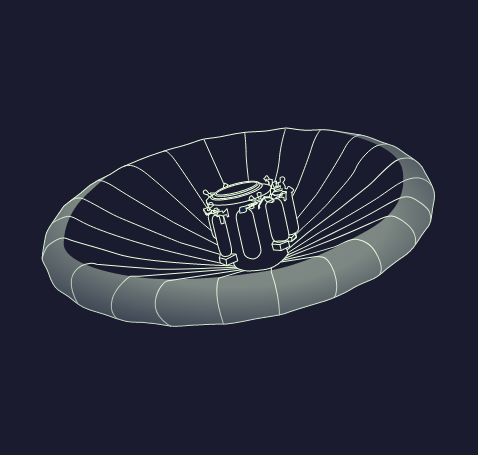
Katalyst's proposed Swift rescue mission
Katalyst’s proposed Swift rescue mission.
Click for original image.

Only seven months after NASA awarded the satellite repair startup Katalyst the contract to save the Gehrels-Swift space telescope, the company has delivered the completed LINK spacecraft to the Goddard Space Flight Center in Maryland for final ground testing.

Katalyst will move forward with LINK’s vibration and thermal tests using NASA Goddard’s in-house facilities in the coming weeks before installation into Northrop Grumman’s Pegasus rocket at the agency’s Wallops Flight Facility in Virginia.

Gehrels-Swift has been one of NASA’s most productive space telescopes. Unfortunately its orbit is decaying and if nothing is done to raise that orbit it will burn up in the atmosphere in 2029 or so. To extend this timeline engineers have stopped almost all science work in February.

Katalyst hopes to launch LINK as soon as later this year. It was able to get it built so quickly because it was already under construction as the company’s first demo of its repair technology. When NASA put out a bid for boosting Swift, the company shifted gears and reconfigured LINK for this mission.

If successfully, the achievement will be a major coup for this startup.

1 comment

The space agencies of Canada and Europe agree to exchange classified information

Canada:
Canada: “We let our government do it all!”

In what appears to be the increasing policy of the Canadian Liberal government to align its space program with Europe, the Canadian Space Agency this week signed an agreement with the European Space Agency that will make it possible for them to freely exchange classified information.

The European Space Agency (ESA) and Canada have signed a General Security of Information Agreement (GSOIA), which will establish a legally binding framework for the exchange of classified information. The agreement was signed on 14 April at the 41st Space Symposium in Colorado Springs, USA, by ESA Director General Josef Aschbacher and President of the Canadian Space Agency Lisa Campbell, on behalf of the Government of Canada.

The GSOIA will ensure that both parties uphold the highest standards of security while enabling the secure exchange of sensitive information entrusted to authorised institutions and industrial partners. It provides a robust foundation for cooperation in areas where the protection of classified information is essential. In particular, the agreement will facilitate closer collaboration in strategic domains such as space-based surveillance, disaster response and security-related technologies. It will also support the development of dual-use capabilities, including advanced sensing systems, secure communications and emerging space technologies.

Canada is the only country not in Europe that is a partner in ESA. This deal, plus Canada’s recent commitment to provide a half billion dollars of funding to ESA projects, illustrates the Liberal government’s policy to look to Europe more for its space effort, rather than the United States.

This appears also to be part of the Liberal government’s shift away from capitalism and towards a government-based space effort, a decision that is certain to produce few results while wasting a lot of money.

20 comments

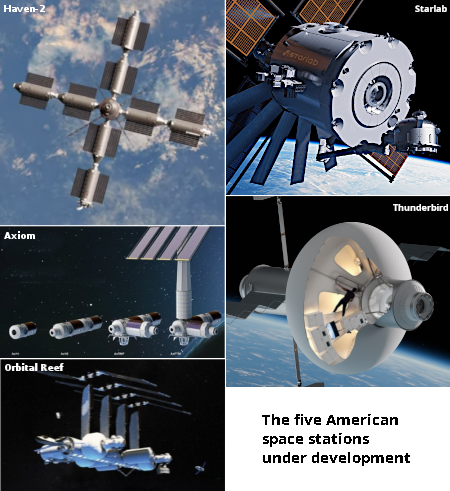
The space station startups: NASA’s new space station plan is mistaken

The American space stations under development

At a conference event this week officials from three of the five American space station startups expressed strong disagreement with NASA’s new space station plan.

The new plan would have NASA build and launch its own new core module, dock it with ISS, and have the new stations attach their first modules to it prior to flying freely. NASA proposed this plan because it does not believe there is enough market to sustain the stations independently and NASA doesn’t have the budget to fully fund them.

The officials repeatedly disagreed about the market issue.

“We believe not only we can be ready by 2030” when the International Space Station is slated to be retired, “but we also believe that we can be profitable on the current market, not waiting for the future market we all will develop and will be successful at,” said Max Haot, CEO of Vast [building the Haven-1 and Haven-2 stations].

…Haot and executives from Axiom Space and Starlab Space said their responses to NASA’s request for information — which were due April 8 — show otherwise. “We put in 390 pages of independent analysis, research studies, datas, contracts, those types of things,” said Marshall Smith, CEO of Starlab Space, which is targeting 2029 for its station to be on orbit. “We’re being very clear and what we can do and how that works.”

One prominent revenue stream the panelists pointed to is other space agencies and nations eager to send their astronauts and payloads to space. “We’ve flown 12 people to space that paid us money to do that,” said Jonathan Cirtain, CEO of Axiom Space, referring to the four private astronaut missions it’s conducted to ISS. “We’ve flown 166 payloads today. All of those are paying payloads that generate revenue for the company.” The Texas company plans to begin operating in 2028 when its first two station modules are slated to be in orbit, then gradually grow the station to five modules.

The officials also said the core module idea would actually slow things down. NASA would have to first build and launch it, and would be starting from scratch to do so. It takes years to build such a thing, and it will certainly not be ready by 2030, when ISS is presently supposed to be retired. Moreover, forcing them to dock to this module would force them all to completely change their own plans, something they all find counter-productive.

In announcing NASA’s core module plan, NASA administrator Jared Isaacman also stated that he was open to industry feedback. I suspect that his core module proposal is going to die, and be replaced with the more direct transition from ISS to these private stations, the approach these companies favor.

I should add that the three startups that spoke up at this conference are also the three that are in the lead to build their stations, according to my rankings below. As far as I can tell, they are all tied for first place, with their station development very robust and well financed.
» Read more

26 comments

Latvia to sign Artemis Accords

NASA announced today that Latvia will be signing on to the Artemis Accords on April 20, 2026, becoming the 62nd nation to join this American alliance in space.

The Republic of Latvia will sign the Artemis Accords during a ceremony at 9 a.m. EDT Monday, April 20, at NASA Headquarters in Washington. NASA Administrator Jared Isaacman will host Dace Melbārde, Latvia’s minister for education and science; Jānis Beķeris, chargé d’affaires at the Embassy of the Republic of Latvia to the United States; and Jacob Helberg, under secretary of state for economic affairs at the U.S. Department of State.

With this signing, all three of the Baltic states that were once occupied and part of the Soviet Union have now joined this American alliance. So have the former Soviet provinces of the Ukraine and Armenia, as well as the nations of Bulgaria, Czech Republic, Slovakia, Hungary, Poland, Romania, and Slovenia, all of which were once part of the Soviet Bloc, behind the Iron Curtain. In fact, almost all of Russia’s neighbors in Europe have allied themselves with the U.S. Artemis space alliance. It does appear that Putin’s stupid effort to recapture the Ukraine has backfired badly, encouraging these nations to come to us out of fear of the aggressive tyrant on their borders. These nations also probably recognize that Russia’s space effort is a Potemkin Village, hollow and of little worth. If they want to go to space, they need to align themselves with American technology.

The full list of all signatories to this American space alliance:

Angola, Argentina, Armenia, Australia, Austria, Bahrain, Bangladesh, Belgium, Brazil, Bulgaria, Canada, Chile, Colombia, Cyprus, Czech Republic, Denmark, Dominican Republic, Ecuador, Estonia, Finland, France, Germany, Greece, Hungary, Iceland, India, Israel, Italy, Japan, Latvia, Liechtenstein, Lithuania, Luxembourg, Malaysia, Mexico, the Netherlands, New Zealand, Nigeria, Norway, Oman, Panama, Peru, Poland, Portugal, Romania, Rwanda, Saudi Arabia, Senegal, Singapore, Slovakia, Slovenia, South Korea, Spain, Sweden, Switzerland, Thailand, the Philippines, the United Kingdom, the United Arab Emirates, the Ukraine, the United States and Uruguay.

2 comments

Saxavord spaceport faces new regulatory and financial issues

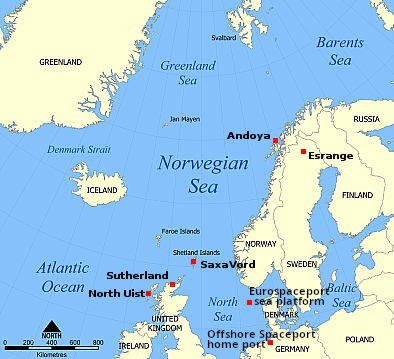
Proposed or active spaceports in North Europe

The long-delayed Saxavord spaceport on the Shetland Islands in Great Britain appears to now face two new problems that could block future launches, one regulatory and the second financial.

First the financial issue: The spaceport, which has lost about $7 million in both ’23 and ’24, appears to be in technical default of a loan of a bit more than $14.3 million. In this case, the lender is willing to ignore the technical issue, assuming the spaceport meets certain conditions presently being negotiated.

The regulatory issue however is more serious, and could block the spaceport’s expected first launch later this year by the rocket startup Rocket Factory Augsburg.

Despite claiming to be ready for launch, the spaceport has also been subject of a formal complaint to the SIC [Shetland Islands Council] over allegations that the facility has not yet been granted a completion certificate or approval for occupation. The complaint alleges that the fire detection and alarm systems appear not to have been installed and that the premises may be in use without adequate fire precautions. It asks the council to confirm whether the premises has been subject to regulatory oversight and whether it has undertaken an inspection of the site.

The SIC said in response: “Concerns have been raised with the council and these are being looked at by our building standards service. A site inspection is scheduled this week as part of the live building warrant process, including to establish the current position in relation to the building on the site that falls within the council’s building standards remit. Any further action will be considered in light of the findings of that inspection.”

In other words, if the local council finds the fire detection and alarm systems not installed and within its regulatory responsibility, it will deny Saxavord its launch permit.

Meanwhile, the spaceport has been trying for years to get other rocket companies interested in using Saxavord, to no avail. Rocket startups have enough difficulties. They quite rightly don’t need the added delays caused by the UK’s red tape, delays that contributed to the bankruptcy of two different rocket startups. For example, most of the regulatory delays — lasting years — have initially come from a variety of national agencies, with Great Britain’s Civil Aviation Authority leading the way. This new issue is local, an additional bureaucratic layer that must be satisfied.

0 comments

Vast unveils a proposed docking port more than 3x larger than standard space station ports

Vast's larger port compared to standard ports now used at ISS
Click for short movie.

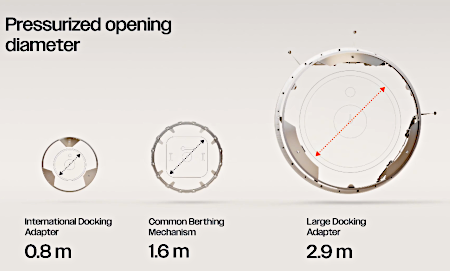
The space station startup Vast yesterday unveiled its proposed Large Docking Adapter, designed to provide a docking port more than three times wider than the standard space station ports presently used on ISS.

The image to the right provides an clear comparison. The two smaller ports on the left are presently used on ISS. Vast’s new port is on the right.

Vast, the company developing next-generation space stations, announced today at the 41st Space Symposium the Large Docking Adapter, including its current development, its availability for purchase, and Vast’s plans to open-source its interface.

Future space stations will use larger modules, have greater overall mass, and dock with a new generation of bigger crewed vehicles. New docking standards and universal hardware are required for the future generation of space vehicles and habitats. The Large Docking Adapter is engineered to support higher mass and increased structural demands while enabling varying types of modules and vehicles to dock together. By open-sourcing the interface, slated for May 2026, Vast is intending to encourage industry-wide collaboration and accelerate the development of interoperable space systems.

Animations of the adapter at this Vast website suggest strongly that the company wants to encourage SpaceX to use the adapter on Starship. Since the company is releasing the design as open-source, it also wants everyone to use it as the standard.

Such a port could also be used on a variety of other spacecraft designs presently under development, and if used would enhance their capabilities significantly.

12 comments

Voyager wins slot to fly tourist mission to ISS in 2028

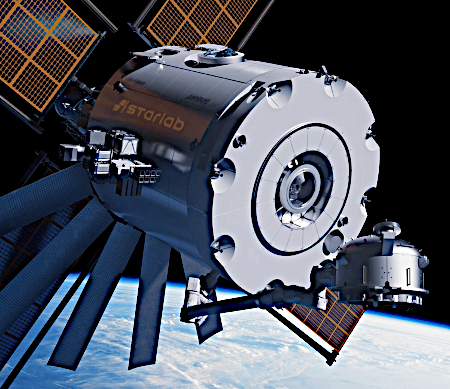
Starlab design as of December 2025

NASA today announced that it has awarded Voyager Technologies a slot to fly a tourist mission to ISS in 2028.

The mission, named VOYG-1, is expected to spend as many as 14 days aboard the space station. A specific launch date will depend on overall spacecraft traffic at the orbital outpost and other planning considerations.

Voyager will submit four proposed crew members to NASA and its international partners for review. Once approved and confirmed, they will train with NASA, international partners, and the launch provider for their flight.

Voyager is the lead company in the consortium that is building the Starlab station, a single very large module to be launched on SpaceX’s Starship.

At this moment three of the five commercial stations that are developing private space stations — Axiom, Vast, and Voyager — now have deals to fly such missions to ISS. The two remaining likely didn’t pass muster with NASA, for different reasons. Max Space is a late comer to this competition, only declaring that it is building its own station this year. Orbital Reef, led by Blue Origin and Sierra Space, is apparently a dead project, with neither company doing anything to sell its project for the past year or so.

In my rankings below of the five American commercial space stations presently in development, the first three are essentially tied at this point.
» Read more

2 comments

Three launches today, two by SpaceX and one by China

The launch beat goes on! First, China launched eight satellites using its Kinetic-1 (Lijian-1) rocket, lifting off from its Jiuquan spaceport in northwest China. China’s state-run press provide no further information about the satellites, nor did it provide information about where the rocket’s lower stages crashed inside China.

Next, SpaceX completed two Starlink launches on opposite coasts. First it placed 29 Starlink satellites in orbit, its Falcon 9 rocket lifting off from Cape Canaveral Space Force Station in Florida. The first stage completed its 26th flight, 42 days after its previous flight, landing on a drone ship in the Atlantic.

The company then did its second launch of the day, placing 25 Starlink satellites into orbit, its Falcon 9 rocket lifting off from Vandenberg Space Force Base in California. The first stage completed its 21st flight, 45 days after its previous flight and landing on a drone ship in the Pacific.

The leaders in the 2026 launch race:

46 SpaceX
20 China
5 Rocket Lab
5 Russia

For the third straight year SpaceX continues to lead the entire world combined in total launches, 46 to 35.

2 comments

Firefly’s delays launch of its Eclipse rocket to 2027

Eclipse as of April 2026
Click for original image.

It appears that Firefly has delayed the first launch of its new more powerful Eclipse rocket — being built in partnership with Northrop Grumman — to 2027.

The company made no specific announcement, but in a tweet today touting the rocket’s “fresh look”, with no details, the company linked to its Eclipse webpage (in the first link above) that describes the rocket in detail. In the last paragraph adds that the first launch is now scheduled for “no earlier than 2027”, a delay from the 2026 launch date both companies were originally targeting.

This guarantees that SpaceX’s Falcon 9 is going to get more launch contracts taking Northrop Grumman’s Cygnus capsule to ISS.

Firefly says Eclipse is being built for re-usability, but the graphics of the rocket, as shown above, are puzzling in that they show grid fins but no landing legs.

7 comments

Space Force selects Blue Origin as possible lessor of “Sudden Flats” site at Vandenberg for future heavy lift rocket launches

Vandenberg Space Force Base

The Space Force has chosen Blue Origin to help develop the plans and possibly lease the “Sudden Flats” site — also dubbed Space Launch Complex-14 (SLC-14) — at Vandenberg Space Force Base in California for the launch of heavy lift commercial rockets.

The location is shown in the map to the right. The Space Force had requested proposals for developing the site in December 2025.

Respondents were evaluated based on technical capability, financial maturity and alignment with U.S. government requirements. The selection of Blue Origin reflects their ability to meet these criteria and contribute to the development of heavy or super-heavy launch capabilities at Vandenberg Space Force Base.

SLC-14 is considered the most viable site at [Vandenberg] for heavy and super-heavy launch operations due to its location.

Several crucial milestones must be achieved before any construction or launch activities can commence, to include safety assessments and an environmental impact analysis. The timeline for increased launch activity will depend on the completion of the safety and environmental analysis and subsequent infrastructure development.

I suspect that Blue Origin won this bid because SpaceX didn’t offer a proposal. It already has three launch sites for Starship/Superheavy, and probably decided it didn’t need this site.

Blue Origin meanwhile in November 2025 announced planned upgrades to its New Glenn rocket that would make it as powerful as NASA’s SLS rocket, but much cheaper because its first stage is reusable. The company is likely hoping to build that rocket, dubbed New Glenn 9×4 (based on the number of engines on the first and second stages respectively), and launch it from this site.

12 comments

Update on Superheavy/Starship: Both ships doing final static fire testing

Link here. The report includes a lot of very interesting information about how SpaceX is evolving its launch platforms and the tank farms that fuel the stages in order to make them operate more efficiently. For example:

In the past, on Pad 1, SpaceX had only four Liquid Oxygen (LOX) Pumps and six subcoolers, and three Liquid Methane (LCH4) Pumps with three subcoolers. This setup allowed SpaceX to start booster load at T-41:15 on Flight 11.

On Pad 2, SpaceX has five pumps and about 10 subcoolers worth of capacity on the LOX side, and four pumps alongside about six subcoolers worth of capacity on the LCH4 side. With these upgrades, along with larger supply lines, SpaceX can now load a full booster within 30 minutes, and each LOX ring takes only about 90 seconds to load. This now means SpaceX can load the Superheavy booster faster than a Falcon 9 and carry over 10 times the propellant. [emphasis mine]

Many of the tests have been more to prove out the fueling systems and launchpad than to test Superheavy.

Other tests however have been to prove out the new Raptor-3 engine. The company have increased the number of engines step by step so that the next test will be the first to test all 33 engines. I suspect that test will also be the full dress rehearsal countdown prior to launch.

Starship meanwhile is undergoing testing on the company’s nearby Massey test stand, the one that I think was rebuilt after an explosion last year.

Stay tuned. It appears the next and 12th orbital test flight will not be long in coming.

6 comments

Three launches, two by SpaceX and one by China

Falcon 9 landing for its seventh time
Falcon 9 landing for its seventh time on today’s
third launch. See below.

Since last night there were three launches globally, two by SpaceX, and one by China.

First, in the wee hours of the morning SpaceX placed 25 more Starlink satellites into orbit, its Falcon 9 rocket lifting off from Vandenberg Space Force Base in California. The first stage (B1063) completed its 32nd flight, landing on a drone ship in the Pacific. With this flight, 43 days after the stage’s previous flight, it moved into a tie for fourth place in the rankings of the most reused launch vehicle:

39 Discovery space shuttle
34 Falcon 9 booster B1067
33 Atlantis space shuttle
32 Falcon 9 booster B1071
32 Falcon 9 booster B1063
30 Falcon 9 booster B1069
28 Columbia space shuttle
27 Falcon 9 booster B1077
27 Falcon 9 booster B1078

Sources here and here.

Next China launched a classified satellite to test “internet technology”, its Smart Dragon-3 (Jielong-3) rocket lifting off from a sea platform in international waters in the South China Sea. Though China has launched numerous times from this sea platform, previous launches were very close to the shore. This was the first time the platform was moved this far into the ocean.

Finally, SpaceX completed its second launch in less than eight hours, sending Northrop Grumman’s Cygnus capsule on its way to ISS with 11,000 pounds of cargo, its Falcon 9 rocket lifting off from Cape Canaveral Space Force Station in Florida. The first stage completed its seventh flight, landing back at Cape Canaveral. Of the two fairings, one was making its first flight, while the other was on its fifth flight.

This was SpaceX’s fourth Cygnus launch for Northrop Grumman. The company originally launched Cygnus on its own Antares rocket, but when that rocket ran out of its Russian first stage engines it was grounded. The company hired Firefly to build a new first stage, but that project remains uncompleted.

Cygnus is scheduled to berth with ISS in two days, on Monday, April 13, at 12:50 pm (Eastern).

The leaders in the 2026 launch race:

44 SpaceX
19 China
5 Rocket Lab
5 Russia

For the third straight year SpaceX continues to lead the entire world combined in total launches, 44 to 34.

28 comments
1 9 10 11 12 13 684