SpaceX launches 25 more Starlink satellites

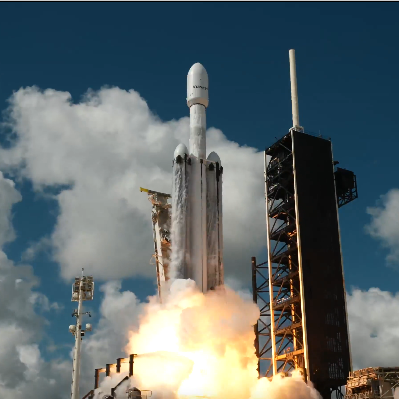
SpaceX this morning successfully placed another 25 Starlink satellites into orbit, its Falcon 9 rocket lifting off from Vandenberg Space Force Base in California.

The first stage completed its 15th flight, landing on a drone ship in the Pacific.

The leaders in the 2026 launch race:

50 SpaceX
23 China
8 Russia
6 Rocket Lab

For the third straight year SpaceX continues to lead the entire world combined in total launches, 50 to 42.

4 comments

Indian rocket startup Skyroot now shipping its Vikram rocket to launch site

The Indian rocket startup Skyroot has now finished assembling its Vikram-1 rocket, and is about to ship it to its launch site at the Sriharikota spaceport on the east coast of India.

At Sriharikota, the rocket moves into final assembly and a round of system checks before a launch window is locked in the coming months. This is the last stretch before liftoff. Countdown operations, testing and integration now shift fully to the launch site.

One of the company’s founders said the most critical testing has been completed, with launch campaign activities set to begin at the spaceport.

The company is presently targeting a launch in June. If Vikram-1 reaches orbit successfully, Skyroot would become the first Indian private company to design, build, and launch its own rocket, and would be well positioned to win launch contracts from smallsat companies, competing directly with Rocket Lab and its Electron rocket.

This success would also help accelerate the Modi government’s effort to transition from a space industry controlled entirely by its government space agency ISRO to a private industry run by competing indepedent companies.

1 comment

Why is Sierra Space’s Dream Chaser spacecraft not ready for flight?

In a press release posted last week Sierra Space proudly announced that its Tenacity Dream Chaser mini-shuttle has completed its pre-launch ground vibration tests at the Kennedy Space Center in Florida, but instead of moving the mini-shuttle to a local facility where it could be integrated with its rocket for launch, the company announced it was shipping it back “to Colorado for final modifications and mission-specific upgrades.”

Normally when a spacecraft, satellite, or any payload passes these last ground tests, it is ready for launch, and it immediately begins integration onto the rocket that will carry it into space. That Sierra Space is not doing this strongly suggests Tenacity did not pass with flying colors, and that some issues were identified that need correction.

Note too that this spacecraft had been delivered for these tests in early 2024, and had been expected to pass them then and be launched that year. Instead, months passed with no word, then its launch was postponed indefinitely, and then NASA canceled Sierra’s contract to provide cargo to ISS.

Now, two years later Tenacity is still not ready for launch. Though the company says the ground tests are now complete, I suspect otherwise. I suspect there is some fundamental issue with the spacecraft that they are hiding because to reveal it would be devastating to Sierra’s public reputation.

Until we know more however this is pure speculation on my part. What we do know however is that this mini-shuttle has not done what was promised, and increasingly appears to be a lemon that will never do it.

13 comments

Space Force issues twelve companies Golden Dome contracts worth $3.2 billion

As part of the first phase of development of the proposed Golden Dome defensive system, the Space Force revealed this week that it has awarded twelve companies contracts worth $3.2 billion to develop the first prototype designs.

The service awarded other transaction authority (OTA) agreements — worth up to a combined $3.2 billion — to the vendors in late 2025 and early 2026, according to a Space Systems Command press release. Under the contracts, the companies will develop prototypes of a space-based architecture that can shoot down enemy missiles after they’re launched.

The companies that received OTAs are Anduril, Booz Allen Hamilton, General Dynamics Mission Systems, GITAI USA, Lockheed Martin, Northrop Grumman, Quindar, Raytheon, Sci-Tec, SpaceX, True Anomaly and Turion Space Corp.

The twelve companies have very different capabilities, suggesting the Space Force is hoping to get a lot of different ideas and proposals that will not only give it options but could also provide it multiple methods for destroying in-coming missiles.

9 comments

Soyuz launch site destroyed at French Guiana

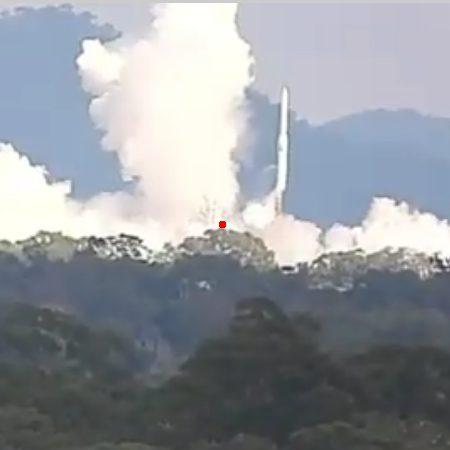
As promised, the Soyuz-2 launch site at France’s French Guiana spaceport was destroyed in a controlled explosion yesterday.

I have embedded video of the explosion below.

The remaining infrastructure at the site—including the assembly and testing complex, railway lines, liquid oxygen storage facilities, and fueling systems—will be transferred to MaiaSpace, a French startup affiliated with Arianespace. The company plans to reuse up to 80% of the existing infrastructure for its own launch vehicle program.

MaiaSpace is not “affliated with Arianespace.” It is a wholly owned subsidiary of ArianeGroup, the company that makes the much larger rocket Ariane-6. The company hopes MaiaSpace’s smaller Maia rocket can capture some of the smallsat business presently owned by Rocket Lab and SpaceX.

The Russians had almost a dozen launches scheduled from this launchpad, worth more than a billion dollars in revenue, when Putin decided to invade the Ukraine in 2022. Russia immediately became a pariah to the rest of the work. That revenue instantly vanished and the companies found other launch providers.

Europe meanwhile gave control of French Guiana back to France, which owns it. France in turn has now been leasing out the unused launchpads there to new rocket startups. Though some pie-in-the-sky academics lobbied to preserve the Soyuz launchpad for “historical reasons”, the French had no desire to do so. Better to make money.
» Read more

5 comments

SpaceX launches 24 more Starlink satellites

SpaceX this evening followed up Rocket Lab with its own launch of 24 more Starlink satellites, its Falcon 9 rocket lifting off from Vandenberg Space Force Base in California.

The first stage completed its fifth flight, landing on a drone ship in the Pacific.

The leaders in the 2026 launch race:

49 SpaceX
21 China
6 Russia
6 Rocket Lab

For the third straight year SpaceX continues to lead the entire world combined in total launches, 49 to 38.

3 comments

Rocket Lab launches satellites for Japan’s space agency JAXA

Rocket Lab today successfully placed eight smallsats for Japan’s space agency JAXA, its Electron rocket lifting off from one of its two launchpads in New Zealand.

Because all of JAXA’s rockets are presently grounded due to technical failures, Japan’s space agency has had to turn to Rocket Lab. In fact, these eight satellites were originally supposed to launch on JAXA’s Epsilon-S rocket, which remains grounded after an explosion during a static fire test. There have been no updates on the status of Epsilon-S since December 2024.

Rocket Lab was also supposed to do a suborbital hypersonic test flight yesterday out of Wallops Island in Virginia, using the first stage of Election in its HASTE suborbital configuration. As this is a test for the War Department, little information is generally released. This video from a distance confirms the launch apparently took place, but whether it was a success or not remains unknown. That Rocket Lab’s announcers did not tout its success either before or after today’s JAXA launch — as they have routinely done in the past — suggests something might have gone wrong, though this too is pure speculation.

The leaders in the 2026 launch race:

48 SpaceX
21 China
6 Russia
6 Rocket Lab

For the third straight year SpaceX continues to lead the entire world combined in total launches, 48 to 38.

10 comments

European startup Atmos raises €25.7 million to develop its orbital research capsules

Atmos' Phoenix-2 during re-entry
A graphic showing Atmos’ Phoenix-2 capsule during re-entry,
protected by an inflatable shield. Click for more information.

The European startup Atmos announced today that it has raised an additional €25.7 million [$30 million] as part of its ongoing commercial program to develop its Phoenix orbital research capsules that will fly in space for several months — where products can be produced in weightlessness — and then return those products safely to Earth.

The funding will support an initial three-vehicle PHOENIX 2 fleet, the launch of ATMOS WORKS for governmental and defence customers, and development of PHOENIX 3, the company’s next-generation orbital return vehicle.

The round is co-led by Balnord and Expansion, and joined by Keen Defence and Security. The European Innovation Council (EIC) participates through its Accelerator programme via blended financing, combining grant and equity components. Additional investors include OTB Ventures, High-Tech Gründerfonds (HTGF), APEX Ventures, Seraphim, Faber, E2MC, Kirch Ventures, Lennertz & Co., Mätch VC, MBG Baden-Württemberg, and Tech Horizons.

Since the American company Varda successfully demonstrated there was money to be made flying these small recoverable capsules, investment capital has poured into this industry. In the U.S. Varda, Inversion Space, and Sierra Space, have raised money for doing such orbital work. In Europe, The Exploration Company in France, Atmos in Germany, PLD in Spain, Genesis in Croatia, and Space Cargo in Luxembourg have also raised capital.

At this moment, however, only Varda has successfully launched and recovered a capsule.

0 comments

Northrop Grumman lost $71 million from its bottom line because of its solid-fueled booster failures

In its most recent financial statement, Northrop Grumman admitted it took a $71 million charge due to nozzle failures on two of its solid-fueled boosters, dubbed GEM 63XL, during two different launches of ULA’s Vulcan rocket.

In a statement about its first-quarter financial results, the company said its Space Systems division recorded a $71 million “unfavorable adjustment” to earnings at completion on its GEM 63XL booster “associated with a launch anomaly that occurred during the first quarter.”

The GEM 63XL solid-fuel booster is used on United Launch Alliance’s Vulcan Centaur rocket. On a Feb. 12 launch, one of four boosters shed debris about 65 seconds after liftoff. The “observation,” as ULA termed it initially, did not affect the success of the USSF-87 mission, placing its payload into its planned geosynchronous orbit.

ULA later called the incident a “significant performance anomaly” with the booster that it would investigate before returning Vulcan to flight. The vehicle has not launched since then.

A similar incidence took place during an earlier Vulcan launch, with the rocket’s core stage and the remaining undamaged boosters getting the payload into the proper orbit. The continuing problem however has now grounded Vulcan, though the military is considering using it for some small payload launches, without the GEM strap-on boosters.

As a result, the Pentagon has already shifted several launches from ULA to SpaceX, costing ULA a significant amount of revenue. In addition, Vulcan’s grounding will impact the launch of Amazon’s Leo internet constellation, which had a major contract with ULA to get its Leo satellites into orbit.

11 comments

Two launches by SpaceX

In the past two days SpaceX completed two more launches. The first, yesterday morning, placed 25 more Starlink satellites into orbit, its Falcon 9 rocket lifting off from Vandenberg Space Force Base in California. The first stage completed its 8th flight, landing on a drone ship in the Pacific.

Then tonight SpaceX launched a GPS satellite for the Space Force, its Falcon 9 rocket lifting off from Cape Canaveral Space Force Station in Florida. The first stage completed its 7th flight, landing on a drone ship in the Atlantic. That drone ship, “Just read the instructions,” is now being shifted to support Starship operations, and will no longer be used for Falcon 9, after supporting 155 first stage landings. What it will do in connection with Starship has not been made clear. The two fairing halves completed their 2nd and 3rd flights respectively.

The Space Force had originally intended to launch this satellite on a ULA Vulcan rocket, but a month ago it shifted the contract to SpaceX because of the nozzle problem that has plagued two different ULA Vulcan launches. Because of this shift, the time from contract award to launch was the quickest by SpaceX for the Space Force.

The leaders in the 2026 launch race:

48 SpaceX
21 China
6 Russia
5 Rocket Lab

For the third straight year SpaceX continues to lead the entire world combined in total launches, 48 to 37.

15 comments

NASA’s IG: With only Axiom building NASA’s future spacesuits, the agency’s lunar program faces great scheduling risk

Axiom's two spacesuits being tested underwater
Axiom’s two spacesuits being tested underwater in October 2025.
Click for original.

According to NASA’s inspector general’s report today [pdf] on the state of NASA’s effort to create new spacesuits for use by its astronauts on future space stations as well as in its Artemis lunar program, the planned schedules for the lunar landing and those stations are threatened because the agency presently has only one contractor, Axiom, building new suits, and has not established any spacesuit standardization rules should it want to issue contracts to others. From the report’s conclusion:

While NASA is taking steps to mitigate schedule risk, it must also contend with the unique risks inherent to a single-provider environment until future competition is introduced. … If Axiom cannot satisfy its contractual requirements in a timely or cost-effective manner, then NASA could be forced to continue using the problematic EMUs throughout the life of the ISS and significantly adjust its lunar plans. [EMUs are the complex suits presently used on ISS, and would not work well for any lunar landing mission.]

While xEVAS [the new suit concept] is flexible enough to allow for additional providers, doing so may not help the Agency meet its more immediate Artemis goals. Critically, NASA must address existing design and safety risks resulting from the lack of standard requirements for spacesuits to be compatible with various lunar spacecraft and assets.

As shown by the photo above, the development of Axiom’s spacesuit has been proceeding, and seems likely to be available for next year’s Artemis-3 Earth orbit test mission. At the same time, it is still behind schedule, a fact that has been mitigated because NASA’s entire Artemis program is equally behind schedule.

The report lists three commercial companies that might be able to provide alternative suits, and thus some redundancy, as shown by the image below.
» Read more

9 comments

New Glenn launches for 3rd time, reuses first stage and lands it, but fails to put satellite in correct orbit

New Glenn's first stage, just prior to landing
New Glenn’s first stage, just prior to landing

Blue Origin in the early morning hours today successfully completed the third launch of its New Glenn rocket, lifting off from Cape Canaveral Space Force station in Florida and placing in orbit AST SpaceMobile’s Bluebird-7 cellphone satellite. For Blue Origin, this launch was the first for a commercial outside customer, a significant step forward for the company, which has sadly earned a reputation for operating too slowly.

Unfortunately, according to an update from Blue Origin the satellite was deployed but in an “off nominal orbit.” An update just posted by AST states the satellite is a loss and is being de-orbited. This satellite would have been the seventh in AST SpaceMobile’s 45-60 satellite constellation designed to act as cell towers in space. AST hopes to have at least half the constellation in orbit by the end of ’26. Several major phone companies, such as AT&T, Verizon, and Vodaphone in Europe, have already signed on.

For Blue Origin, the launch wasn’t a total failure. The rocket’s first stage had flown in November 2025 on the second New Glenn flight, and was refitted (with a new set of engines) to fly again on this flight, the rocket’s third. It not only did its job, getting the upper stage into space, it successfully landed for the second time on New Glenn’s barge in the Atlantic. This fast reuse and successful landing should do a great deal to improve the company’s slow reputation. Unfortunately, the failure to deliver the customer’s satellite will counter that most significantly.

As for Blue Origin, this was its first launch in 2026, and it was also unsuccessful. The leader board for the 2026 launch race remains unchanged:

The leaders in the 2026 launch race:

46 SpaceX
21 China
6 Russia
5 Rocket Lab

For the third straight year SpaceX continues to lead the entire world combined in total launches, 46 to 37.

45 comments
1 8 9 10 11 12 684