Mexican president threatens action against SpaceX at Boca Chica

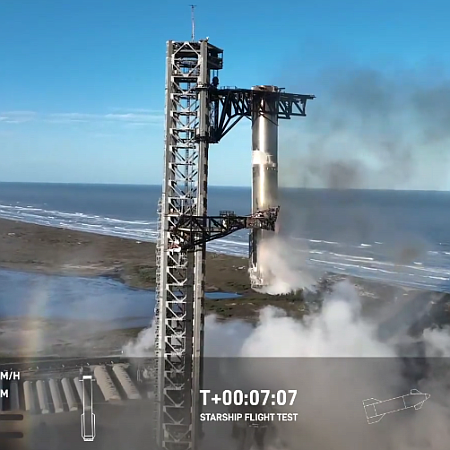
The president of Mexico, Claudia Sheinbaum, yesterday indicated that her government was considering taking legal action against SpaceX because of the debris from its Superheavy rocket that was found washed up on its beaches after a test launch.

Mexico’s government was studying which international laws were being violated in order to file “the necessary lawsuits” because “there is indeed contamination”, Sheinbaum told her morning news conference on Wednesday.

…Mexican officials are carrying out a “comprehensive review” of the environmental impacts of the rocket launches for the neighboring state of Tamaulipas, Sheinbaum said.

Other than this one quote, the article at the link is largely junk, focusing on the test stand explosion last week of Starship, an event that has nothing to do with the material found on Mexico’s beaches. Moreover, that debris was apparently so harmless Mexicans were able to quickly gather it for souvenirs, with some immediately making money from it by selling it on social media.

In other words, this “investigation” and this “reporting” is nothing more than anti-Musk rhetoric because Musk has aligned himself with Trump.

22 comments

Axiom’s manned mission docks with ISS

SpaceX’s newest manned Dragon capsule, dubbed Grace, this morning successfully brought Axiom’s fourth commercial passenger mission to ISS, docking with the space station after launching yesterday on a Falcon 9 rocket.

The spacecraft docked at 6:31 a.m. to the space-facing port of the space station’s Harmony module. Former NASA astronaut Peggy Whitson, ISRO (Indian Space Research Organisation) astronaut Shubhanshu Shukla, ESA (European Space Agency) astronaut Sławosz Uznański-Wiśniewski of Poland, and Tibor Kapu of Hungary now are aboard the space station after launching at 2:31 a.m. on June 25, on the company’s Falcon 9 rocket from Launch Complex 39A at NASA’s Kennedy Space Center in Florida for the fourth private astronaut mission to the orbiting laboratory, Axiom Mission 4.

The plan is for them to stay on ISS for two weeks.

0 comments

German rocket startup Isar Aerospace secures $174 million in financing

The German rocket startup Isar Aerospace announced today that it has obtained $174 million in new financing from a Miami-based investment firm.

This news report adds these details:

On 25 July 2025, Isar Aerospace announced that it had signed a €150 million convertible-bond agreement with Eldridge Industries. The instrument provides the company with funding in the short term, and the debt can later be converted into equity in the form of shares, typically at a pre-agreed valuation during a future financing round or an IPO.

That Isar needed to go to an American investment firm suggests there was a lack of interest in Europe to invest in this European rocket startup. The nature of the deal also suggests the possibility that some ownership rights will shift to Eldridge over time.

In March Isar first launch attempt of its Spectrum rocket from Norway’s Andoya spaceport failed 30 seconds after lift-off. It is building two more rockets, and will use this new capital to expand its production and launch facilities.

17 comments

Rocket Lab wins launch contract from the European Space Agency

The American rocket company Rocket Lab announced today that it has been awarded a launch contract from the European Space Agency (ESA) to place two European-built GPS-type test satellites into orbit.

Rocket Lab will launch two “Pathfinder A” spacecraft for ESA, provided by European satellite prime contractors Thales Alenia Space and GMV, from Rocket Lab Launch Complex 1 no earlier than December 2025. The spacecraft will be deployed to a 510km low Earth orbit as part of a mission to test a new approach of providing location, direction, and timing services from satellites in low orbit – otherwise called LEO-PNT (Low Earth Orbit Positioning, Navigation, and Timing). ESA’s LEO-PNT demonstration mission will assess how a low Earth orbit fleet of satellites can work in combination with the Galileo and EGNOS constellations in higher orbits that provide Europe’s own global navigation system.

That ESA gave Rocket Lab this contract illustrates the failure of this government agency’s own commercial rocket division, Arianespace, as well as the slowly emerging new commercial rocket startups in Europe. ESA likely rejected Arianespace’s Ariane-6 and Vega-C rockets as too expensive. These rockets were also likely unable to meet the required launch time table. It also could not pick any independent private European companies, because none have yet to successfully launch.

And ESA did this even as top government officials in Europe have been loudly demanding that Europe only launch its satellites on European rockets. That demand might make a nice sound bite, but reality trumps nice sound bites every time.

3 comments

SpaceX launches Axiom’s fourth commercial manned mission to ISS

SpaceX last night successfully launched Axiom’s fourth commercial manned mission to ISS, dubbed Ax-4, its Falcon 9 rocket lifting off from the Kennedy Space Center in Florida.

The first stage completed its second flight, landing back at Cape Canaveral. The Dragon capsule, the newest and fifth ship in SpaceX’s fleet of manned capsule, was dubbed “Grace,” as announced by Axiom mission commander and former NASA astronaut Peggy Whitson. The three paying passengers are government astronauts from India, Hungary, and Poland.

The capsule will dock with ISS tomorrow (Thursday) at 7 am (Eastern), where it and its crew will spend about one to two weeks before returning to Earth.

The leaders in the 2025 launch race:

79 SpaceX
35 China
8 Rocket Lab
7 Russia

SpaceX now leads the rest of the world in successful launches, 79 to 58.

The overall lack of excitement about this manned space mission speaks directly to how successful SpaceX has become as a private commercial rocket company. Its rockets and capsules work routinely well, with almost no problems, making these manned space missions seem as boring as an airline trip from New York to Washington.

6 comments

NASA sets another new date for Axiom’s Ax-4 commercial manned mission to ISS

NASA today announced a new launch date of June 25, 2025 for Axiom’s Ax-4 commercial manned mission to ISS carrying a three passengers from India, Poland, and Hungary respectively and commanded by former NASA astronaut Peggy Whitson (now working for Axiom).

As with previous announcements, the information provided was sparse:

NASA, Axiom Space, and SpaceX are targeting 2:31 a.m. EDT, Wednesday, June 25, for launch of the fourth private astronaut mission to the International Space Station, Axiom Mission 4.

The mission will lift off from Launch Complex 39A at NASA’s Kennedy Space Center in Florida. The crew will travel to the orbiting laboratory on a new SpaceX Dragon spacecraft after launching on the company’s Falcon 9 rocket. The targeted docking time is approximately 7 a.m. Thursday, June 26. NASA will provide more details and its coverage information shortly.

The launch had previously been delayed several times because NASA and Russia wanted to first assess the repair work on the leaks in the Russian Zvezda module before allowing another docking at the station. No information however has been released so far detailing that assessment. Though there have been indications that the loss of air in ISS was stopped by the repair, neither NASA nor Roscosmos have provided any specific data.

7 comments

2nd test flight of French cargo capsule prototype “partial success”

According to an update today from the French cargo capsule startup The Exploration Company, its Mission Possible capsule prototype launched yesterday on SpaceX’s Falcon 9 had a “partial success (partial failure)” during its return to Earth.

The capsule was launched successfully, powered the payloads nominally in-orbit, stabilized itself after separation with the launcher, re-entered and re-established communication after black out. But it encountered an issue afterwards, based on our current best knowledge, and we lost communication a few minutes before splash down. We are still investigating the root causes and will share more information soon.

This was the second prototype test flown by the company, the first launched on the inaugural flight of the Ariane-6 rocket. That test was unable to complete its mission because of a problem with the rocket’s upper stage, which prevented it from completing its de-orbit burn, which would have then permitted the prototype to be released and return to Earth for flight testing. Instead, no test was done.

The company had initially only planned two test flights of these smaller prototypes before moving on to test flights of its full scale Nyx cargo capsule, designed to garner commercial cargo business to and from the space stations presently under development. The update today suggests it might now do another test flight with a smaller prototype.

3 comments

Ispace: Resilience’s failure was due to a hardware issue in laser range finder

In a press conference today, officials of the Japanese startup Ispace explained that the failure of its second lunar lander, Resilience, to land softly on the Moon on June 5, 2025 was due to a hardware issue in its laser range finder that prevented it from providing correct altitude data.

At the same time, they have not yet been able to pin down precisely what caused the failure. It could have been because of unexpected degradation during flight, or possibly a technical fault with the range finder in gathering data at the speeds and altitudes experienced.

The company is forming a task force in partnership with Japan’s space agency JAXA as well as NASA to try to figure out the issue. It is also going to add lidar instrumentation to future missions to provide a backup to the laser range finder. These actions will add about $11 million in additional costs, an amount Ispace says it can absorb.

Ispace is building two more lunar landers, one for NASA in partnership with the American company Draper, and the second for JAXA. It appears both missions are still moving forward.

16 comments

SpaceX completes another smallsat Transporter launch, launching 70 payloads

SpaceX today successfully placed 70 payloads, including 66 separate deployments, into orbit as part of its Transporter program for smallsats, its Falcon 9 rocket lifting off from Vandenberg in California.

The first stage completed its 26th flight, landing on a drone ship in the Pacific Ocean. It also completed this flight only 22 days after its last flight. As of posting the deployment of these payloads and satellites was on going.

The leaders in the 2025 launch race:

78 SpaceX
35 China
8 Rocket Lab
7 Russia

SpaceX now leads the rest of the world in successful launches, 78 to 58.

9 comments

France’s space agency awards ArianeGroup contract to build methane-fueled engine

France’s space agency CNES this week awarded ArianeGroup, the rocket partnership between Airbus and Safran that builds the Ariane-6 rocket a contract to develop a more powerful methane-fueled rocket engine.

Aiming to reach between 200 and 300 tons of thrust, the new engine will be twice as powerful as the current Vulcain 2.1 main stage engine that propels Ariane 6.

No details about cost or time schedule were released.

The significance of this deal isn’t the engine, but that it was issued directly to ArianeGroup by France’s space agency, instead of through the European Space Agency’s (ESA) Arianespace commercial arm, as has been routine for the past three decades. The deal illustrates how the ESA is essentially beginning to break up. Rather than go through it, its individual nations are now going it alone, each providing support and funding to their own commercial private space startups. Germany began this process, encouraging the development of three new rocket companies (Rocket Factory Augsburg, Isar, and Hyimpulse). Spain and Italy soon followed with their own new rocket companies, (PLD and Avio respectively). France, which until recently lobbied to keep the old government model alive in ESA, has in the past year shifted strongly to the capitalism model.

This contract only underscores this shift.

1 comment

Isaacman hints of future space plans

In receiving an award from a space advocacy group on June 21, 2025, billionaire Jared Isaacman hinted that his future space-related plans could include working with science organizations to finance scientific probes.

[Had he become NASA administrator he had wanted] NASA to partner with academic organizations on missions where such organizations would have had a bigger role in funding. “My priorities would have been leadership in space and the orbital economy,” he said, “and trying to introduce a concept where NASA could help enable others to conduct interesting scientific missions, getting academic organizations to contribute.”

That was something he said he might be interested in pursuing outside the agency. “I wouldn’t mind maybe trying to put that to a test and see if you could fund an interesting robotic mission, just to show that it can be done, and try and get some of the top tier academic institutions who want to perform. So that’s on my mind.”

He also indicated that he generally has no problem with the Trump administration’s proposed NASA cuts, noting that such academic organizations need to figure out how to work with less money.

Despite this statement, it appears he is still unsure of what he will do next in space. He has not restarted his Polaris Dawn manned program — suspended when he was nominated to become NASA administrator — and has said that right now he is more focused taking advantage of this unexpected break from work to spend more time with his family.

8 comments
1 60 61 62 63 64 684