Dust storms spotted on Titan

Scientists reviewing Cassini data have identified dust storms for the first time of Saturn’s moon Titan.

When Rodriguez and his team first spotted three unusual equatorial brightenings in infrared images taken by Cassini around the moon’s 2009 northern equinox, they thought they might be the same kind of methane clouds; however, an investigation revealed they were something completely different. “From what we know about cloud formation on Titan, we can say that such methane clouds in this area and in this time of the year are not physically possible,” said Rodriguez. “The convective methane clouds that can develop in this area and during this period of time would contain huge droplets and must be at a very high altitude — much higher than the 6 miles (10 kilometers) that modeling tells us the new features are located.”

The researchers were also able to rule out that the features were actually on the surface of Titan in the form of frozen methane rain or icy lavas. Such surface spots would have a different chemical signature and would remain visible for much longer than the bright features in this study, which were visible for only 11 hours to five weeks.

In addition, modeling showed that the features must be atmospheric but still close to the surface — most likely forming a very thin layer of tiny solid organic particles. Since they were located right over the dune fields around Titan’s equator, the only remaining explanation was that the spots were actually clouds of dust raised from the dunes.

Obviously there are large uncertainties here. Nonetheless, the conclusion is a reasonable one, as it is expected that such dust storms would occur on Titan.

Posted just outside Zion National Park in the town of Springdale.
0 comments

Mountains on the Moon

Mountains on the Moon

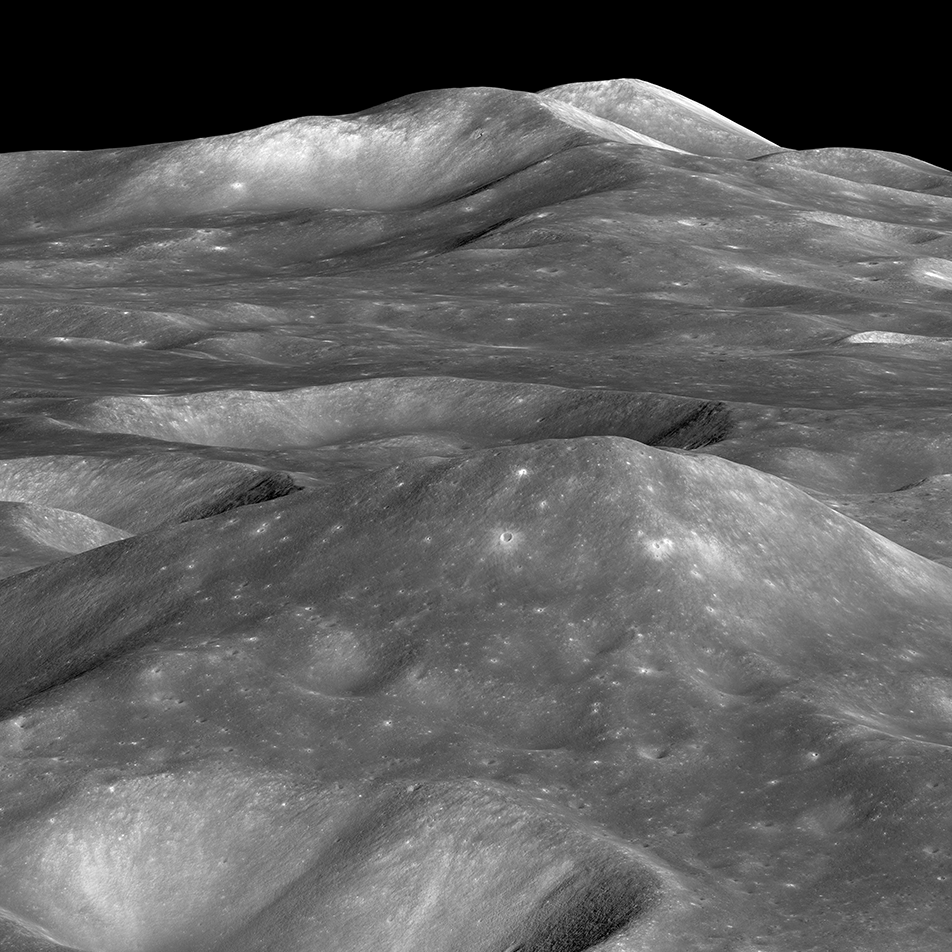
Cool image time! The image on the right, reduced slightly to post here, shows several high mountains on the far side of the Moon. If you click on the image you can see it at full resolution.

The summit of the unnamed peak in the foreground (50.2° S, 236.6° E) has an elevation of 6710 meters, about 7000 meters (about 23,000 feet) of relief relative to the low point at the bottom of the image. The two peaks on the horizon, 200 kilometers in the distance (about 125 miles), have summit elevations of 4320 meters (14,200 feet) and 4680 meters (15,350), respectively and both rise more than 6000 meters (almost 20,000 feet) above their surroundings.

In the Lunar Reconnaissance Orbiter (LRO) science team release in June, they noted that the high peak here is actually taller than Denali (Mount McKinley), the highest peak within the U.S. And it has no name. They also note that the peak is likely 4 billion years old, and has experienced extensive erosion in that time, meaning that it is also likely shorter than it once was.

I don’t have anything to add, other than this would be an amazing place to put up a resort, with trails taking you to the top of the mountains. In the lighter gravity, the hike would actually be somewhat easy, even wearing a spacesuit. And you wouldn’t have to worry about a thinning atmosphere as you climbed higher, as you do on Earth. You’d be carrying it with you.

5 comments

Baby volcanoes on Mars

Pitted cones on Mars

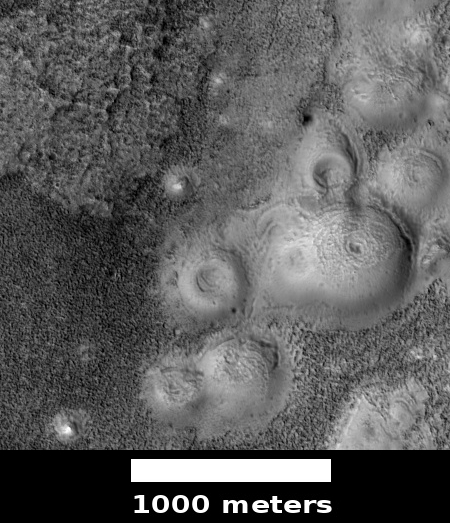
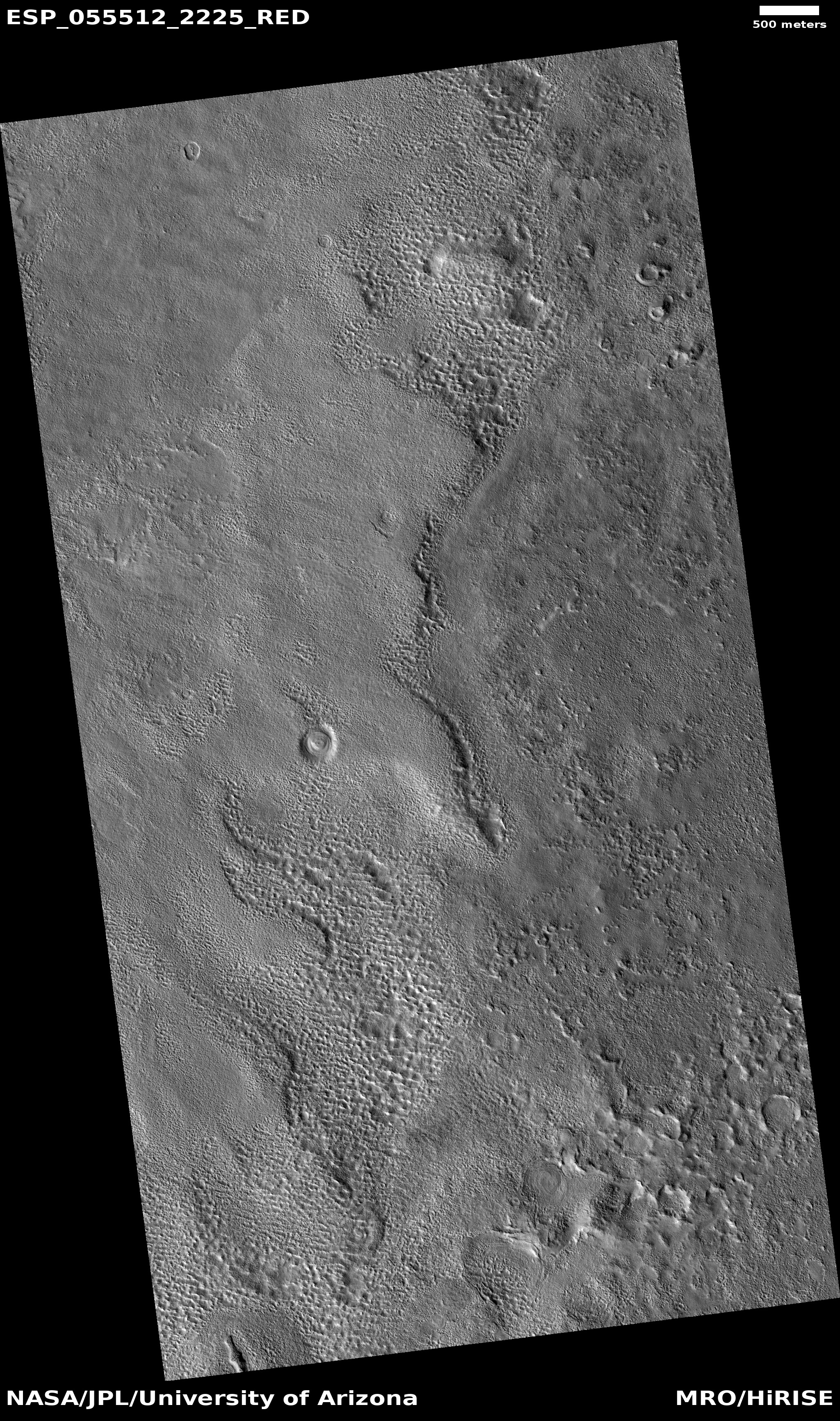
Most people are very aware of Mars’ giant volcanoes. This week the science team for Mars Reconnaissance Orbiter (MRO) decided to highlight instead a location on Mars filled with relatively tiny volcanoes. The image on the right is only one small section from the full image, and shows some of these pitted cones, as well the strange nearby badlands. From their caption:

The origins of these pitted mounds or cratered cones are uncertain. They could be the result of the interaction of lava and water, or perhaps formed from the eruption of hot mud originating from beneath the surface.

These features are very interesting to scientists who study Mars, especially to those involved in the ExoMars Trace Gas Orbiter mission. If these mounds are indeed mud–related, they may be one of the long sought after sources for transient methane on Mars.

The age of these pitted cones is not known. They might be still active, or have sat on Mars unchanged for eons.

Overview map

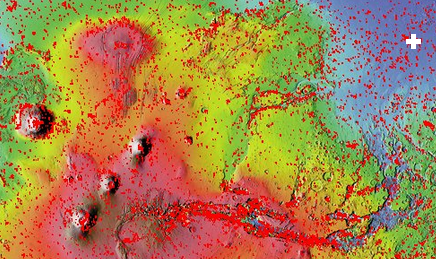
As always, context is crucial for gaining a better understanding of what we are looking at. The map on the right shows that these particular cones, indicated by the white cross, are located in an area of those plains dubbed Chryse Planitia, part of the vast northern plains of Mars, an area where some scientists think an intermittent ocean might have once existed. As you can see, this is also the region that took most of the apparent drainage running off the slopes of the planet’s giant volcanoes.

Nor are these cones unique in this region. MRO has taken a good scattering of images at this general location (41 degrees north, 332 degrees east), and throughout the surrounding terrain are many more of these pitted cones.

If these cones are a source of the transient methane on Mars, then the Trace Gas Orbiter should eventually see a concentration of methane above them. This would not prove them to be the source, but it would make them a much more intriguing target for a later rover mission.

0 comments

Looking for Marsquakes

After eight and a half years of study of one particular very young fault system on Mars using high resolution images from Mars Reconnaissance Orbiter, scientists have found no evidence that any quakes occurred there in that time.

The team studied images of Mars’s surface over nearly a decade to look for changes that might have been caused by marsquakes. The researchers used images of Mars’s surface from the High Resolution Imaging Science Experiment (HiRISE) and applied Co-registration of Optically Sensed Images and Correlation (COSI-Corr)—software that has been validated to track terrestrial glaciers, landslides, and quakes on Earth, as well as dune movement on Mars itself—to hunt for signs of displacement near fault zones.

The researchers focused on the Cerberus Fossae fault system, the youngest fault system on the Red Planet and thus the most likely to still be active. They used the average coregistration performance of each study image to determine that this method should be able to detect fault slip rates of 0.1–10 millimeters a year.

The team identified only one displacement signal that could have been interpreted as evidence of a marsquake—but dismissed it as the result of a topographic artifact. Their results suggest that no seismic movement occurred in the Cerberus Fossae area over the course of the study, which spanned 8.5 Earth years’ worth of images from the planet.

This suggests, but does not prove, that Mars has very few quakes. We shall know more when InSight lands on Mars on November 26.

0 comments

Volcanic rills and lava tubes on Mars

Rills and lava tubes on Pavonis Mons

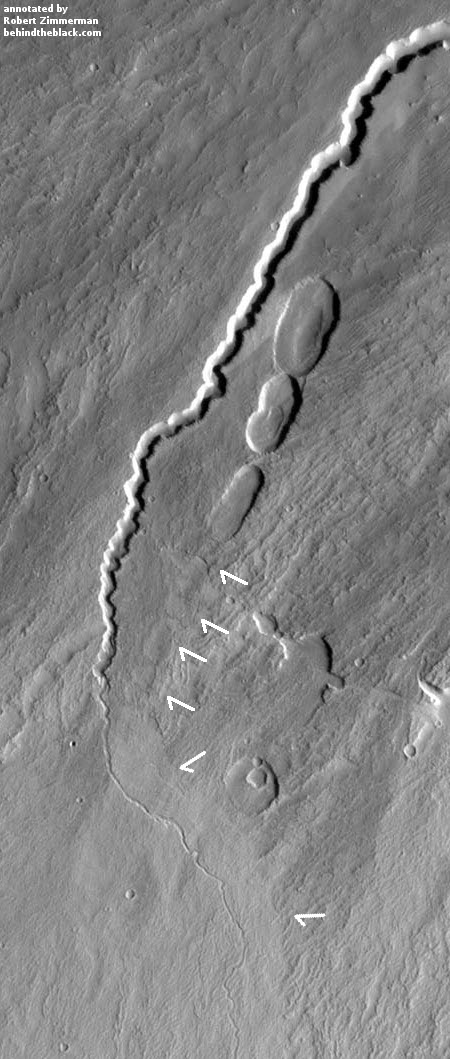
Cool image time! The image on the right, cropped somewhat to show here, was taken by Mars Odyssey of the southwestern slope of Pavonis Mons, the middle volcano of the line of three giant volcanoes located between the biggest volcano in the solar system, Olympus Mons, and the biggest canyon in the solar system, Marineris Valles. The slope goes down to the south, from the top to the bottom of the image. As noted on the image page,

The channel and nearby oval depressions are both related to the flow of lava. Narrow lava flows can create channels. The cooling of the top of the channel will form a roof over the flow, creating a tube beneath the surface. After the lava stops flowing the tube can empty, leaving a subsurface void. The roof will then collapse into the void forming the oval surface features.

I have added arrows to the image to draw your eye to the features that extend south in line with those oval depressions, eventually widening out to resemble a river delta, with the obvious rill probably indicating the lowest point in that delta.

Though the oval depressions are likely sections of a lava tube that collapsed, the features in line with those depressions suggest that the tube itself might still exist below the surface to the south, feeding into that delta where the rill meanders. It is also possible that my desire to find underground voids here, where glacier ice might possibly exist, might be skewing my conclusion. It could also be that the lava tube ended at these depressions, and what the features indicate is a wide surface flow, later embellished by the smaller flow of the meandering rill.

2 comments

A strange bulge on Mars

Pollack Crater

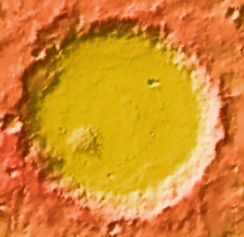
Cool image time! The image on the right is not the cool image, but a context image of 59-mile-wide Pollack Crater, located slightly south of the Martian equator in the planet’s southern cratered highlands. What makes this crater intriguing to planetary scientists, and has prompted them to take many images over the decades, is the bulge in the southwest part of the crater’s floor. You don’t normally see a rise off-center like this inside craters. If there were any peaks, you’d expect them to be in the center, formed during the impact, when the crater floor melts and acts more like water in a pond when you drop a pebble into it, forming ripples with an uplifting drop in the dead center.

It therefore isn’t surprising that planetary scientists have taken a lot of pictures of this bulge, going back to the Mariner 9 orbiter in 1972, which first discovered it. Scientists then dubbed it “White Rock” because in the first black & white images it looked much brighter than the surrounding terrain. Later color images revealed that it is actually somewhat reddish in color, not white. As noted at this Mars Global Surveyor webpage,
» Read more

0 comments

Ancient drainage on Mars?

Drainage on Mars?

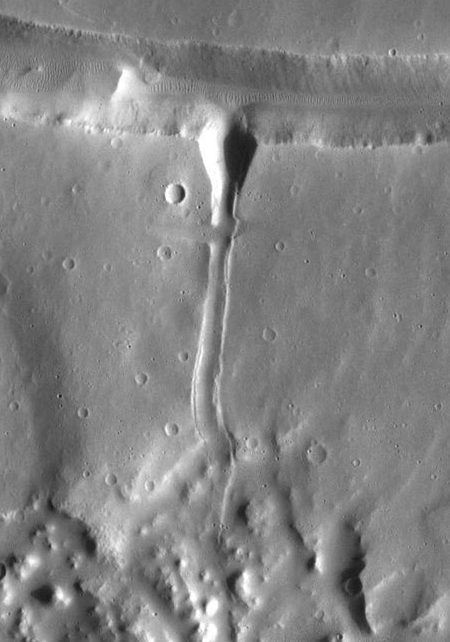
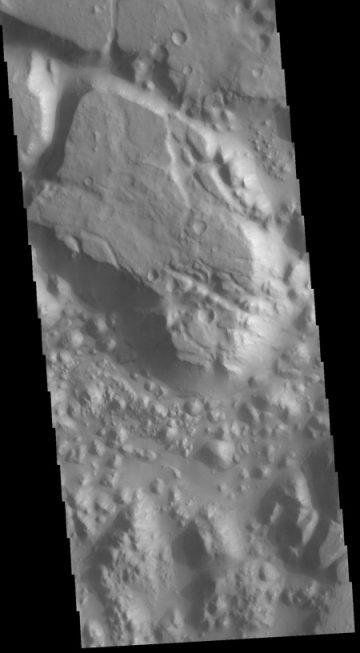
Cool image time! The image on the right, cropped from the original to post here, was taken by Mars Odyssey on May 13, 2018, and shows what clearly looks like a point where a south-to-north drainage broke through a cliff wall to allow a liquid to flow down into the larger and deeper east-west flowing canyon.

The caption at the website for this image provides only a little analysis.

The right angle intersection of the depressions in this VIS image is one of the graben that form Sacra Fossae. The fossae are located on Sacra Mensa, near the beginning of Kasei Valles. Graben are depressions caused by parallel faults where a block of material drops down along the fault face.

According to this geological interpretation, the depressions initially formed due to this geological process. The image however suggests that a flow of liquid also played a part.

Overview map

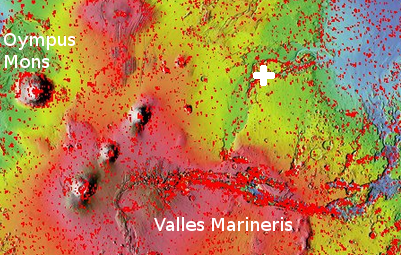
This region, indicated by the white cross on the map to the right, is part of the vast drainages that flow down from Mars’ four giant Martian volcanoes. It is located north of Valles Marineris, the largest of all these drainages. This region is also where you find a lot of chaos terrain, which is what the hummocky depression at the bottom of the image resembles. Much of this mysterious geology is thought to have been formed by the liquid water that is theorized to have once flowed down from the volcanoes. Here, it appears that the liquid ponded in the depression at the bottom of the image until it found a path along the north-south graben to break through into the east-west deeper graben.

0 comments

Weird Martian crater?

Weird crater on Mars

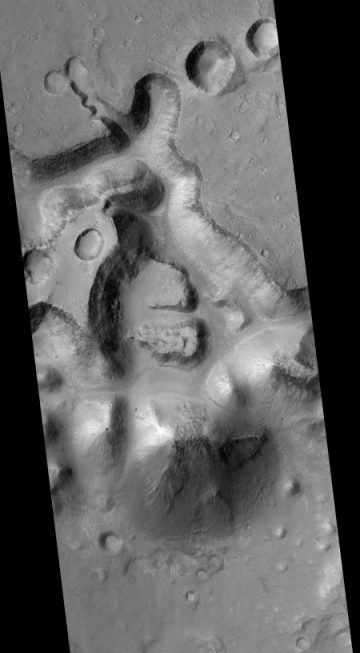
Time for another cool image! The image on the left, cropped to post here, was taken by the high resolution camera on Mars Reconnaissance Orbiter (MRO) on May 31, 2018, and shows a very strange layered mesa sitting in what looks like a crater or collapse feature. If you click on the image you can see the entire picture.

The location of this image is out in the middle of the vast northern plains of Mars. This region has few pronounced features, and generally sits at a lower elevation to the rest of Mars. It is suspected by some scientists that an intermittent ocean was once here, and that we are looking at the floor of a now dry sea.

This image was part of the July image release from MRO, and thus included no caption. They simply refer to it as a layered feature. It sits about a half mile (about 800 meters) to the west of a rough and indistinct cliff that drops down into an area of rougher terrain. This suggests that if this was formed by an impact, it cut down into that lower rougher layer, and since the impact there has been some upwelling from below creating the layered mesa.

I would not take my hypothesis very seriously, however. This feature could have nothing to do with an impact. It might also have been a mesa that now sits in a collapsed sinkhole. Or not. I could come up with many theories, all of which are likely wrong. What I do see here is something that geologically is very strange and baffling.

2 comments

Close-up of bright spot in Occator Crater

Vinalia Faculae in Occator Crater

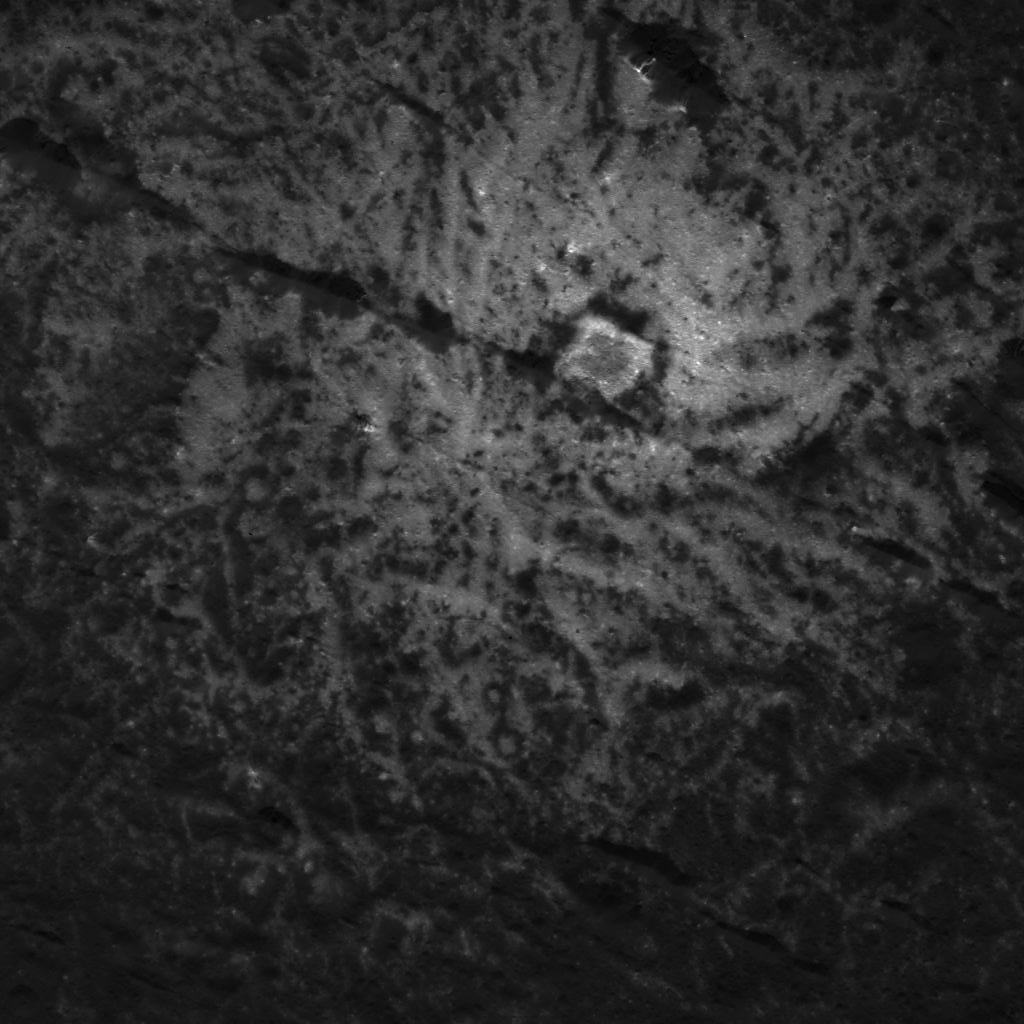
Cool image time! The Dawn science team today released some new images taken by the spacecraft in its final tight orbit around the dwarf planet Ceres. The image on the right is a cropped section of the full image. It shows some interesting details of part of one of the two bright spots in Occator Crater, dubbed Vinalia Facula, and was taken from a distance of 36 miles.

Other images show small bright spots in another small crater, fractures and interesting patterns in the floor of Occator crater, a dome in Occator Crater suggestive of underground processes pushing up, and other close-ups of its crater walls.

While all of these features are reminiscent of geology on Earth, none are really the same. Ceres’ light gravity and harsh environment, plus its history in the asteroid belt, requires alien processes that only hint at similarities to what we see on Earth.

5 comments

Ghost dunes on Mars

Scientists have found Martian pits formed by the leftover remains of dunes that long ago blew away.

Scientists have discovered hundreds of crescent-shaped pits on Mars where sand dunes the size of the U.S. Capitol stood billions of years ago. The curves of these ancient dune impressions record the direction of prevailing winds on the Red Planet, providing potential clues to Mars’s past climate, and may hold evidence of ancient life, according to a new study detailing the findings in the Journal of Geophysical Research: Planets, a publication of the American Geophysical Union.

Ghost dunes are the negative space left behind by long-vanished sand dunes. Lava or water-borne sediments partially buried the dunes and hardened, preserving the dunes’ contours. Wind subsequently blew sand off the exposed tops and scoured it out from inside, leaving a solid mold in the shape of the lost dune.

The claim that these geological features “may hold evidence of ancient life” is pure hyperbole, and absurd. However, the features are important because they will help date the sediment or lava flows around them, while also providing markers to help understand the history of the Martian climate.

1 comment

The mysterious chaos terrain of Mars

In one of my weekly posts last month (dated May 14th) delving into the May image release from Mars Reconnaissance Orbiter’s (MRO) high resolution camera, I featured an image of what planetary geologists have labeled chaos terrain, a hummocky chaotic terrain that has no real parallel on Earth but is found in many places on Mars.

This month’s image MRO release included two more fascinating images of this type of terrain. In addition, the Mars Odyssey team today also released its own image of chaos terrain, showing a small part of a region dubbed Margaritifer Chaos. Below, the Mars Odyssey image is on the right, with one of the MRO images to the left. Both have been cropped, with the MRO image also reduced in resolution. The full MRO image shows what the MRO science team labels “possibly early stage chaos” on the rim of a canyon dubbed Shalbatana Vallis.

young chaos in Shalbatana Vallis

Margaritifer Chaos

» Read more

5 comments

The epic lava flows of Olympus Mons

Lava flows off of Olympus Mons

The eruption of Kilauea volcano in Hawaii has garnered a lot of deserved press coverage, having added at least a 200 acres of new land and destroyed at least 700 homes. Similarly, the recent violent eruption of a volcano in Guatemala, killing 100 people in its wake, has also gotten much deserved news coverage.

The magnitude of both however would pale in comparison to the stupendous eruption that occurred several hundred million years ago at the solar system’s largest volcano, Olympus Mons on Mars. While Kilauea is about 100 miles across, Olympus Mons is about 370 miles wide, and is so large that because of the curvature of Mar’s surface it is literally impossible for a viewer on the ground to actually see the volcano, in its entirety.

Both volcanoes are shield volcanoes, however, which means the lava flows don’t necessarily come from the caldera, but often from vents on the volcano’s slopes. Eruptions might be violent, but they generally do not involve the powerful explosive force of the sudden eruption, as seen in Guatemala and at Mount St. Helens in 1980 in the U.S. Instead, the lava seeps out steadily and continuously, an unstoppable flow that steadily overwhelms the surrounding terrain.

Olympus Mons

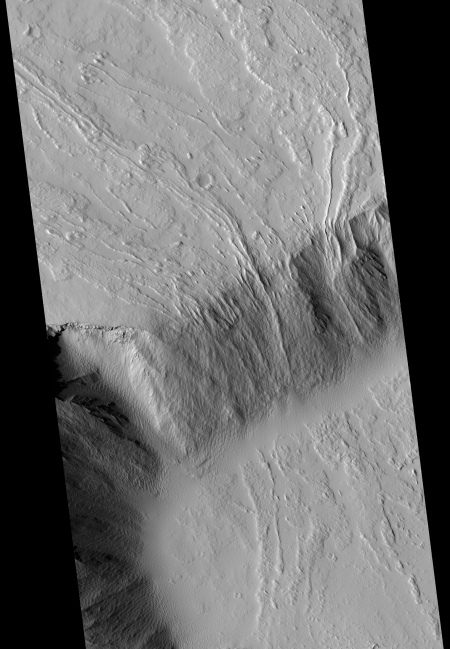
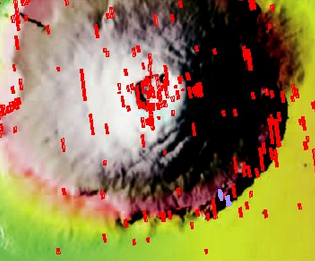
The flows that created Olympus Mons however were an epic event probably lasting millions of years, which brings us to this post. In the June release of Mars Reconnaissance Orbiter high resolution images, I found the image above, cropped and reduced in resolution to post here. It shows lava flowing down off one of the many escarpments on the slopes of Olympus Mons. This is not at the edge of the volcano’s shield, but just inside it. The map at the right, created using the archive of MRO’s high resolution camera, indicates the location of this flow, shown by the left light blue rectangle on the southeast slope of the volcano’s shield. The red rectangles show all the other images MRO has taken of Olympus Mons.

The scale of the MRO image above gives an indication of how big that eruption at Olympus Mons was.
» Read more

2 comments
1 127 128 129 130 131 157