A second Greenland crater discovered?

Scientists are now claiming they have found a second crater buried under Greenland’s icecap.

To confirm his suspicion about the possible presence of a second impact crater, MacGregor studied the raw radar images that are used to map the topography of the bedrock beneath the ice, including those collected by NASA’s Operation IceBridge. What he saw under the ice were several distinctive features of a complex impact crater: a flat, bowl-shaped depression in the bedrock that was surrounded by an elevated rim and centrally located peaks, which form when the crater floor equilibrates post-impact. Though the structure isn’t as clearly circular as the Hiawatha crater, MacGregor estimated the second crater’s diameter at 22.7 miles. Measurements from Operation IceBridge also revealed a negative gravity anomaly over the area, which is characteristic of impact craters.

“The only other circular structure that might approach this size would be a collapsed volcanic caldera,” MacGregor said. “But the areas of known volcanic activity in Greenland are several hundred miles away. Also, a volcano should have a clear positive magnetic anomaly, and we don’t see that at all.”

It must be emphasized that this conclusion remains very uncertain. What they have found is a depression that has features indicative of an impact crater, data that is far from sufficient to definitively prove the crater is real.
0 comments

Mysterious dark-toned Martian terrain

Dark toned ridge in Martian southern highlands
Click for full resolution image

Cool image time! The picture on the right, cropped and reduced to post here, was part of the January image release from the high resolution camera of Mars Reconnaissance Orbiter (MRO). It shows an area in the Martian southern highlands where the surface suddenly gets darker, for no obvious reason.

The uncaptioned release image is titled “Dark-Toned Ridge at Junction with Dark-Toned Plain.” From the image itself it is hard to understand this title. In the full image the darkest terrain is a strip in the center, with slightly lighter dark terrain on either side, and the lightest terrain to the north or south. The photograph however does not show us how far this dark terrain extends to the west or east.

Two Mars Odyssey image strips of less resolution, here and here, show that this region is filled with several large patches of dark-tone surface. With this particular patch the center dark ridge is surrounded by that slightly lighter dark area.

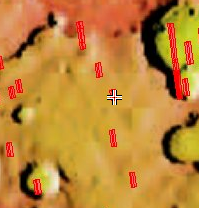
MRO itself has not taken many images of this region, as shown in the overview image below. The red rectangles indicate MRO’s high resolution photographs, with this image indicated by the cross. At this low resolution this region seems somewhat nondescript. The Mars Odyssey image strips show that there many features here, but with little significant relief.

Location of dark toned ridge

At high resolution there does not appear to be much difference between the darker and lighter areas. The lighter areas in general seem less rough and at a slightly lower elevation, but both areas are dominated by ridges and dunes trending southwest-to-northeast.

Why is this slightly higher region darker? Let’s assume that this darker material was a lava flow overlaying the surface. Over eons wind erosion, trending southwest-to-northwest, roughly eroded both it and the lower layers around it, leaving behind this rough corroded terrain. The different make-up of the darker material allows it to erode in a rougher manner.

While possibly correct, I would not bet much money on this guess. It is not clear it is lava. It is not clear that it is a flow. It does not explain why there are two areas of different darkness. And it certainly not clear what the make-up of any of this stuff is.

This is simply another cool mystery on the Martian surface.

1 comment

The location for a future Martian colony?

Pit draining into Kasei Valles

Regular readers of this webpage will know that I am a caver, and am fascinated with the pits and caves that have so far been identified on Mars, as illustrated by an essay I wrote only last week.

Some of the cave research I have cited has being led by planetary scientist Glen Cushing of the U.S. Geological Survey. Two weeks ago Dr. Cushing sent me a slew of pictures of caves/pits that he has accumulated over the years, many of which he has not yet been able to highlight in a paper. At least two were images that I had already featured on Behind the Black, here and here.

One pit image however I had never seen. A cropped and reduced close-up is shown on the right, with the full photograph viewable by clicking on the image. In many ways this pit is reminiscent of many pits on Mars. Its northern rim appears to be an overhang several hundred feet deep that might have an underground passage continuing to the north. The southern lip is inviting in that its slope appears to be very accessible for vehicles, meaning this pit/cave might be a good location to build a first colony.

Because of that accessible southern lip, I decided to do more digging about this particular pit. I was quickly able to find the uncaptioned release of the complete image by doing a quick search through the image catalog of Mars Reconnaissance Orbiter’s (MRO) high resolution camera. That image, reduced and cropped to post here, is shown below, on the right.
» Read more

4 comments

The many pits/caves of Mars

Sinkhole in Martian northern lowlands with dark seep

Time for many cool images! Over the years I have written frequently about the pits/caves on Mars, in both magazine articles and the many posts here at Behind the Black. The following posts are the most significant, with the June 9, 2015 providing the best geological background to many of these pits, especially the many located near the giant volcanoes of Mars.

As I wrote in that June 9, 2015 post:
» Read more

1 comment

Well water likely available across Mars

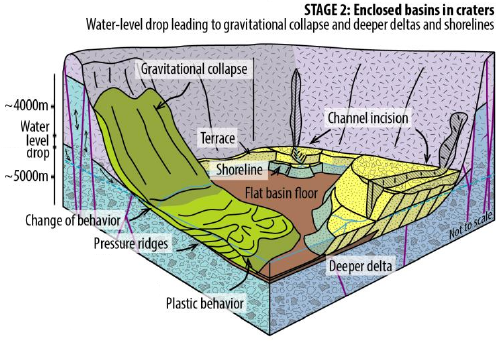
Conceptual model of Martian deep basin evolution

A science paper released today and available for download [pdf] cites evidence from about two dozen deep impact craters located from the equator to 37 degrees north latitude that Mars has a ground ice table at an elevation that also corresponds to other shoreline features. From the abstract:

Observations in the northern hemisphere show evidence of a planet‐wide groundwater system on Mars. The elevations of these water‐related morphologies in all studied basins lie within the same narrow range of depths below Mars datum and notably coincide with the elevation of some ocean shorelines proposed by previous authors.

The image above and on the right shows the middle stage of their conceptual model for the evolution of these deep basins and how that evolution results in many of the geological features seen in many places on Mars, such as the features I have highlighted on Behind the Black previously here and here.

From their conclusion:
» Read more

1 comment

Weird Martian fracture feature

Fractured collapse feature on Mars

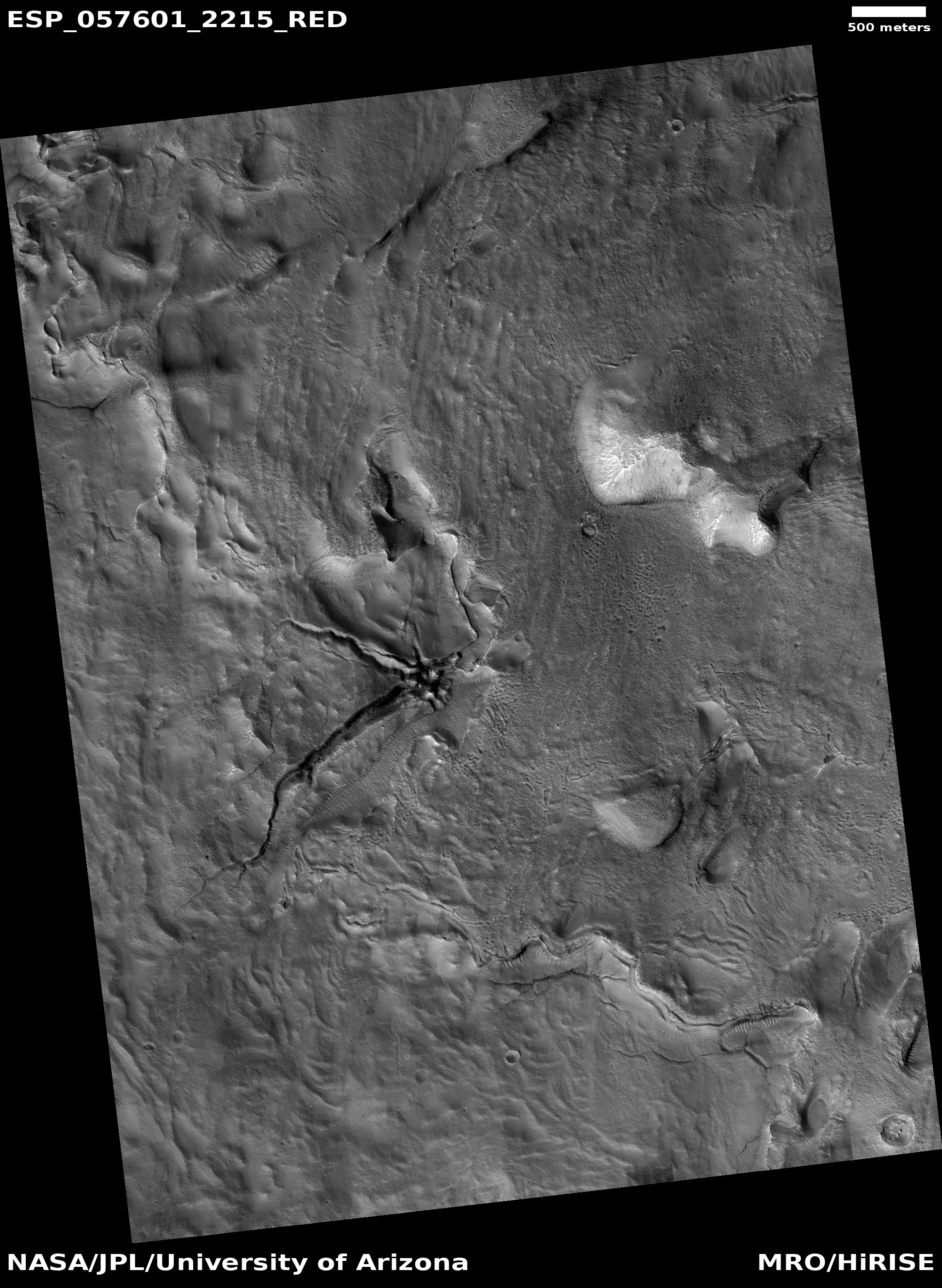
Cool image time! When I first looked at the high resolution Mars Reconnaissance Orbiter (MRO) image on the right, my immediate reaction was, “What the heck is that?” The image to the right is cropped and reduced, but if you click on it you can see the full image at high resolution.

The fractured terrain appears to be all within a collapse. To my eye it appears that while the overall surface has sunk, the fractures indicate an area where there has been an eruption upward, which after the eruption collapsed again, so that the fractured area remains at the apparent bottom of the collapse sink. I was immediately reminded of Upheaval Dome in Yellowstone National Park, which some geologists believe was formed by a “salt bubble” rising upward to create a salt dome.

A thick layer of salt, formed by the evaporation of ancient landlocked seas, underlies much of southeastern Utah and Canyonlands National Park. When under pressure from thousands of feet of overlying rock, the salt can flow plastically, like ice moving at the bottom of a glacier. In addition, salt is less dense than sandstone. As a result, over millions of years salt can flow up through rock layers as a “salt bubble”, rising to the surface and creating salt domes that deform the surrounding rock.

Context image for fracture feature

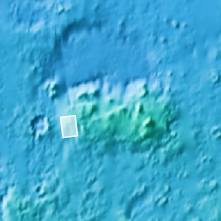
The process and materials involved were certainly different on Mars. Nonetheless, it does appear we are looking at an eruptive feature unrelated to molten lava. The context image to the right, showing this feature’s location in Mars’ vast northern lowlands, also shows that it has occurred on terrain that has bulged upwards relative to the surrounding lowlands. Nearby MRO images also show similar bulge/collapse features.

To decipher the geological mystery here, we would also need to know when this happened and whether there ever was a liquid ocean residing on top of it, before, during, or after the eruption. We also do not know well the make-up of the underground materials, including whether any frozen water and salt is present.

To be honest, we really don’t know much. I am sure a planetary scientist studying this feature could fill us in on some of these details, such as information provided by the colors in the color image. Even so, I am sure any good scientist would also admit to unknowns.

To get some real answers, we need to be there. It is as simple as that.

0 comments

Martian glacier with moraine?

Glacier flow on Mars, with moraine

Cool image time! In the past two decades numerous images and studies of the Martian terrain produced by orbiters have shown us landslides, lava flows, water and ice produced flows, and many glacial features, all vaguely familiar but often having components reminding us of the alien nature of the Martian landscape. I have posted many here at Behind the Black. (Just do a search here for the words “Mars flow” and you will have a wealth of cool images and alien geological features to explore.)

The image on the right, rotated, cropped, and reduced to post here, shows another such feature, but this time it is less alien and more resembling a typical Earth glacier, flowing downhill slowly and pushing a moraine of debris before it. The picture was taken by the high resolution camera on Mars Reconnaissance Orbiter (MRO) and was part of the January image release. If you click on the image you can see the complete photograph at full resolution.

The release has no caption, but is titled “Tongue-Shaped Glacier in Centauri Montes,” referring to the largest tongue-shaped flow on the left. This feature, more than any other in the image, resembles closely many glaciers on Earth. It even has an obvious moraine at its head. As the glacial flow pushed downward slowly it gathered a pile of material that eventually began to act almost like a dam.

The location of this feature is intriguing in its own right.
» Read more

0 comments

Rock from Earth, found on Moon?

The uncertainty of science: Scientists studying rocks brought back by the Apollo 14 lunar mission have concluded that one sample originally came from the Earth, and if so would be the oldest known Earth rock.

It is possible that the sample is not of terrestrial origin, but instead crystallized on the Moon, however, that would require conditions never before inferred from lunar samples. It would require the sample to have formed at tremendous depths, in the lunar mantle, where very different rock compositions are anticipated. Therefore, the simplest interpretation is that the sample came from Earth.

The team’s analyses are providing additional details about the sample’s history. The rock crystallized about 20 kilometers beneath Earth’s surface 4.0-4.1 billion years ago. It was then excavated by one or more large impact events and launched into cis-lunar space. Previous work by the team showed that impacting asteroids at that time were producing craters thousands of kilometers in diameter on Earth, sufficiently large to bring material from those depths to the surface. Once the sample reached the lunar surface, it was affected by several other impact events, one of which partially melted it 3.9 billion years ago, and which probably buried it beneath the surface. The sample is therefore a relic of an intense period of bombardment that shaped the Solar System during the first billion years. After that period, the Moon was affected by smaller and less frequent impact events. The final impact event to affect this sample occurred about 26 million years ago, when an impacting asteroid hit the Moon, producing the small 340 meter-diameter Cone Crater, and excavating the sample back onto the lunar surface where astronauts collected it almost exactly 48 years ago (January 31–February 6, 1971).

The scientists also admit that their conclusion is controversial and will be disputed. If true, however, it suggests that there is significant material on the Moon from the early Earth that can provide a window into parts our planet’s history that are presently inaccessible.

2 comments

Earth’s magnetic field undergoing unexpected changes

The uncertainty of science: For reasons that scientists do not understand, the Earth’s magnetic field has been undergoing unexpected shifts in the past two years, causing its north pole to move significantly and somewhat quickly from Canada across to Siberia.

Earth’s north magnetic pole has been skittering away from Canada and towards Siberia, driven by liquid iron sloshing within the planet’s core. The magnetic pole is moving so quickly that it has forced the world’s geomagnetism experts into a rare move.

On 15 January, they are set to update the World Magnetic Model, which describes the planet’s magnetic field and underlies all modern navigation, from the systems that steer ships at sea to Google Maps on smartphones.

The most recent version of the model came out in 2015 and was supposed to last until 2020 — but the magnetic field is changing so rapidly that researchers have to fix the model now. “The error is increasing all the time,” says Arnaud Chulliat, a geomagnetist at the University of Colorado Boulder and the National Oceanic and Atmospheric Administration’s (NOAA’s) National Centers for Environmental Information.

Note that they have delayed the release of the World Magnetic Model until January 30, claiming the delay is caused by the government shutdown. Seems bogus to me. As I have already noted, these scientists aren’t slaves. If they think this is so important, and they have completed their work (which the article suggests they have), they can release the model, regardless of the federal government’s funding.

Hat tip reader Stephen Taylor.

5 comments

Dried mud cracks on Mars?

Mud cracks on Mars?

Cool image time! The image to the right, cropped and rotated to post here, was one of the uncaptioned photographs in the December Mars Reconnaissance Orbiter (MRO) image release. If you click on the image you can see the entire photograph. I have cropped the most interesting area, though cracks can be seen in other areas in the image.

What we appear to have here is a darker lower valley filled with dried mud, which over time has cracked as it dried. At its edges there appear to be ripples, almost like one sees on the beach as waves wash the shore. The perimeter slopes even show darker streaks as if the water in some places lapped up the slopes, and in others flowed downward into the valley.

Later, several meteorite impacts occurred, the largest of which produced concentric dried cracks on its outside perimeter. This impact also provides a rough idea of the depth of the mud in this valley.

Mud of course suggests that this lower valley once was filled with water. Was it? It is not possible now to come to a firm conclusion, but this image’s location shown by the red dot in the overview map below and to the right, provides a clue that strengthens this hypothesis.
» Read more

0 comments

The lava tubes and canyons of Cerberus Fossae

Cerberus Fossae rock falls

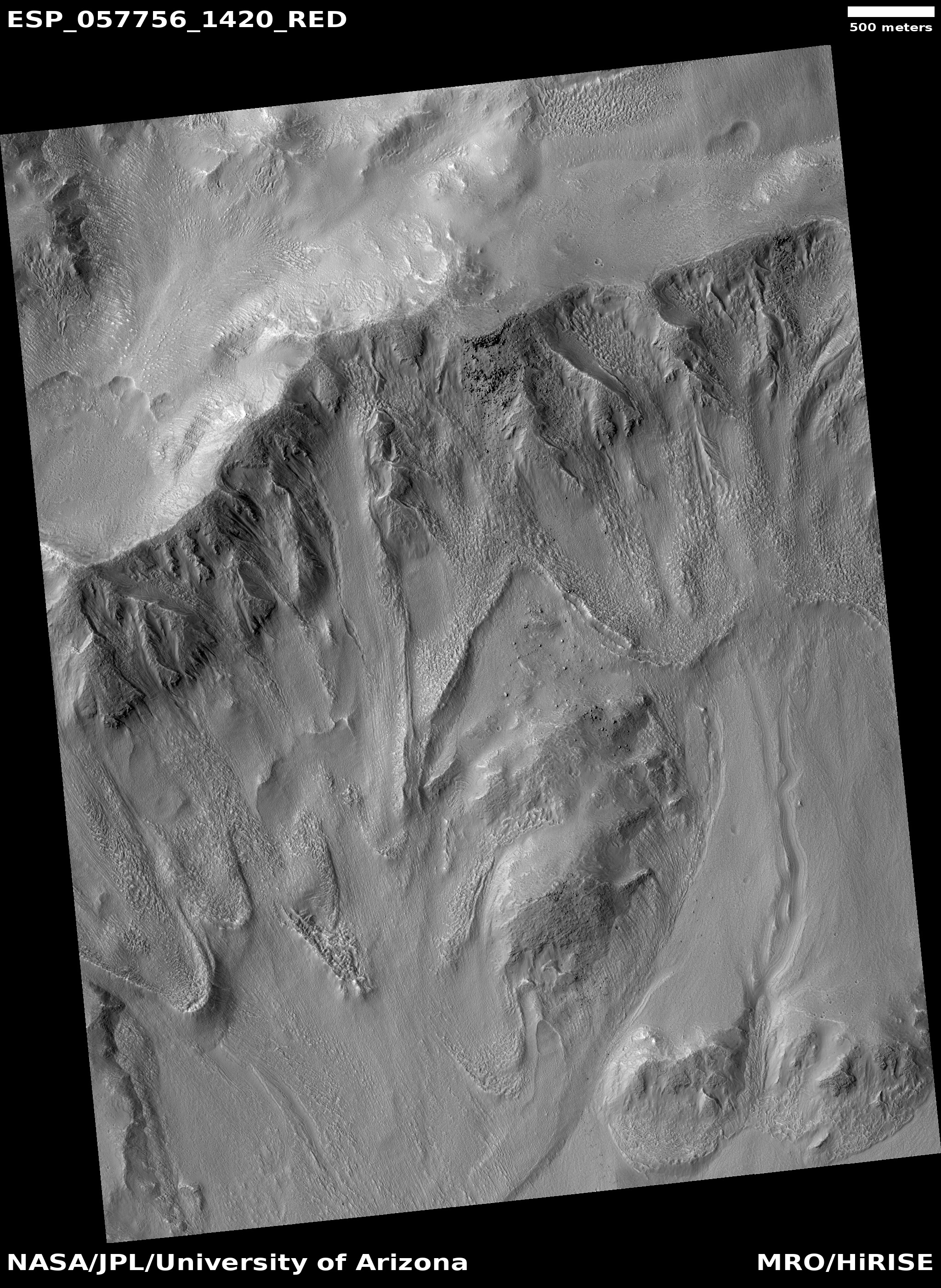
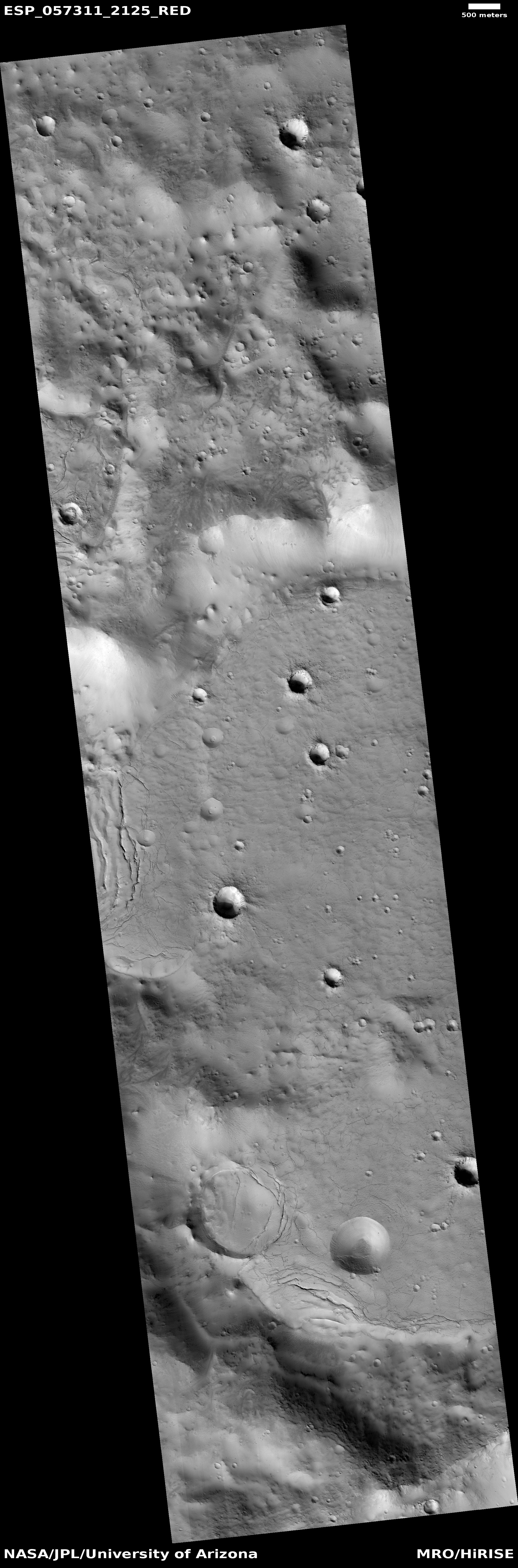
Cool image time! In the November image release from the high resolution camera on Mars Reconnaissance Orbiter (MRO) I found the image on the right (cropped to post here), dubbed “Possible Rock Falls on Steep Slopes in Cerberus Fossae.” You can see the full image by clicking on the photo on the right.

The cropped section focuses on the steep cliffs of this deep canyon, formed when lava flowed down from the giant volcano Elysium Mons almost like water, following the faults created by the bulging volcanoes to carve a long series of parallel canyons more seven hundred miles in length. Not only can individual boulders be seen piled up on the base of the canyon, you can see on the lower right a large section of cliff that has broken off and partly fallen, propped now precariously on the cliff’s steep slope. I would not want to be hiking below it at the base of this canyon.

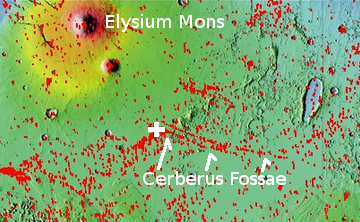
Elysium Mons and Cereberus Fossae

This photograph itself made me more interested in looking at other MRO images of Cerberus Fossae. The context map on the right shows that MRO has taken numerous images along the length of these faults, indicated by the red boxes. The location of the above image is shown by the white cross, at the western end where the canyons tend to be steep, deep, and pronounced. In taking a look at the many images of Cerberus Fossae, I found a variety of canyons, plus pit chains, lava tube skylights, and one especially intriguing image, posted below, that shows what appears to be an extended collapse along the length of what was once an underground lava tube.
» Read more

0 comments

Present and future landing sites on Mars

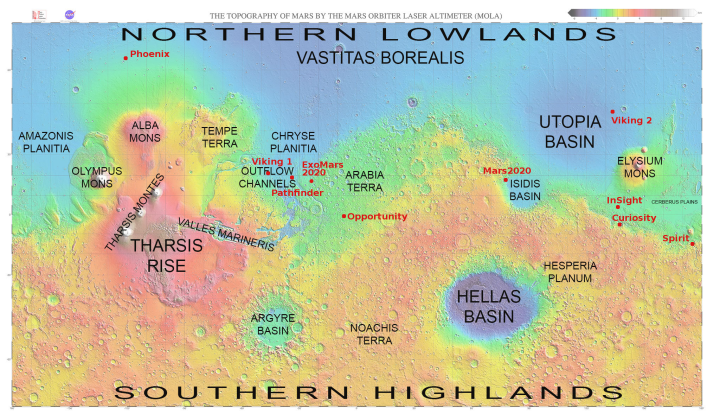
With InSight’s landing on Mars set for 11:54 am (Pacific) this coming Monday, November 26, 2018, I decided to put together a map of Mars showing the location of all the successful landers/rovers, adding the landing sites for the planned landers/rovers through 2020. This will give some context to InSight’s landing site.

Landing sites on Mars

The map does not show the landing sites for the failed Soviet, American, and British landers.

As I noted in describing the Mars2020 landing site, the location of the bulk of these landing sites, along the transition zone from the southern highlands and the northern lowlands, demonstrates the areas of the planet that interest geologists the most. It is here that we find many shoreline features, suggestive of the ocean that many scientists theorize existed intermittently in the northern lowlands. It is here that planetary scientists can quickly gather the most information about Martian geological history. And it is here that they have the opportunity to study the widest range of rock types.

From an explorer’s perspective, however, this approach has its limits. It does not provide us a look at a wide variety of locations. It is not directly aimed at finding lower latitude locations where ice might actually exist. And it is decidedly not focused in studying the planet from the perspective of future colonists. I am sometimes frustrated that we have as yet no plans to send any rovers into Marineris Valles, or to the western slopes of Arsia Mons, the southern most volcano in the chain of three giant volcanoes where there are indications that ice might exist underground, or to any of the places where caves are known to exist where a colony could be built more easily. In fact, the caves on the slopes of Arsia Mons seems a prime exploration target.

Eventually these locations will be explored, likely by private landers aimed at scouting out locations for future private settlements. I am just impatient.

6 comments
1 125 126 127 128 129 157