Update on Hawaiian lava eruption

Link here. This news article is particularly informative, as it includes a map that outlines the extent of the lava flows and what they have engulfed, including the most recent flows that are threatening a geothermal power plant that has been providing the Big Island about 25% of its power.

“Lava flow from Fissures 7 and 21 crossed into PGV [Puna Geothermal Venture] property overnight and has now covered one well that was successfully plugged,” declared the Hawaii Civil Defense Agency in a statement released on Sunday, May 27 at 6:00 pm local time. “That well, along with a second well 100 feet [30 meters] away, are stable and secured, and are being monitored. Also due to preventative measures, neither well is expected to release any hydrogen sulfide.”

Those preventive measures included a complete shutdown of the geothermal plant, the capping of all 11 wells, and the removal of some 60,000 gallons of flammable liquid. Those precautions aside, this is the first time in history—as far as we know—that lava has ever engulfed a geothermal power plant, so it’s all uncharted territory. There’s fear that a rupture of the wells could set off an explosion, releasing hydrogen sulfide and other dangerous gasses into the environment. As of this posting, the lava flows on the PGV grounds have stopped moving.

Environmentalists often promote geothermal power as an alternative to fossil fuels. Environmentalists also sued to prevent this plant from being built because of its proximity to the volcano.
0 comments

Chaos on Mars

chaos terrain

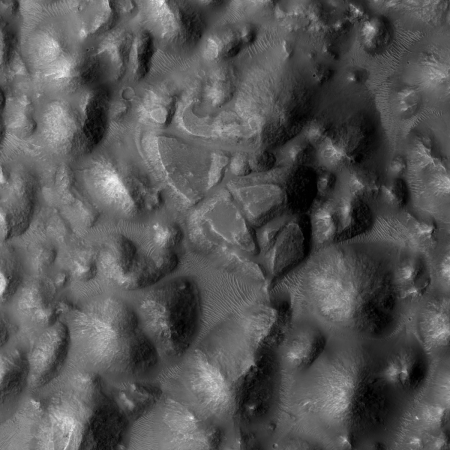
Cool image time! The image on the right, cropped and reduced in resolution to post here, shows an area on Mars that geologists have dubbed “Chaos Terrain.” If you click on the image you can see the full image, which also includes several canyons oriented in what seem to be random directions.

I first heard this geological term for regions on Mars shortly after the first orbital missions circling Mars began taking images back in the 1970s. It applied to places where the terrain was hummocky, a crazy collection of hills forming no pattern at all. Earth does not really have such terrain.

The close-up to the right also shows that at least one of these hills is fractured, made up of several large pieces that have separated over time.

This image was part of the May 2nd image release from the high resolution camera on Mars Reconnaissance Orbiter. What makes it interesting is its location on Mars. The image below shows that location, indicated by a white cross.
» Read more

3 comments

Big earthquake in South Korea linked to geothermal power plant

South Korea’s second largest earthquake has now been linked by two different studies to the injection of water deep below the surface at a new geothermal power plant.

Perched on South Korea’s southeast coast and far from grinding tectonic plates, Pohang is an unlikely spot for a big earthquake. Before the geothermal plant’s two wells were drilled, there had never been an earthquake there of any significance, says Kwanghee Kim, a seismologist at Pusan National University in Busan, South Korea, and lead author of one study. But while Kim was monitoring the aftermath of an unrelated earthquake in 2016, he began to detect rumbles from Pohang. That prompted his lab to deploy eight temporary seismic sensors at the site, which were finally in place on 10 November 2017. He expected any quakes to be small—after all, the largest previous quake tied to enhanced geothermal power, in Basel, Switzerland, was just 3.4 in magnitude.

It took only 5 days to be proved wrong. “The Pohang earthquake was larger than any predicted by existing theories,” Kim says. Although some initial measures placed the source of the quake several kilometers away from the plant, Kim’s network revealed that the earthquake, and several of its foreshocks, all began right below the 4-kilometer-deep well used to inject water into the subsurface to create the plant’s heating reservoir. Indeed, it appears likely that the well’s high-pressure water lubricated an unknown fault in the rock, causing it to slip and triggering the quake, Kim says.

A second paper, by European scientists who used regional seismic data, reinforces the South Korean team’s results, in particular its shallow depth. That study also points out that an earlier 3.1-magnitude earthquake also took place near the well bottom, increasing the odds of a common source. Satellite measures of shifts in the surface after the November 2017 quake support that idea, says Stefan Wiemer, the second study’s lead author and director of the Swiss Seismological Service in Zurich. It’s clear the locked fault was storing energy that was waiting to be released, Wiemer says. “If that fault would have gone next Tuesday or 50 years from now, we’ll never know.”

The article notes that scientists had previously concluded that injecting water underground for geothermal purposes was okay (since it reduced use of fossil fuels) while doing the same for fracking (to obtain and use fossil fuels) was bad.. The data here actually suggests just the reverse, since fracking has never produced an earthquake as large as the 5.5 magnitude Pohang quake.

3 comments

Zooming in on a Martian surprise

Global map of Mars

Let’s take a journey. Above is a global map of Mars, showing its largest and well known geological features. While far smaller than Earth, its lack of oceans means that Mars’ actual dry surface has about the same square footage as the continents of Earth. It is a vast place. Getting a close look at every spot is going to take many decades of work, and probably won’t be finished until humans are actually walking its surface.

Let’s pick a spot, zoom in and find out what’s there.
» Read more

5 comments

Is it a volcano or an impact crater? Mars Express wants to know!

Europe’s Mars Express orbiter has taken a high resolution image of Ismenia Patera, a very large crater located in the Arabia Terra region of Mars, the largest part of the transition zone between the low flat northern plains and the high rough southern terrain.

The crater is intriguing to scientists because they are not sure if it was created by an impact, or a volcano.

Certain properties of the surface features seen in Arabia Terra suggest a volcanic origin: for example, their irregular shapes, low topographic relief, their relatively uplifted rims and apparent lack of ejected material that would usually be present around an impact crater.

However, some of these features and irregular shapes could also be present in impact craters that have simply evolved and interacted with their environment in particular ways over time.

There is also additional evidence that this region was once home to volcanic activity. If so, that activity would have changed the terrain, and thus made its geological history more complex and difficult to decipher, a fact that is important since this is also a region that might have been at the edge of theorized northern Martian Ocean.

3 comments

A Martian snake of collapsed hills

A Martian snake of collapsed hills

Close-up of collapsed hills

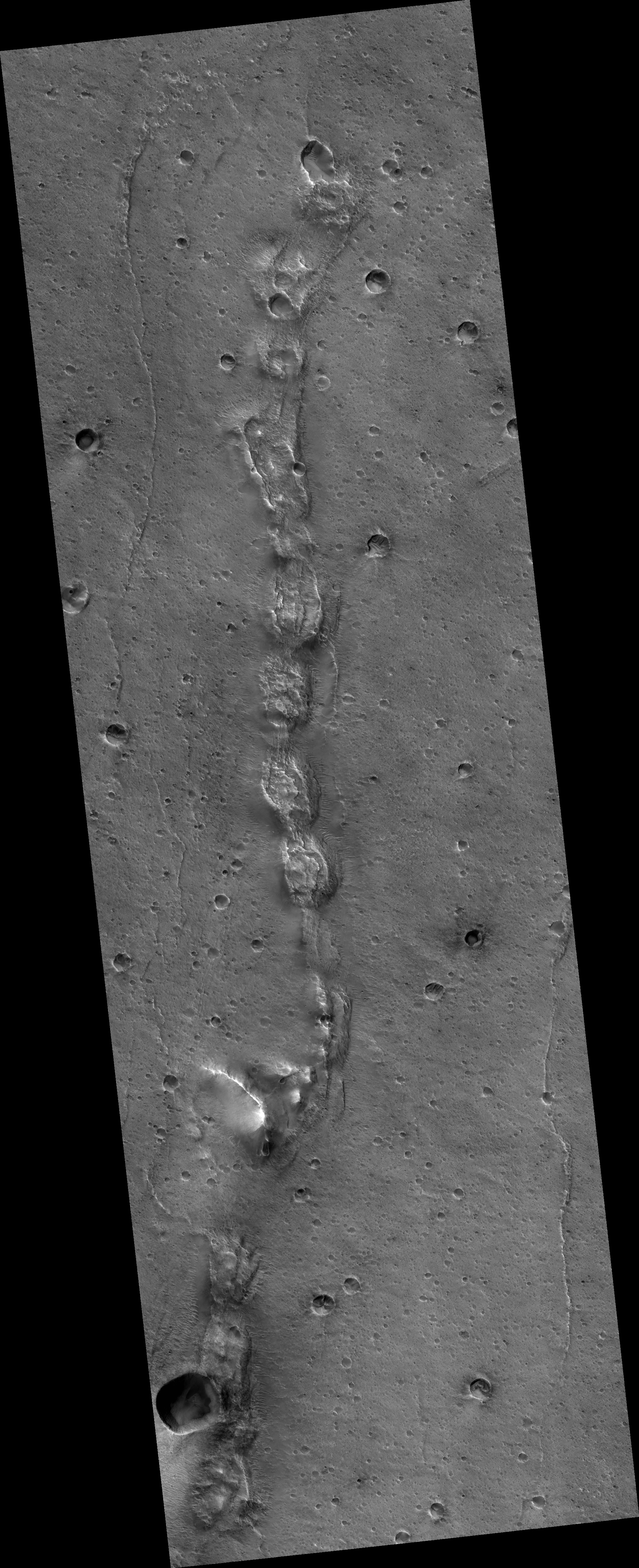
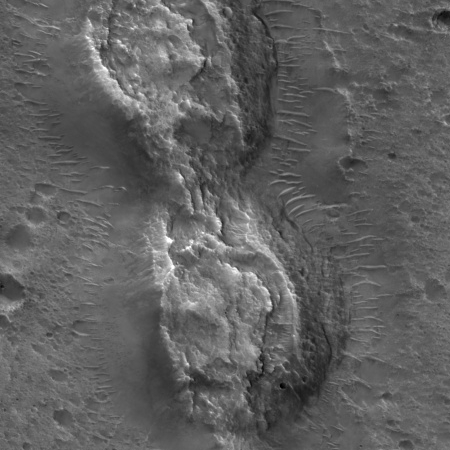
Time to once again delve into this month’s release of high resolution images from Mars Reconnaissance Orbiter. The image above, cropped, rotated, and reduced in resolution to post here, shows a string of strange mounds or hills, each with similar collapse features on their tops. If you click on the picture, you can see the full resolution image, rotated properly with north up. You can also go to the MRO post, which provides some additional information.

The white box indicates the location of the cropped close-up, at full resolution, to the right. This area is typical across the entire snake-like ridge. You have these mounds or hills, each with chaotic depressions at their tops. The depressions suggest that this ridge follows an underground void, like a lava tube. The ridge-like nature of the line of hills also suggest that this tube has been exposed by erosion over time, with the surrounding terrain more easily blown or washed away while the more resistant ridge remains.

At the same time, the line of hills is baffling. Why would a lava tube expand periodically to form something that looks like a string of pearls?

The location of this snaking ridge provides some additional context.
» Read more

8 comments

A spray of volcanic ejecta on Mars?

pit features on floor of crater

Time for some more weird Mars geology! Today the science team for the high resolution camera on Mars Reconnaissance Orbiter released its monthly batch of new images. There is a lot of interesting stuff buried therein, some of which I will feature periodically in the next month.

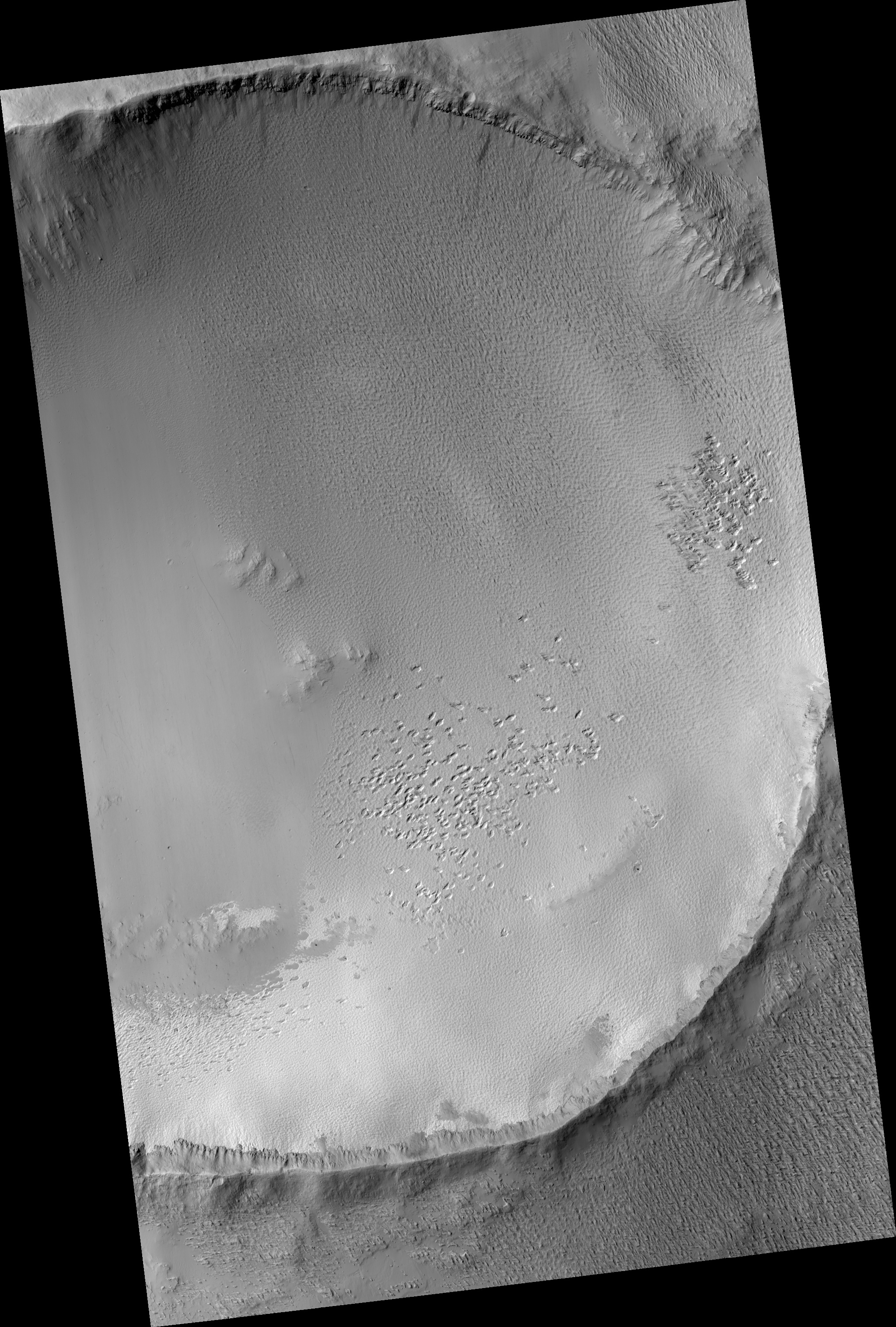
The image on the right, reduced in resolution to post here, is a good example. (If you click on the image you can see the full resolution version.) It shows a scattering of pits in three specific areas on the crater floor, all in a line going from the northeast to the southwest. Yet, the rest of the crater floor lacks similar pits, and is either very smooth or has a mottled appearance. Both the smooth and the mottled areas appear to have a very faint trend going from the northwest to the southeast, which to my eye appears caused by the general wind direction that flows across the crater floor.

Even more intriguing, the pits in these three areas appear to be mostly oblong and also trend from the northeast to the southwest, cutting across the general trend of the rest of the crater floor. You can see this in the cropped closeups from the full resolution image below, showing the two boxed areas indicated on the image on the right.
» Read more

0 comments

Near the Martian shoreline

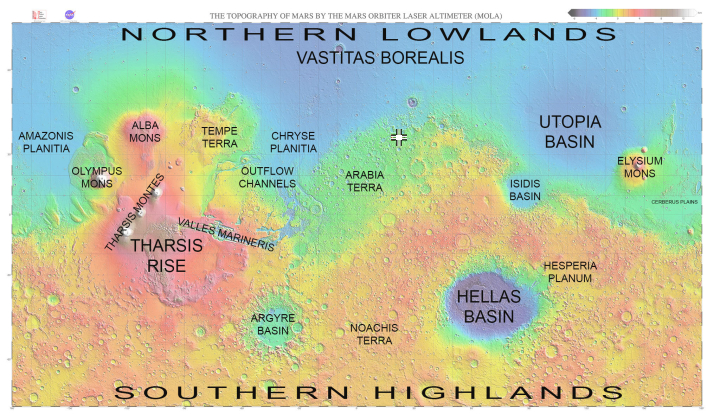
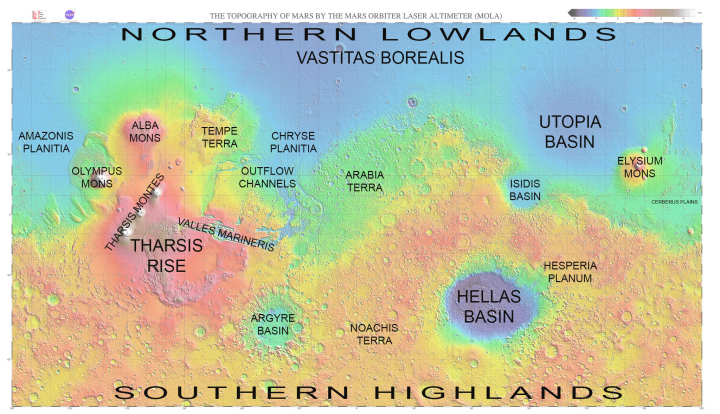
One of the prime areas of research for Mars planetary geologists is the region on Mars where the geography appears to transition from the southern cratered, rough terrain to the northern low, generally smooth, and flat plains. It is theorized by some scientists that the northern plains were once an ocean, probably shallow and probably intermittent, but wet nonetheless for considerable periods. The global map of Mars below, created by the laser altimeter on Mars Global Surveyor, clearly shows the obvious elevation differences between the low northern plans (blue) and the high, more cratered southern regions (changing from yellow to orange as you move higher).

Labeled global Map of Mars

Scientists have spent a considerable effort studying this transition zone (green on the map), illustrated by just one example I recently highlighted, showing that, though there does not appear to be a clear shoreline in many places, there is strong evidence that a shallow ocean repeatedly rose and fell in this transition zone, leaving behind geological ripple marks vaguely reminiscent of those seen on a beach caused by the rise and fall of the tides.

Today we highlight another example, taken in January 2018 at the location indicated by the cross on the above map.
» Read more

1 comment

New theory suggests Mars’ oceans formed earlier and intermittently

Scientists have proposed a new model for the existence of oceans on Mars’ northern plains that proposes they formed earlier, were shallower, were variable in size, and formed in conjunction with the eruptions that formed the planet’s giant volcanoes.

The proposal by UC Berkeley geophysicists links the existence of oceans early in Mars history to the rise of the solar system’s largest volcanic system, Tharsis, and highlights the key role played by global warming in allowing liquid water to exist on Mars. “Volcanoes may be important in creating the conditions for Mars to be wet,” said Michael Manga, a UC Berkeley professor of earth and planetary science and senior author of a paper appearing in Nature this week and posted online March 19.

…The new model proposes that the oceans formed before or at the same time as Mars’ largest volcanic feature, Tharsis, instead of after Tharsis formed 3.7 billion years ago. Because Tharsis was smaller at that time, it did not distort the planet as much as it did later, in particular the plains that cover most of the northern hemisphere and are the presumed ancient seabed. The absence of crustal deformation from Tharsis means the seas would have been shallower, holding about half the water of earlier estimates. “The assumption was that Tharsis formed quickly and early, rather than gradually, and that the oceans came later,” Manga said. “We’re saying that the oceans predate and accompany the lava outpourings that made Tharsis.”

2 comments

Dawn finds recent changes on Ceres

New data from Dawn has found at least one spot on Ceres where recent changes appear to have occurred on the surface.

Observations obtained by the visible and infrared mapping spectrometer (VIR) on the Dawn spacecraft previously found water ice in a dozen sites on Ceres. The new study revealed the abundance of ice on the northern wall of Juling Crater, a crater 12 miles (20 kilometers) in diameter. The new observations, conducted from April through October 2016, show an increase in the amount of ice on the crater wall. “This is the first direct detection of change on the surface of Ceres,” said Andrea Raponi of the Institute of Astrophysics and Planetary Science in Rome.

Raponi led the new study, which found changes in the amount of ice exposed on the dwarf planet. “The combination of Ceres moving closer to the sun in its orbit, along with seasonal change, triggers the release of water vapor from the subsurface, which then condenses on the cold crater wall. This causes an increase in the amount of exposed ice. The warming might also cause landslides on the crater walls that expose fresh ice patches.”

There is a certain irony here. For eons, the only alien body that humans were able to get a good look at, the Moon, was also an object where almost nothing changed. Even today, after humans have visited its surface and numerous orbiting spacecraft have photographed its surface in numbing detail, the Moon has generally been found to be stable and unchanging. Though impacts do occur, and the surface does evolve over time, the Moon is probably one of the most static bodies in the solar system.

The irony is that this lunar stability gave us an incorrect impression of the rest of the solar system. Based on the Moon, it was assumed that airless or almost airless bodies like Mercury, Mars, Pluto, the large moons of Jupiter and Saturn, and asteroids like Ceres would also be stable and unchanging. What we have instead found is that the Moon is the exception that proves the rule. Most of these other worlds are unlike the Moon. They show a lot of surface evolution, over relatively short time scales. They change.

0 comments

More weird Mars geology

Low resolution of full image of crater

Cool image time! Yesterday the Mars Reconnaissance Orbiter team released 460 images taken by the spacecraft’s high resolution camera, HiRISE, as part of their normal and routine image release program. Obsessed with space exploration as I am, I like to scan through these new images to see if there is anything interesting hidden there that will show up eventually in a press release. For example, the first image in this release is a look at Vera Rubin Ridge and Curiosity. I would not be surprised if there is a press release soon using this image, probably aimed at outlining the rover’s future route up Mount Sharp. (The present overview traverse map is getting out of date.)

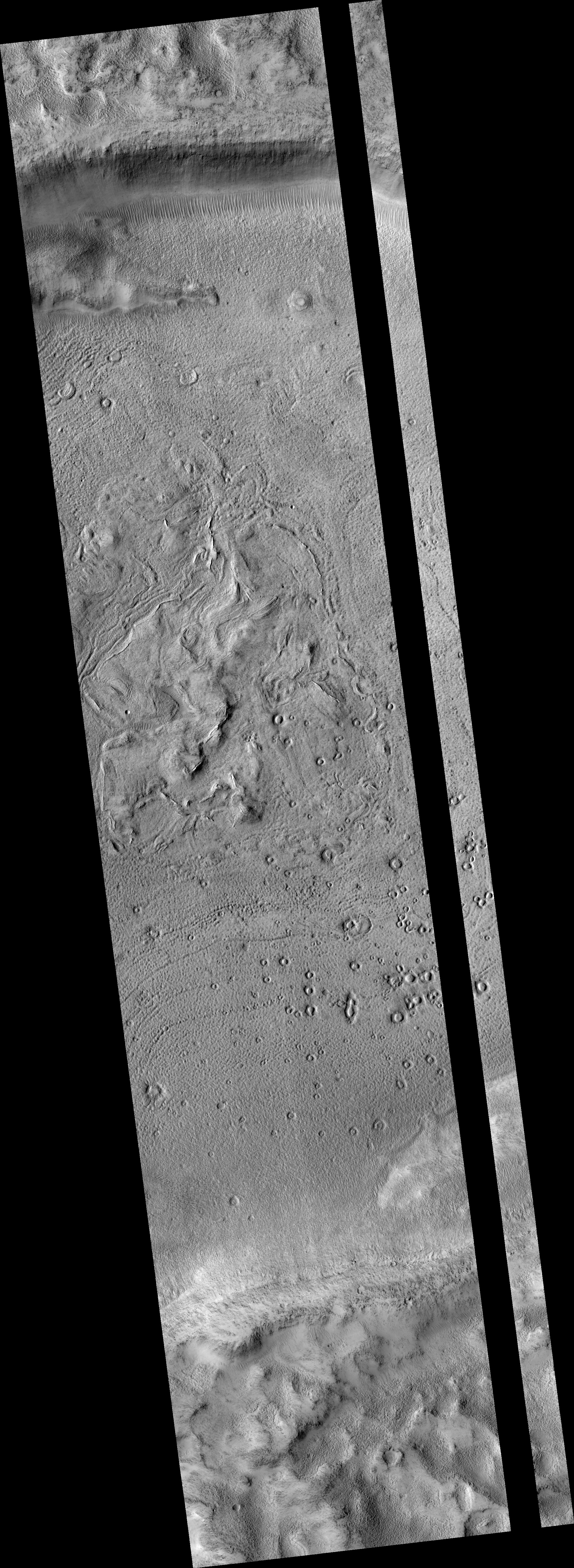
Sometimes however I find images that might never get a press release but probably deserve it. The image on the right, reduced in resolution to show here, is one such example. It is a strip taken from rim to rim across an unnamed crater located in the mid-northern latitudes of Mars, west of Olympus Mons. A review of past images by other Mars orbiters/probes suggests that no good high resolution image of this crater had ever been taken before.

If you click on the image on the right, or go to the actual image site, you can see the original in full resolution. It is definitely worthwhile doing this, because the strip shows some strange and inexplicable geology on the floor of the crater as well in its confusing central peak region. Numerous features appear to have been exposed by later erosion. The many small craters for example are I think what planetary geologists call pedestal craters. The surrounding terrain is less erosion-resistant, so as that terrain erodes away it leaves the crater behind, with its floor actually sitting higher than the surrounding flats.

What makes these craters even weirder however is that their rims appear to have eroded away even more than the surrounding terrain, so that all of these small craters (assuming that is what they are) have ringlike depressions surrounding a circular platform.

In the crater’s central peak region the terrain is even more strange. Sticking up out of the ground are some arched short ridgelines, which appear to have been exposed by erosion. That peak area however also has many strange flow features that I find completely baffling. It almost appears to me that as the molten peak area started to solidify after impact, someone went in with a stirring spoon and did some mixing!

The map below the fold provides the location context for this crater, with the crater’s location indicated by the arrow.
» Read more

29 comments

Weird Martian geology: Kaiser Crater

Kaiser Crater bedrock

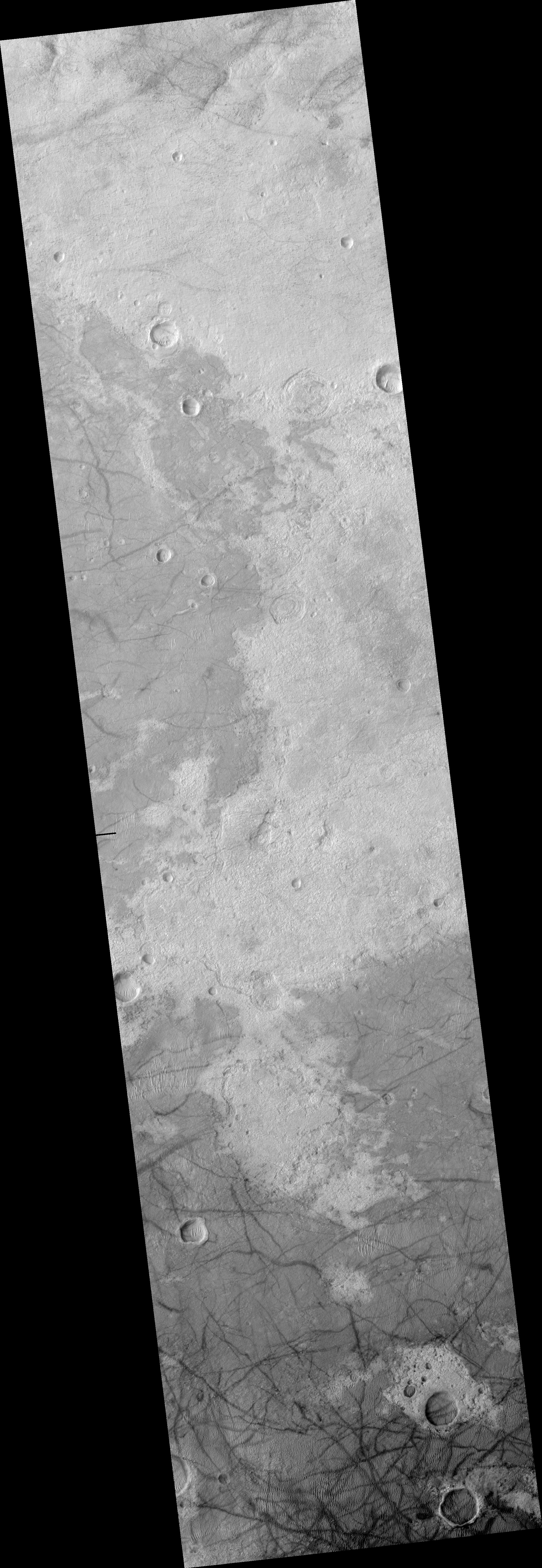
Cool image time! This week JPL’s image site highlighted a picture taken by Mars Odyssey of the floor and dunes inside Kaiser Crater, located to the west of Helles basin in an area dubbed the Noachis Region.

To my eye, the Mars Odyssey picture was interesting, but not worth a post here on Behind the Black. However, I decided to take a look at what HiRise, the high resolution camera of Mars Reconnaissance Orbiter (MRO), had taken of the same area, just out of curiosity. A search at the master HiRise image site at the same latitude and longitude (-45 latitude, 180 longitude) showed that HiRise had imaged a part of the same area, but at much higher resolution.

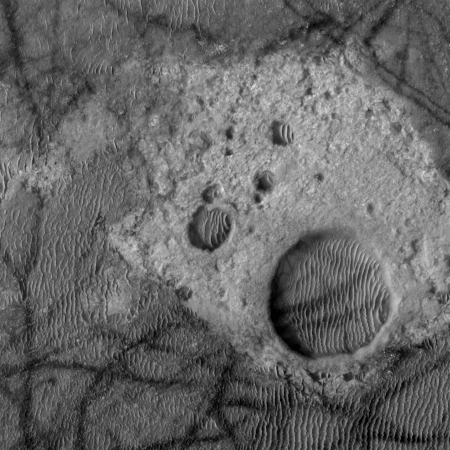
When I zoomed in on this hi resolution image I came across some interesting and weird geology, cropped to show here on the right. Now this, I thought, is worth posting. Notice how the dark tracks, caused by dust devils, leave no tracks as they cut across the brighter areas. Obviously, these bright areas have no dust or sand, and are likely solid bedrock of some kind. The depressions might be craters, but they also might not. The raised area around the depressions might have been caused by the impact, or it might have been caused by some internal geological process that caused the depression while also raising the surrounding bulge. Since then the wind has been steadily depositing sand in the depressions, causing it to get trapped there.

7 comments
1 128 129 130 131 132 157