A spectacular collapse feature at Arsia Mons
Collapse at Arsia Mons

Cool image time! This post could be called an update to my January 8th post, Exploring Arsia Mons. In that post I had compiled together the ten images of Arsia Mons, the southernmost volcano in the line of three giant volcanoes on Mars, that JPL had highlighted over several weeks in early January.

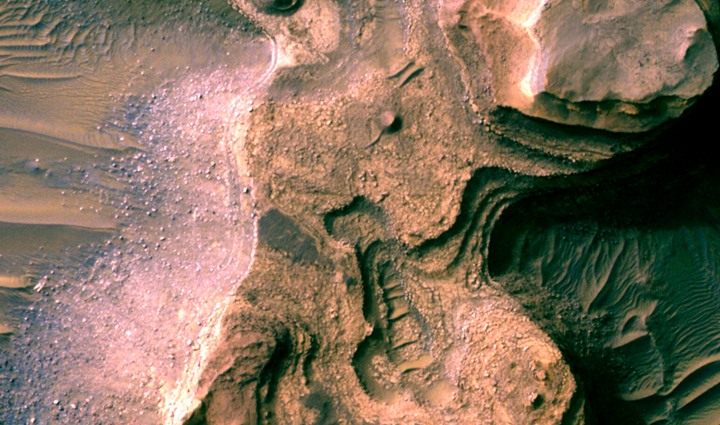
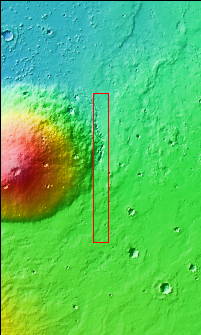
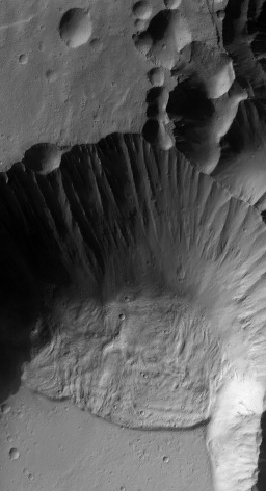
Today, I decided to do some of my own exploration of some of the many images taken of Arsia Mons by all of the Martian orbiters. My goal had been to explore the volcano’s western slopes (an area that had not been featured in the JPL releases) because that is the area where research has found evidence of past glacial activity as well as seasonal water clouds. I haven’t finished that survey, but in the process I came across a spectacular image of a collapse that had been visible in image nine of the January 8th post, but did not stand out there because of the lighting. The image on the right is that better image, cropped to focus in on the collapse itself.

The material at the base of the wall resembles piled up mud, which suggests this collapse is a Martian version of a mud slide. If so, it also suggests the presence of liquid. At the same time, the muddy look might not be from liquid but because of the lighter Martian gravity causing avalanches to be appear different there. The light gravity means material is not as dense, so when it collapses it might break apart more easily into a sandy type flow.

I am only an amateur geologist, so my theories here should not be taken very seriously. Nonetheless, I am sure there are planetary geologists who have looked at this closely because of the information about Martian geology that they can glean from it. I’d be curious to hear their thoughts.

Meanwhile, my exploration of the western slopes of Arsia Mons will continue. In Pioneer the science fiction book I wrote in the early 1980s (now available), I placed my Martian colony in Mangala Valles, a meandering canyon to the west of Olympus Mons that feeds out from the higher southern regions into the lower northern flat plains where even then some scientists thought an ocean might have once existed. My thinking then was that this might be a good location to find underground water. It now appears, with our greater knowledge, that the slopes of the volcanoes themselves might be more promising, and I am curious to find the most likely places in this region where a future colony might end up.
2 comments

Exploring Arsia Mons

Master index

In November over a period of two weeks the Mars Odyssey team posted ten images of Pavonis Mons, the smallest of the aligned three giant volcanoes just to the east of Olympus Mons, the largest known volcano in the solar system. I then made all of those images available in a single link, with some analysis.

They have now done the same thing for the southernmost (and possibly the most interesting) of those three aligned volcanoes, Arsia Mons. From the first image below:

Arsia Mons is the southernmost of the Tharsis volcanoes. It is 270 miles (450km) in diameter, almost 12 miles (20km) high, and the summit caldera is 72 miles (120km) wide. For comparison, the largest volcano on Earth is Mauna Loa. From its base on the sea floor, Mauna Loa measures only 6.3 miles high and 75 miles in diameter. A large volcanic crater known as a caldera is located at the summit of all of the Tharsis volcanoes. These calderas are produced by massive volcanic explosions and collapse. The Arsia Mons summit caldera is larger than many volcanoes on Earth.

In other words, you could fit almost all of Mauna Loa entirely within the caldera of Arsia Mons.

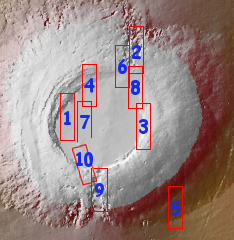
The image on the right above is the master index, annotated by me to show the area covered by each image. The images can accessed individually below.
» Read more

0 comments

Faults on Mars

Faults on Mars

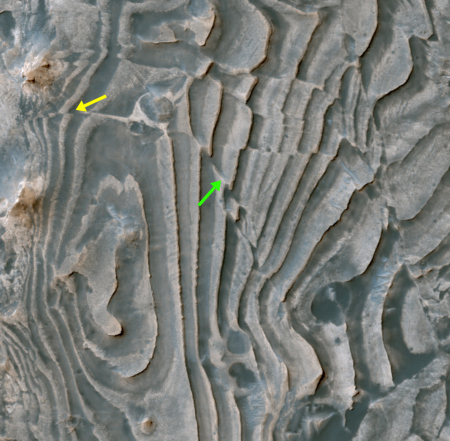
Cool image time! The Mars Reconnaissance Orbiter (MRO) image on the right, reduced in resolution to post here, captures a distinctive fault line that cuts across some layered deposits. As noted by the MRO science team,

Some of the faults produced a clean break along the layers, displacing and offsetting individual beds (yellow arrow).

Interestingly, the layers continue across the fault and appear stretched out (green arrow). These observations suggest that some of the faulting occurred while the layered deposits were still soft and could undergo deformation, whereas other faults formed later when the layers must have been solidified and produced a clean break.

Meridiani Planum

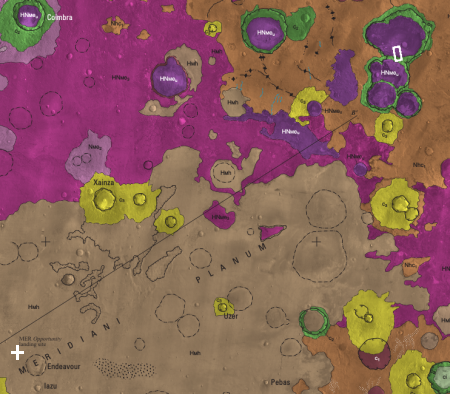
These layers are located in Meridiani Planum, a relatively flat area on the Martian equator. Opportunity landed on this plain to the southwest of this region, as shown on the geology map to the left. The white cross in the southwest corner indicates Opportunity’s landing site, with Endeavour Crater just to the southeast. The white box in the northwest shows where the faulted layered deposits are located. Based on the scale of the map, this places Opportunity approximately 400 miles away.

What exactly caused these distinct faults remains unknown. The likely cause would be a earthquake, but since Mars does not have plate tectonics like the Earth, earthquakes would have to be caused by other geological processes not yet studied.

To my eye, they look like cracks in a mirror, though this provides no real explanation other than it illustrates how cool the image is.

7 comments

Squiggles on Mars

Squiggles on Mars

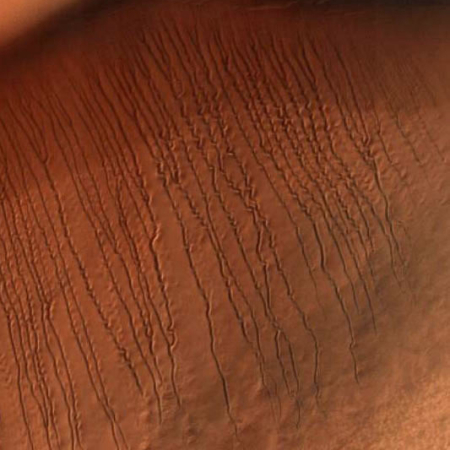
Cool image time! The image on the right, reduced and cropped to post here, shows a sand dune slope with numerous squiggly troughs that end either in a small pit or slowly fade away. At first glance one things the troughs were caused by a boulder rolling downhill, but there are no boulders at the base of the slope, and a rolling boulder wouldn’t create so many similar squiggles like this.

The explanation is that the boulders are made of carbon dioxide ice.

Just like on Earth, high-latitude regions on Mars are covered with frost in the winter. However, the winter frost on Mars is made of carbon dioxide ice (dry ice) instead of water ice. We believe linear gullies are the result of this dry ice breaking apart into blocks, which then slide or roll down warmer sandy slopes, sublimating and carving as they go.

The linear gullies exhibit exceptional sinuosity (the squiggle pattern) and we believe this to be the result of repeated movement of dry ice blocks in the same path, possibly in combination with different hardness or flow resistance of the sand within the dune slopes.

For a really entertaining explanation of this process, take a look at the embedded video below the fold.
» Read more

0 comments

The mysterious dark splotches of Mars

The dark splotches of Mars

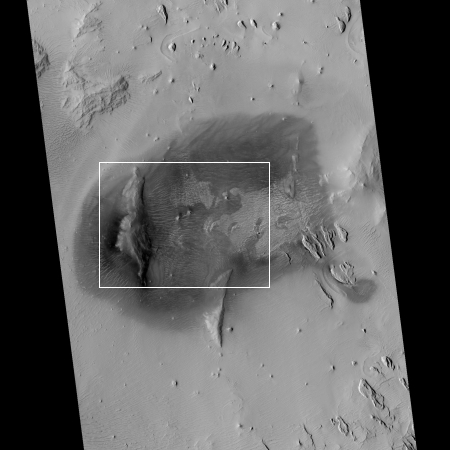
Cool image time! The image on the right, cropped and reduced in resolution to post here, shows one particular dark splotch in a region with several similar dark areas.

Geologists aren’t quite sure what to make of the dark splotch in the middle of this image, one of several similar dark splotches that extend east and west for over 100 kilometers. From measurements made in infrared, this and other dark splotches have what we call “high thermal inertia,” meaning that it heats up and cools down slowly. Scientists use thermal inertia to assess how rocky, sandy, or dusty a place is. A higher thermal inertia than the surrounding area means it’s less dusty.

The image below the fold shows at full resolution the area indicated by the white box. It provides me no clue as to the cause for the darker color. I think we can speculate all we want, but the truth is that we simply don’t have enough information. We need a closer look, including boots on the ground, to figure this out.
» Read more

4 comments

Database of presumed human-caused earthquakes created

The uncertainty of science: Geologists have assembled a database of more than 700 earthquakes they think might have been caused by human activity.

The Human-Induced Earthquake Database, or HiQuake, contains 728 examples of earthquakes (or sequences of earthquakes) that may have been set off by humans over the past 149 years. Most of them were small, between magnitudes 3 and 4. But the list also includes several large, destructive earthquakes, such as the magnitude-7.8 quake in Nepal in April 2015, which one paper linked to groundwater pumping.

Miles Wilson, a hydrogeologist at Durham University, UK, and his colleagues describe the database in a paper set to be published on October 4 in Seismological Research Letters2. The scientists say that HiQuake is the biggest, most up-to-date public listing of human-caused quakes ever made. By bringing the data together in this way, they hope to highlight how diverse induced quakes can be — and help society to understand and manage the future risk.

Many of these quakes were likely caused by human activity. Many however might not have been. The jury is still out, as the article reluctantly admits near the end.

All possible instances of induced quakes were included “without regard to plausibility”, writes the team, because of the difficulty involved in deciding what constitutes absolute proof that an earthquake was caused by human activity. But that could mislead people about the real hazard from induced quakes, says Raphaël Grandin, a geophysicist at the Institute of Earth Physics in Paris. “When you put a dot in the database, and a scientific reference behind it, then you may lead the non-expert to think that the earthquake was caused by humans,” he says. Such a listing might hide scientific uncertainty, as with the Chinese quake: despite the paper linking it to reservoir filling, many seismologists do not believe it was triggered by human activity.

In other words, they included every quake that had the slightest suggestion it was connected to human activity, without noting the uncertainties. This makes this database to me somewhat suspect. Rather than identify the known reliable links between human activity and quakes in order to learn what causes them, this database seems more designed as a political propaganda tool aimed at limiting future human activity. It certainly doesn’t clarify our knowledge on this subject, but instead muddies the water significantly.

6 comments

Astronomers discover complex molecules in protostar accretion disk

Astronomers have discovered several complex molecules in the accretion disk surrounding a very young baby star about 1300 light years away in the constellation Orion.

The research team’s ALMA observations have clearly detected an atmosphere of complex organic molecules above and below the disk. These include methanol (CH3OH), deuterated methanol (CH2DOH), methanethiol (CH3SH), and formamide (NH2CHO). These molecules have been proposed to be the precursors for producing biomolecules such as amino acids and sugars. “They are likely formed on icy grains in the disk and then released into the gas phase because of heating from stellar radiation or some other means, such as shocks,” says co-author Zhi-Yun Li of the University of Virginia.

What is even most interesting about this discovery is that these complex molecules are not scattered throughout the disk, but are concentrated in regions above and below its central plane, what the astronomers are labeling “an atmosphere.” This suggests that differentiation — the same process that separates the heavier molecules from lighter ones both in centrifuges and in the cores of planets — occurs quickly in accretion disks as well.

2 comments

A river canyon on Mars

A river on Mars

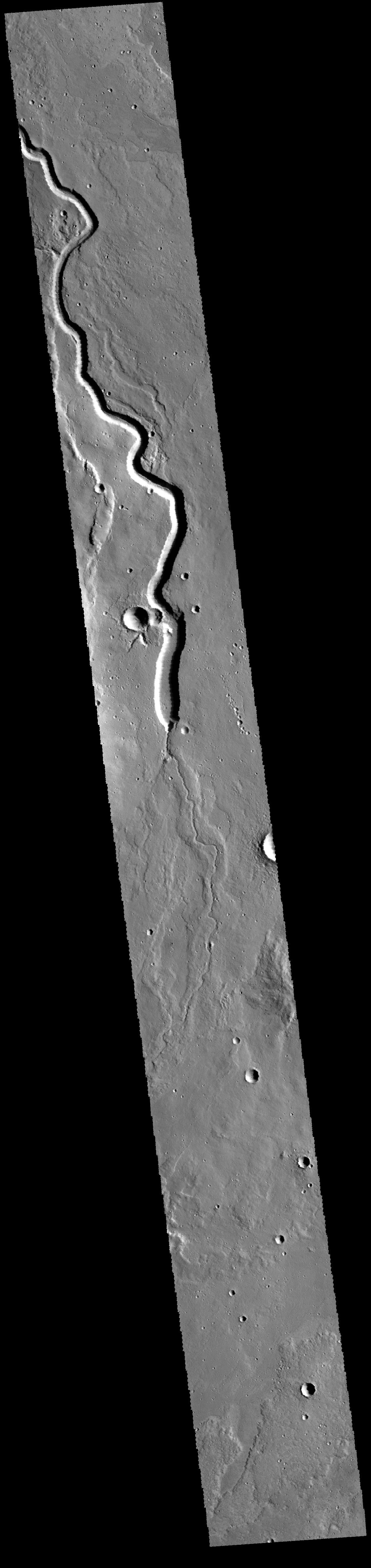
Cool image time! The image on the right, reduced in resolution significantly to show here, was taken by the Themis camera on Mars Odyssey, and shows an unnamed canyon on Mars. Be sure to click on the image to see the full resolution version.

This canyon of course no longer has anything flowing in it. Moreover, it is not clear whether this was formed by water or lava. Unfortunately, the image is part of a series of “Art images” from Mars Odyssey, where they pick an image and suggest it looks like something else. In this case, they are claiming this looks like a “snake, slithering down the image.” Cute, but not very helpful. And unfortunately, they don’t add any further details at all about the image or its location. The context image suggests this canyon is next to a volcano.

After doing further research at the Themis image site, I was able to locate this image on Mars (using latitude 32.0515 and longitude 152.236 given at the link) and look at the images surrounding this one. Further research identified the volcano as Hecates Tholus in the Elyesium Plantia region to the west of Mars’s giant volcanoes.

Looking at all the nearby Mars Odyssey images, it appears that there are a lot of flows like this in this area, and all of them appear to be lava flows, with this one being the largest. A close look at the area just to the south of where the deep canyon opens out shows that the small surface flow draining into the canyon also appears to sit on much larger surface flows (at least two) that left the surface higher than the surrounding terrain.

Elyesium Plantia itself is a plateau, somewhat close to the border between Mars’s southern highlands and the northern plains where some scientists think an ocean might have once existed. Thus, it makes sense that the canyon drains north, as it is following the dip down to those northern low plains.

1 comment

Largest quake in Yellowstone since 2014

The USGS today recorded a magnitude 4.5 earthquake at Yellowstone today, the largest since a magnitude 4.8 occurred in March 2014, and part of a continuing swarming of small quakes that began on June 12.

This sequence has included approximately thirty earthquakes of magnitude 2 and larger and four earthquakes of magnitude 3 and larger, including today’s magnitude 4.5 event.

It is hard to say whether this swarm of small quakes portend a really big volcanic event, or will simply die off in the coming days. Recent data at Yellowstone has suggested the former is possible, though not imminent.

1 comment

The rings of Saturn

The rings of Saturn up close

Cool image time! The image to the right, cropped to post here, is part of one of the closest and highest resolution images that Cassini has yet taken of Saturn’s rings. The image was taken in January during one of the spacecraft’s ring grazing orbits, and has a resolution of 2,300 feet per pixel. And yet, as noted by the Cassini science team, “Even at this level of detail, it is still not fine enough to resolve the individual particles that make up the ring.”

In prepping the image, all I did was crop it to show the closest rings. I purposely did not reduce its resolution, so that you can see that no individual particles are visible. The rings of Saturn are truly made up of billions of small objects, behaving in many ways like liquid floating in the gravity well of Saturn. If you don’t believe me, download the full image and zoom in on it as much as you like. All you will see are pixels.

The fundamental science question therefore is not how Saturn’s rings behave (though this is certainly important and quite fascinating) but why did those rings end up the way they are. No other planet has rings anything like Saturn’s in their density and make-up. Why? Are Saturn’s rings a normal process that only occurs for short times around planets, which is why only Saturn has these types of rings at present? Or is it a rare event, so rare that we happen to be very lucky to see such a thing at all?

Even more important, Saturn’s rings and their behavior are likely linked closely to the same phenomenon that describe the formation of planets around a star. The more we can learn about why these rings exist, the more we will learn about why planets exist, both here circling the Sun as well as around stars everywhere else.

7 comments

The layered mesas of Mars

The mesas of Uzboi Valles

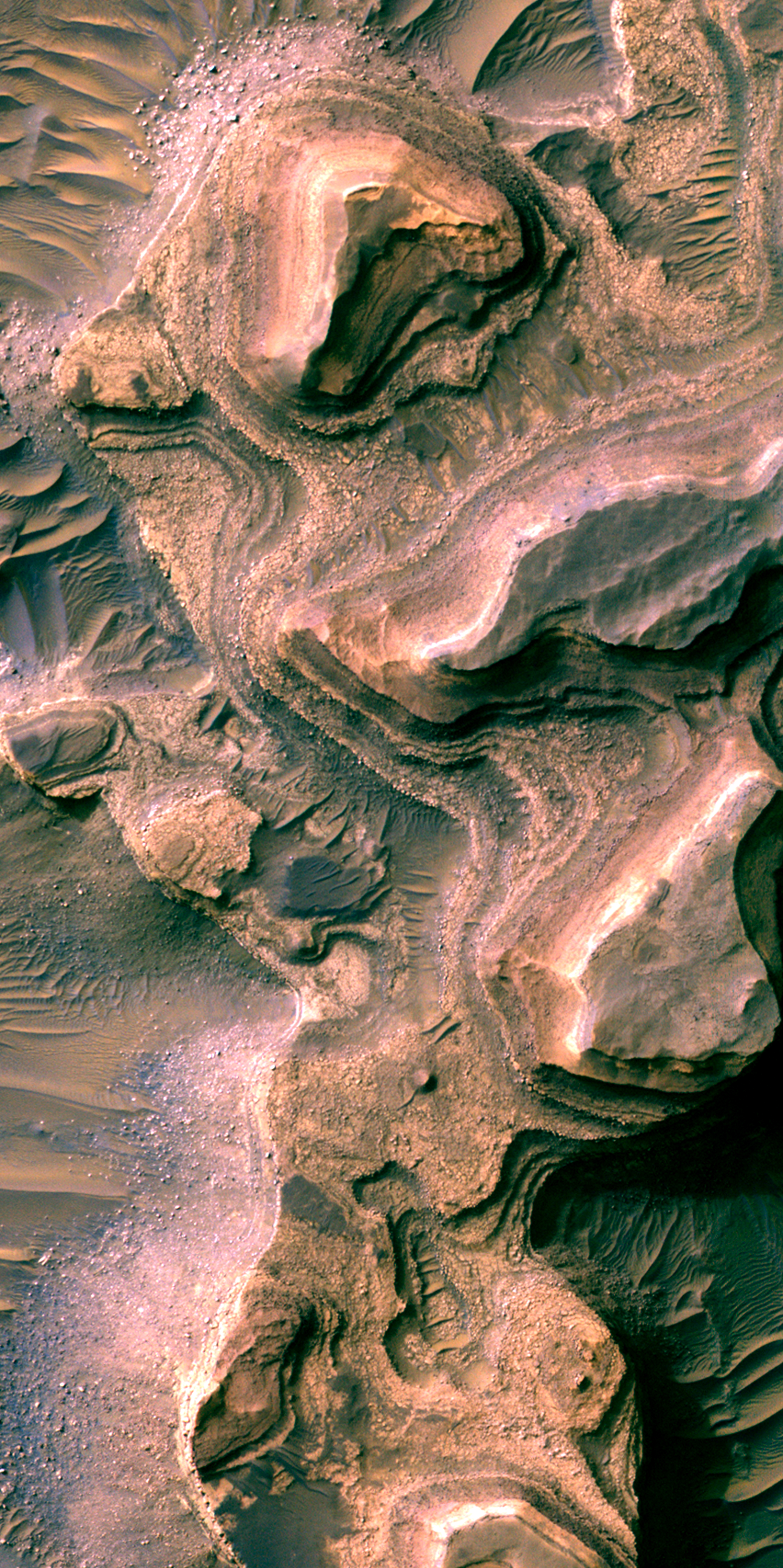
Cool image time! The image above, reduced and cropped to post here, shows the layered deposits and complex erosion that has taken place in this area of Mars dubbed Uzboi Vallis. As noted at the Mars Reconnaissance Orbiter post,

Layered deposits in Uzboi Vallis sometimes occur in alcoves along the valley and/or below where tributaries enter it. These deposits may record deposition into a large lake that once filled Uzboi Vallis when it was temporarily dammed at its northern end by the rim of Holden Crater and before it was overtopped and breached allowing water to drain back out of the valley.

It is important when looking at these erosion patterns, including the strangely shaped rippled sand dunes scattered through the larger image, that wind possibly plays an even more important part in causing erosion on Mars than liquid water might have in the far past.

Either way, the terrain here has the same stark and fascinating beauty as that seen in the American southwest. If we can ever make it possible to live on Mars, this will definitely be a place to visit when on vacation.

6 comments

Scientists estimate age of bright spots in Occator Crater on Ceres

Using crater counts and a careful analysis of features in Occator Crater on Ceres, scientists have estimated that the last major eruption occurred about 4 million years ago.

Nathues and his team interpret the central pit with its rocky, jagged ridge as a remnant of a former central mountain. It formed as a result of the impact that created Occator Crater some 34 million years ago and collapsed later. The dome of bright material is much younger: only approximately four million years. The key to determining these ages was the accurate counting and measuring of smaller craters torn by later impacts. This method’s basic assumption is that surfaces showing many craters are older than those that are less strongly “perforated”. Since even very small craters are visible in highly resolved images, the new study contains the most accurate dating so far.

“The age and appearance of the material surrounding the bright dome indicate that Cerealia Facula was formed by a recurring, eruptive process, which also hurled material into more outward regions of the central pit”, says Nathues. “A single eruptive event is rather unlikely,” he adds. A look into the Jupiter system supports this theory. The moons Callisto and Ganymede show similar domes. Researchers interpret them as volcanic deposits and thus as signs of cryovolcanism.

The volcano itself has slumped away, leaving behind the bright depression. Whether any cryovolcanism is still occurring underground remains unknown.

0 comments
1 129 130 131 132 133 157