Water unneeded to produce wet gullies on Mars

The uncertainty of science: New modeling suggests that the wet gullies seen on Mars can be produced by dry ice, not water.

The theory is not completely new, but Cedric Pilorget and Franรงois Forget, with the University of Paris-Sud, and Parisโ€™ Pierre and Marie Curie University, respectively, flesh out the idea with some hard numbers. Their new computer model calculates seasonal changes and impacts of an underlying layer of regolith, a carbon dioxide ice layer and the carbon dioxide-dominated gas atmosphere above. The simulation can take into account a variety of latitudes, slopes and other parameters.

The scientists found that most of the gullies could be created in a process that does not require any liquid water.

1 comment

A movie of Ceres

Cool movie time! The Dawn science team has released a movie compiled from images taken by the spacecraft, showing in false color the entire dwarf planet’s rotation as well as doing a fly-over of Occator Crater with its double bright spot.

I have posted the movie below the fold. The false colors illustrate the different materials so far detected on the surface, and help explain the nature and origin of the surface features.
» Read more

0 comments

Bright spots on Ceres likely salt deposits

Based on an analysis of Dawn images scientists now believe that the bright spots on Ceres are salt deposits, not water ice.

Le Corre and colleagues, using images from Dawn’s framing camera, suggest that these salt-rich areas were left behind when water-ice sublimated in the past. Impacts from asteroids would have unearthed the mixture of ice and salt. โ€œThe location of some bright spots also coincide with places where water vapor was detected by other spacecraft,โ€ said Reddy, a PSI Research Scientist. โ€œThis gives us confidence that the bright spots are likely salt deposits left over by sublimating salty water.โ€

While the bright spots themselves are not ice, they are what is left over after salty water evaporates.

0 comments

Scientists begin another attempt to drill through the Earth’s crust

An expedition to the Indian Ocean is about to begin an effort to drill a core down through the Earth’s crust and into its mantle.

Geologists have been trying to drill through the contact between the crust and the mantle, called the Moho, since the 1960s, with no success. Either the projects have gone way over budget and been shut down, have failed due to engineering problems, or were stopped by the geology itself. This last issue is maybe the most interesting.

Expeditions have come close before. Between 2002 and 2011, four holes at a site in the eastern Pacific managed to reach fine-grained, brittle rock that geologists believe to be cooled magma sitting just above the Moho. But the drill could not punch through those tenacious layers. And in 2013, drillers at the nearby Hess Deep found themselves similarly limited by tough deep-crustal rocks

This new project hopes to learn from these past problems to obtain the first rock samples from below the Earth’s crust.

4 comments

Earth’s magnetic field might not be flipping

The uncertainty of science: A new analysis of the past strength of the Earth’s magnetic field suggests that today’s field is abnormally strong and that, even with the 10% decline in the field’s strength in the past two centuries, it remains stronger than the average over the past 5 million years.

The new data also suggests that the field might not be about to shut down and then reverse polarity, as some scientists have theorized based on the 10% decline. Instead, the data says that the field’s unusual strength today only means that the decline is bringing it back to its average strength, and is not necessarily an indication of a pending reversal.

To put it mildly, there are a lot of uncertainties here, including questions about the database that has been used previously by geologists to estimate the past strength of the Earth’s magnetic field. The database might have been right, but the new study raises significant new questions.

1 comment

Study questions scientific dating method

The uncertainty of science: A new study has raised questions about the methods scientists have used to date the late heavy bombardment in the early solar system.

A study of zircons from a gigantic meteorite impact in South Africa, now online in the journal Geology, casts doubt on the methods used to date lunar impacts. The critical problem, says lead author Aaron Cavosie, a visiting professor of geoscience and member of the NASA Astrobiology Institute at the University of Wisconsin-Madison, is the fact that lunar zircons are “ex situ,” meaning removed from the rock in which they formed, which deprives geoscientists of corroborating evidence of impact. “While zircon is one of the best isotopic clocks for dating many geological processes,” Cavosie says, “our results show that it is very challenging to use ex situ zircon to date a large impact of known age.”

The problem is that the removal of the zircon from lunar rocks changes the data enough to make the dating unreliable. The method might work on Earth, but the dating done on Apollo samples can be questioned. This means that much of the supposed history of the solar system, centered on what planetary scientists call the late heavy bombardment, a period 4 billion years ago when the planets were being hit by innumerable impacts as they cleared the solar system of its dusty debris disk, might not have happened as dated from lunar samples. If so, our understanding of when that bombardment ended and life began to form on Earth might be considerably incorrect.

The solution? Get to the planets in person, where you can obtain many samples in situ and thus gather a much deeper understanding of the geology.

7 comments

Back from a weekend underground

Bob Zimmerman underground

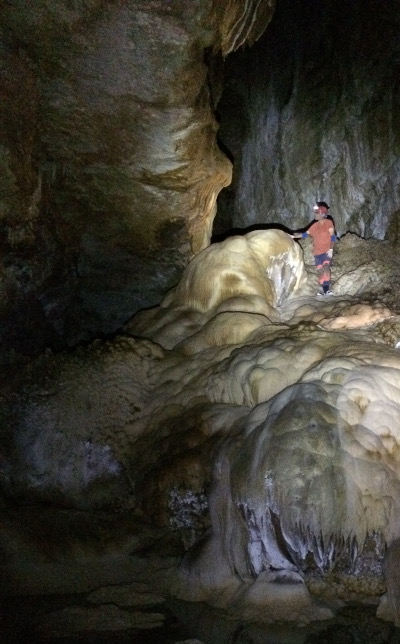
The picture on the right will explain why I have been silent posting since Friday. I have just returned with five friends from three days of caving in New Mexico, doing some wild caving plus my first visit to Carlsbad Caverns since 1992, guided by a local caver who has been helping me with my cave survey project in Arizona.

New Mexico probably has the largest concentration of truly large and spectacularly decorated caves in the entire world. I’ve caved there previously, but this was my first trip driving from Arizona. We went to two wild caves, one of which I had never visited before and a second that I had seen during my 1992 trip. The picture shows me in the latter, standing above a large clear pool near the back of the cave with some giant flowstone speleothems all around me.

The new cave contained a room dubbed Speleogasm, because every formation there, of which there are too many to count, is completely festooned with helectites and sodastraws in a mad protrusion that no geologist can as yet explain. Nor is there any way to describe it adequately or photograph it successfully. To witness it you need to go, requiring the specialized caving skills that include the techniques and equipment required to rappel and climb a 40 foot rope.

As always, the advantages of learning how to do this successfully is the reward of seeing things that few ever see. It is why engineers and scientists strive so hard to get planetary probes to distant planets. And why humans want to travel to the planets. For me, getting inside a remote and beautifully decorated cave will just have to do.

1 comment

An avalanche on Mars, as it happens

Avalanche on Mars

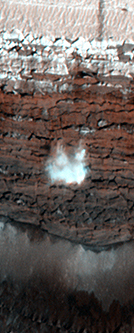
Cool image time! In their routine monitoring for avalanches at the layered deposits at the Martian north pole, the Mars Reconnaissance Orbiter science team captured the avalanche on the right, as it happened.

This picture managed to capture a small avalanche in progress, right in the color strip. … The small white cloud in front of the brick red cliff is likely carbon dioxide frost dislodged from the layers above, caught in the act of cascading down the cliff. It is larger than it looks, more than 20 meters across, and (based on previous examples) it will likely kick up clouds of dust when it hits the ground.

They note that avalanches in this area of Mars are common in the spring when things are warming, and have been documented previously, but possibly not so dramatically.

4 comments

Changes on the surface of Comet 67P/C-G

In a science paper now accepted for publication, the Rosetta science team have described changes that have occurred on the surface of Comet 67P/C-G from May through July of this year as the comet moved closer to the Sun and activity increased.

The changes were seen in a smooth area dubbed Imhotep.

First evidence for a new, roughly round feature in Imhotep was seen in an image taken with Rosettaโ€™s OSIRIS narrow-angle camera on 3 June. Subsequent images later in June showed this feature growing in size, and being joined by a second round feature. By 2 July, they had reached diameters of roughly 220 m and 140 m, respectively, and another new feature began to appear.

By the time of the last image used in this study, taken on 11 July, these three features had merged into one larger region and yet another two features had appeared.

Be sure to click on the link to see the images. The changes look like a surface layer is slowing evaporating away.

1 comment
1 133 134 135 136 137 157