Curiosity prepares to move on

Route through Murray Buttes

After several days of drilling, the Curiosity science team is preparing to move forward. As one member of the team notes,

After a short drive weโ€™ll acquire images for context and targeting. Overnight, Curiosity will complete a SAM electrical baseline test to monitor instrument health. Based on some of the recent Mastcam images that weโ€™ve acquired…, the view ahead should be quite scenic as we drive through the Murray Buttes!

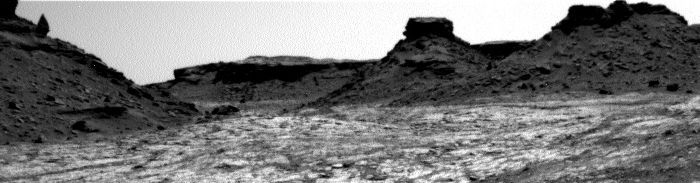
The image above is a close-up of those Buttes, showing Balanced Rock on the left, taken from one of three raw left navigation images. The image below is a panorama I have created from those navigation images, with an inset box to show the location of the above picture.
» Read more

5 comments

Craters on Ceres

craters on Ceres
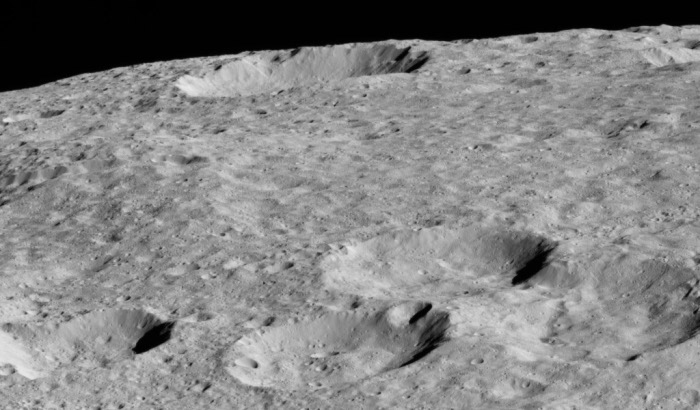
Cool image time! The image above, cropped and reduced in resolution to show here, was taken on May 30, 2016 by Dawn from 240 miles away. It looks northward at the dwarf planet’s horizon, and has a resolution of about 120 feet per pixel.

My only comment is to note how soft the terrain looks. I realize this is not really an accurate description, but data has shown that Ceres has a somewhat low density and is somewhat malleable. It sure looks that way here.

1 comment

Rivers of liquid carved deep gorges on Titan

Cassini radar data of Via Flumina

Cool image time! New data from Cassini has now both confirmed that there is liquid inside some of the river-like formations on Titan, and that this liquid has carved these formations into very deep gorges.

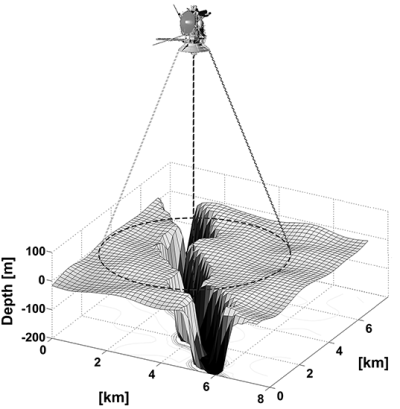
The Cassini observations reveal that the channels — in particular, a network of them named Vid Flumina — are narrow canyons, generally less than half a mile (a bit less than a kilometer) wide, with slopes steeper than 40 degrees. The canyons also are quite deep — those measured are 790 to 1,870 feet (240 to 570 meters) from top to bottom.

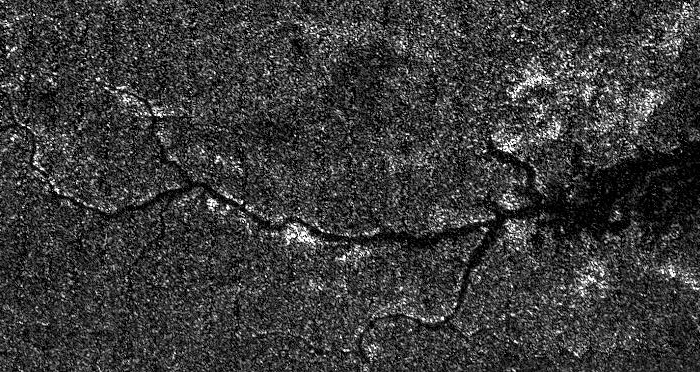
The branching channels appear dark in radar images, much like Titan’s methane-rich seas. This suggested to scientists that the channels might also be filled with liquid, but a direct detection had not been made until now. Previously it wasn’t clear if the dark material was liquid or merely saturated sediment — which at Titan’s frigid temperatures would be made of ice, not rock.

The diagram on the above right is from the paper itself, and shows some of the radar data obtained by Cassini. It also illustrates the deep and narrow nature of Via Flumina. This is almost the equivalent of what we call slot canyons on Earth, formed by periodic flash floods that cut their way down as the surface is slowly uplifted by other processes.

The new radar data showed that the surface at the base of the gorge was smooth and flat, just as you’d find if that base was filled with liquid.The altimeter data showed that gorge’s elevation matched that of Titan’s lakes at its insurgence, but as you traveled upstream the elevation rose, just as it does on any river on Earth. Moreover, this data was reasonably trustworthy as they had already used Cassini to successfully do exactly the same thing — identify a known river — when it flew past Earth on its way to Saturn.

Be prepared for one piece of misinformation when the press reports on this story, almost certainly caused by the American Geological Union’s press release about this paper. That press release incorrectly claims that the paper confirmed that these are methane rivers. It does no such thing. It only shows that the gorges have a liquid in them, and that the liquid almost certainly formed the gorges. Though methane is a very likely candidate for this liquid based on what we know of Titan, the actual make-up of the river remains uncertain.

I therefore predict our incompetent modern mainstream press will only read this press release and not the paper itself, and thus they will tout these incorrectly as methane rivers.

Below is a cropped Cassini radar image of Via Flumina, showing its river-like appearance. Scientists always suspected these were formed by flowing liquid. Now they have strong evidence from within the gorge to justify that suspicion.

Via Flumina on Titan

2 comments

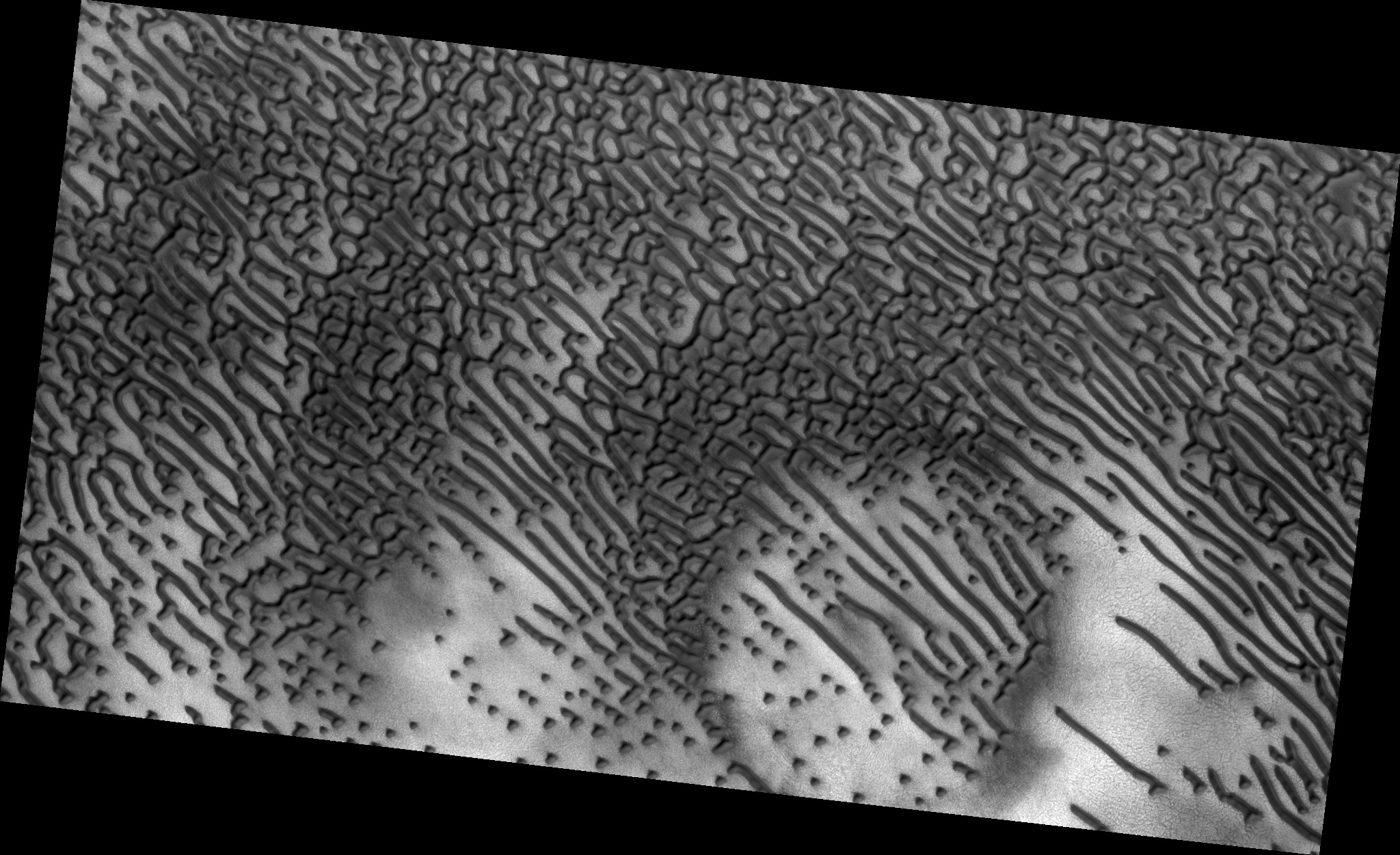
Wind erosion on Mars

Wind erosion on Mars

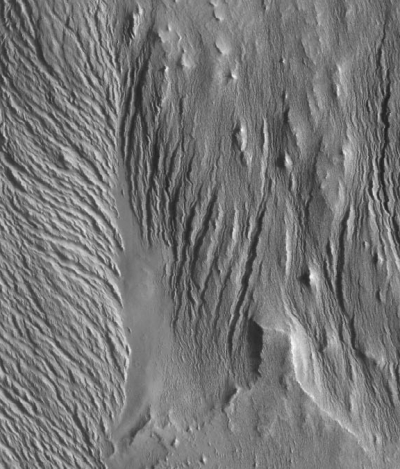
Cool image time! The image on the right, cropped to show here, was taken by Mars Odyssey. While the features shown appear at first glance to have been formed by water, they have instead in etched by wind.

The narrow ridge/valley system seen in this image are a feature called yardangs. Yardangs form when unidirectional winds blow across poorly cemented materials. Multiple yardang directions can indicate changes in regional wind regimes.

The release does not say what direction the wind was blowing, but if I had to guess, I’d say from south to north.

1 comment

The interior of Ceres

Using data from Dawn, scientists have created their first rough map of the internal structure of Ceres.

The data indicate that Ceres is “differentiated,” which means that it has compositionally distinct layers at different depths, with the densest layer at the core. Scientists also have found that, as they suspected, Ceres is much less dense than Earth, the moon, giant asteroid Vesta (Dawn’s previous target) and other rocky bodies in our solar system. Additionally, Ceres has long been suspected to contain low-density materials such as water ice, which the study shows separated from the rocky material and rose to the outer layer along with other light materials. “We have found that the divisions between different layers are less pronounced inside Ceres than the moon and other planets in our solar system,” Park said. “Earth, with its metallic crust, semi-fluid mantle and outer crust, has a more clearly defined structure than Ceres,” Park said.

Scientists also found that high-elevation areas on Ceres displace mass in the interior. This is analogous to how a boat floats on water: the amount of displaced water depends on the mass of the boat. Similarly, scientists conclude that Ceres’ weak mantle can be pushed aside by the mass of mountains and other high topography in the outermost layer as though the high-elevation areas “float” on the material below. This phenomenon has been observed on other planets, including Earth, but this study is the first to confirm it at Ceres.

In other words, Ceres behaves more like a semi-hardened blob of jello than a rock.

10 comments

Martian gullies not formed by water flow

The uncertainty of science: Spectroscopy of many of the gullies on Mars strongly suggests that water had nothing to do with their formation, even though these gullies resemble closely similar gullies on Earth that were carved by flowing water..

Color coding in light blue corresponds to surface composition of unaltered mafic material, of volcanic origin. Mafic material from the crater rim is carved and transported downslope along the gully channels. No hydrated minerals are observed within the gullies, in the data from CRISM, indicating limited interaction or no interaction of the mafic material with liquid water. These findings and related observations at about 100 other gully sites on Mars suggest that a mechanism not requiring liquid water may be responsible for carving these gullies on Mars. (Gullies on Mars are a different type of feature than seasonal dark streaks called recurring slope lineae or RSL; water in the form of hydrated salt has been identified at RSL sites.) [emphasis mine]

In other words, these gullies were formed by flowing lava, not water. Considering Mars’s lower gravity, one third that of Earth’s, we should not be surprised if lava is capable of doing things there that it is not generally capable of doing on Earth. In fact, we should remind ourselves constantly that Mars is an alien planet, and that conditions there are different enough to make any predictions based on our knowledge of Earth very unreliable.

More details here.

5 comments

Heading directly for Balanced Rock

Curiosity's course to Balanced Rock

As I predicted Sunday, the Curiosity science team is aiming the rover directly towards the gap in the mesas, dubbed the Murray Buttes, that also has the balanced rock seen in earlier images.

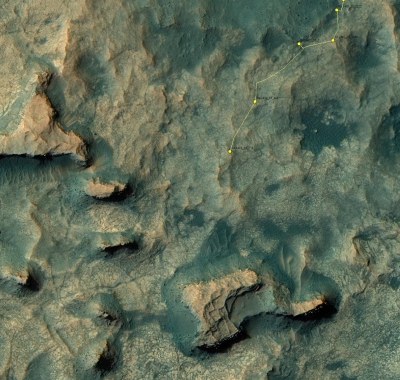
The image on the right shows the rover’s most recent two traverses, superimposed on a Mars Reconnaissance Orbiter image. I have cropped it to focus in on the area of most interest.

Based on the rover’s general rate of travel, I would expect them to enter the gap after about two or three more traverses. This means they will be there in about a week, since after each traverse they usually stop and do science and reconnaissance before resuming travel.

7 comments

Dormant volcano near Rome reawakens

A volcano near Rome that last erupted 36,000 years ago is now showing signs of re-awakening.

Scientists previously assumed Colli Albani, a 15-kilometer (9-mile) semicircle of hills outside Rome, was an extinct volcano since there was no record of it having erupted in human history. But in recent years, scientists have observed new steam vents, earthquakes and a rise in ground level in the hills and surrounding area. These observations, along with new evidence of past eruptions and satellite data, indicate Colli Albani is starting a new eruptive cycle and could potentially erupt in 1,000 years from now, according to a new study published in Geophysical Research Letters, a journal of the American Geophysical Union.

2 comments

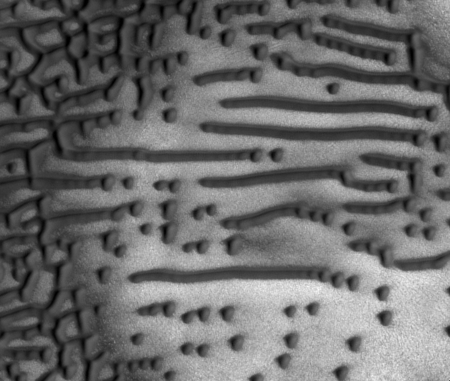
Weird dunes on Mars

Weird dunes on Mars

Cool image time! The image on the right, cropped and reduced in resolution to fit here, shows an area of inexplicable dark dunes located in Mars’ high northern latitudes. Located in a circular depression (whose outline can be seen across the top and left side of the image), geologists only partly understand the processes producing these dunes. As the noted on the release webpage:

However, a circular depression (probably an old and infilled impact crater) has limited the amount of sand available for dune formation and influenced local winds. As a result, the dunes here form distinct dots and dashes. The โ€œdashesโ€ are linear dunes formed by bi-directional winds, which are not traveling parallel to the dune. Instead, the combined effect of winds from two directions at right angles to the dunes, funnels material into a linear shape. The smaller โ€œdotsโ€ (called โ€œbarchanoid dunesโ€) occur where there is some interruption to the process forming those linear dunes. This process is not well understood at present and is one motivation for HiRISE to image this area.

Be sure to look at the full image, as it covers a wider area and shows dunes that travel in all directions, forming mazelike patterns that no theory presently explains.

3 comments

Geologists discover giant field of underground helium in Tanzania

Geologists have discovered a gigantic new field of underground helium gas, located in Tanzania’s Rift Valley.

Researchers figure there’s about 54 billion cubic feet of helium in just one section of the valley. To put that in context, the Federal Helium Reserve in Texas, which supplies more than 40% of domestic helium needs and contains about 30% of the world’s total helium supply, right now holds about 24.2 billion cubic feet, per Live Science.

The discovery is also important in that it wasn’t an accident. The geologists located the helium based on their theories of where they should find it.

6 comments

More weird Pluto geology

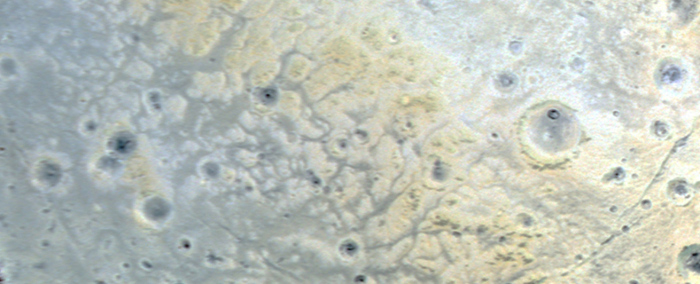
fretted terrain

Cool image time! The New Horizons science team has released an image taken during the spacecraft’s fly-by of Pluto in July 2015 showing what they are calling “fretted terrain”.

The image above is a cropped reduced section of that image. It shows the strange transition zone between the higher elevation bright areas and the lower dark plains. As they note,

New Horizons scientists havenโ€™t seen this type of terrain anywhere else on Pluto; in fact, itโ€™s rare terrain across the solar system โ€“ the only other well-known example of such being Noctis Labyrinthus on Mars. The distinct interconnected valley network was likely formed by extensional fracturing of Plutoโ€™s surface. The valleys separating the blocks may then have been widened by movement of nitrogen ice glaciers, or flowing liquids, or possibly by ice sublimation at the block margins.

In other words, they really don’t know what is going on.

0 comments
1 131 132 133 134 135 157