Petrified sand dunes on Mars

Petrified sand dunes on Mars
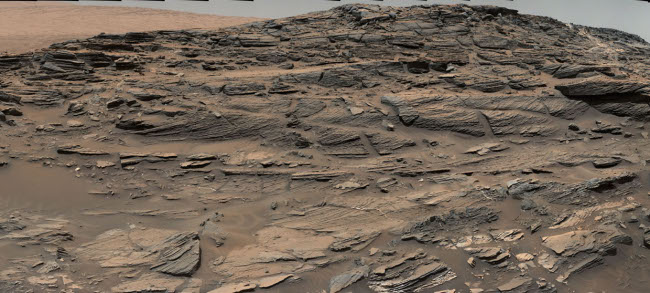
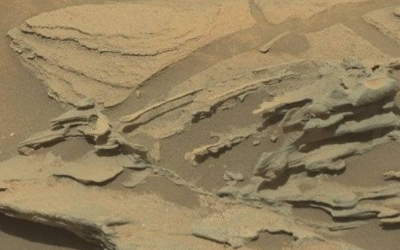
Cool image time! A panorama produced from images taken by Curiosity’s Mast camera has revealed the remains of ancient sand dunes, cemented into sandstone and now eroding.

This sandstone outcrop — part of a geological layer that Curiosity’s science team calls the Stimson unit — has a structure called crossbedding on a large scale that the team has interpreted as deposits of sand dunes formed by wind. Similar-looking petrified sand dunes are common in the U.S. Southwest. Geometry and orientation of the crossbedding give information about the directions of the winds that produced the dunes.

The Stimson unit overlies a layer of mudstone that was deposited in a lake environment. Curiosity has been examining successively higher and younger layers of Mount Sharp, starting with the mudstone at the mountain’s base, for evidence about changes in the area’s ancient environment.

The image above is cropped and reduced in resolution. Be sure to look at the original.

This report also suggests that Curiosity is definitely moving up the geological layers on Mount Sharp. With each layer, we learn a little bit more about the complex geological history of Gale Crater.
1 comment

Martian floods regional, not global

Using the data accumulated from various modern Mars orbiters scientists now think that many of the Martian floods were caused by regional circumstances rather than a single global event.

“The flooding is due to regional processes, not global processes,” said Rodriguez, a Senior Scientist at the Planetary Science Institute and lead author of “Martian outflow channels: How did their source aquifers form, and why did they drain so quickly?” that appears in a Nature Scientific Report. “Deposition of sediment from rivers and glacial melt filled giant canyons beneath a primordial ocean contained within the planet’s northern lowlands. It was the water preserved in these canyon sediments that was later released as great floods, the effects of which can be seen today.”

The canyons filled, the Martian ocean disappeared, and the surface froze for approximately 450 million years. Then, about 3.2 billion years ago, lava beneath the canyons heated the soil, melted the icy materials, and produced vast systems of subterranean rivers extending hundreds of kilometers. This water erupted onto the now-dry surface in giant floods.

This theory suggests that Mars still has a great deal of trapped frozen water held in large underground reserves, available for future colonists. I like the fact that it also suggests that there were “vast systems of subterranean rivers extending hundreds of kilometers” where this frozen water was once stored and, having now melted, has left behind gigantic underground caverns.

0 comments

Curiosity spots a spoon on Mars!

The spoon on Mars

Very cool image time! In one of Curiosity’s recent images of the Martian surface on the slopes of Mount Sharp appears what looks like a long thin spoon jutting horizontally out of the ground.

The shadow below the feature is strong evidence that that this almost certainly a real object, shaped exactly as we see it. However, it is not an artificially created spoon. If you look at both the full raw image as well as zoom in on the feature itself, you will see that it is something that formed naturally due to Mars’ low gravity and the geology here. The spoon is a thin prong of harder material that has remained intact as the ground below it has been slowly eroded away by the ever-present but very weak Martian wind. If you look close you can see that harder material extend back into the rock behind the spoon.

Some of that erosion might also have been caused by flowing water sometime in the past, but to confirm this will take additional geological research.

4 comments

Largest glacier calving event ever filmed

An evening pause. Hat tip Phill Oltmann. I had sworn I had posted this already, but now can’t find it on BtB. And even if I have posted it, it is worth watching again. My only comment is that I am baffled by the film’s description of the event as “horrifying.” I don’t find this natural event horrifying, I find it awe-inspiring. It reminds us that the scale of the universe if far far beyond anything we can imagine.

1 comment

Comet 67P/C-G’s fractured surface

Rosetta scientists today published a paper describing the many different types of fractures they have identified on the surface of Comet 67P/C-G.

Ramy’s team identified three distinct settings in which the fractures occur: networks of long narrow fractures, fractures on cliffs and fractured boulders. In addition, several unique features were identified: the parallel fractures running across Hathor’s 900 m-high cliffs, an isolated 500 metre-long crevice in the Anuket region of the comet’s neck, and a 200 m-long complex crack system in Aker on the large lobe. “The fractures show a variety of morphologies and occur all over the surface and at all scales: they are found in the towering 900 m-high cliffs of Hathor right down to the surfaces of boulders a few metres across,” describes lead author M. Ramy El-Maarry from the University of Bern.

The most prevalent setting appears to be networks of narrow fractures that extend for a few metres to 250 m in length, typically on relatively flat surfaces. Interestingly, in some locations, the fractures appear to cross cut each other in polygonal patterns at angles of 90º – on Earth and Mars this is often an indicator of ice that has contracted below the surface.

While their focus is on the geology of the comet and its development as indicated by the fractures, what I see is the root cause of the comet’s eventual destruction. Its two-lobed shape is inherently unstable, and these fractures illustrate this. At some point, the comet will break apart. The fractures indicate where the first breaks might occur.

0 comments

The wild Martian terrain

Yardangs on Mars

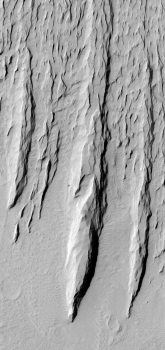
This week’s image release from the high resolution camera on Mars Reconnaissance Orbiter illustrate well the wild and mysterious geology of the Martian surface. I include cropped sections from two images here, just to give you a taste. Go to the link to do your own exploring.

The image to the right is a cropped and scaled down version of the original image, so the details are not easily seen. Make sure you look at the original. The strange yardang ridges, all aligned alike, rise up out of a relatively smooth plain.

Yardangs are formed when a surface that is composed of materials of differing strengths (i.e., of both harder and softer materials) is shaped by the abrasive action of sand and dust carried by the wind. In this case, and given the proximity of the Apollonaris Patera volcanic center, we think that these wind-carved deposits are comprised of volcanic ash and pyroclastics that erupted from Apollonaris when it was last active in the not-too-distant geologic past. Over time, the softer materials (likely volcanic ash) were eroded away, leaving behind the harder materials in the form of elongated ridges that are parallel to the direction of the prevailing wind. The end result is a stunning, out-of-this-world display of yardangs, sculpted with the artistic chisel of the Martian wind.

That’s the theory, anyway. The actual geological process that formed these ridges is probably a lot more complicated.

The image below the fold illustrates the on-going surface activity on Mars.
» Read more

0 comments

Puzzling red arcs on the Saturn moon Tethys

Red arcs on Tethys

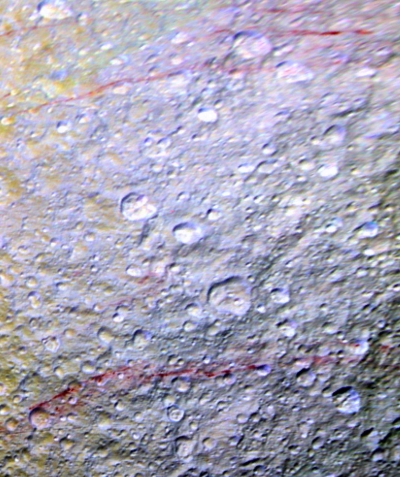
Baffling image time! Images taken in April 2015 by Cassini of the Saturn moon Tethys have produced the best images yet of the puzzling red arcs on the moon’s surface, first identified in 2004.

The origin of the features and their reddish color is a mystery to Cassini scientists. Possibilities being studied include ideas that the reddish material is exposed ice with chemical impurities, or the result of outgassing from inside Tethys. They could also be associated with features like fractures that are below the resolution of the available images.

Except for a few small craters on Saturn’s moon Dione, reddish-tinted features are rare on other moons of Saturn. Many reddish features do occur, however, on the geologically young surface of Jupiter’s moon Europa. “The red arcs must be geologically young because they cut across older features like impact craters, but we don’t know their age in years.” said Paul Helfenstein, a Cassini imaging scientist at Cornell University, Ithaca, New York, who helped plan the observations. “If the stain is only a thin, colored veneer on the icy soil, exposure to the space environment at Tethys’ surface might erase them on relatively short time scales.”

I could also file this under “the uncertainty of science”, as the scientists at this point haven’t the slightest idea what created these arcs.

3 comments

New Pluto data released

Pluto

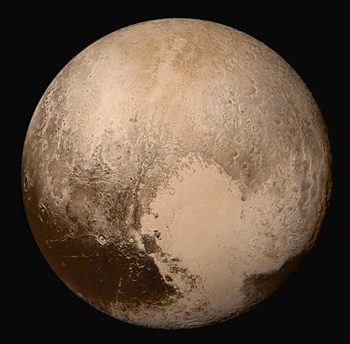
Cool image time! During today’s New Horizons’ press conference, principal investigator Alan Stern noted that only 4%-5% of the data has been recovered. They have finished first phase of download and are moving into second phase, which will be dominated by engineering and other data, not images. So, for the next couple of months they will only be able to release images once and awhile. Beginning in September images, however, they will begin downloading images at a much faster pace.

Some results from today:
» Read more

0 comments

Active lava flows found on Venus

volcanoes on Venus

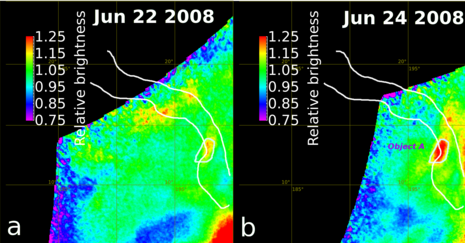
Cool image time! Using archival data from Venus Express, scientists have identified several spots on Venus where it appears there are active lava flows.

Using a near-infrared channel of the spacecraft’s Venus Monitoring Camera (VMC) to map thermal emission from the surface through a transparent spectral window in the planet’s atmosphere, an international team of planetary scientists has spotted localised changes in surface brightness between images taken only a few days apart. “We have now seen several events where a spot on the surface suddenly gets much hotter, and then cools down again,” says Eugene Shalygin from the Max Planck Institute for Solar System Research (MPS) in Germany, and lead author of the paper reporting the results in Geophysical Research Letters this month. “These four ‘hotspots’ are located in what are known from radar imagery to be tectonic rift zones, but this is the first time we have detected that they are hot and changing in temperature from day to day. It is the most tantalising evidence yet for active volcanism.”

The hotspots are found along the Ganiki Chasma rift zone close to the volcanoes Ozza Mons and Maat Mons. Rift zones are results of fracturing of the surface, which is often associated with upwelling of magma below the crust. This process can bring hot material to the surface, where it may be released through fractures as a lava flow.

There have been hints of volcanic activity on Venus since Pioneer Venus Orbiter first circled the planet from 1978 to 1992. This appears to be the first solid evidence of it.

0 comments

Finding caves on Mars

A new study of pits on Mars has isolated one particular type of pit that has all the features of an Earth-like cave entrance, with a large number located in the regions around the giant volcanoes where evidence of past glacier activity has been found. From the abstract:

These Atypical Pit Craters (APCs) generally have sharp and distinct rims, vertical or overhanging walls that extend down to their floors, surface diameters of ~50–350 m, and high depth to diameter (d/D) ratios that are usually greater than 0.3 (which is an upper range value for impacts and bowl-shaped pit craters) and can exceed values of 1.8. Observations by the Mars Odyssey Thermal Emission Imaging System (THEMIS) show that APC floor temperatures are warmer at night and fluctuate with much lower diurnal amplitudes than nearby surfaces or adjacent bowl-shaped pit craters.

In other words, these pits are deeper with steeper and overhanging walls that suggest underlying passages. They also maintain warmer temperatures at night with their day/night temperatures changing far less than the surface, similar to caves on Earth where the cave temperature remains the same year-round.

The study’s most important finding, from my perspective, was the location of these pit craters.
» Read more

3 comments
1 134 135 136 137 138 157