Update on Perseverance’s future travel plans

Perseverance's future travels
Click for full image.

The science team for the rover Perseverance yesterday released a revised map of where they intend over the next few months to send the rover on the floor of Jezero Crater.

The map to the right, cropped and reduced to post here, shows that route.

The first science campaign (depicted with yellow hash marks) begins with the rover performing an arching drive southward from its landing site to Séítah-North (Séítah-N). At that point the rover will travel west a short distance to an overlook where it can view much of the Séítah unit. The “Séítah-N Overlook” could also become an area of scientific interest – with Perseverance performing a “toe dip” into the unit to collect remote-sensing measurements of geologic targets.

Once its time at the Séítah-N Overlook is complete, Perseverance will head east, then south toward a spot where the science team can study the Crater Floor Fractured Rough in greater detail. The first core sample collected by the mission will also take place at this location. After Cratered Floor Fractured Rough, the Perseverance rover team will evaluate whether additional exploration (depicted with light-yellow hash marks) farther south – and then west – is warranted.

Whether Perseverance travels beyond the Cratered Floor Fractured Rough during this first science campaign, the rover will eventually retrace its steps. As Perseverance passes the Octavia B. Butler landing site, the first science campaign will conclude. At that point, several months of travel lay ahead as Perseverance makes its way to “Three Forks,” where the second science campaign will begin.

At that point the rover will begin studying the base of the delta of material that in the far past poured through a gap in the western rim of Jezero Crater.

0 comments

Evidence of past underground water in the Martian equatorial regions?

Mosaic of strange feature
Click here, here, here, and here for full images.

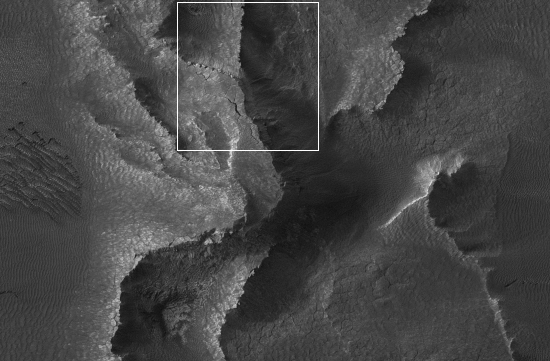
Today’s cool image, to the right, takes us to the equatorial regions of Mars, a region that today appears quite arid and dry based on all the orbital and rover/lander data so far gathered. The photo and its complex geology however provides us a hint that once liquid water did exist here. At least, that is the hypothesis that scientists presently favor, though making it fit this complex geology is not simple or straightforward.

The mosaic to the right is made from four context camera images taken by Mars Reconnaissance Orbiter (MRO). It shows a very complicated series of depressions — one of which vaguely resembles a crater — that appear to have been washed out by some past erosion process, though that process could not have been that simple because of the fissures and cracks that dominate the floor of the circular feature.

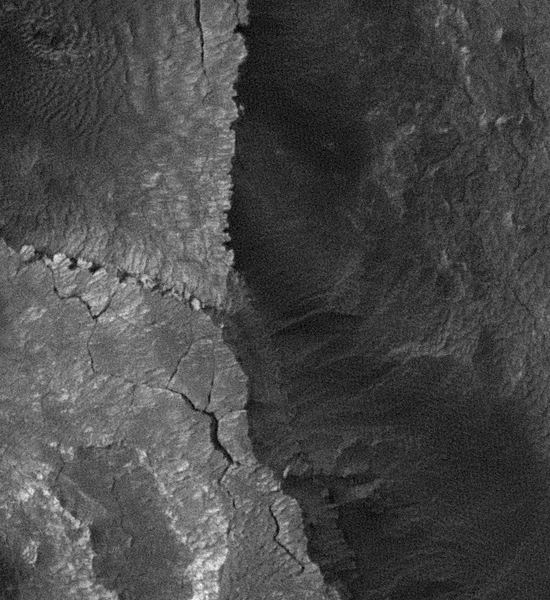
I contacted Chris Okubo of the U.S. Geological Survey, who had requested a high resolution image from MRO of a small part of this mosaic, as indicated by the white box, to ask him what we are looking at. His answer was appropriately noncommittal:
» Read more

28 comments

Ingenuity completes 7th flight on Mars

Locations of Perseverance and Ingenuity on Mars
Click for interactive map.

Ingenuity yesterday successfully completed its 7th flight on Mars, heading south and landing exactly as planned.

Ingenuity lifted off around 12:34 local mean solar time on Tuesday, which corresponds to 11:54 a.m. EDT (1554 GMT). As planned, the chopper then traveled 348 feet (106 meters) south from its previous location on the floor of Mars’ Jezero Crater, staying aloft for nearly 63 seconds, JPL officials wrote in another tweet. The solar-powered rotorcraft set down at a new airfield, the fourth one it has reached since landing on the Red Planet with NASA’s Perseverance rover on Feb. 18.

Both the rover Perseverance and Ingenuity are traveling south on the floor of Jezero Crater, with the helicopter leapfrogging ahead every few weeks. On the map the red dot indicates Perseverance location, with the green dots Ingenuity’s last three landing sites. They have not yet added to the map exactly where Ingenuity landed yesterday (#7), so I have estimated it based on the information above.

The red outline indicates the region they are planning to explore over the next few months in order to gather a very thorough understanding of the geology of the floor of Jezero Crater. They will eventually head to the northwest towards the cliffs in the upper left, which is the foot of the large delta that flowed in the past into the crater through a gap in its western rim. The route they will take to get there however remains undetermined.

0 comments

Eroding Martian lava?

Eroding Martian lava?
Click for full image.

Cool image time! The photo to the right, rotated, cropped, and reduced to post here, was taken on April 19, 2021 by the high resolution camera on Mars Reconnaissance Orbiter (MRO). Requested by Colin Dundas of the U.S. Geological Survey’s Astrogeology Science Center in Arizona, the image was entitled “Enigmatic Terrain in Elysium Planitia.” The image is labeled so because, as Dundas explained,

Flood lava is a key part of the feature, best seen at the north and south ends of the image. What’s unusual is the knobby terrain at the center. … I haven’t yet been able to do a more thorough study of these features, so plenty of puzzles remain!

The higher material in the upper right is likely flood lava. A 2016 paper [pdf] led by Dundas on similar features in Elysium Planitia that were not as knobby found their origin somewhat baffling. The evidence suggested that lava, mud, wind, and ice could all be involved in their formation, but the evidence was also not sufficient to eliminate any possibility.

In the case of today’s image, the explanation might also be any of these possibilities. For example, we might be looking at the erosion of the flood lava, exposing harder knobs of different material that had been there before and had been covered by the lava. Or maybe the knobs are simply the last bits of that layer of flood lava that has not yet eroded away.

As always, the overview map provides some context.
» Read more

0 comments

Mini-volcanoes (mud or lava?) near Zhurong’s Mars landing site

Mosaic of features near Zhurong's planned landing site on Mars
Click here, here, and here for full images.

Cool image time! Though we still do not know exactly where the Chinese Mars rover Zhurong landed on Mars, we have a rough idea based on the latitude and longitude numbers leaked to the Chinese press in October 2020 and were apparently confirmed by photos taken by the Tianwen-1 orbiter soon after reaching Mars. We also know Zhurong’s engineers wanted to land in the northern lowland plains dubbed Utopia Planitia, a region that is relatively flat and thus makes a safe landing spot for their first attempt to reach the surface of Mars.

The mosaic to the right, rotated and reduced to post here, is made from three context camera images taken by Mars Reconnaissance Orbiter (MRO). The white cross on the right edge is essentially Zhurong’s leaked landing spot. The red box indicates the area covered by one of only two photos that China has released that were taken by its Tianwen-1 orbiter.

The white box in the upper left shows the area covered by today’s cool image, shown below.
» Read more

0 comments

NASA picks two missions to fly to Venus later this decade

NASA today announced two new missions to go to Venus to study its atmosphere and surface, both scheduled to launch sometime between 2028 and 2030.

One, dubbed DAVINCI+, send a probe into Venus’s atmosphere, both to measure its gases as well as taken the first high resolution images of a unique Venusian geological called “tesserae.” On radar images tesserae regions appear to be high plateaus cross-cut with many sharp ridges.

The second, dubbed VERITAS, will be a radar-orbiter designed to map the planet’s surface at higher resolution than the earlier Pioneer and Magellan radar orbiters. It will also do this:

VERITAS also will map infrared emissions from Venus’ surface to map its rock type, which is largely unknown, and determine whether active volcanoes are releasing water vapor into the atmosphere.

That data will help tell us whether there are now active volcanoes on Venus. The data we presently have suggest it is a planet of many volcanoes, numbering in the millions. That data has also hinted at the possibility that some are active. VERITAS will attempt to find out.

4 comments

Inexplicable ridges north of China’s Mars rover

Wrinkle ridges in Utopia Planitia?
Click for full image.

Cool image time! The photo to the right, rotated, cropped, and reduced to post here, shows some unusual geology about 450 miles north of the approximate area where China’s Zhurong rover landed in the northern lowlands of Mars. It was taken on April 14, 2021 by the high resolution camera on Mars Reconnaissance Orbiter (MRO).

These scattered ridges remind me of wrinkle ridges, formed when the surface of a place shrinks. With less surface area, the extra material needs somewhere to go, and so ridges are forced up at weak points to release the pressure.

Assuming this hand-waving explanation is true, the next question would be: What causes the shrinking? The overview map below might help provide an answer.
» Read more

1 comment

A visit to a crater near the non-face on Mars

Glacial erosion features inside crater
Click for full image.

Cool image time! The photo to the right, rotated, cropped, and reduced to post here, was taken on March 12, 2021 by the high resolution camera on Mars Reconnaissance Orbiter (MRO). It looks down at small six-mile-wide Apt crater in the northern lowland plains of Mars located at about 40 degrees north latitude. The image’s focus were the layers on the crater interior rim as well as the eroded glacial features on the crater’s floor. The color strip suggests [pdf] that the bluish material on the north-facing south interior rim and floor are likely icy, while the tan-colored material seen in the crater’s north half are likely dusty.

While the suggestion of glacial material on the crater’s interior is very typical for many craters in the mid-latitudes, what makes this crater of interest is its location, only a short few miles south of that mesa on Mars that for decades the shallow-minded insisted was a face and proof of an alien Martian civilization.
» Read more

4 comments

The strange flows in Shalbatana Vallis on Mars

Strange flows in Shalbaltana Vallis
Click for full image.

Cool image time! The photo to the right, rotated, cropped, and reduced to post here, was taken by the high resolution camera on Mars Reconnaissance Orbiter (MRO) on March 31, 2021, and shows a series of very distinct arrowhead-shaped sloping ridges interspersed with hollows flowing down from the southern cliff face of Shalbatana Vallis, one of the larger long meandering drainages flowing into the northern lowlands of Chryse Planitia and north of Valles Marineris.

This location is at 5 degrees north latitude, so nothing we see in the picture is likely glacial or evidence of ice.

So what are we looking at? My guess is that the parallel ridges show us a hint of the original slope of alluvial fill. In the past canyon’s south rim or cliff either did not exist, or was much smaller. Instead the ground mostly sloped gently downhill from the plateau to the canyon floor.

Scientists believe that in the far past catastrophic floods of water flowed through Shalbatana. If a massive flood of water off that rim came down that slope of alluvial fill, it could have pushed into that fill and created the hollows, washing the fill down into the canyon floor and leaving behind the ridges in between.

The overview maps below provide the geographical context.
» Read more

1 comment

Yutu-2 data suggests Moon’s far side is “bombarded more frequently” than the near side

The uncertainty of science: According to a new paper, based on ground-penetrating radar data obtained by China’s Yutu-2 rover on the far side of the Moon, scientists now think that the Moon’s more heavily cratered far side is that way because it actually gets bombarded more frequently than the near side.

From the paper’s abstract:

The Lunar Penetrating Radar (LPR) onboard Yutu-2 can transmit electromagnetic pulses to detect the lunar subsurface structure and properties of the regolith. The relative permittivity, loss tangent and TiO2+FeO content of lunar regolith materials at landing site are constrained with LPR data in this paper. The results indicate that the farside may be bombarded more frequently, leading to different regolith accumulation rates on the lunar nearside vs. farside. [emphasis mine]

The data was accumulated during the rover’s first five months on the surface, during those five lunar days. It found that the regolith at the landing site was about 39 feet thick, much thicker than found at the landing site for Yutu-1 on the Moon’s near side. The difference was partly expected because of the nature of the different locations, but combined with other factors the scientists concluded that a higher bombardment rate on the far side would also help explain the difference.

To put it mildly, this conclusion is uncertain. We only have one data point on the far side, and only a few more on the near side. At the same time, the conclusion is somewhat an example of science discovering the obvious. The very first images of the Moon’s far side, taken The Soviet Union’s Luna 3 lunar probe in 1959, showed the surface much more heavily cratered than the near side, with far less areas of smooth mare. Numerous mapping missions since have confirmed that impression.

And it is also intuitive to come to this conclusion. The near side always faces the Earth, which likely acts to intercept many of the type of meteorite hits that reach the Moon’s far side.

This conclusion however is still intuitive, and an honest scientist will not trust it. That this result from Yutu-2 appears to confirms it is therefore nice.

2 comments

Glacial flows covering a crater on Mars?

Partially covered crater by glacial flows?

Cool image time! The photo to the right, cropped and reduced to post here, was taken on March 4, 2021 by the high resolution camera on Mars Reconnaissance Orbiter (MRO). It shows an eroded mound that appears to have flows coming off its north and south slopes that fill the surrounding low spots, including half-covering a nearby crater.

The science team for MRO’s high resolution camera chose this picture as their April 28th picture of the day, noting the following:

The objective of this observation is to examine a crater which seems to be in the process of getting covered by flow from a mound. This image, in Protonilus Mensae, may show us characteristics of the covering material: could it be debris-covered glaciers?

Below is a global map of Mars, with this mound’s location in Protonilus Mensae in the northern mid-latitudes indicated by a black cross.
» Read more

0 comments

The big cliffs of Gediz Vallis on Mars

The Big Cliffs of Mt Sharp
Click for full image.

Cool image time! The photo to the right, cropped and reduced to post here, was taken on May 21, 2021 by Curiosity’s chemistry camera (ChemCam), normally designed to look at high resolution close-up imagery of nearby objects.

However, it can also be used as what the science team call “a long distance spyglass.” The image to the right is an example, looking at what I think are the distant but steadily approaching big cliffs on the western wall of the canyon Gediz Vallis. Make sure you look close at the shadowed cliff-face, probably several hundred feet high. It is filled with huge rock faces reminiscent of the most stark rock cliffs on the mountains of Earth.

The two images below provide the context, which makes the image even more quite breath-taking.
» Read more

3 comments
1 93 94 95 96 97 157