
A review of Glenn Reynolds’ The Social Media Upheaval:
A Modern Call for Freedom

We have a free speech problem in America, and it isn’t because our government is trying to restrict our speech.

The problem exists because almost all our speech today is fed through a tiny handful of giant social media outlets, Google, Facebook, Instagram, Youtube, and Twitter, all of whom seem dominated by leftists and partisan Democratic Party ideaology.

Only last week we saw a perfect example of this problem. A mob of protesters had gathered outside the private home of Senate majority leader Mitch McConnell (R-Kentucky) because he refused to acquiesce meekly to draconian new gun control laws.

Several protesters shouted threatening obscenities against McConnell and his wife, with the leader of the local Kentucky chapter of Black Lives Matter, Chanelle Helm, screaming for someone to “just stab the mother-%#$&!&/!”

McConnell’s campaign office then followed the next day with the following tweet:

Last night, an angry left-wing mob of Amy McGrath supporters stormed Senator McConnell’s Louisville home screaming obscenities and hoping someone would “just stab the mother****** in the heart.”

The tweet then linked to a video showing this mob’s violent chants and death threats.

Twitter’s response? It suspended McConnell’s account, even though he threatened no one and merely wanted to highlight the vicious ugliness of his opponents. Meanwhile the tech giant continued to allow direct statements of violence against the right by many leftists, including one thread dubbed “#MassacreMitch,” with no consequences.

Only after the Republican Party threatened to pull all of its advertising from Twitter did that social media giant finally back down and reinstate the McConnell account, though it added a warning tag to the video.

Twitter, like Google and Facebook, has decided to take sides in the political battles that this country is now undergoing. And with their almost godlike total power over internet access, these tech giants are in a position to very effectively censor any opposition to their political goals.

So what do we do? In an effort to make an intelligent stab at this issue, Glenn Reynolds, law professor at the University of Tennessee and the manager of the internet site Instapundit, has recently written a book on the subject, The Social Media Upheaval (Encounter Books 2019). As the book’s Amazon page notes,
» Read more
10 comments

Hong Kong airport reopens as protesters retreat

It appears the actions by Chinese riot police yesterday has caused the airport protesters in Hong Kong to back off and allow the airport to reopen.

Most of the protesters left the airport Tuesday after riot police tried to enter the terminal, fighting with demonstrators who barricaded entrances with luggage carts. The brief clash led to several injuries.

The violence included protesters beating up at least two men they suspected of being undercover Chinese agents. Airport security appeared unable to control the crowd, and paramedics later took both men away. Police have acknowledged using “decoy” officers, and some protesters over the weekend were seen being arrested by men dressed like demonstrators — in black and wearing face masks.

Hu Xijin, editor-in-chief of the Global Times, identified one of the men as a journalist at the nationalistic Chinese tabloid. “Fu Guohao, reporter of GT website is being seized by demonstrators at HK airport,” Hu wrote on his Twitter account. “I affirm this man being tied in this video is the reporter himself. He has no other task except for reporting.”

The protesters apologized that some of them had become “easily agitated and overreacted.” On posters, the demonstrators said they have been “riddled with paranoia and rage” after discovering undercover police officers in their ranks.

Meanwhile the article describes other clashes elsewhere in Hong Kong. The conflict in Hong Kong does not appear to be over, by any means.

3 comments

Chandrayaan-2 successfully puts itself in route to the Moon

Chandrayaan-2 today successfully completed its last Earth perigee burn, raising its orbital apogee so that it will enter the Moon’s gravitational sphere of influence on August 20th.

Chandrayaan-2 will approach Moon on August 20, 2019 and the spacecraft’s liquid engine will be fired again to insert the spacecraft into a lunar orbit. Following this, there will be further four orbit maneuvers to make the spacecraft enter into its final orbit passing over the lunar poles at a distance of about 100 km from the Moon’s surface.

…Subsequently, Vikram lander will separate from the orbiter on September 02, 2019. Two orbit maneuvers will be performed on the lander before the initiation of powered descent to make a soft landing on the lunar surface on September 07, 2019.

Vikram will be doing the hardest part, the landing.

0 comments

Arecibo gets $12.3 million NSF grant

The National Science Foundation has awarded the Arecibo radio telescope in Puerto Rica a $12.3 million grant to pay for needed repairs and upgrades following the hurricane damage from 2017.

The money will pay for the following work:

  • Repairing one of the suspension cables holding the primary telescope platform, ensuring long-term structural integrity of one of the main structural elements of the telescope.
  • Recalibrating the primary reflector, which will restore the observatory’s sensitivity at higher frequencies.
  • Aligning the Gregorian Reflector, improving current calibration and pointing.
  • Installing a new control system for S band radar, which is part of the microwave band of the electromagnetic spectrum.
  • Replacing the modulator on the 430 MHz transmitter, increasing consistency of power output and data quality.
  • Improving the telescope’s pointing controls and data tracking systems.

Most of this looks to be very basic maintenance, which suggests the telescope is still very starved for funds.

1 comment

Riot police attack Hong Kong airport protesters

Riot police today attacked the Hong Kong airport protesters, storming into their midst with batons and pepper spray.

CNN International reported, following the police operation that reporters witnessed at least four arrests and that officers appeared to be targeting specific people. To get through the protesters, police used pepper spray and batons to push back the crowd. According to an official statement from Hong Kong police, airport officials requested that the riot officers enter the airport to rescue a man who protesters had apprehended and accused of being an undercover police officer. The South China Morning Post also reported that the airport received a court injunction requesting police remove the protesters from the premises, though Hong Kong police did not issue an official statement to that effect and officers left without clearing out every protester.

Pro-democracy protesters shut down the airport Tuesday for the second day in a row, forcing administrators to cancel all flights, in a bid to get the China-controlled Hong Kong government to listen to their demands. Some protesters appeared to panic and target others suspected of working for the communist government after officials admitted this weekend that officers had dressed up as protesters to infiltrate the marches.

So far this attack today does not appear to be an effort to shut the protest down with violence. It appears that after extracting two men, possibly pro-China reporters, the police retreated, though the authorities are now limiting access to the airport, probably with the goal of starving the protest with a lack of new supporters.

A very sad messy situation. The Chinese want to impose its tyranny on Hong Kong. Hong Kong’s citizens want to remain free. The result are street protests that can only turn violent, one way or the other, because China’s government is very unlikely to back down.

4 comments

NASA extends life of private BEAM module

Capitalism in space: Having found that Bigelow’s privately built ISS module BEAM has exceeded its design capabilities, NASA has now decided to leave it docked to ISS for at least five more years, using it as a storage bin.

BEAM cost NASA a whopping $17 million, considerably less than it has traditionally spent (a billion-plus) for its previous ISS modules, designed and built under full NASA supervision.

3 comments

Linkspace completes vertical take-off and landing test

China’s semi-private company Linkspace on August 9 successfully completed its highest vertical take-off and landing test flight yet, flying to a height of 300 meters.

The 8.1-meter-tall, 0.65-meter-diameter, 1.5-metric-ton rocket reached an altitude of 300.2 meters during its 50-second flight before making a powered descent and vertical landing with an accuracy of 0.07 meters, Linkspace CEO Hu Zhenyu stated on Sina Weibo, a Chinese Twitter-like service. The launch follows two tests reaching 20 and 40 meters in March and April respectively.

The latest test was carried out at a new facility in the Lenghu region of Qinghai province in the northwest of the country. Chinese magazine Future Aerospace states that the RLV-T5 is powered by five variable-thrust rocket engines which use ethanol and liquid oxygen, a propellant combination used by the German V2 rockets.

Unlike the other new semi-private Chinese commercial companies, Linkspace appears to be using liquid fueled rockets, rather than depending on military solid rocket technology. This suggests to me that this company, aggressively supervised by the Chinese government, will eventually be going for both the small and big orbital business, not just smallsats.

I also give credit to the Chinese, both their government and this company, for quickly facing reality posed by SpaceX’s capabilities and working to develop their own rocket reusability as fast as possible. In contrast, Europe, Russia, and the old American big rocket companies have mostly sat twiddling their thumbs, making believe that this capability is either irrelevant, or still impossible, even as SpaceX has taken all of their business because it can undercut their prices significantly as it repeatedly re-uses its Falcon 9 first stages.

1 comment

Blue Origin protests Air Force launch procurement process

Blue Origin has submitted a protest to the Government Accountability Office (GAO) yesterday about the Air Force plan to pick two launch providers now for all its satellite launches after 2026.

According to a copy of the protest obtained by FLORIDA TODAY, the ordering period for the launches would run from 2020 to 2024 and ultimately select two contractors for flights beginning in 2026.

“The most recent market research, however, indicates the total global addressable space launch market, including NSSL launches, could support three or even four U.S. launch companies,” the protest reads. “Even the Agency’s own LSP source selection support contractor – the Aerospace Corporation – predicts that the space launch market has significant potential to suffer from a launch capacity shortfall because U.S. and foreign government launches will require most of the available launch capacity.”

I couldn’t agree with Blue Origin more. The Air Force wants to limit competition in the 2020s to only two companies, which will almost certainly be ULA and SpaceX since they are the only two presently flying, when by the 2020s there might be several more companies available providing competition that can lower the price.

There is no reason for the Air Force to make this decision now. None. When they need to order these launches in the early 2020s they should open that bidding process to all comers, and pick appropriately, then. Everything about this Pentagon plan stinks, reeking of the corruption that permeates Washington. I even wonder if some people have gotten pay-offs in connection with the decision to favor only two companies. It wouldn’t surprise me. (I myself have been offered money to let military lobbying companies ghostwrite op-eds using my name, supporting this Air Force plan, offers that I very bluntly turned down.)

Also, even if Blue Origin’s protest now fails, expect whoever doesn’t get picked by the Air Force now to file lawsuits in the 2020s when they are denied the right to bid on those future launches. And expect the Air Force to then back down, as it was forced to do when SpaceX was denied the right to bid on Air Force contracts early in this decade.

One more thought: This protest suggests Blue Origin already expects to not get picked. This expectation might also explain why Jeff Bezos decided to sell more Amazon stock last week, raising almost $3 billion in capital. He might be anticipating that Blue Origin will be cut out of those Air Force contracts, and so needs more of his own money to develop its New Glenn rocket.

4 comments

ESA confirms ExoMars parachute test failure

You heard it hear first! The European Space Agency (ESA) today confirmed earlier stories from last week that the parachutes for its ExoMars 2020 spacecraft had failed during a high altitude drop test on August 5.

I reported this on Saturday, August 10, noting that ESA had not confirmed it. It apparently took them a week to write the press release.

This was the second consecutive test failure for these parachutes, as noted in the release.

On 28 May this year, the deployment sequence of all four parachutes was tested for the first time from a height of 29 km – released from a stratospheric helium balloon. While the deployment mechanisms activated correctly, and the overall sequence was completed, both main parachute canopies suffered damage.

Following hardware inspection, adaptations were implemented to the design of the parachutes and bags ready for the next high-altitude test, which was conducted on 5 August, this time just focusing on the larger, 35 m diameter, parachute.

Preliminary assessment shows that the initial steps were completed correctly, however damages to the canopy were observed prior to inflation, similar to the previous test. As a result, the test module descended under the drag of the pilot chute alone.

The tests occur at high altitude where the Earth’s atmosphere mimics the thin atmosphere of Mars. In both cases it appears the parachutes became damaged very early in their deployment process, possibly during deployment. This means there might be a design problem with the deployment process. It also means that both tests were unable to test the chutes themselves, as they were damaged before inflation, meaning that the engineers still do not know if they would work as intended once filled with air.

All this puts incredible time pressure on the mission, which needs to launch in the summer of 2020 to meet its launch window. There is very little time to redesign and retest these chutes. I would rate their chances of meeting that launch date as less than 50-50.

0 comments

As protesters shut down Hong Kong airport, government brings military into city

Be prepared for bad news: While protesters against a new Chinese law in Hong Kong have shut the airport down, the Chinese government has begun to bring its military into the downtown area.

The initial cause of these protests is an attempt by China to impose a new extradition law on Hong Kong that would allow them to extradite people from Hong Kong into mainland China.

The changes will allow for extradition requests from authorities in mainland China, Taiwan and Macau for suspects accused of criminal wrongdoings, such as murder and rape. The requests will then be decided on a case-by-case basis.

Several commercial offenses such as tax evasion have been removed from the list of extraditable offenses amid concerns from the business community. Hong Kong officials have said Hong Kong courts will have the final say whether to grant such extradition requests, and suspects accused of political and religious crimes will not be extradited.

The government has sought to reassure the public with some concessions, including promising to only hand over fugitives for offenses carrying maximum sentences of at least seven years.

It appears that the population in Hong Kong does not trust the Chinese government that has ruled them since the British left in 1999. They fear the misuse of this law in order to arrest anyone the Chinese government doesn’t like.

The question is whether the Chinese can do in Hong Kong what they did in Tiananmen Square in 1989. Then the government moved the military in and massacred the protesters, effectively ending any political opposition to communist rule. If they do this in Hong Kong they will also end the lingering freedom in that city left over from British rule..

4 comments

Reports of another ExoMars parachute failure during test

Following a failure of ExoMars’ parachutes during a May test, there are now reports that a second failure occurred on August 5.

A fresh test of the parachute system for the Russian-European mission ExoMars-2020 have failed again as a structural mockup of the Russian-built lander crashed during the simulated landing, a source familiar with the test results told Sputnik.

The test with the use of a high-altitude balloon was carried out on August 5 at a Swedish Space Corporation’s test site in northern Sweden.

“Tests of the parachute system at the Esrange test site in Sweden failed. A full-size mockup of the landing module of the ExoMars-2020 Martian station crashed during the landing,” the source said.

I have seen this report in two other sites, but it has not yet been confirmed by the European Space Agency.

If these reports are true, the chances of ExoMars launching in July 2020 is likely almost nil. They haven’t even begun assembling the spacecraft, and have had two parachute failures in tests, with the second destroying the prototype used for those tests.

0 comments

Are you a decent human being?

In recent weeks I have grown so horrified by the blatant hate being screamed by Democrats and leftists in the mainstream press against Republicans, conservatives, and Trump supporters that I have found myself unable to write about this stuff.

It is just too disgusting. Here are just a few examples that barely represent the full gamut of anger and hate being expressed by Democrats and their willing accomplices in the press:

All of the accusations against Trump and Republicans in these stories are outright lies, worthy of Joseph Goebbels. And the actions of Democratic politicians like Biden and Castro to attack and smear Trump and his supporters is equally vile, and worthy of the worst form of scapegoating done by anti-Semites. Worse, these people are using terrible mass murders, committed by clearly unstable and sick individuals, to score political points. Such behavior is beyond the pale.

One might, if one was willing to stretch the truth beyond the breaking point, to find some justification in the criticisms of Trump. However, though Trump’s twitter comments are often ugly and crude and insulting, the one thing a careful reading of all those statements reveals is that he has always tried to state the truth, honestly and bluntly. Moreover, there is no evidence of racism in any of his comments. He has merely been attacking those who deserve attacking.

The Democratic attacks, however, on the decency of the American population, especially its non-minority population, are especially vile and dishonest. Remember, this is the same population that only a few years ago twice voted for a black president. For Democratic politicians and mainstream press pundits to accuse it of being in favor of white supremacy is more than just absurd, it is a lie and slander.

The problem I have is that I try to be a decent human being. I don’t like to give these liars and slanderers a platform to spread their hateful lies. In fact, I don’t even wish to read or discuss their childish and mean-spirited behavior. Thus, I have posted nothing until now about the mass murders that occurred this past weekend and the reactions to them.
» Read more

36 comments

FCC streamlines and cuts fees for smallsat licensing

Capitalism in space: In an effort to ease its bureaucratic obstacles to private enterprise, the FCC has streamlined its licensing process for new smallsats, while cutting its licensing fees by more than 90%.

Under the optional licensing regime, which stands to take effect this year, smallsat operators with spacecraft that meet certain criteria will be able to obtain a spectrum license about twice as fast and pay only $30,000 instead of nearly $500,000. A maximum of 10 satellites at a time can be licensed under the streamline process.

…Operators will be able to use the streamlined licensing for satellites that weigh 180 kilograms or less, operate below 600 kilometers (or have propulsion) and will deorbit within six years, among other criteria.

One component of these new regulations is that they require new smallsats to never be smaller than 10 centimeters on their smallest dimension, thus essentially forbidding the launch of nanosats smaller than that.

3 comments

Video of Long March 2C grid fins used in July

China Central Television has released a very short video showing the grid fins used during the July 26 launch of China’s Long March 2C rocket in order to better control the descent of that rocket’s expendable first stage.

I have embedded the video below the fold. It shows the four grid fins unfolding, but not much else. It also reveals that the Chinese very clearly were inspired by SpaceX’s Falcon 9 grid fin design.

The video also gives me the impression that the Long March 2C first stage does not have any thrusters, which were SpaceX’s primary mode for controlling its first stages, the grid fins added later when they understood better the engineering required. Thus I suspect that the fins were not very successful in controlling that stage’s flight.

Nonetheless, the Chinese are doing these tests during operations, which means they are only a first step on a path to success.
» Read more

6 comments

Vector gets Air Force launch contract

Capitalism in space: Vector has signed its first Air Force launch contract for an orbital cubesat launch in 2021.

The Air Force must know something about Vector’s rocket development that we don’t. The company had planned a suborbital test launch for March/April, delayed it until June, and has still not flown it. These delays put the company behind its original launch schedule by a considerable amount, which originally had called for its first orbital launch in 2018.

Hopefully we shall soon see some actually progress from Vector. At the moment however their lack of launches has allowed a number of other smallsat rocket companies to gain on them from behind.

0 comments

Yutu-2 and Chang’e-4 go to sleep again

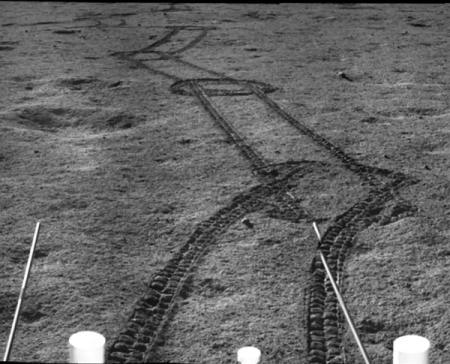
Yutu-2's travels

Both Yutu-2 and Chang’e-4 have been put in dormant mode after completing their eighth lunar day on the far side of the Moon.

The article at the link provides a lot of new details about what both spacecraft have learned and done since they landed, including a nice detailed map showing Yutu-2’s exact path during those eight lunar days. The image to the right, reduced to post here, was taken by Yutu-2, and shows the rover’s tracks during what appears to be its seventh lunar day. It appears that the rover periodically stopped and did a pirouette, probably to obtain a 360 degree mosaic of the surrounding terrain.

Yutu-2’s travels have tended west from Chang’e-4, and on its eighth lunar day it continues that route, traveling 271 meters. After a period of short traveling days, they have now upped the distance traversed by a considerable amount. Since the planned nominal mission for both spacecraft had been three lunar days, both are demonstrating that the Chinese have figured out how to do this, and are now pushing Yutu-2 hard as a result.

The article vaguely describes some of the science obtained so far, but in general the Chinese remain tight-lipped about most of their discoveries.

0 comments

Cygnus undocks from ISS, will remain in orbit for five more months

Northrop Grumman’s Cygnus cargo capsule has undocked from ISS, but will remain in orbit until December.

First, the capsule, dubbed the S.S. Roger Chaffee, will deploy a bunch of cubesats and nanosats. Then,

Northrop Grumman plans several months of long-duration spaceflight experiments using the Cygnus spacecraft after release of the CubeSats. Four miniaturized control moment gyroscopes are flying on the cargo freighter for the first time, and engineers will assess their performance in controlling the spacecraft’s pointing without consuming rocket fuel.

Ground teams also want to evaluate how the Cygnus spacecraft’s avionics function on a long-duration mission, and Northrop Grumman plans to demonstrate dual Cygnus operations for the first time after the launch of the company’s next resupply mission — NG-12 — in October.

Northrop Grumman has gotten a NASA contract to use Cygnus as the basis for the habitable module of NASA’s Lunar Gateway project, and this extended flight is a way to test the engineering for that module now during operations.

Though I continue to have many doubts about Gateway, I laud Northrop Grumman for this approach. It speeds things up and saves money.

4 comments

India’s new smallsat rocket gets its first launch contract

The new colonial movement: India today signed its first customer for its new and still untested SSLV rocket, designed to provide orbital launch services for the burgeoning smallsat market.

Spaceflight announced Aug. 6 that it will purchase the first commercial launch a new Indian vehicle scheduled to make its debut later this year. Spaceflight said it will launch payloads for an undisclosed U.S. satellite constellation customer on a flight of the Small Satellite Launch Vehicle (SSLV), a derivative of the existing, larger Polar Satellite Launch Vehicle (PSLV). The launch is scheduled for later this year and will be the second for the SSLV after a demonstration launch expected no earlier than September.

While the companies didn’t announce the customer for the mission, a July 25 filing with the Federal Communications Commission by Earth imaging company BlackSky Global sought a license for four of its satellites it said would launch on the SSLV in November 2019. The applications said the satellites would be deployed into two orbital planes, consistent with Spaceflight’s announcement.

While this Indian rocket is hardly a private operation, it has no military component, as do the new Chinese smallsat companies. ISRO, India’s space agency, is wholly civilian with no apparent ties to its military, as far as I know. Its goal is to purely make money and grab market share.

At the same time, the use of government funds to develop this rocket gives India the same advantage that China’s smallsat companies have over the privately funded rockets from the U.S. It allows them to set lower prices and undercut the competition.

0 comments
1 276 277 278 279 280 594