Hubble creates time lapse movie of fading supernova

Using the Hubble Space Telescope, astronomers have created a time lapse movie showing the fading of a supernova in a nearby galaxy over a year.

The supernova is captured by Hubble in exquisite detail within this galaxy in the left portion of the image. It appears as a very bright star located on the outer edge of one of its beautiful swirling spiral arms. This new and unique time-lapse of Hubble images created by the ESA/Hubble team shows the once bright supernova initially outshining the brightest stars in the galaxy, before fading into obscurity during the year of observations. This time-lapse consists of observations taken over the course of one year, from February 2018 to February 2019.

The video of that time lapse is embedded below the fold.

The galaxy itself is located 70 million light years away. That the supernova of this single star initially outshone the entire galaxy indicates the almost unimaginable power of the explosion.
» Read more

6 comments

Hubble snaps new hi-res photo of Jupiter

Jupiter, as seen by Hubble in 2020
Click for full image.

Astronomers have used the Hubble Space Telescope to take a new global image of Jupiter, aimed to provide an global census of the gas giant’s storm systems.

This latest image of Jupiter, taken by NASA’s Hubble Space Telescope on August 25, 2020, was captured when the planet was 406 million miles from Earth. Hubble’s sharp view is giving researchers an updated weather report on the monster planet’s turbulent atmosphere, including a remarkable new storm brewing, and a cousin of the famous Great Red Spot region gearing up to change color – again.

The moon seen to the left is Europa. Hubble takes annual images of the planets outward from Earth in order to provide scientists this global view.

5 comments

Hubble maps giant gas halo around Andromeda

Astronomers using the Hubble Space Telescope’s ability to observe in ultraviolet wavelengths have now mapped the giant halo of gas that surrounds the Andromeda galaxy 2.5 million light years away.

The work found that the halo appears to have both an inner and outer shell.

“We find the inner shell that extends to about a half million light-years is far more complex and dynamic,” explained study leader Nicolas Lehner of the University of Notre Dame in Indiana. “The outer shell is smoother and hotter. This difference is a likely result from the impact of supernova activity in the galaxy’s disk more directly affecting the inner halo.”

A signature of this activity is the team’s discovery of a large amount of heavy elements in the gaseous halo of Andromeda. Heavier elements are cooked up in the interiors of stars and then ejected into space—sometimes violently as a star dies. The halo is then contaminated with this material from stellar explosions.

The Andromeda galaxy, also known as M31, is a majestic spiral of perhaps as many as 1 trillion stars and comparable in size to our Milky Way. At a distance of 2.5 million light-years, it is so close to us that the galaxy appears as a cigar-shaped smudge of light high in the autumn sky. If its gaseous halo could be viewed with the naked eye, it would be about three times the width of the Big Dipper. This would easily be the biggest feature on the nighttime sky.

Though there is of course uncertainty here, this research is confirming earlier work, making its conclusions more robust.

A side note: Ultraviolet observations can only be done in space, as the atmosphere blocks it. Hubble I think is the only telescope in space right now with this capability. There used to be others, the most noteworthy of all being the International Ultraviolet Explorer, which functioned from 1978 to 1996 but was then decommissioned because neither NASA nor ESA were willing to fund its operation any longer.

No replacements have been launched because the budget for space astronomy has almost entirely been eaten by the overbudget and long delayed James Webb Space Telescope, with future budgets to be eaten similarly by the Roman.Space Telescope.

0 comments

Astronomers use Hubble to detect ozone on Earth

Using the Hubble Space Telescope, scientists have shown that it will be possible to detect ozone in the atmospheres of exoplanets, using larger telescopes while observing transits of those exoplanets across the face of their star.

What the scientists did was aim Hubble at the Moon during a lunar eclipse. Moreover, they timed the observations so that the sunlight hitting the Moon and reflecting back to Earth (and Hubble) had also traveled through the Earth’s atmosphere on its way to the Moon.

They then looked at the spectrum of that light, and were able to glean from it the spectral signal of ozone in the Earth’s atmosphere. When giant ground-based telescopes under construction now come on line in the coming decades they will have the ability to do this with transiting exoplanets.

The measurements detected the strong spectral fingerprint of ozone, a key prerequisite for the presence – and possible evolution – of life as we know it in an exo-Earth. Although some ozone signatures had been detected in previous ground-based observations during lunar eclipses, Hubble’s study represents the strongest detection of the molecule to date because it can look at the ultraviolet light, which is absorbed by our atmosphere and does not reach the ground. On Earth, photosynthesis over billions of years is responsible for our planet’s high oxygen levels and thick ozone layer. Only 600 million years ago Earth’s atmosphere had built up enough ozone to shield life from the Sun’s lethal ultraviolet radiation. That made it safe for the first land-based life to migrate out of our oceans.

“Finding ozone in the spectrum of an exo-Earth would be significant because it is a photochemical byproduct of molecular oxygen, which is a byproduct of life,” explained Allison Youngblood of the Laboratory for Atmospheric and Space Physics in Colorado, USA, lead researcher of Hubble’s observations.

Ozone does not guarantee the presence of life on an exoplanet, but combined with other detections, such as oxygen and methane, would raise the odds significantly.

4 comments

A July 4th Hubble image of Saturn

Saturn as seen by Hubble on July 4, 2020
Click for full image, annotated.

Cool image time! The photo to the right, cropped and reduced to post here, was taken by the Hubble Space Telescope on July 4, 2020, and shows Saturn, its rings, plus several moons, in all their glory.

The dot near the bottom center is Enceladus. The dot at center right is Mimas. If you click on the annotated full image it will show the locations of several other smaller moons much harder to see.

This new Saturn image was taken during summer in the planet’s northern hemisphere.

Hubble found a number of small atmospheric storms. These are transient features that appear to come and go with each yearly Hubble observation. The banding in the northern hemisphere remains pronounced as seen in Hubble’s 2019 observations, with several bands slightly changing color from year to year. The ringed planet’s atmosphere is mostly hydrogen and helium with traces of ammonia, methane, water vapor, and hydrocarbons that give it a yellowish-brown color.

Hubble photographed a slight reddish haze over the northern hemisphere in this color composite. This may be due to heating from increased sunlight, which could either change the atmospheric circulation or perhaps remove ices from aerosols in the atmosphere. Another theory is that the increased sunlight in the summer months is changing the amounts of photochemical haze produced.

The distance across from one end of the rings to the other is about 150,000 miles, about two thirds the distance from the Earth to the Moon.

0 comments

Midnight repost: Behind the Black

In celebration of the tenth anniversary the Behind the Black, I will each evening at midnight this month repost an earlier essay or article posted on the website sometime during the past ten years. Since I have posted more than 22,000 times since I started this website in July of 2010, I have plenty of good stuff to choose from. The thirty reposts over the next month will highlight some of the best.

We begin with what is really the only Easter Egg on Behind the Black, as it has sat as a unheralded link dubbed only Behind the Black on the main page since the website’s beginning. That link takes you to the following essay, excerpted and adapted from the final afterword in the paperback edition of my book about the Hubble Space Telescope, The Universe in a Mirror.

It explains much about my goals in all that I write.
————————————
Behind the Black

At the end of the last spacewalk during this last servicing mission to Hubble, astronaut John Grunsfeld took a few moments to reflect on Hubble’s importance. This was Grunsfeld’s third spaceflight and eighth spacewalk to Hubble, and no one had been more passionate or dedicated in his effort to get all of Hubble’s repairs and upgrades completed.

“As Arthur C. Clarke says,” Grunsfeld said, “the only way of finding the limits of the possible is by going beyond them into the impossible.”

For most of human history, the range of each person’s experience was of a distant and unreachable horizon. This untouchable horizon defined “the limits of the possible.” No matter how far an individual traveled, there was always a forever receding horizon line of unknown territory tantalizingly out of reach before him.
» Read more

1 comment

Two new multi-wavelength Hubble images of planetary nebulae

Hubble images of the Butterfly and Jewel Bug planetary nebulae
Click for full image.

Cool images from Hubble! Astronomers have used the Hubble Space Telescope’s entire suite of instruments to produce spectacular new multi-wavelength images of two planetary nebulae, stars that for some reasons not yet entirely understood are surrounded by breath-taking jets and cloud-formations of all shapes and sizes.

The two images are to the right, cropped and reduced to post here.

Planetary nebulas, whose stars shed their layers over thousands of years, can turn into crazy whirligigs while puffing off shells and jets of hot gas. New images from the Hubble Space Telescope have helped researchers identify rapid changes in material blasting off stars at the centers of two nebulas — causing them to reconsider what is happening at their cores.

In the case of NGC 6302, dubbed the Butterfly Nebula, two S-shaped streams indicate its most recent ejections and may be the result of two stars interacting at the nebula’s core. In NGC 7027, a new cloverleaf pattern — with bullets of material shooting out in specific directions — may also point to the interactions of two central stars. Both nebulas are splitting themselves apart on extremely short timescales, allowing researchers to measure changes in their structures over only a few decades.

This is the first time both nebulas have been studied from near-ultraviolet to near-infrared light, a complex, multi-wavelength view only possible with Hubble.

The press release suggests that the most likely and popular explanation for the formation of planetary nebula is the interaction of two closely orbiting stars. While this might be true, it remains only one theory among many, all of which explain some of what we see and none of which explain everything. As I noted in my November 2014 cover story about planetary nebulae for Sky & Telescope:
» Read more

2 comments

Hubble captures giant galaxy

Giant spiral galaxy imaged by Hubble
Click for full image.

Cool image time! The above image, cropped and reduced to post here, was compiled from images taken by the Hubble Space Telescope in 2018 of one of the largest known spiral galaxies.

One of the most photogenic is the huge spiral galaxy UGC 2885, located 232 million light-years away in the northern constellation, Perseus. It’s a whopper even by galactic standards. The galaxy is 2.5 times wider than our Milky Way and contains 10 times as many stars, about 1 trillion. This galaxy has lived a quiescent life by not colliding with other large galaxies. It has gradually bulked up on intergalactic hydrogen to make new stars at a slow and steady pace over many billions of years. The galaxy has been nicknamed “Rubin’s galaxy,” after astronomer Vera Rubin (1928 – 2016). Rubin used the galaxy to look for invisible dark matter. The galaxy is embedded inside a vast halo of dark matter. The amount of dark matter can be estimated by measuring its gravitational influence on the galaxy’s rotation rate.

This majestic spiral galaxy might earn the nickname the “Godzilla Galaxy” because it may be the largest known in the local universe. The galaxy, UGC 2885, is 2.5 times wider than our Milky Way and contains 10 times as many stars.

But it is a “gentle giant,” say researchers, because it looks like it has been sitting quietly over billions of years, possibly sipping hydrogen from the filamentary structure of intergalactic space. This fuels modest ongoing star birth at half the rate of our Milky Way. In fact, its supermassive central black hole is a sleeping giant, too; because the galaxy does not appear to be feeding on much smaller satellite galaxies, it is starved of infalling gas.

There are mysteries here, many of which we are as yet entirely unaware of yet.

3 comments

New Hubble images of Comet 2I/Borisov

Comet 2I/Borisov taken by Hubble prior to and at its closest approach to Sun
Click for full image.

Scientists today released new images taken by the Hubble Space Telescope of the interstellar object Comet 2I/Borisov. The image on the left was taken prior to the comet’s closest approach to the Sun, while the image on the right was taken during that closest approach. The vertical smeared object to the left in the earlier image is a galaxy that happened to be in the field of view. The blue color of both images is a false color to bring out details.

“Hubble gives us the best upper limit of the size of comet Borisov’s nucleus, which is the really important part of the comet,” said David Jewitt, a UCLA professor of planetary science and astronomy, whose team has captured the best and sharpest look at this first confirmed interstellar comet. “Surprisingly, our Hubble images show that its nucleus is more than 15 times smaller than earlier investigations suggested it might be. Our Hubble images show that the radius is smaller than half-a-kilometer. Knowing the size is potentially useful for beginning to estimate how common such objects may be in the solar system and our galaxy. Borisov is the first known interstellar comet, and we would like to learn how many others there are.”

The first image was taken from a distance of 203 million miles, while the second was taken from 185 million miles. Expect more images in late December, when the comet makes its closest approach to Earth at a distance of 180 million miles.

5 comments

New Hubble image of Saturn

Saturn taken by Hubble in 2019
Click for full image.

Astronomers have used the Hubble Space Telescope to snap a new high resolution image of Saturn. That image, cropped and reduced to post here, can be seen on the right.

The image was part of a new Hubble program to obtain regular images of the outer planets, begun in 2018.

[The Saturn images] reveal a planet with a turbulent, dynamic atmosphere. This year’s Hubble offering, for example, shows that a large storm visible in the 2018 Hubble image in the north polar region has vanished. Smaller storms pop into view like popcorn kernels popping in a microwave oven before disappearing just as quickly. Even the planet’s banded structure reveals subtle changes in color.

But the latest image shows plenty that hasn’t changed. The mysterious six-sided pattern, called the “hexagon,” still exists on the north pole. Caused by a high-speed jet stream, the hexagon was first discovered in 1981 by NASA’s Voyager 1 spacecraft.

As beautiful as this Hubble photograph is, I cannot help but be saddened by it. It is now the best image of Saturn we will get until 2036 at the earliest, when a NASA mission to Titan finally arrives.

0 comments

New Hubble image of Jupiter

Jupiter as seen by Hubble in 2019
Click for full image.

The Hubble science team today released a new global image the telescope took of Jupiter on June 27, 2019. The photograph on the right is that image, reduced and cropped to post here. As noted by the press release about the Great Red Spot,

The Great Red Spot is a towering structure shaped like a wedding cake, whose upper haze layer extends more than 3 miles (5 kilometers) higher than clouds in other areas. The gigantic structure, with a diameter slightly larger than Earth’s, is a high-pressure wind system called an anticyclone that has been slowly downsizing since the 1800s. The reason for this change in size is still unknown.

A worm-shaped feature located below the Great Red Spot is a cyclone, a vortex around a low-pressure area with winds spinning in the opposite direction from the Red Spot. Researchers have observed cyclones with a wide variety of different appearances across the planet. The two white oval-shaped features are anticyclones, like small versions of the Great Red Spot.

Another interesting detail is the color of the wide band at the equator. The bright orange color may be a sign that deeper clouds are starting to clear out, emphasizing red particles in the overlying haze.

In many ways Hubble’s images of Jupiter are comparable to those taken by Juno, except that Hubble can’t zoom in as close.

2 comments

New image of Eta Carina from Hubble

Eta Carina
Click for full image.

Using the Hubble Space Telescope, astronomers have taken a new spectacular image of the Luminous Blue Giant star Eta Carina. The image on the right is that photograph, reduced to post here.

Using Hubble’s Wide Field Camera 3 to map the ultraviolet-light glow of magnesium embedded in warm gas (shown in blue), astronomers were surprised to discover the gas in places they had not seen it before.

Scientists have long known that the outer material thrown off in the 1840s eruption has been heated by shock waves after crashing into the doomed star’s previously ejected material. In the new images, the team had expected to find light from magnesium coming from the same complicated array of filaments as seen in the glowing nitrogen (shown in red). Instead, a completely new luminous magnesium structure was found in the space between the dusty bipolar bubbles and the outer shock-heated nitrogen-rich filaments.

Eta Carina had a major eruption in the 1840s, followed by other lesser outbursts, the evidence of which is obvious in this and other earlier Hubble images. In fact, over the past twenty-five years Hubble has actually tracked the expansion of those two lobes of material being flung from the star hidden deep in the material.

Someday in the far future astronomers believe it will die as a supernova, though that is only a hypothesis at this point, based on our presently limited understanding of stellar evolution.

3 comments

New Hubble data baffles cosmologists about universe’s expansion rate

The uncertainty of science: New and very firm data from the Hubble Space Telescope on the universe’s expansion rate conflicts with just-as-firm data obtained by Europe’s Planck astronomical probe.

According to Planck, the present universe should be expanding at a rate of 67 kilometers per second per megaparsec. According to Hubble, the actual expansion rate is 74 kilometers per second per megaparsec.

And according to the scientists involved, both data sets are reliable and trustworthy, leaving them baffled at the difference.

“This is not just two experiments disagreeing,” explained [lead researcher and Nobel laureate Adam Riess of the Space Telescope Science Institute (STScI) and Johns Hopkins University, in Baltimore, Maryland.] “We are measuring something fundamentally different. One is a measurement of how fast the universe is expanding today, as we see it. The other is a prediction based on the physics of the early universe and on measurements of how fast it ought to be expanding. If these values don’t agree, there becomes a very strong likelihood that we’re missing something in the cosmological model that connects the two eras.”

Ya think? Any cosmologist who claims we really understand what is going on, based on our present fragile and very limited knowledge, is either fooling him or herself or is trying to fool us.

I should note that there seems to be an effort, based on the press release above as well as this second one, to downplay the amount of uncertainties that exist in this cosmological work. Both releases fail to note that when scientists announced their first expansion rate estimate from Hubble’s first data back in 1995, those scientists claimed with absolute certainty that the expansion rate was 80 kilometers per second per megaparsec. At the time some scientists, led by the late Allan Sandage of the Carnegie Observatory, disputed this high number, claiming the number could be as low as 50. Some even said it could be as low as 30 kilometers. Sandage especially found himself poo-pooed by the cosmological community for disputing that the 80 number pushed by Hubble’s scientists in 1995.

In the end, the Hubble scientists in 1995 were closer to today’s Hubble number than Sandage, but his estimate was not wrong by that much more, and he was right when he said the number had to be lower. Either way, Hubble’s modern estimate of 74 for the present expansion rate is very well constrained, and is a far more trustworthy number than previous estimates.

However, do we know with any reliability what the expansion rate was billions of years ago? No. Cosmologists think it was faster, based on supernovae data, which is where the theory of dark energy comes from. It is also where Planck’s predictions come from.

That early expansion rate, however, is based on such tentative data, containing so many assumptions and such large margins of error, that no serious scientist should take it too seriously. It suggests things, but it certainly doesn’t confirm them.

This is why their faith in the numbers derived from Planck puzzles me. It is based on a “prediction,” as Riess admits in the quote above, which means it is based on a theoretical model. It is also based on that very tentative early supernovae data, which makes it very suspect to me.

The Hubble data is real data, obtained by looking at nearby stars in a very precise matter. Its margin of error is very small. It contains only a few assumptions, mostly involving our understanding of the Cepheid variable stars that Hubble observed. While skepticism is always called for, trusting this new Hubble data more is perfectly reasonable.

In the end, to really solve this conflict will require better data from the early universe. Unfortunately, that is not something that will be easy to get.

12 comments

Hubble celebrates 29 years in orbit

Hubble's 29th anniversary image

Click for full image.

In celebration of the 29th anniversary of the launch of the Hubble Space Telescope, the Space Telescope Science Institute (STScI) that operates the telescope has released a new image of one of the more spectacular astronomical objects in the southern hemisphere, what astronomers have dubbed the Southern Crab Nebula. I have cropped and reduced the image slightly to post it to the right.

The nebula, officially known as Hen 2-104, is located several thousand light-years from Earth in the southern hemisphere constellation of Centaurus. It appears to have two nested hourglass-shaped structures that were sculpted by a whirling pair of stars in a binary system. The duo consists of an aging red giant star and a burned-out star, a white dwarf. The red giant is shedding its outer layers. Some of this ejected material is attracted by the gravity of the companion white dwarf.

The result is that both stars are embedded in a flat disk of gas stretching between them. This belt of material constricts the outflow of gas so that it only speeds away above and below the disk. The result is an hourglass-shaped nebula.

The bubbles of gas and dust appear brightest at the edges, giving the illusion of crab leg structures. These “legs” are likely to be the places where the outflow slams into surrounding interstellar gas and dust, or possibly material which was earlier lost by the red giant star.

The outflow may only last a few thousand years, a tiny fraction of the lifetime of the system. This means that the outer structure may be just thousands of years old, but the inner hourglass must be a more recent outflow event. The red giant will ultimately collapse to become a white dwarf. After that, the surviving pair of white dwarfs will illuminate a shell of gas called a planetary nebula.

Hubble first revealed this nebula’s shape in a photograph taken in 1999.

The telescope was initially designed for a fifteen year mission. It is about to double that, assuming its last remaining gyroscopes can hold on through next year.

7 comments

Hubble’s main camera resumes science work

The main camera on the Hubble Space Telescope has resumed science operations after going into safe mode last week.

At 8:31 p.m. EST on Feb. 28, the Advanced Camera for Surveys aboard NASA’s Hubble Space Telescope suspended operations after an error was detected as the instrument was performing a routine boot procedure. The error indicated that software inside the camera had not loaded correctly in a small section of computer memory. The Hubble operations team ran repeated tests to reload the memory and check the entire process. No errors have been detected since the initial incident, and it appears that all circuits, computer memory and processors that are part of that boot process are now operating normally. The instrument has now been brought back to its standard operating mode for normal operations.

From the press release, it appears that they have not been able to trace why the error occurred. However, much like a typical Windows computer, after a mysterious crash and reboot now all appears well, so they have shrugged their shoulders and moved on.

0 comments

Hubble’s main camera down

The main camera on the Hubble Space Telescope has suspended operations, and remains so as engineers troubleshoot the problem.

According to NASA, at 8:31 p.m. EST Feb. 28 (01:31 GMT March 1), 2019, the Advanced Camera for Surveys, or ACS, suspended its operations when an error was detected while the instrument was performing a routine boot procedure. “The error indicated that software inside the camera had not loaded correctly,” a statement from NASA reads. “A team of instrument system engineers, flight software experts and flight operations personnel quickly organized to download and analyze instrument diagnostic information.

They have not yet pinpointed the cause of the problem. The telescope has other cameras, however, though one of which had problems several months ago.

It is ten years since the last shuttle repair mission. That mission was expected to extend the telescope’s life for five years. Thus, the end Hubble’s life is getting closer and closer.

6 comments

New Hubble images of Uranus and Neptune

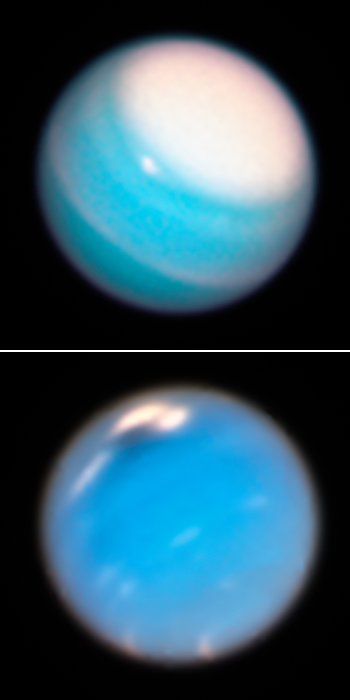
Uranus (top) and Neptune

The Hubble Space Telescope’s new annual images of Uranus (top) and Neptune (bottom) has revealed new atmospheric features for both, a giant north pole cloud cap on Uranus and a new dark storm developing on Neptune.

For Neptune:

The new Hubble view of Neptune shows the dark storm, seen at top center. Appearing during the planet’s southern summer, the feature is the fourth and latest mysterious dark vortex captured by Hubble since 1993. Two other dark storms were discovered by the Voyager 2 spacecraft in 1989 as it flew by the remote planet. Since then, only Hubble has had the sensitivity in blue light to track these elusive features, which have appeared and faded quickly. A study led by University of California, Berkeley, undergraduate student Andrew Hsu estimated that the dark spots appear every four to six years at different latitudes and disappear after about two years.

Hubble uncovered the latest storm in September 2018 in Neptune’s northern hemisphere. The feature is roughly 6,800 miles across.

For Uranus:

The snapshot of Uranus, like the image of Neptune, reveals a dominant feature: a vast bright cloud cap across the north pole.

Scientists believe this feature is a result of Uranus’ unique rotation. Unlike every other planet in the solar system, Uranus is tipped over almost onto its side. Because of this extreme tilt, during the planet’s summer the Sun shines almost directly onto the north pole and never sets. Uranus is now approaching the middle of its summer season, and the polar-cap region is becoming more prominent. This polar hood may have formed by seasonal changes in atmospheric flow.

The images are part of an annual program that monitors both planets with images every year when the Earth is best placed to view them. This allows scientists to track atmospheric changes over time.

The sharpness of both images matches that of previous Hubble images, so these photographs do not show any decline in the telescope’s image capability. However, when they lose that next gyroscope and shift to one gyroscope mode, I believe it will be very difficult to get images even this sharp of the outer planets. In fact, I suspect this monitoring program will likely have to end, or will be badly crippled.

1 comment

Fix pinpointed for Hubble main camera

Engineers have identified the issue that put the main camera of the Hubble Space Telescope into safe mode last week, and expect to have the camera back in operation in two or three days.

Hubble’s Wide Field Camera 3 (WFC3) took itself offline last week as a safety precaution, after onboard software noticed anomalous voltage readings within the instrument. But Hubble team members have now determined that voltage levels actually remained within the normal range, ascribing the glitch to a telemetry issue rather than a power-supply problem.

The mission team reset the relevant telemetry circuits, gathered some more engineering data and then brought the WFC3 back to an operational state. “All values were normal. Additional calibration and tests will be run over the next 48 to 72 hours to ensure that the instrument is operating properly,” NASA officials wrote in a Hubble update Tuesday (Jan. 15).

None of this changes the reality that it is almost a decade since the last shuttle repair mission, and Hubble is facing a long slow decline leading to its eventual loss, with no replacement planned by anyone.

0 comments

Hubble’s main camera in safe mode

The coming dark age: The Wide Field Camera on the Hubble Space Telescope has experienced “an anomaly” that has forced its shut down.

The announcement is a mere one paragraph long, and provides no further information.

This camera was installed on the space telescope during the last shuttle mission in 2009. It is now almost a decade since that mission, which was expected to extend Hubble’s life for at least five years. It is therefore not surprising that things are beginning to fail. In October they had a serious gyroscope problem when a gyroscope failed and they had problems getting their last back-up gyroscope to work. They got it working, but this has left us with a telescope with no gyroscope backups. With the next failure they will have to shift to one gyroscope mode, meaning sharp images will no longer be possible. Now the main camera has shut down.

Unfortunately, it appears that we are reaching the end of Hubble’s life span. The sad thing is that this shouldn’t be necessary. It can be repaired, but this would require a robot mission, something that would have been very difficult a decade ago but is quite doable at a reasonable cost today. No such mission is being considered however.

Even worse, the bad planning that is routine for our modern intellectual class has left us with no replacement, for the foreseeable future. In the late 1990s the astronomy community chose this path, deciding to replace Hubble with an infrared space telescope, the James Webb Space Telescope. They and NASA also decided to push the limits of engineering with Webb, resulting in a project that is about a decade behind schedule with a budget that has ballooned from $1 billion to $9 billion. Meanwhile, there has been no money for any other major space telescopes. And the one the astronomy community proposed in 2011, WFIRST, is already over budget and behind schedule, in its design phase.

The astronomy community has also decided in the past two decades that it could replace Hubble with giant ground-based telescopes, a decision that has so far proven to be problematic. Though adaptive optics can eliminate some of the fuzziness caused by the atmosphere, it limits observations to very narrow fields of view, meaning it cannot obtain large mosaics of big objects, such as this Hubble release earlier this week of an image of the nearby Triangulum Galaxy. Moreover, almost all of the giant ground-based telescopes built so far have struggled with many engineering issues.

In terms of astronomy, we are thus about to go blind, returning to the days prior to the space age when our view of the heavens was fuzzy and out of focus.

5 comments

Nancy Roman passes away at 93

R.I.P. Nancy Roman, NASA’s first chief astronomer, died on Christmas at the age of 93.

Her name is largely forgotten, but her support for building the Hubble Space Telescope in the 1960s and the 1970s was critical in getting it done. As important, her support for all in-space astronomy in these early years eventually made it possible. During her term NASA built and launched the first space telescopes. Some were duds. Some were incredible successes. Regardless, her leadership proved that astronomy in space made sense, leading to the achievements that have followed in the half century that has followed.

God speed, Nancy Roman.

1 comment
1 9 10 11 12 13 15