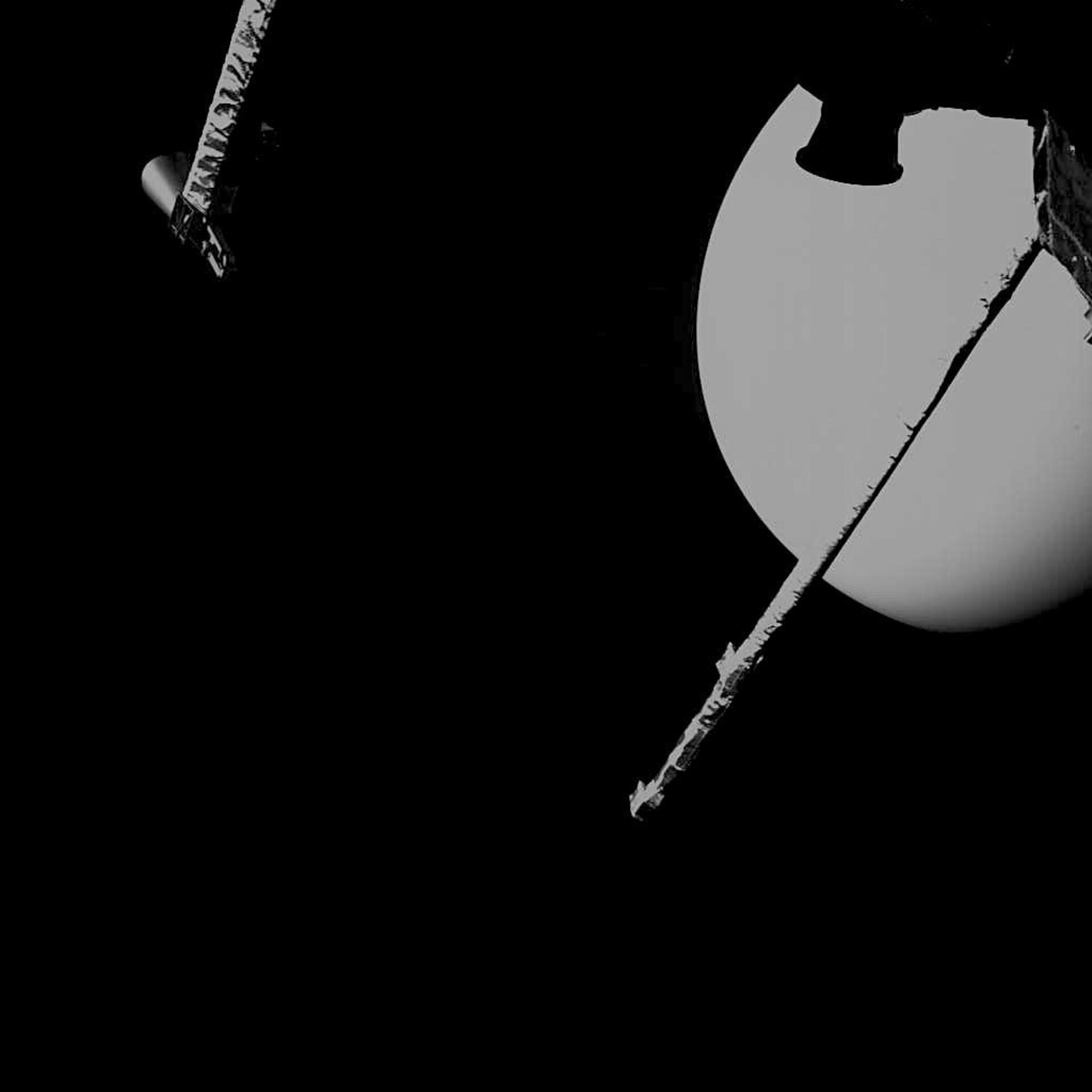
Japan’s lunar lander shuts down for long lunar night

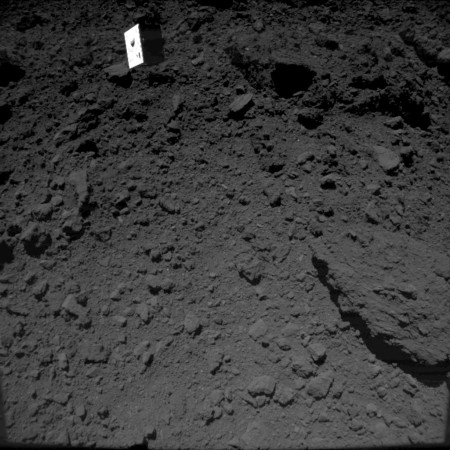
SLIM's last image
Click for original image.

After two days of post landing operations, engineers for the Japanese lunar lander SLIM have shut it down now as the sun has set at its landing site on the Moon and its solar panel can no longer charge its batteries.

The picture to the right, reduced to post here, was the last image sent back by SLIM before shut down. It looks to the southeast across the width of 885-foot-wide Shioli Crater, the opposite rim the bright ridge in the upper right about a thousand feet away.

The engineers shut the spacecraft down prior to sunset in order to increase the chances that it will survive that very long harsh lunar night and reactivate when the Sun rises in two weeks. They recognized that the odds of this occurring are slim (no pun intended), because the lander was not designed to withstand the night’s cold temperatures, and more important, the solar panel will not get recharged until late in the lunar day, an additional week-plus past sunrise. That long period of inactivity will likely kill it.

No matter. The spacecraft’s main goal was to prove the ability of its landing system to land softly within a small target zone. It did so, even if it had an engine issue that caused it to land upside down. This new engineering will make it possible to send unmanned and manned landers to places on other planets that previously were impossible.

1 comment

Japan and India team up for unmanned lunar lander mission

Japan and India are now partnering to put a lander/rover on the Moon in 2025, dubbed LUPEX.

Set tentatively for 2025, LUPEX will be launched on JAXAโ€™s H3 launcher, with a 350-kg rover developed by the Japanese agency. ISRO is developing the lander. The instruments will be on the lander and the rover. Initial feasibility studies and the landerโ€™s configuration have been completed. The rover will sample the soil with a driller and the samples will be analysed using equipment on the rover,

Unlike the previously successful lunar landers from both countries (India’s Chandrayaan-3 and Japan’s SLIM), LUPEX is being designed to survive the 14-day-long lunar night, with a mission that is aiming to last three to six months.

0 comments

Communications with SLIM lunar lander re-established

According to Japan’s space agency JAXA, engineers last night successfully re-established communications with its SLIM lunar lander sitting up-side down on the Moon, the Sun finally shifting to the western sky so that its westward-facing solar panel could get light and provide power.

Communication with SLIM was successfully established last night, and operations resumed! Science observations were immediately started with the MBC, and we obtained first light for the 10-band observation.

One image was immediately downloaded. Engineers will attempt to initiate as many operations as possible in the next few days, before the Sun sets at the end of the month and the spacecraft shuts down again, likely forever.

0 comments

SLIM landed on the Moon softly, but upside down!

SLIM upside down
Click for original image.

We now know why SLIM’s solar panel was not facing the Sun after the Japanese lunar lander touched down. When it was only 10 to 15 feet above the ground, preparing to land, one of its two descent engines failed, causing the spacecraft to tumble as it softly touched down. As a result, it landed softly, but upside down, thus putting the panel on its west side instead of its east side as planned.

The image to the right, cropped to post here, was taken by one of the two tiny rovers released by SLIM just prior to landing. It shows SLIM upside down, but essentially undamaged.

The lander however still apparently achieved its primary goal, landing within a small zone only 300 feet across, or 100 meters.

Analysis of the data acquired before shutting down the power confirmed that SLIM had reached the Moonโ€™s surface approximately 55m east (180 feet) of the original target landing site. The positional accuracy before the commencement of the obstacle avoidance maneuver (at around a 50m altitude) which indicates the pinpoint landing performance, was evaluated to be at approximately 10m or less, possibly about 3 – 4m.

…Under these circumstances, the SLIM onboard software autonomously identifies the anomaly, and while controlling the horizontal position as much as possible, SLIM continued the descent with the other engine and moved gradually towards the east. The descent velocity at the time of contact with the ground was approximately 1.4 m/s or less, which was below the design range., but conditions such as the lateral velocity and attitude were outside the design range, and this is thought to have resulted in a different attitude than planned.

In other words, when that engine failed, SLIM was only about 10 to 30 feet from its pinpoint landing target, but then drifted eastward as its dropped those last few feet because of the unbalanced engine burn caused by only one engine.

That the spacecraft is still operating and can communicate with Earth, even though it is upside down, is remarkable. Moreover, SLIM did achieve its main goals quite successfully. It landed within its tight target zone, it released two mini-rovers which operated successfully, and has been able to send its own pictures back to Earth. It was not able however to test its crushable landing legs, as they remain in the air.

11 comments

Engineers shut lunar lander SLIM down in hope sunlight can recharge its batteries

SLIM's landing zone
Map showing SLIM landing zone on the Moon.
Click for interactive map.

Once they were able to download sufficient data, engineers have intentionally shut down Japan’s lunar lander SLIM in order to increase the chances it will recover should sunlight hit its solar panels and recharge its batteries.

The shutdown occurred three hours after landing on January 19, 2024, when the batteries still has a charge of about 12%.

Before turning the lander off remotely, mission control was able to receive technical and image data from its descent, and from the lunar surface. “We’re relieved and beginning to get excited after confirming a lot of data has been obtained,” JAXA said Monday in a statement, adding that “according to the telemetry data, SLIM’s solar cells are facing west”.

“If sunlight hits the Moon from the west in the future, we believe there’s a possibility of power generation, and we’re currently preparing for restoration,” it said.

The landing took place in the morning on the Moon, so there is a chance that in about a week, when the Sun shifts to the western sky, the panels will get sunlight and begin to recharge the battery.

Meanwhile, engineers confirmed that the two experimental mini-rovers were successfully deployed (see the media kit [pdf] for more details). At the moment we do not know if they have operated as planned, one rolling and the other hopping.

0 comments

JAXA: SLIM soft landing successful but will likely die prematurely after landing

According to managers at Japan’s space agency JAXA, its SLIM lunar lander successfully completed its soft landing on the Moon.

It appears SLIM’s solar cells are not producing power. The spacecraft is presently on battery power, which will only last a few hours. Engineers are presently rushing to download images, taken during descent and after landing. There is also no word yet on whether the two test rovers were successfully released and achieved their test goals.

To precisely determine if the lander achieved its goal to hit a precise landing zone less than 300 feet across will require further analysis, much of which will depend on the images presently being downloaded. At the moment the engineers believe this goal was achieved, however, based on the telemetry already received.

Thus, it appears Japan has managed a soft-landing, something that in the past few years several countries (Israel, Russia, India, United States) and private companies (SpaceIL, Ispace, Astrobotic) have failed to do. Right now Japan appears to be the third nation to succeed in this new round of lunar exploration, joining China and India (which succeeded on its second attempt).

The next lunar landing attempt will be by the American private company, Intuitive Machines. Its Nova-C lander is scheduled for launch on a Falcon 9 rocket in mid-February.

8 comments

SLIM lands on the Moon

Telemetry after SLIM's landing

According to telemetry data (as shown on the screen capture to the right), Japan’s SLIM lander has apparently landed on the Moon near Shioli Crater, proving its autonomous precision landing system worked as planned.

At the moment however Japan’s space agency JAXA has not yet confirmed that the landing was completely successful. After landing the announcers on the live stream repeatedly noted that though the telemetry indicated it had landed as planned, engineers had not yet confirmed that the lander was still operational. Note how the data to the right suggests the spacecraft is tilted slightly. This tilt appears to match the tilt of the surface, but it could also indicate a problem with communications.

A press conference announcing either a confirmation or a failure will begin shortly at the live stream above.

4 comments

Japan’s H2A rocket launches military surveillance satellite

Japan’s H2A rocket today successfully launched a new military surveillance satellite designed to observe North Korean’s missile launch sites.

The live stream of the launch is here, cued to T-10 seconds.

New reports had previously reported the last launch of the H2A occurred in September 2023, launching Japan’s SLIM lunar lander and XRISM X-ray telescope. This was obviously incorrect. Today’s launch appears to close out the H2A manifest, leaving Japan rocketless until it can get both its new H3 and grounded Epsilon rockets operational.

The 2024 launch race:

4 China
3 SpaceX
1 India
1 ULA
1 Japan

0 comments

Japan delays launch of Mars sample return mission due to problems with its H3 rocket

Japan’s space agency JAXA last week officially delayed the launch of its MMX Mars sample return mission, from later this year until the next Mars launch window in 2026.

A September 2024 launch would have seen MMX reach the Red Planet in August 2025 and return to Earth with around 0.35 oz (10 grams) of samples of the Mars moon Phobos in 2029. But the mission now must wait until the next Mars launch window opens in late 2026; its samples are slated to reach Earth in 2031.

The delay is because of JAXA’s ongoing problems getting its new H3 rocket off the ground. The first test launch last year failed, and though the next launch attempt is now scheduled for February, the agency decided it wanted more time to prove out the rocket before putting the Mars mission on it.

This decision once again highlights the overall failure of JAXA to produce for Japan a viable space effort. It is long past time for the Japanese government to take control from this agency, and allow the private sector to compete freely for business. Right now Japan’s continuing failures in space are downright embarrassing, compared to its Asian neighbors of China, India, and South Korea.

0 comments

Japan’s SLIM lunar lander releases its first pictures of Moon

Oblique view of Moon by SLIM
Oblique view of the Moon, as seen by SLIM.
Click for original image.

Japan’s space agency JAXA today released the first pictures taken of the Moon by its SLIM lunar lander after entering lunar orbit on December 25, 2023.

Three images were included in the tweet. The one to the right, reduced to post here, gives an oblique view of the Moon, including its horizon. None of the images are of great scientific value, but all are very significant in terms of SLIM’s engineering. They prove the spacecraft is operating as designed, able to orient itself precisely as well as point its camera correctly. These facts bode well for the precision landing attempt, which is SLIM’s main purpose, now targeting January 24, 2024. The primary goal is to demonstrate the ability for an unmanned spacecraft to land autonomously within a tiny landing zone only 300 feet across.

If SLIM succeeds, it will then hopefully operate for one lunar day, about two weeks. It is not expected to survive the lunar night that follows.

2 comments

Japan’s space agency JAXA schedules next H3 rocket launch

JAXA, Japan’s space agency, announced today that it has now scheduled the next test launch of its new H3 rocket for February 15, 2024.

This rocket, built by Mitsubishi for JAXA, is supposed to replace the H2A rocket, which completed its last launch in September 2023. The H3 was supposed to be flying years ago, but has experienced numerous engineering problems throughout its development. It was initially supposed to launch in 2020, but was first delayed to 2021 because of “engine issues,” which were later described as cracks and holes in the engine’s combustion chamber.

That launch date was never met. When JAXA was gearing up to launch in 2022 news sources revealed another yearlong delay until 2023 because of new engine problems, which appeared to require a complete engine redesign.

Then in February 2023 the rocket’s first launch attempt was aborted at T-0 when the two strap-on solid rocket boosters failed to ignite. A second launch attempt a month later failed when the second stage failed during launch.

Even if the rocket successfully launches in February, it still leaves Japan far behind the rest of the space-faring industry. The H3 is entirely expendable, and is far more expensive to launch than the new reuseable rockets in use or being developed by numerous private American companies or other nations. JAXA says it hopes to launch it six times a year, but I can’t imagine it getting even a third that number of customers.

What Japan’s government really needs to do is to get the launch business away from JAXA completely. Let other companies besides Mitsubishi build their own rockets and have JAXA buy their services, rather than try to design its own rockets. This system is working marvelously in the U.S., so much so that India is now aggressively trying to copy it, while communist China has made its own pseudo attempt, somewhat successfully, to do the same for the past five years.

3 comments

JAXA identifies cause of Epsilon-S solid-fueled engine failure during test

Japan’s space agency JAXA has now identified the cause of the explosion that destroyed an Epsilon-S solid-fueled engine during a static fire test in July.

The explanation at the link is somewhat unclear, but the bottom line is that the failure was caused “by the melting and scattering of a metal part from the ignition device inside the engine.”

JAXA is working on a fix to prevent the part from melting, but the report provides no timeline on when the next Epsilon launch will occur. Nor do we know when Japan’s larger new rocket, the H3, will launch next as well, having failed during its first launch in the spring. At the moment, Japan is essentially out of the game.

0 comments
1 3 4 5 6 7 10