Japan’s space agency JAXA test flies and vertically lands a prototype first stage

Japan’s space agency JAXA today successfully completed a 40-second vertical take-off and landing of a small scale prototype Grasshopper first stage.

At its Noshiro testing center in Akita Prefecture, northeastern Japan, the RV-X test rocket slowly landed after rising about 11 meters and moving horizontally while maintaining a vertical position during its 40-second flight. JAXA found no major issues with the test rocket after the landing.

…The 7.3-meter-long, 1.8-meter-diameter test rocket, which uses liquid hydrogen fuel, is a prototype of the reusable first stage of future large rockets. [emphasis mine]

This is a typical government test program, like many at NASA. Private companies in general have moved away from the use of hydrogen as a fuel because of the difficulty of obtaining and managing it, moving instead to methane. Thus, this project is not tied to any specific financial goals, and will likely dies stillborn once it is complete.

It also illustrates how far behind Japan has fallen when compared to China. China is building multiple reusable rockets, has tested three with one landing successfully. Japan at present is struggling to get any of its three government and one private rockets off the ground.

3 comments

BepiColumbo’s team prepares for arrival at Mercury in the fall

The arrival plan for BepiColombo
Click for original graphic.

After eight years of travel through the inner solar system to get to Mercury, the European/Japanese dual orbiter mission BepiColombo is finally getting close to arrival at Mercury in the fall, and the science team has been doing rehearsals to prepare for that orbital insertion.

Teams must align timelines, verify readiness criteria and maintain a common understanding of what constitutes a ‘go’ or ‘no-go’ decision. During one recent simulation, controllers were confronted with an anomaly that forced them to abort and re-schedule a planned separation scenario. “It generates continuous discussions and iterations between the different teams,” Nacho adds.

The exercise highlighted an essential aspect of Mercury arrival: success depends not only on operating the spacecraft, but on ESA and JAXA working together as one team.

That arrival is made more complicated in that BepiColombo is not a single orbiter. It is made up of the following parts:

  • The Mercury Transfer Module (MTM), which provided the service module and ion engines for the journey, including six fly-bys of Earth, two ofVenus, and six of Mercury
  • The Mercury Planetary Orbiter (MPO) from the European Space Agency (ESA)
  • The Mercury Magnetospheric Orbiter (Mio) from Japan’s space agency JAXA
  • The Mio Sunshield and Interface Structure (MOSIF), which protected everything during its journey in the inner solar system close to the Sun

The graphic to the right outlines the arrival plan. First the MTM must separate. Then the two orbiters enter Mercury orbit. Next Japan’s Mio separates and is deployed in its own orbit. Then the sunshield is ejected from Europe’s orbiter and it moves into its planned orbit.

As the spacecraft uses ion engines, with low but continuous thrust, these maneuvers can take weeks.

Both orbiters have complementary orbits to study different aspects of the planet. Europe’s orbiter will orbit closer to get a better look at the planet, while Japan’s Mio’s orbit is highly elliptical, to study the planet’s magnetic field.

During the journey to Mercury BepiColombo overcome several problems. First, the Covid panic threatened operations by limiting staffing and preventing normal behavior. Next the solar panels failed to produce the expected power, a problem that appears to still exist but which has not prevented operations. Finally, its thrusters produced less thrust than expected during a mid-course correction in 2024, causing an eleven month delay in arrival.

It is now however about to arrive. Let us hope that arrival proceeds as planned.

1 comment

Japan’s Hayabusa-2 successfully flies past asteroid Torifune

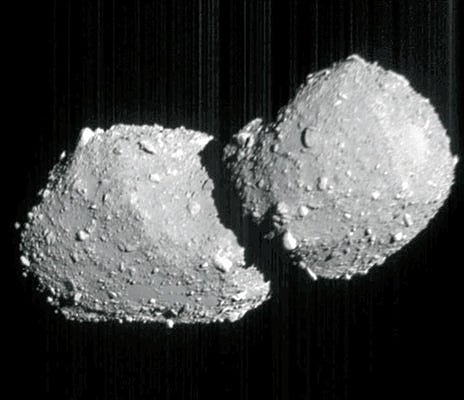
Torifune as seen by Hayabusa-2

Japan’s Hayabusa-2 asteroid probe successfully flew past the asteroid Torifune yesterday, getting less than 2,000 feet from its surface as it zipped past at a relative speed of more than 10,000 miles per hour.

The picture to the right is the first image released by Japan’s space agency, JAXA. It shows that Torifune appears to be a contact binary, made up of two rubble-pile asteroids that gentle fused together in their dance in space. Contact binaries are presently thought to comprise about 15% of all asteroids, but that estimate might prove to be an understatement as we gather more information. This is the first seen close-up that appears made up of two rubble piles.

While Japan’s press and its space agency touted this fly-by success loudly, both failed to mention the technical problems facing Hayabusa-2, which made the fly-by even more impressive. The spacecraft, which was launched in 2014, rendezvoused and grabbed samples from the asteroid Ryugu from 2018 to 2019, and then returned those samples to Earth in 2020, has been flying somewhat crippled. It has four ion engines for maneuvering, three of which no longer work and a fourth that is showing signs of failure. Thus, it could not do much during this fly-by to control its path or orientation. That it could grab this image as it zipped by is a testament to its engineers.

Hayabusa-2 is on its way to asteroid 1998 KY26 in 2031. Whether it will be capable of doing much when it gets there remains at this moment an unknown.

3 comments

Hayabusa-2 to fly past asteroid July 5, 2026

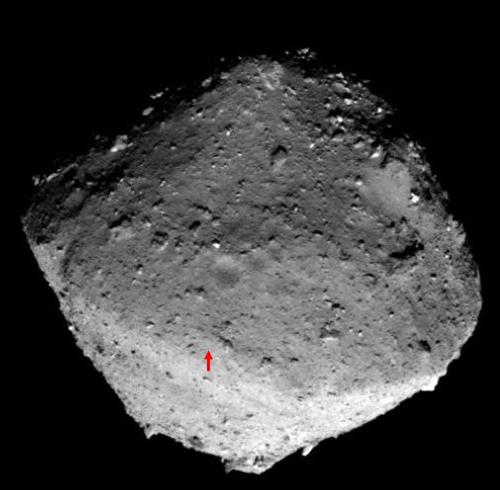
Ryugu's northern hemisphere
Ryugu as seen by Hayabusa-2 shortly before it grabbed
samples from the surface in 2019. Arrow indicates planned touchdown
site.

Despite having only one working ion engine, Japan’s Hayabusa-2 asteroid probe will do a fast and extremely close fly-by of the asteroid Torifune on July 5, 2026.

The flyby will see Hayabusa2 get within 1 to 10 kilometers (0.62 to 6.2 miles) of Torifune, using its instrument suite to study the roughly 450-meter-wide (1,476 feet) asteroid as it whizzes past at 5.3 kilometers per second (3.3 miles per second).

Not much is known about Torifune, so a fly-by this close carries risk. In addition, three of Hayabusa’s four ion engines no longer work, and the fourth is starting to degrade.

If successful, however, the fly-by will not only tell us something more about Torifune, it will increase the chances Hayabusa-2 can reach asteroid 1998 KY26 in 2031. That asteroid is small, only about 35 feet across. The plan would be for Hayabusa- to fly in formation for a period, and even attempt a touch down.

2 comments

Two launches today by Japan and SpaceX

The beat goes on! Even as SpaceX proceeds today with the largest initial public offering of stock ever, raising an expected $75 billion in cash for its long term plans, the global launch industry marched on with two launches today.

First, Japan’s space agency JAXA successfully launched its H3 rocket on a test flight following a launch failure in December 2025. The rocket lifted off from JAXA’s Tanegashima spaceport in southern Japan, using its simplest configuration, with no solid-fueled strap-on boosters. Though the rocket deployed some cubesats, its main payload was a dummy satellite to test the rocket’s deployment system, which caused the 2025 failure by not holding its satellite in place. On today’s launch, the deployment system worked as planned, which means JAXA can now resume operational launches with H3.

This was Japan’s first launch in 2026.

Next, SpaceX placed another 29 Starlink satellites into orbit, its Falcon 9 rocket lifting off from Cape Canaveral Space Force Station in Florida. The first stage completed its 27th flight, landing on a drone ship in the Atlantic (58 days after its previous flight).

The leaders in the 2026 launch race:

70 SpaceX
36 China
8 Russia
8 Rocket Lab (plus two suborbital HASTE launches)

For the third straight year SpaceX leads the entire world combined in total launches, 70 to 63.

11 comments

Rocket Lab launches satellites for Japan’s space agency JAXA

Rocket Lab today successfully placed eight smallsats for Japan’s space agency JAXA, its Electron rocket lifting off from one of its two launchpads in New Zealand.

Because all of JAXA’s rockets are presently grounded due to technical failures, Japan’s space agency has had to turn to Rocket Lab. In fact, these eight satellites were originally supposed to launch on JAXA’s Epsilon-S rocket, which remains grounded after an explosion during a static fire test. There have been no updates on the status of Epsilon-S since December 2024.

Rocket Lab was also supposed to do a suborbital hypersonic test flight yesterday out of Wallops Island in Virginia, using the first stage of Election in its HASTE suborbital configuration. As this is a test for the War Department, little information is generally released. This video from a distance confirms the launch apparently took place, but whether it was a success or not remains unknown. That Rocket Lab’s announcers did not tout its success either before or after today’s JAXA launch — as they have routinely done in the past — suggests something might have gone wrong, though this too is pure speculation.

The leaders in the 2026 launch race:

48 SpaceX
21 China
6 Russia
6 Rocket Lab

For the third straight year SpaceX continues to lead the entire world combined in total launches, 48 to 38.

10 comments

Japan to do test launch of its H3 rocket in June

Japan’s space agency JAXA is now planning a test launch on June 10, 2026 of its H3 rocket, carrying a dummy payload only in order to test the changes it has made in the rocket after a failed launch in December 2025.

The failure of the eighth H3 rocket was likely caused by an adhesion problem in the satellite mounting structure, which led it to break apart during flight, according to an investigation by JAXA. Similar issues were found in other units, prompting the space agency to fix them so the components can maintain their structural integrity.

In the June launch, a dummy satellite will be mounted on the test vehicle to collect data and verify the effectiveness of the measures. For future launches of actual satellites or space probes, JAXA plans to review the mounting structure design to reduce the risk of failure.

In other words, the method for attaching the payload to the rocket at some points failed, so that the satellite separated prematurely. The June launch will be to test a new mounting system.

Posting has been light the last few days as I deal with recovery from knee surgery.

0 comments

Japan to do vertical tests of its own Grasshopper-type demo stage this month

Japan’s space agency is about to attempt two test vertical take-off-and-landing test flights of of its own Grasshopper-type demo stage, dubbed RV-X later this month.

First flight of a small experimental version of a reusable launch vehicle has been scheduled for March 6 by the Japan Aerospace Exploration Agency (JAXA). The 24-ft.-tall vertical-takeoff-and-vertical-landing (VTVL) RV-X is planned to make a short hop at the agency’s Noshiro Rocket Testing Center on the Sea of Japan coast.

RV-X is the first of two flight experiments planned by JAXA on the path to development of a reusable first stage for a next-generation launch vehicle. A second vehicle is planned to fly in 2027 under the multinational Callisto program.

Callisto is being developed jointly with the European Space Agency. Both it and RV-X have been in development for about a decade. Both were initiated in response to SpaceX’s successful reuse of its Falcon 9 first stage. Both projects however appeared stalled until the last two years or so, with little happening.

The JAXA engine on RV-X is apparently the engine it is providing for Callisto. If the flight tests are successful this March, it will be the be transferred to French Guiana for Callisto tests planned no sooner than ’27.

0 comments

JAXA releases preliminary results of investigation into December 2025 H3 rocket launch failure

Japan's space agency JAXA

JAXA yesterday released the preliminary results of its investigation into upper stage failure during the December 2025 launch of its H3 rocket.

Previously the agency had indicated it believed the cause was linked to the separation of the rocket’s payload fairings. This new report changes that conclusion:

After liftoff, the No. 8 H3 rocket sustained damage to the section where the Michibiki No. 5 positioning satellite was mounted, when the satellite cover, called fairing, was separated.

In addition, the fuel tubing of the rocket’s second-stage engine was damaged, presumably causing combustion to stop earlier than planned, JAXA said in a progress report on its investigation into the failure at a meeting of a subgroup of a science ministry panel.

As the section was damaged, the satellite was no longer attached to the second stage of the rocket. The satellite fell off when the first stage separated.

In other words, as the fairings released, the satellite apparently deployed, damaging the fuel feed to the upper stage engine. It is as yet unclear whether the deployment system worked as intended, but did so prematurely, or if it failed entirely, allowing the satellite to fall away once the fairings separated.

At the moment Japan has no launch capability. Both of JAXA’s rockets, the H3 and the Epsilon-S are grounded due to launch failures. Meanwhile, the country has only recently begun to develop private launch companies, none of which are ready to launch.

1 comment

Japan’s government gives Ispace a $125 million contract to build a high-precision lunar lander

Is this the first sign that Japan's space agency JAXA is becoming irrelevant?
Is Japan’s failed space agency JAXA finally
starting to become irrelevant?

The Japanese lunar lander startup Ispace last week announced it has won a $125 million contract to build a high-precision lunar lander targeting a 2029 launch in the Moon’s “polar regions”.

Ispace, inc, a global lunar exploration company, announced that the company was selected to implement its proposal for “High Precision Landing Technology in the Lunar Polar Regions” project under the second phase of Japan’s Space Strategy Fund. The technology will be implemented in ispace’s Mission 6, with development now underway.

The funding amount is subject to change based on stage gate reviews and other factors, so full receipt is not guaranteed at this time.

The mission will also include a lunar orbiter that will act as a relay communication satellite that will also remain in orbit after the mission to provide communications for future missions, not only for polar missions but for missions to the Moon’s far side.

Ispace plans to use some of the technology it is developing for its 2nd generation lunar lander, scheduled to fly in ’28.

This contract is significant because it appears to leave ownership of the project entirely in Ispace’s hands, with Japan’s space agency JAXA having little design or management control. It also appears to use the funds from country’s ten-year $6.6 billion fund as intended. That fund was established in 2023 to support new space startups under the capitalism model, whereby the companies provide the product and government and JAXA are merely the customer.

Up until now it appeared this fund was accomplishing little. In fact, there have been indications that JAXA was trying to repurpose the fund for its own benefit, using it to hire a lot more staff while maintaining control and ownership of any project, rather than let the private sector own its own work.

Since JAXA has increasingly done a very bad job promoting Japan’s space exploration industry, those indications were a very bad sign for Japan’s future in space.

This deal appears however to use that strategic fund properly, even if JAXA might still be skimming a large percentage of the fund off the top. This is not unlike what NASA has been doing. Bureaucrats must be bureaucrats, and all government agencies must be eternal and immortal, no matter what.

Like NASA, however, the success of Ispace and rest of Japan’s private space sector from projects financed by this fund will eventually allow that private sector to make those bureaucrats and JAXA irrelevant. It is happening now in the U.S. It now appears there is a chance it will happen in Japan as well.

Hat tip to BtB’s stringer Jay.

15 comments

JAXA identifies cause of H3 rocket failure

In releasing today the preliminary results of its investigation into the failure on December 21, 2025 of the upper stage of its H3 rocket, Japan’s space agency pinned the likely cause on the rocket’s fairings.

Japan Aerospace Exploration Agency officials told a science ministry panel on Dec. 23 they suspect an abnormal separation of the rocket’s payload fairing—a protective nose cone shield—caused a critical drop in pressure in the second-stage engine’s hydrogen tank.

Engineers think the fairing might have hit the rocket at separation, damaging the tank.

Japan at present has no way to launch payloads. It has no operating independent commercial rocket companies, and its JAXA-owned H3 and Epsilon-S rockets have had repeated problems. The H3 failed on its first launch in 2023, causing a year-long delay, and Epsilon-S still in limbo because of repeated failures during development.

1 comment

Three launches and one scrub overnight

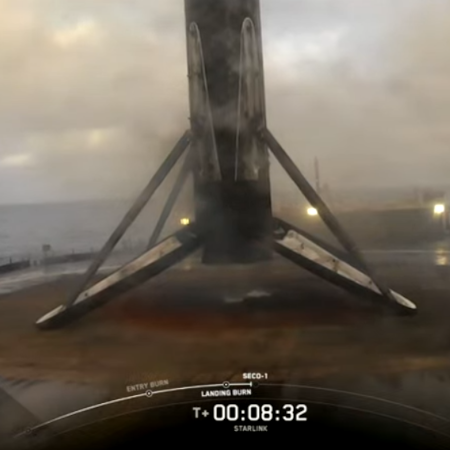
Falcon 9 1st stage after landing for 30th time

In the past twelve hours there was one launch abort at T-0 and three successful launches.

First, Japan’s space agency JAXA attempted to launch a GPS-type satellite using its H3 rocket, built by Mitsubishi. The countdown reached T-0 but then nothing happened. The launch was then scrubbed because of an issue in the ground systems. No new date was announced.

Next, Arianespace, the commercial division of the European Space Agency (ESA), launched two European Union GPS-type satellites, Galileos 33 and 34, its Ariane-6 rocket lifting off from French Guiana.

This was Arianespace’s seventh launch in 2025, the most it has achieved since 2021, though still about 20-30% lower than the numbers it generally managed in the 2010s.

Finally, SpaceX followed with two launches on opposite coasts. First, its Falcon 9 rocket launched 29 Starlink satellites from the Kennedy Space Center in Florida, the first stage completing its sixth flight by landing on a drone ship in the Atlantic.

Shortly thereafter the company launched another 27 Starlink satellites, its Falcon 9 rocket lifting off from Vandenberg Space Force Base in California. The first stage (B1063) completed its 30th flight, landing on a drone ship in the Pacific. This stage is now the third Falcon 9 booster to reach 30 reuses:
» Read more

11 comments

Japan launches a new upgraded version of its HTV cargo freighter

Japan today (October 26th in Japan) successfully launched to ISS a new upgraded version of its HTV cargo freighter, its H3 rocket lifting off from its Tanegashima spaceport in southern Japan.

The HTV-X1 carries more than freight. After its cargo is unloaded at ISS it will spend an additional three months flying independently in orbit, where engineers will conduct three additional experiments. JAXA, Japan’s space agency, hopes it can market HTV-X1 for use by the commercial space stations presently being developed. It is also marketing it as a potential orbital capsule that others can use for in-space manufacturing.

This was only the third launch by Japan in 2025, so there is no change to the 2025 leader board:

138 SpaceX
64 China
13 Russia
13 Rocket Lab

SpaceX now leads the rest of the world in successful launches, 138 to 106.

19 comments

Germany’s space agency DLR delivers one prototype leg for Europe’s Callisto grasshopper

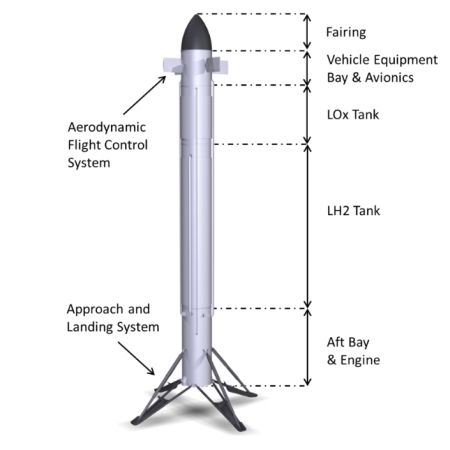
Callisto's basic design
Callisto’s basic design

Government in-action: After a decade of work, the German space agency DLR this week finally delivered for testing a prototype leg of the Callisto grasshopper-type demo rocket, intended by the European Space Agency (ESA) to demonstrate vertical take-off and landing.

On 9 October, the Institute of Structures and Design announced that it had delivered a qualification model of the demonstrator’s landing leg to the Institute of Space Systems in Bremen. According to a 3 December 2024 update, the leg will now undergo a series of tests at the Institute’s Landing and Mobility Facility, including deployment, touchdown, and vibration testing.

Once the qualification test campaign is complete and the landing leg design has been validated, the Institute of Structures and Design will proceed with the construction of the four flight-ready legs.

Note again that Callisto, as shown to the right, was proposed as a joint ESA and JAXA project in 2015. Only now, a decade later, as DLR delivered one prototype leg. The first test hop has been repeatedly delayed, so that now it is now not expected to happen until 2027, and that rocket will not even be an operational version, it will simply be a small scale prototype.

Meanwhile, SpaceX has landed its Falcon 9 first stage hundreds of times, and reused them dozens of times. Other companies are flying or building their own reusable rockets, and hope to fly operational versions next year.

The contrast between this government project and the private sector is quite embarrassing. What makes it even more embarrassing is that it is par for the course, and yet so many people still look to the government as the god who can get things done. When will people learn?

2 comments

Rocket Lab gets two-launch contract from Japan’s space agency JAXA

In what appears to be a significant slap at its own rockets (especially its delayed Epsilon-S rocket), Japan’s space agency JAXA this week signed a two-launch deal with the American rocket company Rocket Lab.

Launching from Rocket Lab Launch Complex 1 in New Zealand, the two Electron missions will deploy satellites for JAXA’s Innovative Satellite Technology Demonstration Program. The first launch, scheduled from December 2025, will deploy the agency’s RApid Innovative payload demonstration SatellitE-4 (RAISE-4) spacecraft, a single satellite that will demonstrate eight technologies developed by private companies, universities, and research institutions throughout Japan.

The second launch, scheduled for 2026, is a JAXA-manifested rideshare of eight separate spacecraft that includes educational small sats, an ocean monitoring satellite, a demonstration satellite for ultra-small multispectral cameras, and a deployable antenna that can be packed tightly using origami folding techniques and unfurled to 25 times its size.

Rocket Lab has previously won contracts from several private Japanese satellite companies (Q-Shu, Astroscale, ALE), but this I think is the first JAXA contract it has won. What makes it significant is that JAXA has always focused on using its own rockets, the large retired H2A and the new H3 as well as the smaller Epsilon-S. To go to an American company is somewhat unprecedented.

Though larger than Rocket Lab’s Electron rocket, Epsilon-S was being developed to compete for the same market. That development however has been plagued by failure, including explosions of engines during tests of both its upper and first stages in ’23 and ’24 respectively. After the second explosion JAXA announced in December 2024 the rocket’s first launch would not occur in the spring of 2025 as planned, but provided no additional information. Since then there have been no updates.

This Rocket Lab deal suggests the Epsilon program is in big trouble. In the long run however this might be a very good thing for both JAXA and Japan’s own nascent rocket industry. JAXA might finally be recognizing that building and owning its own rockets is not the best plan, that it would be better to use the capitalism model and simply be a customer buying the services from the private sector. At the moment Japan doesn’t yet have a viable commercial rocket sector, with only Mitsubishi having an operational commercial rocket, the H3 (mostly controlled by JAXA). There are a number of new startups however, including Interstellar, Honda, Space One, and Tispace, all of which have done tests of one kind or another. If JAXA is ready to abandon its own government rockets and buy the service from the private sector, those Japanese startups will start to prosper.

6 comments

Japan closes down its Akatsuki Venus orbiter mission

japan’s space agency JAXA today announced that it has shut down down operations on its Akatsuki orbiter, in orbit around Venus since 2015.

Communication with “Akatsuki” was lost during operations near the end of April 2024, triggered by an incident in a control mode of lower-precision attitude maintenance for a prolonged period. Although recovery operations were conducted to restore communication, there has been no luck so far. Considering the fact that the spacecraft has aged, well exceeding its designed lifetime, and was already in the late-stage operation phase, it has been decided to terminate operations.

Akatsuki has a interesting history. Launched in 2010, it failed to enter Venus orbit as planned in two attempts in 2010 and 2011 because of a failure in its main engine. Engineers then improvised and — after orbiting the Sun for several years — were able to get it into Venus orbit in 2015 using only its attitude thrusters. Its primary mission ended in 2018, but it continued to study Venus’ atmosphere since.

3 comments

Europe once again delays test flights of its Callisto 1st stage hopper

Callisto's basic design
Callisto’s basic design

First proposed in 2015 as Europe’s answer to SpaceX’s Falcon 9, the first test flights of the European Space Agency (ESA)’s Callisto grasshopper-type reusable test prototype, as shown on the right, has once again been delayed, now from 2026 to 2027.

On Friday, CNES published a call seeking a partner to provide mechanical operations and procedures support ahead of the Callisto flight-test campaign, including contributions to operations user manuals, drafting mechanical operation procedures, and conducting detailed studies of mechanical interfaces between the vehicle and the ground segment. In the preamble to the scope of work, the notice states that the campaign will be carried out from the Guiana Space Centre in French Guiana in 2027. It will include an integration phase followed by eight test flights and two demonstration flights, all to be completed over a period of eight months.

The project, in which Japan’s space agency JAXA is participating, had an initial budget of $100 million, and originally planned to do its first hops in 2020. Instead, ESA spent a dozen years making powerpoint presentations, while SpaceX flew hundreds of operational flights with its Falcon 9, for profit.

Worse, this program is not attached to any rocket. It is a dead end. ESA and JAXA might get some useful engineering data from it, but it will belong to no one, and it is unclear anyone will care. At this moment it appears several private companies in Europe will have flown their own new rockets before Callisto even gets off the ground, and the data from those real rocket launches will be much more useful to them down the road.

2 comments

Two Japanese shipping companies are developing floating landing platforms for rockets

Two different Japanese shipping companies are now developing floating ship platforms that rocket companies could use to land their rocket’s first stages.

Japan’s Nippon Yusen Kaisha (NYK) is following compatriot Mitsui OSK Lines in targeting space exploration as a new source of revenues.

NYK has obtained an approval in principle from ClassNK for the conceptual design of an offshore recovery system for reusable rockets, an initiative developed through the Space Strategy Fund at the Japan Aerospace Exploration Agency (JAXA). NYK now aims to carry out a demonstration test of this new vessel type in 2028 working with multiple partners including Mitsubishi Heavy Industries.

Since JAXA and Mitsubishi own and build Japan’s new H3 rocket, JAXA’s funding here suggests both are considering upgrading the H3 for reusability. It is also possible Mitsubishi is mulling plans to build its own new commercial rocket.

1 comment

JAXA/Mitsubishi test upgraded engines for H3 rocket

Japan’s space agency JAXA, working with Mitsubishi, successfully completed today a static fire test of new more powerful engines to be used on its new H3 rocket, thus eliminating the need for solid-fueled boosters with the goal of reducing the rocket’s cost.

Thursday’s test involved the sixth H3 rocket, which is a Type 30 test vehicle that has three main engines and no boosters. The three main engines were fired for 25 seconds while the rocket remained attached to the launchpad. JAXA will check acceleration, temperature and other data collected during the test.

This new version of the H3 is expected to do its first launch before the end of 2025. If successful, the launch price compared to JAXA’s now retired H2A rocket will be cut in half, to about $35 million, a number that will almost be competitive with the Falcon 9. SpaceX officially charges about $70 million per launch, but it is believed it could reduce that price significantly — some estimate to as low as $20 million — and still make a profit.

0 comments

Ispace: Resilience’s failure was due to a hardware issue in laser range finder

In a press conference today, officials of the Japanese startup Ispace explained that the failure of its second lunar lander, Resilience, to land softly on the Moon on June 5, 2025 was due to a hardware issue in its laser range finder that prevented it from providing correct altitude data.

At the same time, they have not yet been able to pin down precisely what caused the failure. It could have been because of unexpected degradation during flight, or possibly a technical fault with the range finder in gathering data at the speeds and altitudes experienced.

The company is forming a task force in partnership with Japan’s space agency JAXA as well as NASA to try to figure out the issue. It is also going to add lidar instrumentation to future missions to provide a backup to the laser range finder. These actions will add about $11 million in additional costs, an amount Ispace says it can absorb.

Ispace is building two more lunar landers, one for NASA in partnership with the American company Draper, and the second for JAXA. It appears both missions are still moving forward.

16 comments
1 2 3 6