
The growing X-ray shell of the 1604 Kepler supernova
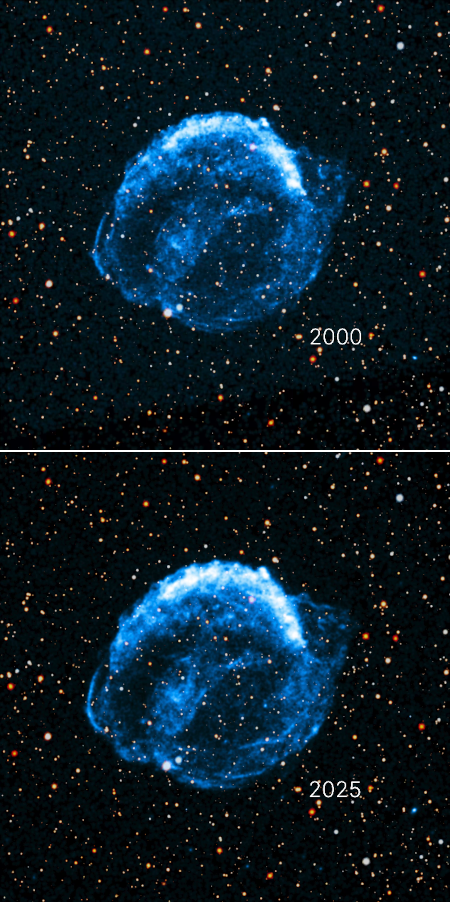
Kepler's supernovae remnant over time
Click to see movie.

Cool image time! Astronomers now have created a short movie from X-ray data compiled by the Chandra X-ray Observatory accumulated during the past quarter century showing the expansion of the cloud ejected from the 1604 supernova discovered by astronomer Johannes Kepler.

The two images to the right are the first and last frames in the movie. Though they appear the same, if you look closely you will see that in the more recent image the cloud is larger. From the press release:

Supernova remnants, the debris fields left behind after a stellar explosion, often glow strongly in X-ray light because the material has been heated to millions of degrees from the blast. The remnant is located in our galaxy, about 17,000 light-years from Earth, allowing Chandra to make … detailed images of the debris and how it changes with time. This latest video includes its X-ray data from 2000, 2004, 2006, 2014, and 2025. This makes it the longest-spanning video that Chandra has ever released, enabled by Chandra’s longevity. Only Chandra, with its sharp X-ray images and longevity, can see changes like those seen here.

…The researchers used the video to show that the fastest parts of the remnant are traveling at about 13.8 million miles per hour (2% of the speed of light), moving toward the bottom of the image. Meanwhile, the slowest parts are traveling toward the top at about 4 million miles per hour (0.5% of the speed of light). This large difference in speed is because the gas that the remnant is plowing into toward the top of the image is denser than the gas toward the bottom. This gives scientists information about the environments into which this star exploded.

This is one of the curses that astronomers live with. Things take a loooong time to unfold, often several generations. Thus Kepler might see this supernova when it erupts, but the explosion continues for many centuries.
0 comments

Do Kepler’s sunspot drawings tell us the length of the solar cycle in the 17th century?

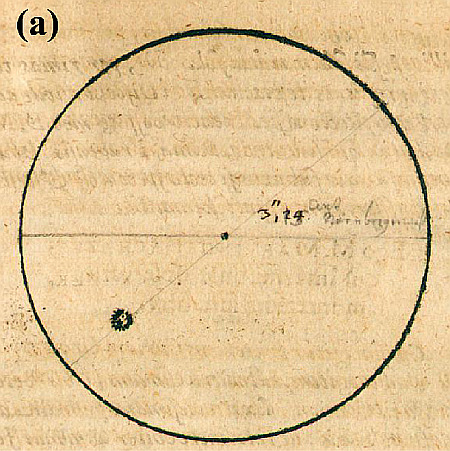
Kepler's first sunspot drawing
Click for original image.

The uncertainty of science: Scientists have done a new analysis of Johannes Kepler’s three drawings of sunspots on the Sun in 1607, and have concluded that the solar cycle at that time — just before the start of the Maunder grand minimum of no sunspots for decades — was about the same length, 11 years, that has been measured since the 1700s onward.

You can read the peer-reviewed paper here. The drawing to the right is figure 1 in that paper, and shows Kepler’s first drawing of the Sun’s surface showing sunspots. From the paper’s conclusion:

In combination with sunspot drawings in the 1610s–1620s, it is reasonable to suppose that the duration of the Solar Cycle −13 was between 11 and 14 yr. This does not support Miyahara et al.’s claim of anomalously long/short durations for Solar Cycle −13 (16 yr) and Solar Cycle −14 (5 yr) but supports Usoskin et al.’s reconstruction of regular durations of Solar Cycle −13 (11 yr) and Solar Cycle −14 (14 yr).

In other words, the solar cycle prior to the sixty-plus yearlong Maunder Minimum, when few to none sunpots occurred, was about eleven years long, like now, and not five years or sixteen years long, as some scientists have theorized. Knowing the length and nature of the cycle before the Maunder grand minimum would help scientists predict when the next minimum might occur. It would also help them better document the Sun’s long term behavior.

There is however great uncertainty in this result, since there really is so little data about sunspots prior to the Maunder Minimum. Before Galileo’s first use of the telescope in astronomy in 1609, such observations like Kepler’s were rare and very difficult. The conclusions here are intriguing, but hardly convincing.

In fact, it is really impossible to get a defiinitive answer from this data. We really won’t know how the Sun behaves just prior to a grand minimum until it happens again and scientists can use modern technology to observe it.

0 comments

Kepler’s first discovered exoplanet is spiraling into its aging star

Measurements of the orbit of first exoplanet discovered by the Kepler space telescope have determined that its orbit is very slowly shrinking, and that it will eventually spiral into its aging sun.

In the case of Kepler-1658b, according to the new study, its orbital period is decreasing at the miniscule rate of about 131 milliseconds (thousandths of a second) per year, with a shorter orbit indicating the planet has moved closer to its star.

Detecting this decline required multiple years of careful observation. The watch started with Kepler and then was picked up by the Palomar Observatory’s Hale Telescope in Southern California and finally the Transiting Exoplanet Survey Telescope, or TESS, which launched in 2018. All three instruments captured transits, the term for when an exoplanet crosses the face of its star and causes a very slight dimming of the star’s brightness. Over the past 13 years, the interval between Kepler-1658b’s transits has slightly but steadily decreased.

The scientists think tidal forces are causing the orbit to shrink. The star itself is old and beginning to expand as it evolves towards its own stellar death.

1 comment

Kepler signs up D-Orbit’s orbital tug for its next two satellites

Capitalism in space: The Canadian company Kepler — which already has nineteen satellites in orbit providing data communications — will use the orbital tug developed by the start-up D-Orbit and dubbed ION on its next two satellites.

After separating from the launch vehicle, D-Orbit intends to use ION to drop Kepler’s satellites off at a sun-synchronous orbit (SSO) between 500 and 600 kilometers. Each satellite is the size of six cubesats, a standard smallsat form factor measuring 10 centimeters on each side.

Kepler previously had a deal to use Momentus’s Vigoride tug, but delays and further in-orbit technical problems with that tug has apparently forced it to switch to D-Orbit.

0 comments

Earth-sized exoplanet in habitable zone found in old Kepler data

A review of the data produced by the space telescope Kepler, now retired, has discovered an exoplanet about the same size as Earth and also located in the habitable zone that had been missed previously by software.

Scientists discovered this planet, called Kepler-1649c, when looking through old observations from Kepler, which the agency retired in 2018. While previous searches with a computer algorithm misidentified it, researchers reviewing Kepler data took a second look at the signature and recognized it as a planet. Out of all the exoplanets found by Kepler, this distant world – located 300 light-years from Earth – is most similar to Earth in size and estimated temperature.

This newly revealed world is only 1.06 times larger than our own planet. Also, the amount of starlight it receives from its host star is 75% of the amount of light Earth receives from our Sun – meaning the exoplanet’s temperature may be similar to our planet’s as well. But unlike Earth, it orbits a red dwarf. Though none have been observed in this system, this type of star is known for stellar flare-ups that may make a planet’s environment challenging for any potential life.

A number of Earth-like planets have been found around red dwarf stars. Whether life could evolve in such places is entirely unknown. Red dwarfs are small, and would have likely formed in a nebula cloud with a dearth of many elements and materials needed for life. Moreover, because they are also so dim, the habitable zone is very near the star, meaning that, as the article mentions, strong flares are more dangerous.

At the same time, red dwarfs are the most common star, and the most long-lived, capable of burning for tens of billions of years. With enough time and numbers anything is still possible.

1 comment

Review of Kepler data uncovers seventeen more possible exoplanets

Worlds without end: In reviewing the entire Kepler database of 200,000 stars, scientists have found seventeen more candidate exoplanets, including one only 1.5 times the mass of the Earth that is also in the habitable zone.

From the paper’s abstract:

We present the results of an independent search of all ~200,000 stars observed over the four year Kepler mission (Q1–Q17) for multiplanet systems, using a three-transit minimum detection criterion to search orbital periods up to hundreds of days. We incorporate both automated and manual triage, and provide estimates of the completeness and reliability of our vetting pipeline. Our search returned 17 planet candidates (PCs) in addition to thousands of known Kepler Objects of Interest (KOIs), with a 98.8% recovery rate of already confirmed planets. We highlight the discovery of one candidate, KIC-7340288 b, that is both rocky (radius $\leqslant 1.6{R}_{\oplus }$) and in the Habitable Zone (insolation between 0.25 and 2.2 times the Earth’s insolation). Another candidate is an addition to the already known KOI-4509 system.

I must emphasize that these are candidate exoplanets, meaning their existence has not been confirmed by other observations, and could very well turn out to be false positives.

Still, that this independent review matched the previous list of Kepler candidates within 98.8% means that the list of exoplanet candidates from Kepler is solid and worth further study. With thousands of candidates, however, that further study is likely going to take a very long time. And the backlog will be growing significantly with the many thousands of additional exoplanet candidates expected to be found by TESS.

0 comments

Scientists confirm first exoplanet candidate found by Kepler

Worlds without end: Ten years after Kepler was launched into space to find exoplanets, astronomers have finally confirmed one of the space telescopes thousands of candidates.

Despite being the very first planet candidate discovered by NASA’s Kepler Space Telescope, the object now known as Kepler-1658 b had a rocky road to confirmation. The initial estimate of the size of the planet’s host star was incorrect, so the sizes of both the star and Kepler-1658 b were vastly underestimated. It was later set aside as a false positive when the numbers didn’t quite make sense for the effects seen on its star for a body of that size. Fortuitously, Chontos’ first year graduate research project, which focused on re-analyzing Kepler host stars, happened at just the right time.

“Our new analysis, which uses stellar sound waves observed in the Kepler data to characterize the host star, demonstrated that the star is in fact three times larger than previously thought. This in turn means that the planet is three times larger, revealing that Kepler-1658 b is actually a hot Jupiter-like planet,” said Chontos. With this refined analysis, everything pointed to the object truly being a planet, but confirmation from new observations was still needed.

“We alerted Dave Latham (a senior astronomer at the Smithsonian Astrophysical Observatory, and co-author on the paper) and his team collected the necessary spectroscopic data to unambiguously show that Kepler-1658 b is a planet,” said Dan Huber, co-author and astronomer at the University of Hawaiʻi. “As one of the pioneers of exoplanet science and a key figure behind the Kepler mission, it was particularly fitting to have Dave be part of this confirmation.”

It is important to remember that until scientists obtain independent data on each of these candidates, they are not yet confirmed as exoplanets, and might only be false positives. To do this, however, is going to take a lot of work and time.

7 comments

NASA officially retires Kepler

NASA today officially retired Kepler after nine years of operations.

After nine years in deep space collecting data that indicate our sky to be filled with billions of hidden planets – more planets even than stars – NASA’s Kepler space telescope has run out of fuel needed for further science operations. NASA has decided to retire the spacecraft within its current, safe orbit, away from Earth. Kepler leaves a legacy of more than 2,600 planet discoveries from outside our solar system, many of which could be promising places for life.

Exoplanet hunting however does not end here. Unlike Hubble, astronomers and NASA planned ahead for Kepler’s demise, and this year launched TESS to continue its work, in an even more sophisticated manner.

5 comments

Number of candidate exo-Earths reduced by Gaia data

Worlds without end: The number of candidate exo-Earths identified by Kepler has now been reduced based on data from Europe’s Gaia telescope.

To date, NASA’s prolific Kepler space telescope has discovered about 30 roughly Earth-size exoplanets in their host stars’ “habitable zone” — the range of orbital distances at which liquid water can likely exist on a world’s surface.

Or so researchers had thought. New observations by the European Space Agency’s (ESA) Gaia spacecraft suggest that the actual number is probably significantly smaller — perhaps between two and 12, NASA officials said today.

Gaia launched in December of 2013 to create an ultraprecise 3D map of the Milky Way. So far, this map includes position information for about 1.7 billion stars and distance data for about 1.3 billion stars, according to NASA officials. Gaia’s observations suggest that some of the Kepler host stars are brighter and bigger than previously believed, the officials added. Planets orbiting such stars are therefore likely larger and hotter than previously thought.

Being hotter and larger, the habitable zone for these stars shifts outward, placing the exoEarth’s outside the habitable zone.

7 comments

TESS releases its first batch of exoplanet candidates

The science team for the U.S.’s exoplanet space telescope TESS this week released its first batch of exoplanet candidates.

TESS scientists released the list so that other astronomers could make an initial determination as to whether these candidates are planets. There are 73 objects in this first batch, including some planets previously known from ground-based searches, says George Ricker, the mission’s principal investigator at the Massachusetts Institute of Technology in Cambridge. Perhaps 5 to 20% of the objects on the list will turn out to be false alarms, he says. Others, if confirmed, will join the ranks of newly discovered exoplanets.

Researchers expect TESS to find as many as 10,000 large planets. But its main goal is to discover and measure the masses of at least 50 small worlds no more than four times the size of Earth.

Meanwhile, Kepler has resumed operations despite being almost out of fuel. The science team there is attempting to squeeze every last ounce of data it can before the spacecraft’s fuel runs out.

1 comment

Kepler on verge of death

The Kepler space telescope is now almost out of fuel, and scientists have ceased science observations to devote the telescope’s last days downloading its last 51 days of data.

The telescope lasted far longer than planned, and discovered thousands of exoplanets. Its archives will be producing new discoveries for decades. And a new exoplanet space telescope, TESS, is already in orbit to take over.

2 comments

Kepler to run out of fuel in the coming months

After nine years of success, the Kepler space telescope is running out of fuel, which will force an end to the mission sometime in the next several months.

The Kepler team is planning to collect as much science data as possible in its remaining time and beam it back to Earth before the loss of the fuel-powered thrusters means that we can’t aim the spacecraft for data transfer. We even have plans to take some final calibration data with the last bit of fuel, if the opportunity presents itself.

Without a gas gauge, we have been monitoring the spacecraft for warning signs of low fuel— such as a drop in the fuel tank’s pressure and changes in the performance of the thrusters. But in the end, we only have an estimate – not precise knowledge. Taking these measurements helps us decide how long we can comfortably keep collecting scientific data.

They are doing a dance here. If they run out of fuel while collecting data, that data will be lost. If they stop collecting data too soon, however, to transmit it to Earth, they will not maximize the data obtained.

Meanwhile, the next exoplanet hunter, TESS, is scheduled for launch on April 16 on a Falcon 9 rocket.

3 comments

Astronomers find 20 more exoplanet candidates in Kepler archive

Worlds without end: Astronomers reviewing the Kepler archive have found 20 more exoplanet candidates, including one that has a mass about 97 percent of the Earth with an orbit 395 days long circling a star like the Sun.

The planet would be colder than Earth, as its star is slightly cooler than the Sun, and its orbit is slightly farther away. Nonetheless, this is an amazing twin, and would certainly be a prime target when interstellar travel becomes routine.

0 comments

Have astronomers using Kepler discovered the first exomoon?

The uncertainty of science: Using data from Kepler astronomers think they have spotted the first exomoon, orbiting a star 4,000 light years away.

They think it might be the size of Neptune, and orbits a planet about ten times more massive than Jupiter.

All this is unconfirmed, however, especially because their conclusions are based on data from only three transits. They plan to use the Hubble Space Telescope to do more observations and hopefully confirm the discovery.

4 comments

Update of Kepler exoplanet catalog

Worlds without end: The Kepler science team has released an update of the space telescope’s exoplanet candidate list, adding 219 new exoplanet candidates.

NASA’s Kepler space telescope team has released a mission catalog of planet candidates that introduces 219 new planet candidates, 10 of which are near-Earth size and orbiting in their star’s habitable zone, which is the range of distance from a star where liquid water could pool on the surface of a rocky planet. This is the most comprehensive and detailed catalog release of candidate exoplanets, which are planets outside our solar system, from Kepler’s first four years of data. It’s also the final catalog from the spacecraft’s view of the patch of sky in the Cygnus constellation.

With the release of this catalog, derived from data publicly available on the NASA Exoplanet Archive, there are now 4,034 planet candidates identified by Kepler. Of which, 2,335 have been verified as exoplanets. Of roughly 50 near-Earth size habitable zone candidates detected by Kepler, more than 30 have been verified.

Additionally, results using Kepler data suggest two distinct size groupings of small planets. Both results have significant implications for the search for life. The final Kepler catalog will serve as the foundation for more study to determine the prevalence and demographics of planets in the galaxy, while the discovery of the two distinct planetary populations shows that about half the planets we know of in the galaxy either have no surface, or lie beneath a deep, crushing atmosphere – an environment unlikely to host life.

34 comments

Citizen scientists crowd scource discovery of 4 exoplanets

After being promoted on an Australian tv show an effort to use public help to plow through Kepler’s vast archives discovered four new exoplanets within two days.

In three days, the Australia iteration of astronomy TV show Stargazing Live brought us #SpaceGandalf and now its viewers have discovered four planets. After it was promoted on the show, citizen scientists and fans of the program came together to contribute to a crowd-sourcing project, stalking around 100,000 stars on the Zooniverse website, which displays recent data from the Kepler Space Telescope.

And you betcha, in just 48 hours, around 10,000 volunteers discovered scores of potential new planet candidates, with scientists confirming the discovery of four “super-Earth” planets orbiting a star in the constellation of Aquarius.

0 comments

The clouds of hot Jupiter exoplanets

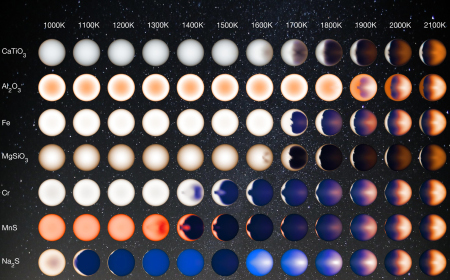
Exoplanet clouds

Cool image time! The image on the right, reduced to show here, provides an overall summary of what astronomers know about the atmospheres of many gas giant exoplanets that also orbit very close to their suns and are tidally locked. The view is of the planet hemisphere facing away from the star, which is also where most of the clouds are thought to be. These results come from Kepler data combined with computer modeling, and show what scientists thinks happens with different cloud compositions at different temperatures.

Link fixed!

2 comments

100 Kepler exoplanet candidates confirmed

Worlds without end: Astronomers have confirmed another 100 of Kepler’s more than 3,000 candidate exoplanets.

One of the most interesting set of planets discovered in this study is a system of four potentially rocky planets, between 20 and 50 percent larger than Earth, orbiting a star less than half the size and with less light output than the Sun. Their orbital periods range from five-and-a-half to 24 days, and two of them may experience radiation levels from their star comparable to those on Earth.

Despite their tight orbits—closer than Mercury’s orbit around the sun—the possibility that life could arise on a planet around such a star cannot be ruled out, according to Crossfield.

Because the host star of this as well as many of these other confirmed exoplanets are red dwarf stars, the possibility of life is reduced because the star and its system is likely to have a less rich mix of elements compared to our yellow G-type Sun.

0 comments
1 2 3 5