Mangalyaan passes three years in Mars orbit

India’s Mangalyaan orbiter has passed its third anniversary operating in Mars orbit.

The spacecraft could last as long as five more years before running out of fuel. Though it has five instruments and has taken more than 700 images, its importance so far is not in the science it has done but in what it has taught Indian engineers for running future more sophisticated missions.

1 comment

Curiosity tops Vera Rubin Ridge

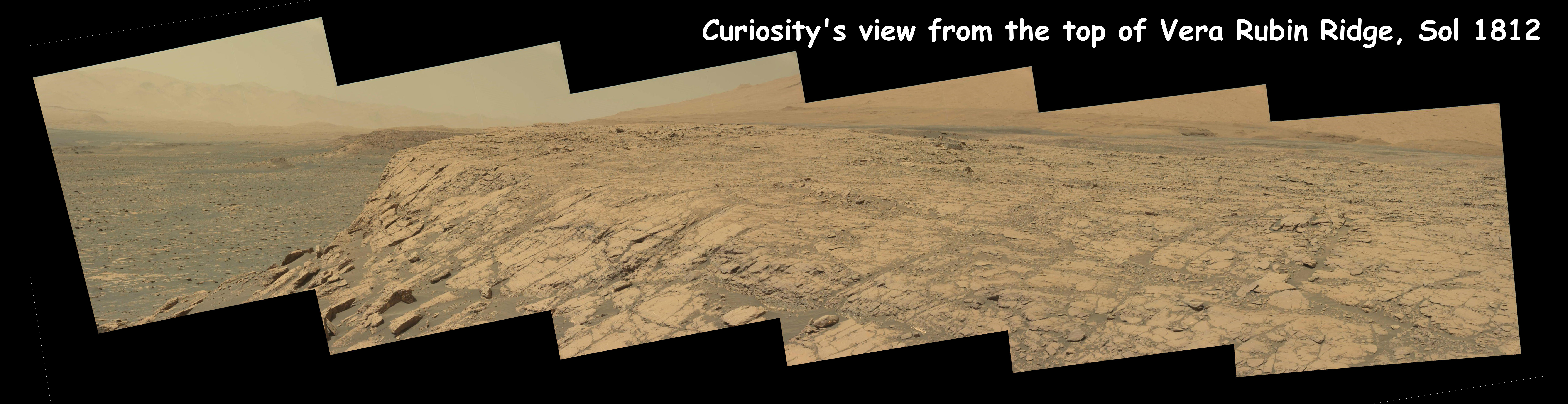
Curiosity's view from on top of Vera Rubin Ridge, sol 1812

The image above is a reduced resolution version of a panorama created by reader Phil Veerkamp of images downloaded today from Curiosity. If you click on the image you can see the full resolution image. It looks to more to the east than the panorama shown in my September 6 rover update, revealing more of the type of surface the rover will have to cross on its drive forward on this new geological layer called the Hematite Unit.

Curiosity has now topped Vera Rubin Ridge, but the plateau above is really not as flat as the image implies. The Hematite Unit that the rover is now traversing still climbs upward, and they will continue to gain altitude now with almost every drive.

1 comment

Mars rover update: September 6, 2017

Summary: Curiosity ascends up steepest part of Vera Rubin Ridge, getting just below the ridgetop, while Opportunity inspects its footprint in Perseverance Valley.

Curiosity

For the overall context of Curiosity’s travels, see Pinpointing Curiosity’s location in Gale Crater.

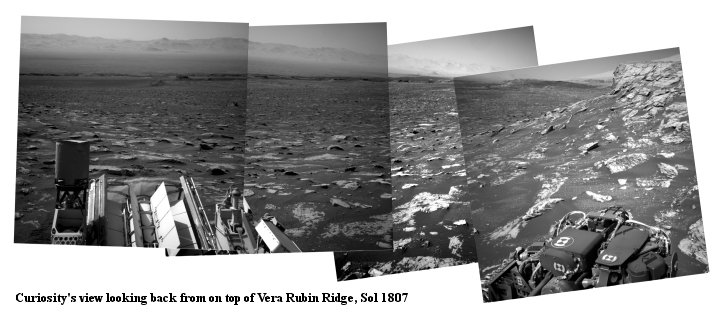
Curiosity panorama, Sol 1807

Curiosity's location, Sol 1802

Since my last update on August 11, Curiosity has been slowly working its way along the base of Vera Rubin Ridge, and up its slope. Today’s update from the science team describes how the rover is now on the steepest part of that slope, which is also just below the ridgetop. The panorama above looks east at the ridge, at the sand-duned foothills in the Murray Formation that Curiosity has been traversing since March 2016, and the crater plains beyond.

The image on the right shows Curiosity’s approximate position, with the point of view of the panorama indicated. The image also shows their planned upcoming route across the Hematite Unit. As they note in their update:

Curiosity now has great, unobstructed views across the lowlands of Gale crater to the rear of the rover. The view is improving as the air becomes clearer heading into the colder seasons. The first image link below shows a Navcam view into the distance past a cliff face just to the left of the rover. The image is tilted due to the to the unusually high 15.5 degree tilt of the rover as it climbs the ridge. Part of Mount Sharp is in the background. The second link shows an image looking ahead, where we see much more rock and less soil. The foreground shows that some of the pebbles are relatively well rounded. The rock face up ahead is smooth, which will mean easier driving.

That report I think is somewhat optimistic.
» Read more

0 comments

Mars or a bacterial cell?

Mars's southern polar regions

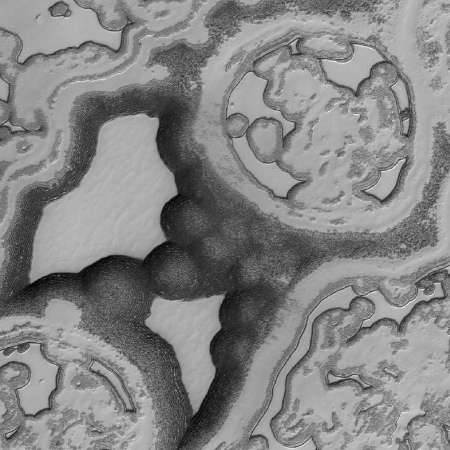
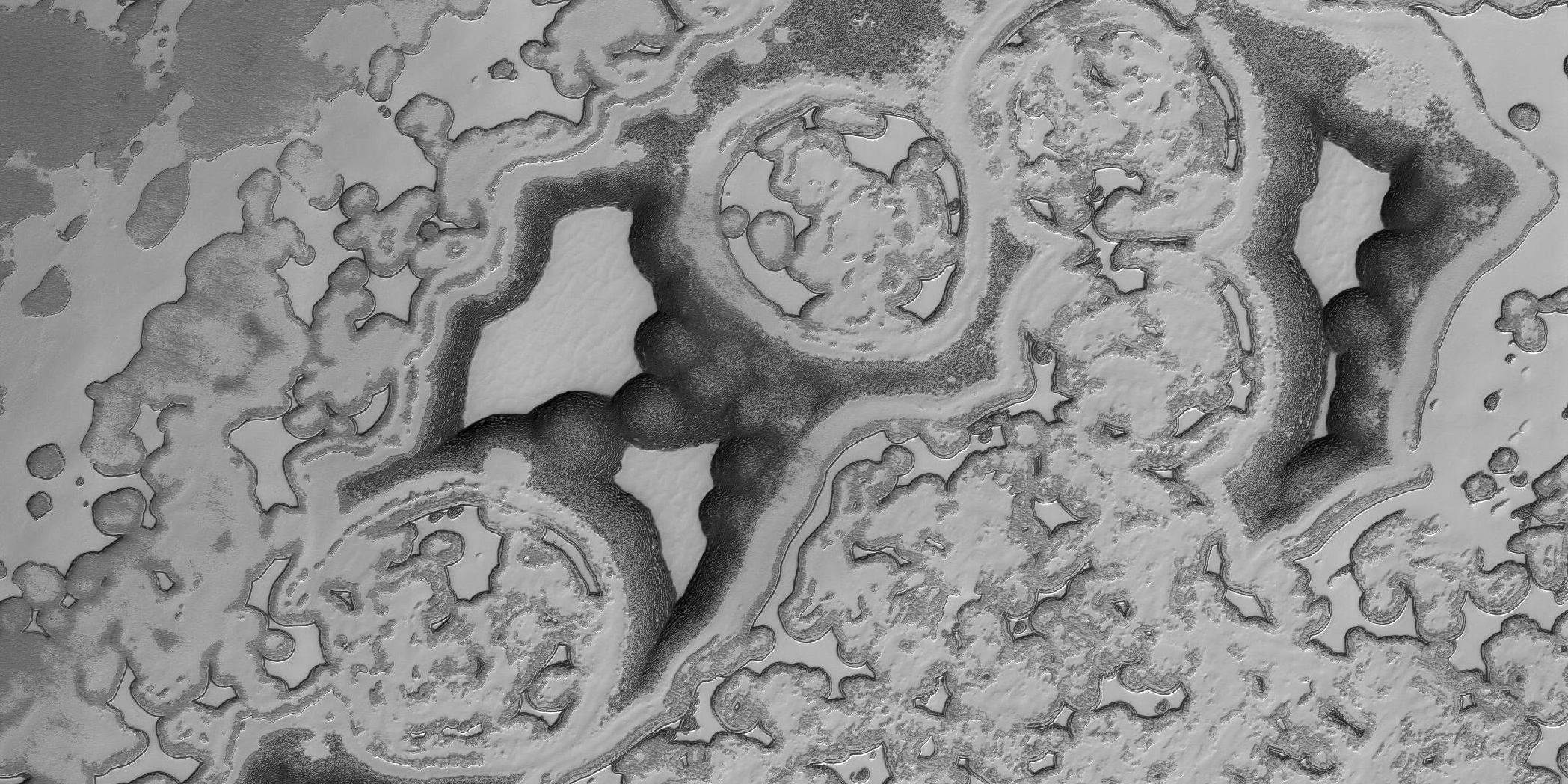
Cool image time! The image on the right, reduced and cropped to show here, was taken by Mars Reconnaissance Orbiter and shows just one spot in Mars’s southern polar regions. The surface only looks like bacteria because the basic structure of both is based on fractals. Scientists call this area “swiss-cheese terrain” because of the many holes that have opened up there.

The texture is very alien, bearing more of a resemblance to the universe of the very small, rather than the universe far, far away. But if this is a polar cap, then why does it not look like the polar caps on Earth? Indeed, there is no equivalent terrain observed here on Earth.

The so-called “Swiss cheese terrain,” referencing the numerous holes of the region, is a product of seasonal exchange between the surface and the Martian atmosphere. With a predominantly carbon dioxide content at 98 percent, the colder temperatures condense the gas out of the atmosphere to produce dry ice. The prevalence of water is more concentrated in the north, leaving the South polar region more carbon dioxide rich, and it’s this difference in composition that generates the unusual texture of the Swiss cheese terrain.

Be sure and take a look at the full resolution image. It is quite wild.

1 comment

SpaceX postpones Mars Dragon missions

Based on statements from one NASA official, it appears that SpaceX has put its plans to fly a Dragon capsule to Mars on “the back burner.”

Jim Green, head of NASA’s planetary science division, told Spaceflight Now in an interview that SpaceX has told the agency that it has “put Red Dragon back on the back burner.”

“We’re available to talk to Elon when he’s ready to talk to us … and we’re not pushing him in any way,” Green said. “It’s really up to him. Through the Space Act Agreement, we’d agreed to navigate to Mars, get him to the top of the atmosphere, and then it was up to him to land. That’s a pretty good deal, I think.”

It is my impression that, because NASA has forced SpaceX to give up on propulsive landing of its Dragon manned capsules, the company cannot afford to invest the time and money on it themselves, and thus do not have a method yet for landing a Dragon on Mars. Thus, they must postpone this program.

6 comments

Water ice found near Martian equator

A review of old Mars Odyssey data has revealed the presence on Mars of water ice near the planet’s equator.

The article makes a big deal about the importance of this discovery for the possibility of past or even present life on Mars. I say that its real importance relates to future colonists, and cannot be understated.

I should add one caveat: The resolution of the data is not great, 290 kilometers, which leaves a lot of room for error.

1 comment

Mars rover update: August 11, 2017

Summary: After a two week hiatus because the Sun was between the Earth and Mars and blocking communications, both rovers are once again on the move.

Curiosity

For the overall context of Curiosity’s travels, see Pinpointing Curiosity’s location in Gale Crater.

Curiosity panorama, Sol 1782

Vera Rubin Ridge close-up

Since my last update on July 12,, Curiosity spent most of the month waiting out the solar conjunction that placed the Sun between the Earth and Mars and blocked communications. In the past few days, however, the rover has begun to send down images again while resuming its journey up Mt. Sharp. The panorama above, reduced to show here, was taken by the rover’s left navigation camera, and shows the mountain, the ridge, and the route the rover will take to circle around the steepest sections to get up onto the ridge. To see the full resolution panorama click on the picture.

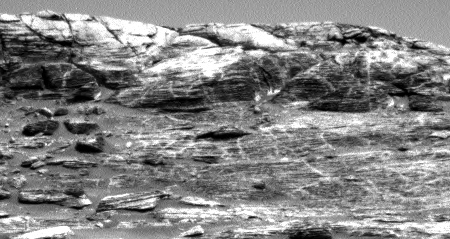
To the right is a full resolution section of the area in the white box. As you can see, the geology of the ridge is many-layered, with numerous vertical seams or cracks. In order to track the geological changes across these layers as the rover climbs, the science team is as expected taking a systematic approach.

Lately, one of our biggest science objectives is to conduct bedrock APXS measurements with every 5-meter climb in elevation. This allows us to systematically analyze geochemical changes in the Murray formation as we continue to climb Mount Sharp. Yesterday’s drive brought us 6 meters higher in elevation, so another touch and go for today it is!

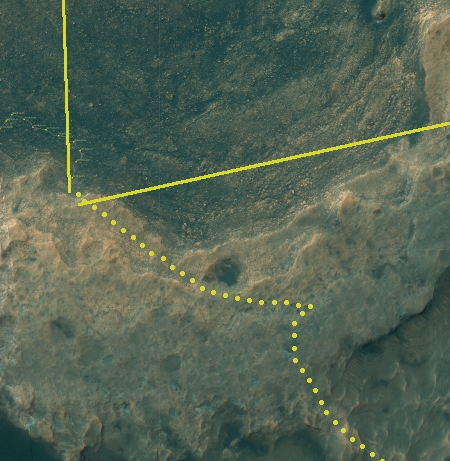
Below is a cropped and reduced resolution image of the most recent orbital traverse image, dated sol 1754. The dotted line shows where I think the rover’s has traveled in the last 28 sols. I have also annotated what I think is the point of view of the panorama above.
» Read more

3 comments

A Martian Journey

The exploration of the solar system has barely begun. Though we regularly get to see some spectacular images taken by the fleet of unmanned planetary probes that now circle or rove the various planets throughout the solar system, we mustn’t think we have seen very much. In truth, we have only gotten a very distant glimpse of only a few tiny spots, most of which have been viewed from very far away. Even at the highest resolution the images do not really tell us what it really will be like when we can stroll across those surfaces routinely.

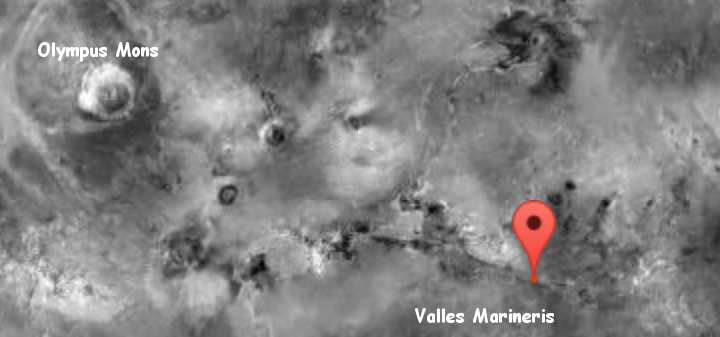
To give you an idea of how much remains hidden, let’s take a journey inward from Mars orbit. The image below looks down on a good portion of the Martian globe, with the giant volcano Olympus Mons on the left, its three companion volcanoes in line to the east, and the vast valley of Valles Marineris east of these. This valley would cover the continental United States almost entirely, and extend significantly beyond into the oceans on either side.

Olympus Mons and Valles Marineris

This was essentially our first good look at Mars, taken from orbit by Mariner 9 in 1971.
» Read more

2 comments

New images downloaded from Curiosity for the first time in two weeks

For the first time since communications with Mars ceased two weeks ago because the orbits of the Earth and Mars had placed the Sun in between, new images have been downloaded from Curiosity.

For the past two weeks, the last raw images posted had been from sol 1760. Today, the Hazard Avoidance Cameras (Hazcams) added daily images through sol 1774 (taken as per previously uploaded commands). The images all show the same view, the part of Vera Rubin ridge that the rover has been circling around to get to the place where it will be easier to climb up. The science team probably programmed this sequence so that they could look for any changes from wind, over time.

No new images from either Curiosity’s other cameras or from Opportunity have yet appeared, but I expect this to soon change.

0 comments

Opportunity enters Perseverance Valley

Opportunity in Perseverance Valley

Just prior to the drop in communications this week because of the Sun’s position between the Earth and Mars, Opportunity was ordered down into Perseverance Valley, where it will sit until the return of full communications.

Opportunity entered Perseverance Valley on the west rim of Endeavour crater. The rover is positioned within the valley where she will spend the solar conjunction period.

Solar conjunction is when the Sun comes between Earth and Mars, which occurs about once every 26 months. During this time, there will be diminished communications to Opportunity. More on solar conjunction here: https://mars.jpl.nasa.gov/allaboutmars/nightsky/solar-conjunction/

Two weeks of commanding have been uploaded to the rover to keep her active during solar conjunction with short communications with the Mars orbiters during the period.

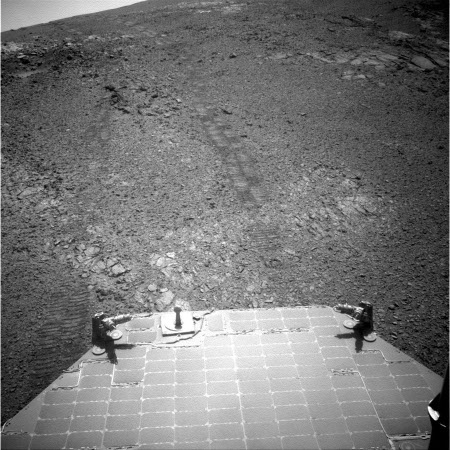
The image on the right, reduced to show here, was taken by the rover’s navigation camera looking back uphill at the crater’s crest and the rover’s tracks in the valley. For the scientists the tracks are important because they reveal what the surface of the valley is like, which will help them determine whether it was formed from flowing water, flowing ice, or wind.

Even more significant, this initial drive into the valley means the science team has decided that either the wheel issues in June were not serious enough to prevent them from making this downhill trip, or the science is important enough that they are willing to risk the rover to get that science.

2 comments

Opportunity takes panorama at top of Perseverance Valley

On top of Perseverance Valley

During Opportunity’s two week pause in its travels in June as engineers tried to diagnose a problem with its left-front wheel, it took a wide panorama of the surrounding terrain, including the top of Perseverance Valley, released today.

The full panorama, shown above in reduced resolution, is a bit confusing. The head of Perseverance Valley to the northeast is on the right. The view straight ahead looks west, away from the crater. The hill and raising terrain on the left is the crater rim to the south of Perseverance Valley. The panorama is not a complete 360 degree view, as it does not include a direct view to the east and into Endeavour Crater itself.

Be sure and click on the link and look at the full image. The top of the valley is really interesting to view. Was it formed by wind or water or water ice? They hope to find out.

0 comments

Hubble shoots movie of Phobos

Phobos over Mars

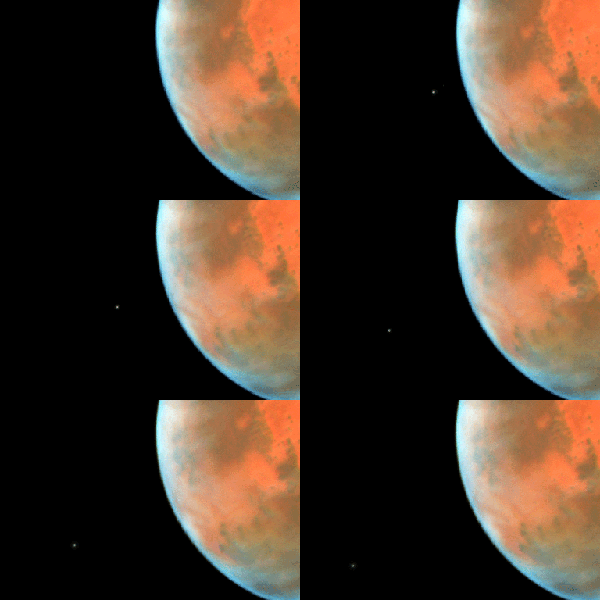
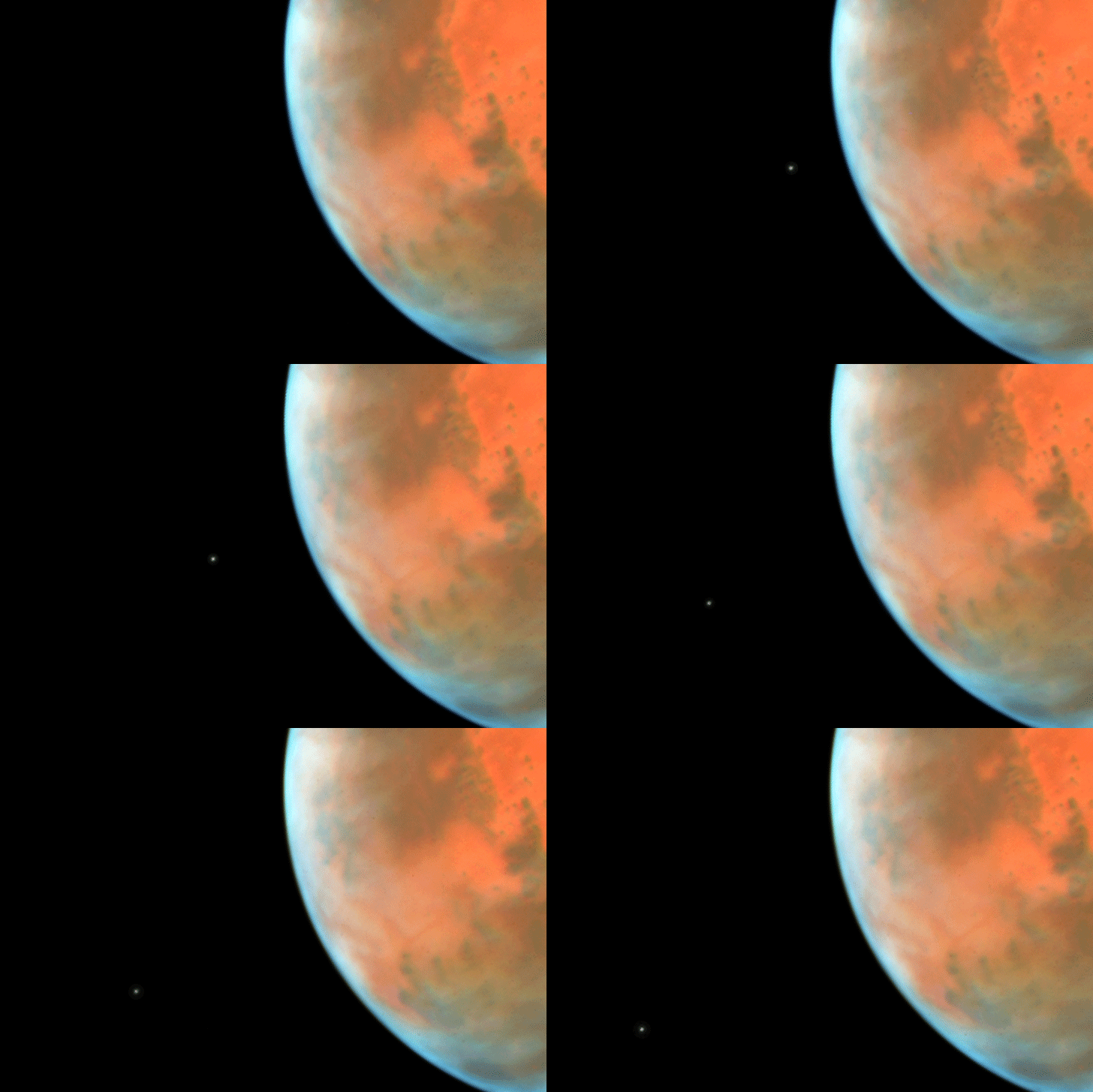
Cool image time! By taking a quick series of thirteen images, the Hubble Space Telescope was able to shoot a short movie of the rotation of Phobos above the surface of Mars. The gif animation on the right is the smaller of the two animations released today. Be sure and view the full resolution version.

What is even cooler is that movie was apparently unplanned. From the link:

Over the course of 22 minutes, Hubble took 13 separate exposures, allowing astronomers to create a time-lapse video showing the diminutive moon’s orbital path. The Hubble observations were intended to photograph Mars, and the moon’s cameo appearance was a bonus.

In terms of science this movie has a somewhat limited value. In terms of space engineering it is triumph, and once again illustrates the unprecedented value of having an optical telescope in space. Woe to us all when Hubble finally dies, as we have no plans to replace it.

6 comments
1 159 160 161 162 163 212