Curiosity’s last dune investigation

As Curiosity moves closer to the very base of Mount Sharp, it is presently making its last investigation of the various types of dunes found at the foot of the mountain.

From early February to early April, the rover examined four sites near a linear dune for comparison with what it found in late 2015 and early 2016 during its investigation of crescent-shaped dunes. This two-phase campaign is the first close-up study of active dunes anywhere other than Earth.

Among the questions this Martian dune campaign is addressing is how winds shape dunes that are relatively close together, on the same side of the same mountain, into different patterns. Others include whether Martian winds sort grains of sand in ways that affect the distribution of mineral compositions, which would have implications for studies of Martian sandstones. “At these linear dunes, the wind regime is more complicated than at the crescent dunes we studied earlier,” said Mathieu Lapotre of Caltech, in Pasadena, California, who helped lead the Curiosity science team’s planning for the dune campaign. “There seems to be more contribution from the wind coming down the slope of the mountain here compared with the crescent dunes farther north.”

The article also included a vague update on the status of Curiosity’s drill, out of commission since its drill feed mechanism had problems moving the drill up and down back in the fall of 2016.

Engineers are assessing how the use of vibration to deliver samples may affect the drill feed mechanism, which is used to move the drill bit forward and backwards. In addition, high winds at the linear-dunes location were complicating the process of pouring sample material into the entry ports for the laboratory instruments.

“A balky brake appears to be affecting drill feed mechanism performance,” said Curiosity Deputy Project Manager Steven Lee, of NASA’s Jet Propulsion Laboratory, Pasadena, California. “In some cases, vibration has been observed to change feed effectiveness, so we’re proceeding cautiously until we better understand the behavior. In the meantime, the engineering team is developing several methods to improve feed reliability.”

What this release does not say is whether they are any closer to solving the problem, or whether the drill is essentially out of business for the reminder of Curiosity’s life. To me, the silence on this question is deafening, and strongly suggests that they have decided the drill cannot be used, for the foreseeable future.
1 comment

The soft avalanches of Mars

Krupac Crater gullies

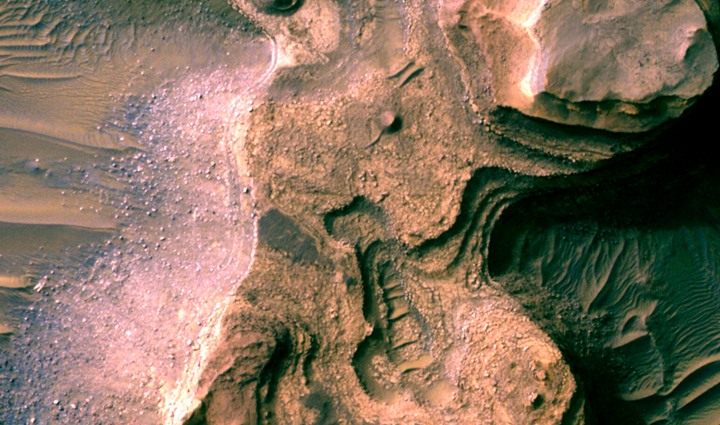
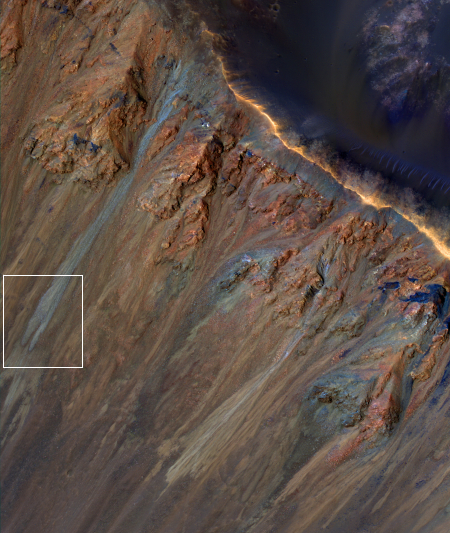
Cool image time! The image on the right, reduced in resolution to show here, shows the gullies flowing down Krupac Crater on Mars. Be sure to check out the original, released today by the Mars Reconnaissance Orbiter science team, since they have enhanced the colors to bring out the sandy flows, noting as well that while most of these gullies are found in higher latitudes, this crater at 7.8 latitude has them as well.

Although large gullies (ravines) are concentrated at higher latitudes, there are gullies on steep slopes in equatorial regions. An enhanced-color closeup shows part of the rim and inner slope of Krupac Crater located just 7.8 degrees south of the equator.

The colors of the gully deposits match the colors of the eroded source materials. Krupac is a relatively young impact crater, but exposes ancient bedrock. Krupac Crater also hosts some of the most impressive recurring slope lineae (RSL) on equatorial Mars outside of Valles Marineris.

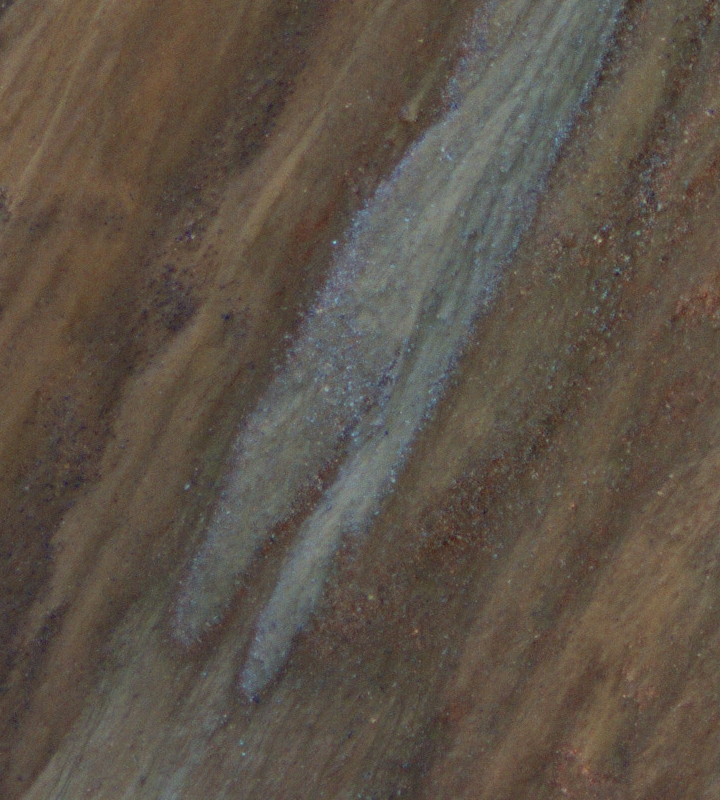
Below I have cropped out a small section showing, at full resolution, the termination point of one of these flows, indicating where this section is on the larger image to the right. This avalanche is clearly not liquid, though it has a very sandy and soft nature, suggesting — as some scientists have theorized — that liquid from below the surface might have played a part in its flow.

It is important in looking at these images to repeatedly remind yourself that the gravity here is about one third that of Earth, and thus the angle of repose will be different, and that avalanches will behave very differently in this environment. Moreover, Mars’s far colder climate will also effect things. The avalanche we are looking at could not happen in this way on Earth.

close-up of flow

10 comments

Mars rover update: April 21, 2017

Curiosity

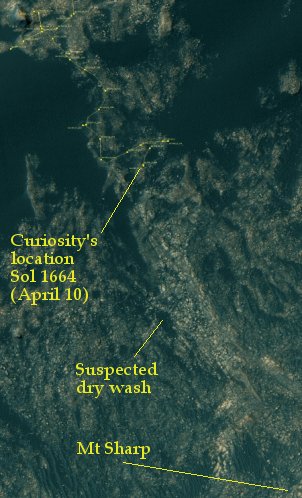
Curiosity's position, Sol 1664 (April 10, 2017)

For the overall context of Curiosity’s travels, see Pinpointing Curiosity’s location in Gale Crater.

Since my previous February 14, 2017 update, Curiosity has worked its way through the dunes and has emerged, as planned at the head of what looks like a dry wash flowing down from Mount Sharp. At the time I had predicted that the science team would then have the rover make a beeline to Mount Sharp, following the smoothest route. That prediction is almost certainly wrong. Instead, the scientists are probably going to have the rover zig-zag its way south into the dry wash so that they can study the geology there. This is what they have been doing, as shown on the traverse map to the right, which shows Curiosity’s location through Sol 1664 (April 10). Ideally I expect them to want to check out the flow areas of the central parts of the wash as well as the contact point on either side where the color of the terrain changes from dark to light. This appears to be what they doing now, two weeks later, based on this update posted yesterday.

The 23 m drive on Sol 1673 put Curiosity alongside Murray bedrock blocks that appeared to be capped with a different material, with a darker color and smoother texture relative to the Murray

» Read more

1 comment

Scientists release geological map of potential landing site for 2020 rover

Researchers have released a detailed geological map of Northeast Syrtis Major, one of the prime candidate landing sites for NASA’s next Mars rover, scheduled for launch in 2020.

Within Northeast Syrtis are the mineral signatures of four distinct types of watery and potentially habitable past environments. Those minerals had been detected by prior research, but the new map shows in detail how they are distributed within the region’s larger geological context. That helps constrain the mechanisms that may have formed them, and shows when they formed relative to each other.

The lowest and the oldest layer exposed at Northeast Syrtis has the kind of clay minerals formed when rocks interact with water that has a fairly neutral pH. Next in the sequence are rocks containing kaolinite, a mineral formed by water percolating through soil. The next layer up contains spots where the mineral olivine has been altered to carbonate—an aqueous reaction that, on Earth, is known to provide chemical energy for bacterial colonies. The upper layers contain sulfate minerals, another sign of a watery, potentially life-sustaining environment.

Understanding the relative timing of these environments is critical, Mustard says. They occurred around the transition between the Noachian and Hesperian epochs—a time of profound environmental change on Mars.

This press release is very much an effort by these scientists to influence the final landing site choice. They like this site, and they want to convince other scientists that are part of the project to agree with them.

1 comment

ESA narrows landing site choice for ExoMars 2020 to two

The European Space Agency has narrowed its choice of landing sites for its ExoMars 2020 rover mission.

Two ancient sites on Mars that hosted an abundance of water in the planet’s early history have been recommended as the final candidates for the landing site of the 2020 ExoMars rover and surface science platform: Oxia Planum and Mawrth Vallis.

A primary technical constraint is that the landing site be at a suitably low level, so that there is sufficient atmosphere to help slow the landing module’s parachute descent. Then, the 120 x 19 km landing ellipse should not contain features that could endanger the landing, the deployment of the surface platform ramps for the rover to exit, and driving of the rover. This means scrutinising the region for steep slopes, loose material and large rocks.

Oxia Planum was selected in 2015 for further detailed evaluation. Although not yet complete, the investigation so far indicates that the region would meet the various constraints.

They will spend the next year evaluating both sites, though based on the press release it sounds as if Oxia Planum is the favorite.

0 comments

More wear found on Curiosity’s wheels

Routine inspections of Curiosity’s wheels has found new damage on the rover’s left middle wheel.

None of this is unexpected. Nor is it a serious problem. They expected the wheels to wear out over time, though I must say that it seems to me that Curiosity’s wheels, in use now for about five years, do not seem to be doing as well as Opportunity’s, working on Mars for more than a dozen years. Opportunity was only supposed to last for 90 days. Curiosity was designed to last years. Yet, it seems that Curiosity’s wheels are wearing out faster than Opportunity’s.

4 comments

The layered mesas of Mars

The mesas of Uzboi Valles

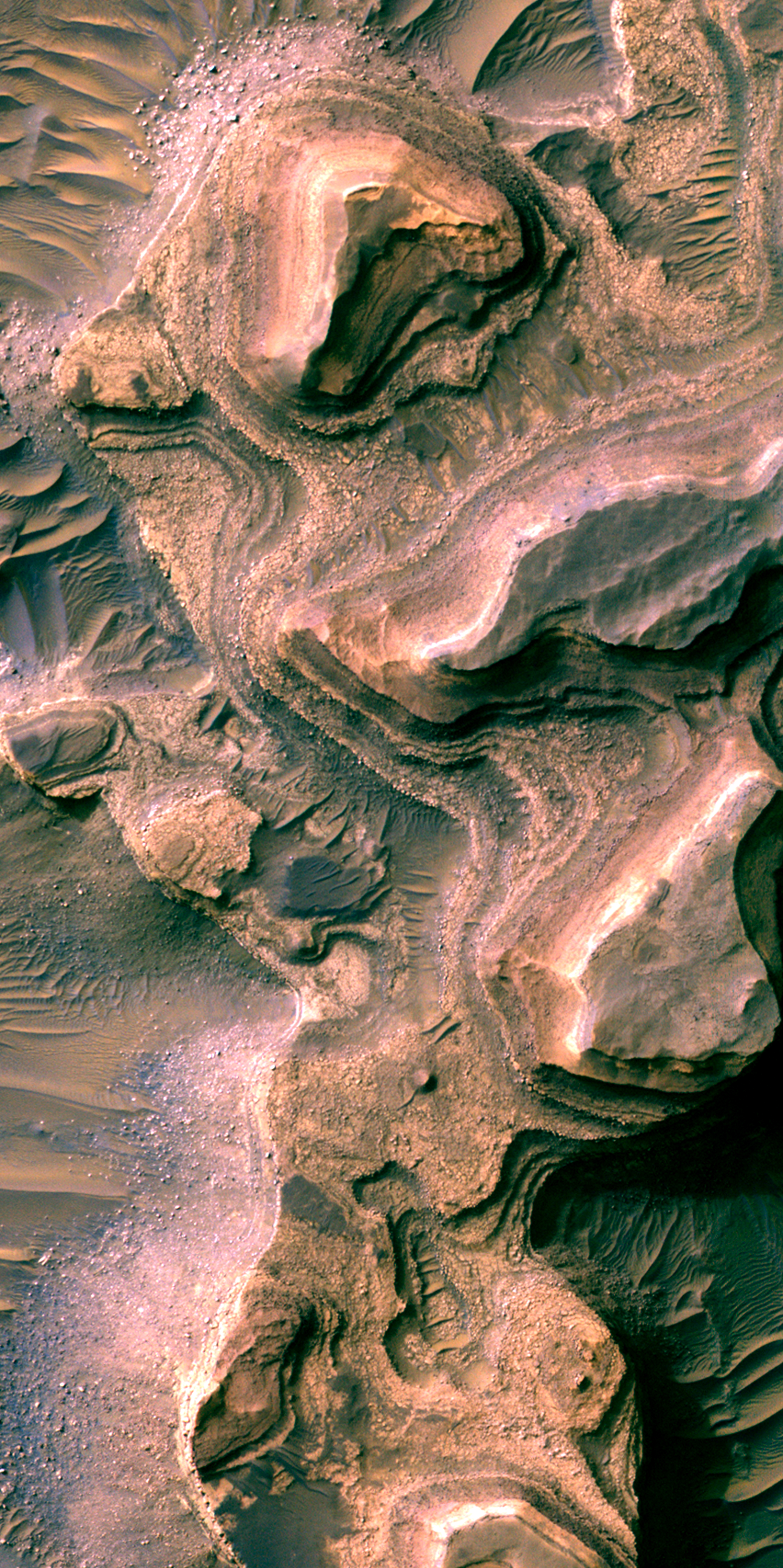
Cool image time! The image above, reduced and cropped to post here, shows the layered deposits and complex erosion that has taken place in this area of Mars dubbed Uzboi Vallis. As noted at the Mars Reconnaissance Orbiter post,

Layered deposits in Uzboi Vallis sometimes occur in alcoves along the valley and/or below where tributaries enter it. These deposits may record deposition into a large lake that once filled Uzboi Vallis when it was temporarily dammed at its northern end by the rim of Holden Crater and before it was overtopped and breached allowing water to drain back out of the valley.

It is important when looking at these erosion patterns, including the strangely shaped rippled sand dunes scattered through the larger image, that wind possibly plays an even more important part in causing erosion on Mars than liquid water might have in the far past.

Either way, the terrain here has the same stark and fascinating beauty as that seen in the American southwest. If we can ever make it possible to live on Mars, this will definitely be a place to visit when on vacation.

6 comments

At the crest

Looking north at the crest

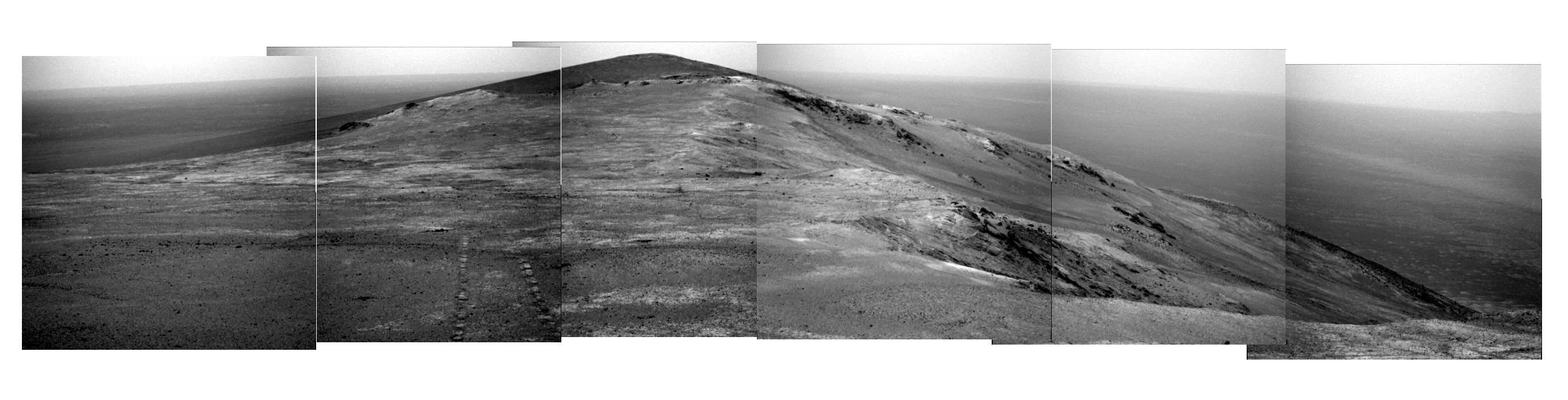
Cool images time! The image above, cropped and reduced to show here, is a panorama that I have created from the most recent images sent down from Opportunity yesterday. The rover sits on the crest of the rim of Endeavour Crater, and this panorama looks north at that crest, back in the direction where the rover has come. The rovers tracks can be seen fading away into the distance slightly to the left of the crestline..If you click on the picture you can see the full resolution image.

The crater floor is to the right, the plains that surround the crater are to the left.

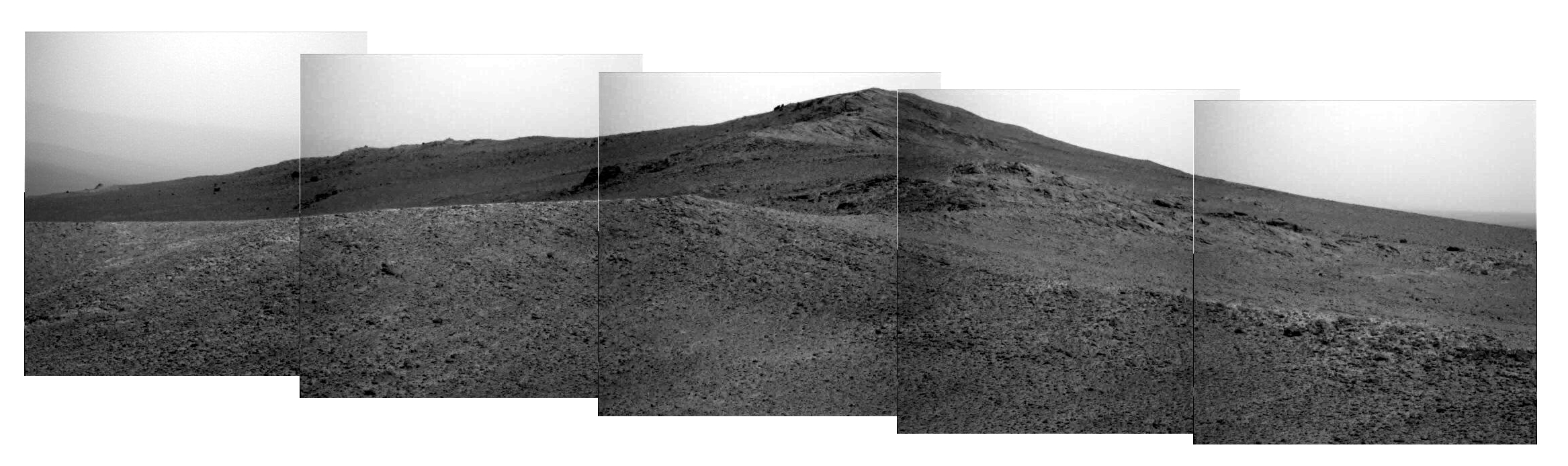
Below is another panorama, created by me from the same images sent down today, this time looking south at the crest in the direction Opportunity is heading. Once again, if you click on the picture you can see the full resolution version.

The full set of today’s images from Opportunity suggest that the science team took them to assemble a full 360 degree panorama before they begin the journey south to the gully that is just now becoming visible at the southernmost edge of the most recent overhead traverse image. To get to that gully they will now have to descend off the crest and down outside the rim of Endeavour Crater, moving to the right in the panorama below. This is therefore their last opportunity for awhile to get a good view from a high overlook.

Looking south at the crest

2 comments

Dream Chaser flight tests upcoming

The competition heats up: According to Sierra Nevada officials, drop tests and glide tests of the engineering test ship of its Dream Chaser cargo spacecraft will begin this spring.

The partially-assembled test craft arrived at the California test site, located on Edwards Air Force Base, on Jan. 25. Technicians are adding the ship’s V-shaped tail fins and other equipment before kicking off ground and flight tests in the coming months, according to Mark Sirangelo, corporate vice president of Sierra Nevada’s space systems division. “We’ll do a series of ground tests,” Sirangelo said in a recent interview. “That will include towing the vehicle down the runway, and that allows us to see how it stops and how it moves, but it also allows us to test all the sensors on the vehicle because we can get it up to a high enough speed where that will happen.”

…After the ground tests, Sirangelo said the Dream Chaser test article will perform “captive carry” tests suspended under a helicopter, using the exercises to verify the movements of the craft’s aerosurfaces and navigation instrumentation. “When that’s done, we’ll move into a series of flight tests, where it will be dropped for approach and landing like the shuttle Enterprise,” Sirangelo said, referring to the vehicle NASA used for landing demonstrations in the 1970s before the first full-up space shuttle mission.

This all sounds great, but Sierra Nevada has been promising these test flights now for more than a year. It is time they got started already.

1 comment

Bigelow advocates his space stations for lunar missions

The competition heats up: Robert Bigelow today advocated using his privately built inflatable space station modules as a tool for launching future American lunar missions.

Bigelow’s company is eager to put a space station depot in lunar orbit, from which such activities and others can be initiated, as well as support onboard research. “We do not have the technologies, and there is zero business case for Mars. We do have a business case for the moon. And that’s why the moon absolutely makes the best sense,” Bigelow said. “And we can do the lunar activities far sooner than we can with Mars, which stretches out to, NASA’s views are Mars may be in the 2040s.”

His “New Space” company, Bigelow Aerospace of Las Vegas, designs space habitats, including a fully self-contained space station with 330 cubic meters of living and working space, which he said is ready for a lower-Earth orbit or, in about three years given the expected advancements in rocketry, for lunar orbit.

The key statement above is the comparison between lunar missions and Mars missions, at this time. The Moon has the chance to be profitable in the near future. Mars does not. If you had money to invest (even if it is taxpayer dollars) which would you invest it in?

2 comments
1 161 162 163 164 165 212