Mars rover update: July 12, 2017

Summary: Curiosity looks at some big dune ripples, then creeps up hill. Opportunity tests its wheels.

Curiosity

For the overall context of Curiosity’s travels, see Pinpointing Curiosity’s location in Gale Crater.
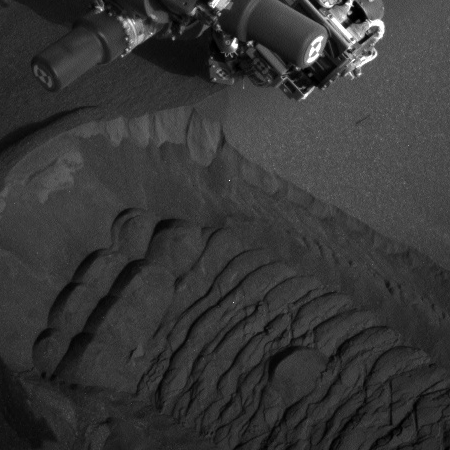
The interior of a dune ripple

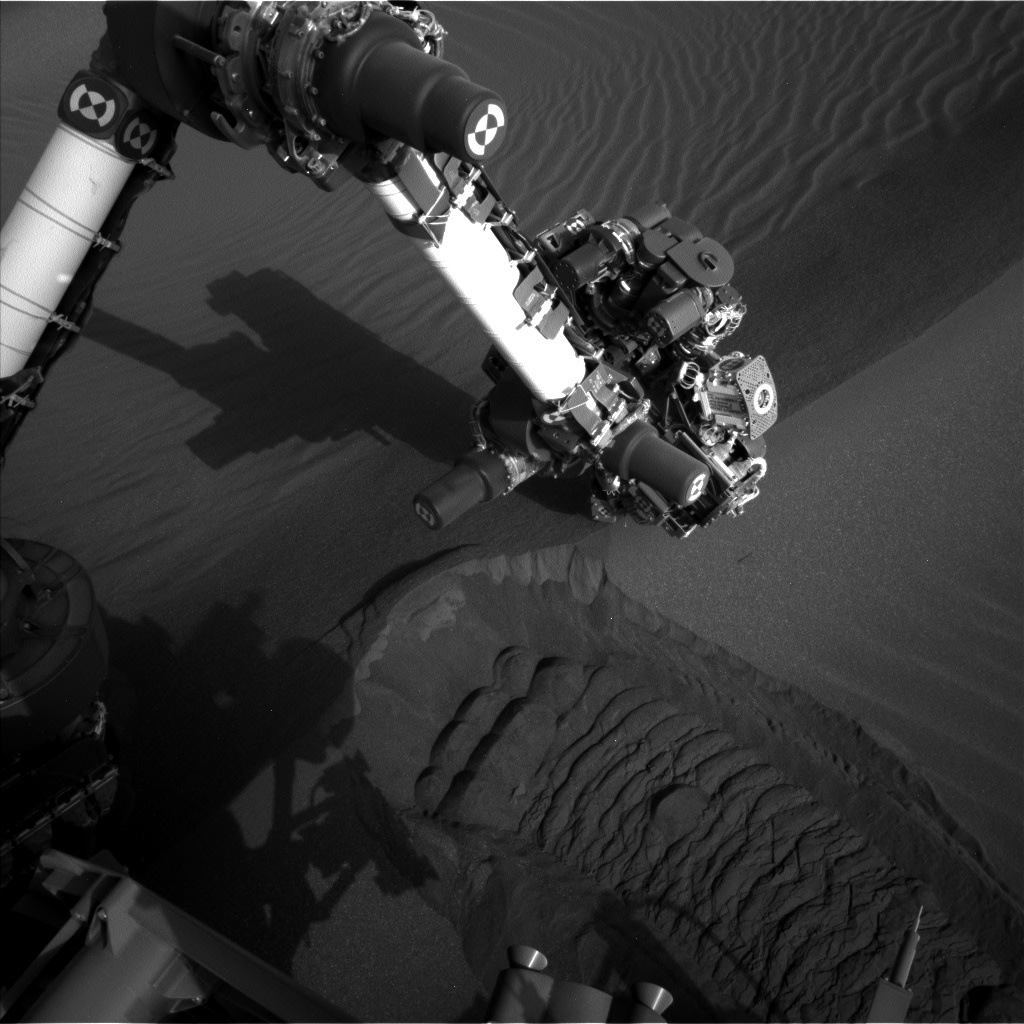
Since my last update on June 23,, Curiosity has worked its way around and, for a few days, even into the small sandy field at the base of Vera Rubin ridge. The scientists noticed that the sandy here had a series of large ripples, and they wanted to take a close look at at least one. The image on the right, cropped to show here, was taken shortly after they had the rover drive through one ripple in order to expose its interior. You can see the robot arm directly above the cut created by the rover’s wheels. On the cut’s wall several distinctly different toned layers are visible. A close look reveals that they are wavy, and probably indicate numerous and repeated overlays as the wind brushes a new layer of dust on top of old layers, time after time. The different tones indicate a change in the material’s composition, which could reveal something about some past events in either Mars’ weather or geology.

In order to decipher this information, however, they will need to be able to date the layers, and figure out when each tonal change happened. I am not sure Curiosity can do this, especially since they have not scooped up any of this dust for later analysis.

They are now approaching Vera Rubin Ridge, and should climb up onto in the coming weeks. At that point they will move off the Murray Formation, where they have been since March 2016, made up of dried and ancient crushed mud, and up onto a lighter, yellowish layer of rock, dubbed the Hematite Unit. This October 3, 2016 press release. gives a good outline of the geology of these regions.
» Read more
0 comments

Improved software uploaded to Curiosity to extend wheel life

Engineers have designed and uploaded new software to Curiosity to better protect and use the rover’s wheels as it travels over rough terrain.

The software, referred to as traction control, adjusts the speed of Curiosity’s wheels depending on the rocks it’s climbing. After 18 months of testing at NASA’s Jet Propulsion Laboratory in Pasadena, California, the software was uploaded to the rover on Mars in March. Mars Science Laboratory’s mission management approved it for use on June 8, after extensive testing at JPL and multiple tests on Mars.

The timing is important, because Curiosity is about to move into terrain that looks far rougher than the ground it has so far traversed.

1 comment

A river canyon on Mars

A river on Mars

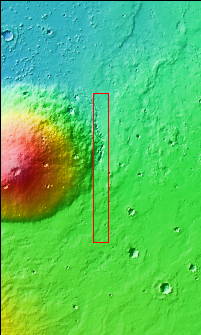
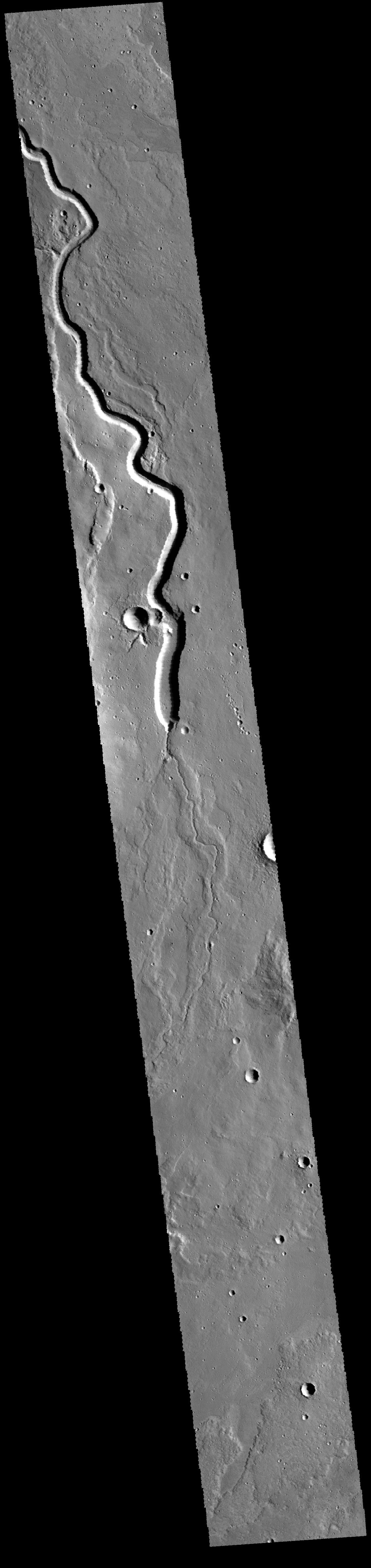
Cool image time! The image on the right, reduced in resolution significantly to show here, was taken by the Themis camera on Mars Odyssey, and shows an unnamed canyon on Mars. Be sure to click on the image to see the full resolution version.

This canyon of course no longer has anything flowing in it. Moreover, it is not clear whether this was formed by water or lava. Unfortunately, the image is part of a series of “Art images” from Mars Odyssey, where they pick an image and suggest it looks like something else. In this case, they are claiming this looks like a “snake, slithering down the image.” Cute, but not very helpful. And unfortunately, they don’t add any further details at all about the image or its location. The context image suggests this canyon is next to a volcano.

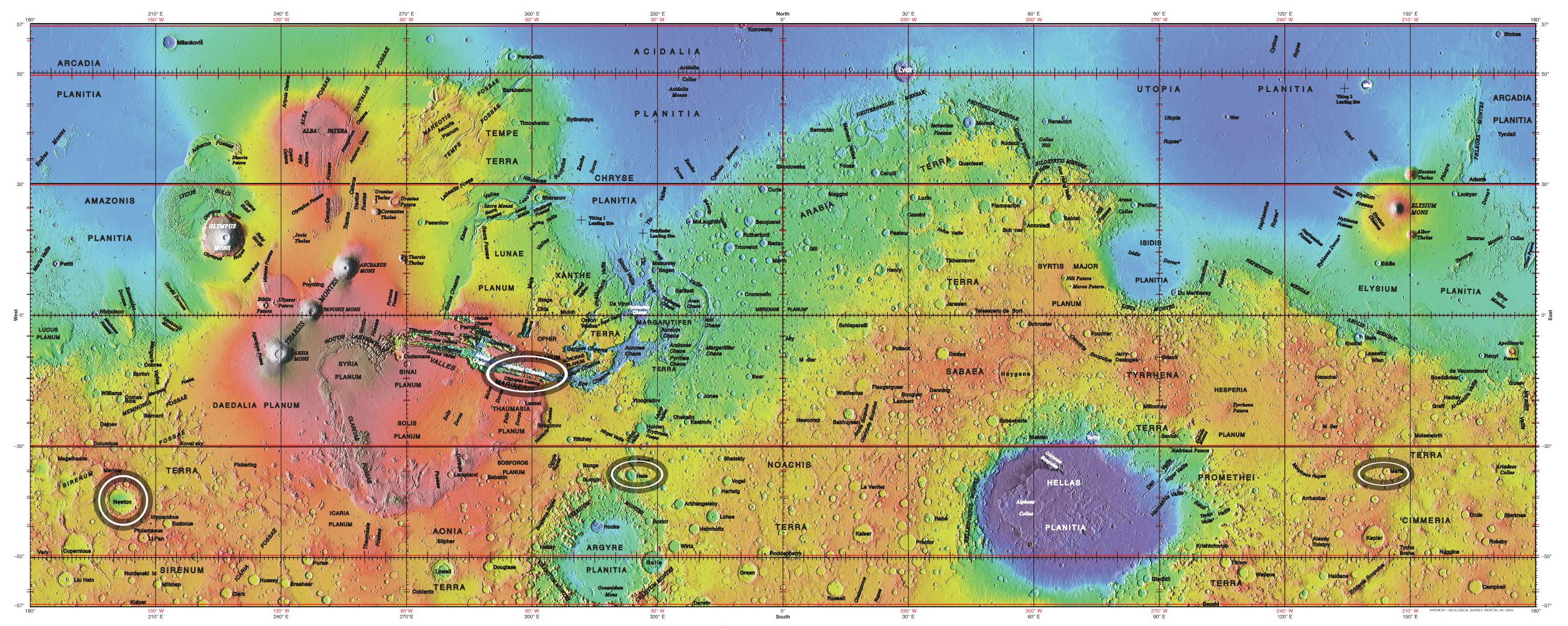
After doing further research at the Themis image site, I was able to locate this image on Mars (using latitude 32.0515 and longitude 152.236 given at the link) and look at the images surrounding this one. Further research identified the volcano as Hecates Tholus in the Elyesium Plantia region to the west of Mars’s giant volcanoes.

Looking at all the nearby Mars Odyssey images, it appears that there are a lot of flows like this in this area, and all of them appear to be lava flows, with this one being the largest. A close look at the area just to the south of where the deep canyon opens out shows that the small surface flow draining into the canyon also appears to sit on much larger surface flows (at least two) that left the surface higher than the surrounding terrain.

Elyesium Plantia itself is a plateau, somewhat close to the border between Mars’s southern highlands and the northern plains where some scientists think an ocean might have once existed. Thus, it makes sense that the canyon drains north, as it is following the dip down to those northern low plains.

1 comment

Mars rover update: June 23, 2017

Summary: Curiosity continues up hill. Opportunity has wheel problems.

Curiosity

For the overall context of Curiosity’s travels, see Pinpointing Curiosity’s location in Gale Crater.

The march up Mt Sharp continues. Since my last update on May 15, Curiosity has continued working its way up towards what the science team has named Vera Rubin Ridge, the beginning of a lighter, yellowish layer of rock, dubbed the Hematite Unit, that sits higher up the mountain’s slope. They have been traveling on the Murray Formation now for more than a year, since March, 2016, so entering this new layer of geology is eagerly anticipated by the science team. (This October 3, 2016 press release. gives an overall picture of the geology Curiosity is traversing.)

Reader Phil Veerkamp sent me a beautiful panorama he stitched together from recent Curiosity images of Vera Rubin Ridge, directly to the south of the rover and higher up hill. Below is a reduced resolution version. Be sure you click on it to explore the full resolution image. This is a new type of terrain, significantly different than anything Curiosity has seen up to now. It also appears that the rover will see far less dust, and might be traveling mostly over solid boulders. Below I have cropped out a very small section of the ridge line near the center of the full image, just to illustrate this.
» Read more

6 comments

A dust-off broom for Mars

Romanian engineers have developed a small plasma jet capable of blowing Martian dust from solar panels and other equipment that can be used by future missions.

The “plasma broom” solution developed by Ticoş and colleagues uses bursts of plasma jet produced by a simple plasma accelerator. When a large current is passed through two electrode plates separated by a field of rarefied gas, the voltage difference between the two electrodes ionizes the gas, creating the plasma. In the broom, this is done with a coaxial gun – the two metal electrodes are arranged as an inner rod within a hollow cylindrical shell. The discharge current flowing through the central rod electrode produces a magnetic field, which, together with the electric field, exerts a Lorentz force on the ionized gas that expels it. “The trick is that you need a quite high current in order to produce a reasonable magnetic field and this can be achieved more conveniently in a pulsed operation,” Ticoş explains. “For a fraction of a second (100 µs) the current is very high (several kiloamps) and the force pushing the plasma is quite strong.” During a pulse, the plasma is expelled at a very high speed – several kilometres per second – and so can simply blow dust away from an area two to four times bigger than the diameter of the jet.

An advantage of the plasma broom is that it uses low-pressure CO2 as the gas between the electrodes. This is particularly ideal for operation on Mars as the atmospheric pressure there is 150 times lower than on Earth and the atmosphere is 96% CO2. This means the gun will be able to function in “open” Martian atmosphere without the need for a pump or gas bottle. Ticoş and colleagues have also considered the energy required for the cleaner to function on Mars. This depends on the voltage the gun operates at and can vary between a few hundred to a few thousand Joules per pulse. “We did an energy budget estimate taking into account the solar irradiance on Mars,” says Ticoş, “and it appears perfectly feasible to fire a few shots even on a daily basis for cleaning the solar panels, which will boost considerably the energy production rate.”

Essentially, they are using ion engine concepts to create a can of dust-off, using the Martian atmosphere itself as the can.

Hat tip Mike Buford.

12 comments

Cumulative data from Curiosity shows Gale Crater lake stratified

The cumulative data from Curiosity since its arrival on Mars three and a half years ago shows that the lake that once filled Gale Crater lake had had a stratified chemical make-up.

Previous work had revealed the presence of a lake more than three billion years ago in Mars’ Gale Crater. This study defines the chemical conditions that existed in the lake and uses Curiosity’s powerful payload to determine that the lake was stratified. Stratified bodies of water exhibit sharp chemical or physical differences between deep water and shallow water. In Gale’s lake, the shallow water was richer in oxidants than deeper water was.

“These were very different, co-existing environments in the same lake,” said Joel Hurowitz of Stony Brook University, Stony Brook, New York, lead author of a report of the findings in the June 2 edition of the journal Science. “This type of oxidant stratification is a common feature of lakes on Earth, and now we’ve found it on Mars. The diversity of environments in this Martian lake would have provided multiple opportunities for different types of microbes to survive, including those that thrive in oxidant-rich conditions, those that thrive in oxidant-poor conditions, and those that inhabit the interface between those settings.”

While what Hurowitz says above is true, remember that this discovery provides zero evidence of past life on Mars. All it has done is teach us something about the different conditions in the lake at different depths.

0 comments

Near the Martian south pole

Near the Martian south pole

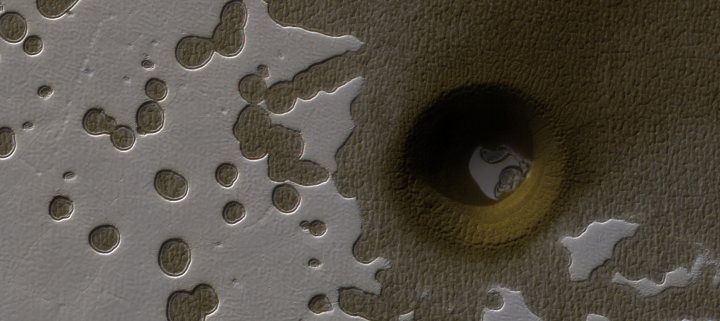
Cool image time! The image above, reduced and cropped to show here, shows an area at 87 degrees south latitude, not far from the south pole of Mars and in the region at the edge of its icecap of dry ice.

It is late summer in the Southern hemisphere, so the Sun is low in the sky and subtle topography is accentuated in orbital images.

We see many shallow pits in the bright residual cap of carbon dioxide ice (also called “Swiss cheese terrain”). There is also a deeper, circular formation that penetrates through the ice and dust. This might be an impact crater or it could be a collapse pit.

Because of the low Sun angle the bottom of the deep pit is poorly lit, making it hard to determine the pit’s nature. What can be seen at its bottom however are some patches of carbon dioxide ice, melting in the same manner as the dry ice in the surrounding terrain. Also, the dust pattern surrounding the pit indicates the prevailing winds at this location, consistently blowing to the northeast.

I am certain there will be additional photos taken of this pit, when the Sun is higher in the sky and its floor is thus better illuminated.

5 comments

Curiosity data increases time water existed Gale Crater

New research using data from Curiosity has found evidence suggesting that significant water was present in Gale Crater for a very long time.

Lighter-toned bedrock that surrounds fractures and comprises high concentrations of silica — called “halos”— has been found in Gale crater on Mars, indicating that the planet had liquid water much longer than previously believed. The new finding is reported in a new paper published today in Geophysical Research Letters, a journal of the American Geophysical Union.

“The concentration of silica is very high at the centerlines of these halos,” said Jens Frydenvang, a scientist at Los Alamos National Laboratory and the University of Copenhagen and lead author of the new study. “What we’re seeing is that silica appears to have migrated between very old sedimentary bedrock and into younger overlying rocks. The goal of NASA’s Curiosity rover mission has been to find out if Mars was ever habitable, and it has been very successful in showing that Gale crater once held a lake with water that we would even have been able to drink, but we still don’t know how long this habitable environment endured. What this finding tells us is that, even when the lake eventually evaporated, substantial amounts of groundwater were present for much longer than we previously thought—thus further expanding the window for when life might have existed on Mars.”

The actual paper provides no time frame. What it does state is that for the halos to have formed requires a lot of time, and that during that time a lot of groundwater was required.

0 comments

Mars rover update: May 15, 2017

This update could also be entitled, “Up and down into Martian gullies,” as that is what both rovers, Curiosity and Opportunity, are presently focused on doing.

Curiosity

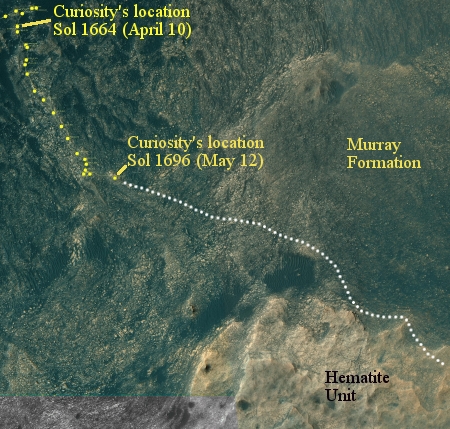
Curiosity's position, Sol 1696 (May 12, 2017)

For the overall context of Curiosity’s travels, see Pinpointing Curiosity’s location in Gale Crater.

In the past month, since my previous April 21, 2017 update, Curiosity has been working its way up the dry wash, frequently stopping to inspect the rocky surface terrain within. As they note,

As we climb up Mount Sharp, recently over slopes of 4-6 degrees, we have seen more varied outcrop structures and chemistries than the rest of the Murray formation, and such changes catch the collective eye of the team.

Only in the last week have they shifted to the east, as planned. Their near term goal is the lighter, yellowish layer of rock, dubbed the Hematite Unit, that sits higher up the slope of Mount Sharp. As they have been traveling on the Murray Formation now for more than a year, since March, 2016, I am certain the science team is even more eager to get to this different layer of geology to find out what it is made of and why it is there.

You can get an overall view of the geology Curiosity is traversing from this October 3, 2016 press release. Below is a version of the traverse map shown at that site that I posted as part of my October 6, 2016 rover update, updated to show Curiosity’s present location. It is apparent that Curiosity is finally moving out of the foothills below Mount Sharp and beginning its climb up the mountain’s actual slopes.
» Read more

5 comments

UAE reveals details on its 100 year Mars colonization plan

The United Arab Emirates (UAE) has unveiled some of the reasoning behind its plan to colonize Mars by 2117, including an overall outline of its long term approach.

“In the UAE, we live in a rough neighborhood,” Al Gergawi added. “Our neighborhood has over 100 million youth, with over 35 percent unemployment.”

This high rate of youth unemployment in the region has a well-known negative impact such as radicalisation and even terrorism, Al Gergawi explained. One of the rationales for the Mars 2117 programme, however, is to turn the circumstances of young people in the Middle East into a positive impact that engages them in meaningful goals involving education in science and technology. “This is the impact we’re betting on,” said Al Gergawi. “We want to enable the youth to play an active role in advancing the global efforts toward enhancing the Red Planet and other planetary bodies.”

…“The Mars 2117 Project is a long term project, where our first objective is to develop our educational system so our sons will be able to lead scientific research across the various sectors. The UAE became part of a global scientific drive to explore the space, and we hope to serve humanity through this project,” Abu Dhabi Crown Prince His Highness Sheikh Mohamed bin Zayed Al Nahyan added.

I wish them well. The aims and approach seem to be right, though the hill they need to climb is quite steep.

15 comments

Two Dragon Mars missions in 2020?

It appears that SpaceX is considering flying two test Dragon capsules to Mars in 2020.

NASA’s manager of science missions, Jim Green, said on Tuesday that the 2020 launch window when Earth and Mars are in favorable alignment for relatively short transits is getting crowded. Speaking Tuesday at the Humans to Mars conference in Washington, DC, Green said, “Every 26 months, the highway to Mars opens up, and that highway is going to be packed. We start out at the top of that opportunity with a SpaceX launch of Red Dragon. That will be followed at the end of that opportunity with another Red Dragon. Those have been announced by SpaceX.” NASA plans to launch a Mars lander in 2020 as well.

Two Red Dragon missions in 2020 have not yet formally been announced by SpaceX. Company spokesman John Taylor told Ars he would have to look into the question of sending two Dragons to Mars in 2020. However, other industry sources told Ars this is definitely under consideration by SpaceX, although no final decisions have been made.

That would mean two Falcon Heavy launches that year, just for this. And it would happen long before NASA manages its first launch of a complete SLS rocket.

10 comments

Europe considers a helicopter drone for future Mars missions

The European Space Agency is considering flying a technology demonstration helicopter drone on a future Mars mission.

Note that they don’t yet have the money to build this, and it appears that they don’t yet have a mission to fly it on. What they have done is just completed a preliminary study, which suggests the idea is feasible. They are now lobbying for more cash to move forward.

3 comments
1 160 161 162 163 164 212