Mars rover update: January 16, 2018

Summary: Both rovers have moved little in the past month, Opportunity because it is in a good science location and because it must save energy during the winter and Curiosity because it is in a geological location so good the scientists appear to almost be going ga-ga over it.

Curiosity
null

For the overall context of Curiosity’s travels, see Pinpointing Curiosity’s location in Gale Crater.

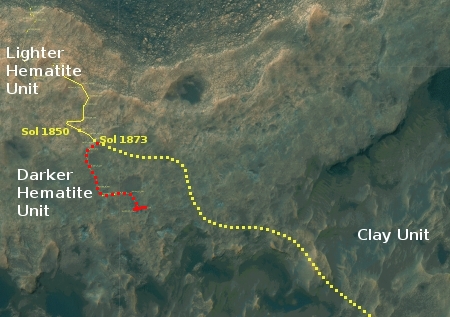
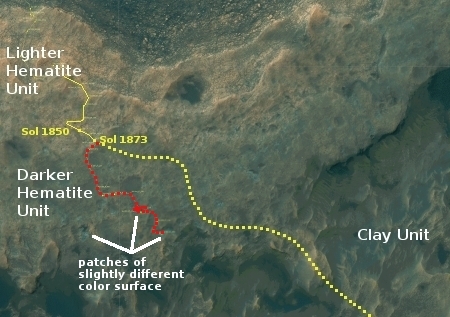
In the month since my December 18 update, Curiosity has continued to head south rather than east as originally planned (as indicated by the dotted yellow line in the traverse map to the right). Moreover, the rover has not moved very much, because the science team has decided that there is just too much significant geology in this area on Vera Rubin Ridge, also part of a geological unit they have dubbed the Hematite Unit.

Right now the rover is located at an area they call “Region e,” one of the three patches I have also indicated on the image to the right. From the second update below:

This location is a slight depression with exposed fractured bedrock that appears more “blue” from orbit than the surrounding region. In addition, the orbital evidence and observations from the ground suggest that this location is similar to “Region 10” that we visited just last week, which was shown to have some pretty spectacular small-scale features that were of particular interest to many on the science team. As a result, the team was very excited to reach “Region e” and begin our scientific investigation!

The last few updates on the Curiosity mission update page indicate the excitement the geologists have for this site:
» Read more
3 comments

The known ice cliffs on Mars

Last week there was a big NASA story about the discovery of eight locations on Mars where the evidence strongly suggests that these spots have cliff faces with exposed layers of water ice.

The press release however did not provide an overview about where those eight locations were. Only two locations were given, one for a scarp in Milankovič Crater in the northern hemisphere, and one in an area called Promethei Terra, located in the remote cratered highlands in the southern high-mid-latitudes.

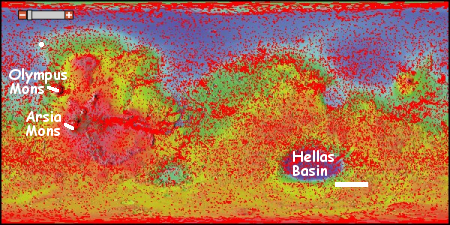
The location of known ice scarps on Mars

After much digging (and some assistance from John Batchelor) I was finally able to obtain the latitudes and longitudes of all 8 locations. All but the scarp in Milankovič Crater crater (shown by the white dot north of Olympus Mons) are located in the white rectangular box shown to the south and east of Hellas Basin, the area with Mars’ lowest elevation. This part of Mars is not well imaged with the high resolution camera on Mars Reconnaissance Orbiter (indicated by the fewer number of red squares in the image), mostly because it appears relatively boring from a distance. Nothing appears to be there for hundreds and hundreds of miles except craters, sand, and sand dunes..

The discovery of these scarps in this area however changes the picture. It suggests that cratered highlands that surround Hellas Basin, including those close to the planet’s equator, could contain similar buried layers of ice. More research is necessary to pin down more locations, especially those closer to the equator where conditions might be more hospitable for a colony.

Moreover, educated readers of Behind the Black have previously noted that because of Hellas Basin’s low elevation the air pressure there is thicker, and therefore the location has some advantages as a potential colony location. These ice scarps raise the value of Hellas Basin considerably, as they suggest that such layers could easily be exposed as you descend into Hellas Basin. If such layers are exposed on the northern flanks of the basin, they would be at latitudes of around 25 to 30 degrees south, a much more friendly latitude for settlement.

2 comments

Exposed mid-latitude ice deposits found on Mars

Scientists have discovered eight locations on Mars where underground ice appears to be exposed on cliff faces

The scarps directly expose bright glimpses into vast underground ice previously detected with spectrometers on NASA’s Mars Odyssey orbiter, with ground-penetrating radar instruments on MRO and on the European Space Agency’s Mars Express orbiter, and with observations of fresh impact craters that uncover subsurface ice. NASA sent the Phoenix lander to Mars in response to the Odyssey findings; in 2008, the Phoenix mission confirmed and analyzed the buried water ice at 68 degrees north latitude, about one-third of the way to the pole from the northernmost of the eight scarp sites.

The important thing about this discovery is that, though we have known for several years that water ice exists underground in the Martian mid-latitudes, this is the first time we have identified specific places there it is exposed and accessible.

Unfortunately, the press release does not provide the specific eight locations, except for the one image, which is located in the southern hemisphere in a region called Promethei Terra, far from areas that have been studied much more extensively. I will do some digging to see if I can identify the other seven locations.

2 comments

A spectacular collapse feature at Arsia Mons

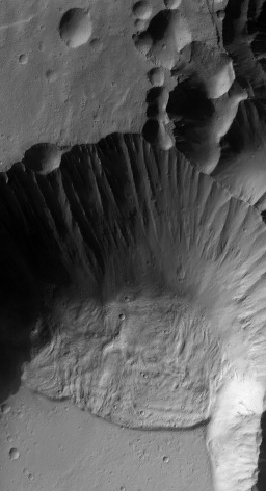
Collapse at Arsia Mons

Cool image time! This post could be called an update to my January 8th post, Exploring Arsia Mons. In that post I had compiled together the ten images of Arsia Mons, the southernmost volcano in the line of three giant volcanoes on Mars, that JPL had highlighted over several weeks in early January.

Today, I decided to do some of my own exploration of some of the many images taken of Arsia Mons by all of the Martian orbiters. My goal had been to explore the volcano’s western slopes (an area that had not been featured in the JPL releases) because that is the area where research has found evidence of past glacial activity as well as seasonal water clouds. I haven’t finished that survey, but in the process I came across a spectacular image of a collapse that had been visible in image nine of the January 8th post, but did not stand out there because of the lighting. The image on the right is that better image, cropped to focus in on the collapse itself.

The material at the base of the wall resembles piled up mud, which suggests this collapse is a Martian version of a mud slide. If so, it also suggests the presence of liquid. At the same time, the muddy look might not be from liquid but because of the lighter Martian gravity causing avalanches to be appear different there. The light gravity means material is not as dense, so when it collapses it might break apart more easily into a sandy type flow.

I am only an amateur geologist, so my theories here should not be taken very seriously. Nonetheless, I am sure there are planetary geologists who have looked at this closely because of the information about Martian geology that they can glean from it. I’d be curious to hear their thoughts.

Meanwhile, my exploration of the western slopes of Arsia Mons will continue. In Pioneer the science fiction book I wrote in the early 1980s (now available), I placed my Martian colony in Mangala Valles, a meandering canyon to the west of Olympus Mons that feeds out from the higher southern regions into the lower northern flat plains where even then some scientists thought an ocean might have once existed. My thinking then was that this might be a good location to find underground water. It now appears, with our greater knowledge, that the slopes of the volcanoes themselves might be more promising, and I am curious to find the most likely places in this region where a future colony might end up.

2 comments

Exploring Arsia Mons

Master index

In November over a period of two weeks the Mars Odyssey team posted ten images of Pavonis Mons, the smallest of the aligned three giant volcanoes just to the east of Olympus Mons, the largest known volcano in the solar system. I then made all of those images available in a single link, with some analysis.

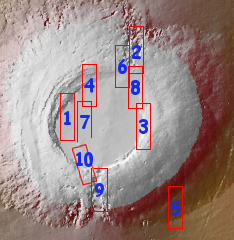
They have now done the same thing for the southernmost (and possibly the most interesting) of those three aligned volcanoes, Arsia Mons. From the first image below:

Arsia Mons is the southernmost of the Tharsis volcanoes. It is 270 miles (450km) in diameter, almost 12 miles (20km) high, and the summit caldera is 72 miles (120km) wide. For comparison, the largest volcano on Earth is Mauna Loa. From its base on the sea floor, Mauna Loa measures only 6.3 miles high and 75 miles in diameter. A large volcanic crater known as a caldera is located at the summit of all of the Tharsis volcanoes. These calderas are produced by massive volcanic explosions and collapse. The Arsia Mons summit caldera is larger than many volcanoes on Earth.

In other words, you could fit almost all of Mauna Loa entirely within the caldera of Arsia Mons.

The image on the right above is the master index, annotated by me to show the area covered by each image. The images can accessed individually below.
» Read more

0 comments

Curiosity images small tubelike rock features on Vera Rubin Ridge

tubes on Mars

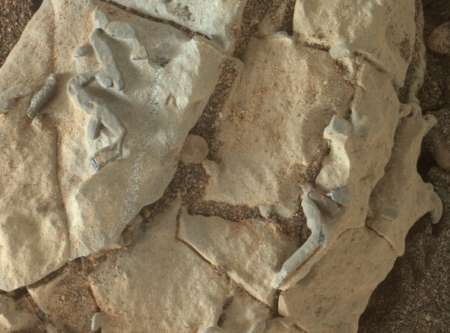
During Curiosity’s extended science observations in the past month on Vera Rubin Ridge the rover has found a number of rocks with strange tubelike features that remind some scientists of fossils. The image on the right, taken by the rover’s Mars Hand Lens Imager (MAHLI) and cropped and reduced to post here, shows some of these weird tubes.

The origin of these odd features — geological or biological processes — is in TBD limbo at the moment. Regarding trace fossils on Mars, “we don’t rule it out,” Vasavada said, “but we certainly won’t jump to that as our first interpretation.”

Close-up looks at these features show them to be angular in multiple dimensions. That could mean that they are related to crystals in the rock, perhaps “crystal molds” that are also found here on Earth, Vasavada added. Crystals in rock that are dissolved away leave crystal molds, he said.

Still, that’s just one of a few possibilities, Vasavada explained. “If we see more of them … then we begin to say that this is an important process that’s going on at Vera Rubin Ridge,” he said.

The article outlines a number of other possible explanations, including fossil remains. None are convincing at this time, based on the limited data. Nor does Curiosity have the equipment to clarify things much.

7 comments

A faint seasonal fluctuation of methane on Mars?

The uncertainty of science: Data from Curiosity during its two Martian years on Mars have revealed a faint but distinct seasonal fluctuation in the amount of methane in the local atmosphere, a fluctuation that scientists do not have a good explanation for.

Since landing in 2012, Curiosity has on 30 occasions opened a few valves to the martian night and taken a sniff of the thin, frigid air. In a small, mirrored chamber, it shines a laser through the air sample and measures the absorption at specific wavelengths that indicate methane. At the meeting, Webster reported vanishingly small background levels of the gas: 0.4 parts per billion (ppb), compared with Earth’s 1800 ppb.

Where that whiff comes from is the heart of the mystery. Microbes (including those that live in the guts of cows and sheep) are responsible for most of Earth’s methane, and Mars’s could conceivably come from microbes as well—either contemporary microbes or ancient ones, if the methane they produced was trapped underground. But methane can also be made in ways that have nothing to do with biology. Hydrothermal reactions with olivine-rich rocks underground can generate it, as can reactions driven by ultraviolet (UV) light striking the carbon-containing meteoroids and dust that constantly rain down on the planet from space.

Now, add to the methane puzzle the seasonal variation Curiosity has detected, with levels cycling between about 0.3 ppb and 0.7 ppb over more than two martian years. Some seasonality is expected in an atmosphere that is mostly carbon dioxide (CO2), says François Forget, who models the climate of Mars at the Laboratory of Dynamical Meteorology in Paris. In the southern winter, some of that CO2 freezes out onto the large southern polar cap, making the overall atmosphere thinner. That boosts the concentration of any residual methane, which doesn’t freeze, and by the end of northern summer this methane-enriched air makes its way north to Curiosity’s location, Forget says. Seasonal variations in dust storms and levels of UV light could also affect the abundance of methane, if interplanetary dust is its primary source.

But, Webster said at the meeting, the seasonal signal is some three times larger than those mechanisms could explain. Maybe the methane—whatever its source—is absorbed and released from pores in surface rocks at rates that depend on temperature, he said. Another explanation, “one that no one talks about but is in the back of everyone’s mind,” is biological activity, says Mike Mumma, a planetary scientist at Goddard Space Flight Center in Greenbelt, Maryland. “You’d expect life to be seasonal.”

They have a lot of theories, from asteroids to alien life, but none really explains this adequately.

1 comment

Mars rover update: December 18, 2017

Summary: The scientists and engineers of both Curiosity and Opportunity have route decisions to make.

Curiosity

null

For the overall context of Curiosity’s travels, see Pinpointing Curiosity’s location in Gale Crater.

Since my November 16 update, Curiosity’s travels crossing Vera Rubin Ridge, a geological bedding plain dubbed the Hematite Unit, has continued apace. They however have not been following the route that had been planned beforehand, as shown by the yellow dotted line on the right. Instead, they have headed south, along the red dotted line. For the past week or so they have been doing a variety of research tasks in the same area, analyzing samples taken months before, studying sand deposits, and taking many images of some interesting rock layers.

I also suspect that the lack of movement in the past week is partly because they need to make some route-finding decisions. The planned yellow route shown above appears to be somewhat rough in the full resolution orbital image. While I suspect they will still head in that direction, I also think they are doing some very careful analysis of this route and beyond, to make sure they will not end up in a cul de sac where the rover will not be able to continue its climb of Mount Sharp.

Opportunity

For the context of Opportunity’s recent travels along the rim of Endeavour Crater, see my May 15, 2017 rover update.
» Read more

3 comments

Faults on Mars

Faults on Mars

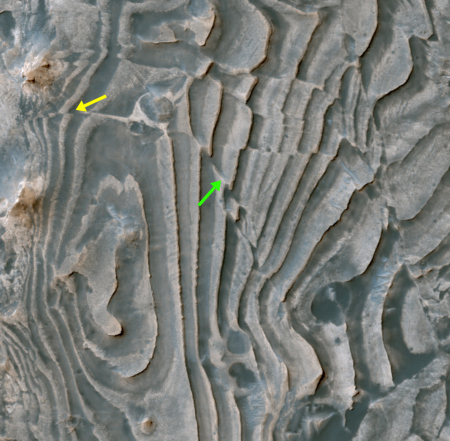
Cool image time! The Mars Reconnaissance Orbiter (MRO) image on the right, reduced in resolution to post here, captures a distinctive fault line that cuts across some layered deposits. As noted by the MRO science team,

Some of the faults produced a clean break along the layers, displacing and offsetting individual beds (yellow arrow).

Interestingly, the layers continue across the fault and appear stretched out (green arrow). These observations suggest that some of the faulting occurred while the layered deposits were still soft and could undergo deformation, whereas other faults formed later when the layers must have been solidified and produced a clean break.

Meridiani Planum

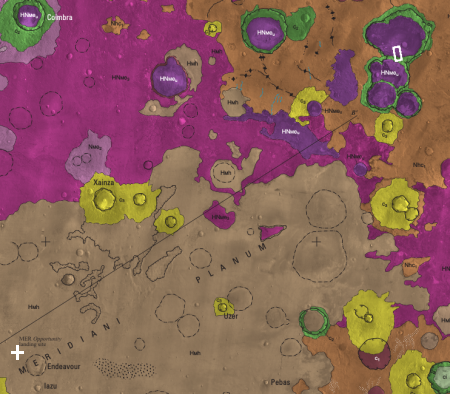
These layers are located in Meridiani Planum, a relatively flat area on the Martian equator. Opportunity landed on this plain to the southwest of this region, as shown on the geology map to the left. The white cross in the southwest corner indicates Opportunity’s landing site, with Endeavour Crater just to the southeast. The white box in the northwest shows where the faulted layered deposits are located. Based on the scale of the map, this places Opportunity approximately 400 miles away.

What exactly caused these distinct faults remains unknown. The likely cause would be a earthquake, but since Mars does not have plate tectonics like the Earth, earthquakes would have to be caused by other geological processes not yet studied.

To my eye, they look like cracks in a mirror, though this provides no real explanation other than it illustrates how cool the image is.

7 comments

Wind eating away the Martian terrain

Yardangs on Mars

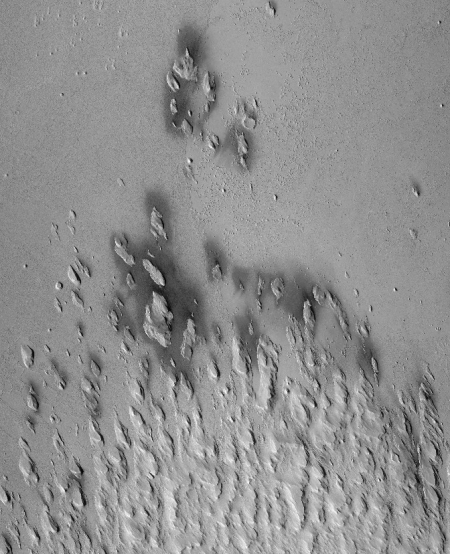
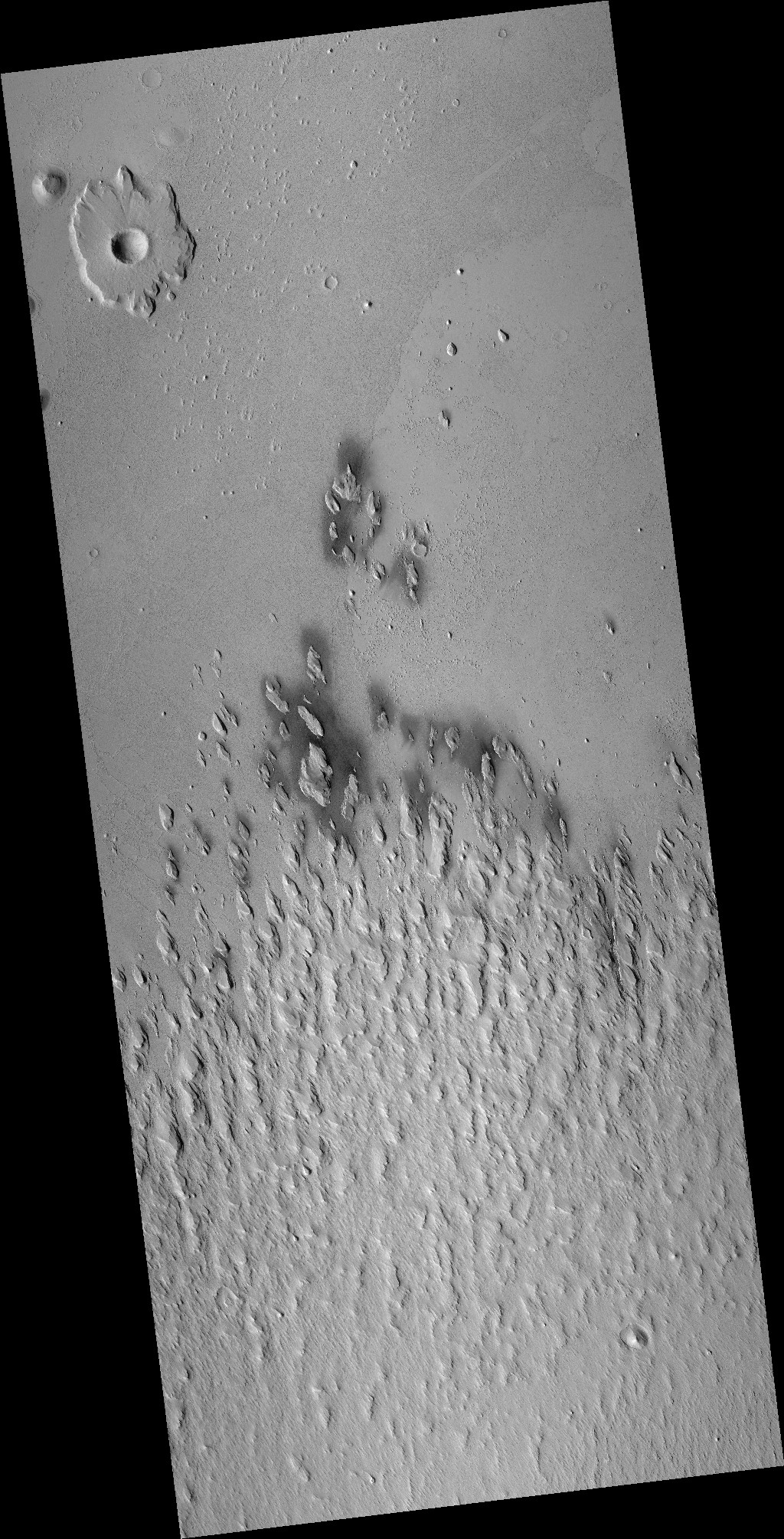
Cool image time! The Mars Reconnaissance Orbiter (MRO) image on the right, cropped and reduced in resolution to post here, shows the transition zone between the lower flat plain to the north and the higher but rougher region to the south. What makes it interesting is the north-south aligned mesas. These are yardangs, a geological feature that actually acts like a weather vane.

Yardangs are composed of sand grains that have clumped together and have become more resistant to erosion than their surrounding materials.

As the winds of Mars blow and erode away at the landscape, the more cohesive rock is left behind as a standing feature. (This Context Camera image shows several examples of yardangs that overlie the darker iron-rich material that makes up the lava plains in the southern portion of Elysium Planitia.) Resistant as they may be, the yardangs are not permanent, and will eventually be eroded away by the persistence of the Martian winds.

For scientists observing the Red Planet, yardangs serve as a useful indicator of regional prevailing wind direction. The sandy structures are slowly eroded down and carved into elongated shapes that point in the downwind direction, like giant weathervanes. In this instance, the yardangs are all aligned, pointing towards north-northwest. This shows that the winds in this area generally gust in that direction.

Crater splash

The wind comes from the southeast and blows to the northwest, and is slowly wearing down the southern rougher terrain. Why some of these yardangs are surrounded by dark material remains a mystery, as noted I noted in a previous post.

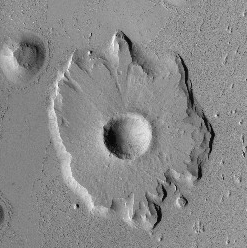
Meanwhile, the northern plain is not as boring as it seems. Only a short distance to the north is an unusual crater, cropped from the full image to show here on the right. To my eye, when this impact occurred it literally caused a splashlike feature of compressed and more resistant material. Over time, the prevailing wind has eroded away the surrounding less resistant regolith to better reveal that splash, leaving behind a mesa with a crater in its center.

Why the impact created this splash tells us something about the density and make-up of the plain. It suggests to me a surface that was once muddy and soft that over time has hardened like sandstone.

0 comments

Worms on Mars!

Scientists growing plants on Earth using a simulated Martian soil have found that earthworms like it.

These slimy invertebrates play a key role in making Earth soil healthy by digesting dead organic matter and excreting a potent fertilizer that helps release nutrients like nitrogen and phosphorus. Their constant burrowing also helps lighten up the soil, allowing air and water to seep through better.

That’s an important improvement for the simulated Mars soil, which water struggled to soak through in previous tests. Altogether, the tests showed that the combination of worms and pig slurry helped the plants grow in Martin soil, and the worms not only thrived but reproduced. “Clearly the manure stimulated growth, especially in the Mars soil simulant, and we saw that the worms were active,” says Wamelink. “However, the best surprise came at the end of the experiment when we found two young worms in the Mars soil simulant.”

Obviously, we do not know yet how the worms would respond to the lower Martian gravity, but it sure would be a significant experiment to see them reproduce there.

15 comments

A spot on Mars, as seen by different orbiters over the past half century

Mars as seen over the past half century

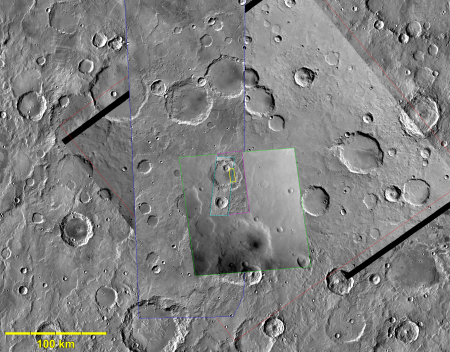
The science team of Mars Reconnaissance Orbiter (MRO) have assembled a collection of images of the same location on Mars that were taken by different Martian orbiters, beginning with the first fly-by by Mariner 4 in 1965 and ending with MRO’s HiRise camera. The image on the right, reduced in resolution to post here, shows these images superimposed on that location, with resolutions ranging from 1.25 kilometers per pixel (Mariner 4) down to 50 meters per pixel (MRO).

This mosaic essentially captures the technological history of the first half century of space exploration in a single image. Mariner 4 was only able to take 22 fuzzy pictures during its fly-by. Today’s orbiters take thousands and thousands, with resolutions so sharp they can often identify small rocks and boulders.

The mosaic also illustrates well the uncertainty of science. When Mariner 4 took the first pictures some scientists thought that there might be artificially built canals on Mars. Instead, the probe showed a dead cratered world much like the Moon. Later images proved that conclusion to be wrong as well, with today’s images showing Mars to be a very complex and active world, with a geological history both baffling and dynamic. Even now, after a half century of improved observations, we still are unsure whether life there once existed, or even if exists today.

1 comment
1 157 158 159 160 161 212