The winds of Mars

New data from Curiosity has confirmed that the winds of Mars have been the primary force shaping the red planet’s landscape for billions of years.

The new data suggests that Mount Sharp once filled Gale Crater, and it was the winds that eroded it away to create the impression that it is the crater’s central peak. Instead it appears that it is the crater’s original floor!

Below the fold is the video from the link showing a number of dust devils imaged by Curiosity.

This link provides a gif animation showing the surprisingly significant changes to the ripples in the sand dunes directly below Curiosity that take place in only one day. The changes are astonishing, and show that even though Mars’ atmosphere is far thinner than Earth’s, it is capable of moving things quickly across the Martian surface.
» Read more

0 comments

SpaceX delays first Dragon Mars mission to 2020

SpaceX has decided to delay its first Dragon flight to Mars from 2018 to 2020 so as to focus on more immediate priorities.

Instead of aiming for the 2018 deadline, SpaceX will now try to launch a robotic mission to Mars — known as its Red Dragon mission — two years later, in 2020, SpaceX president Gwynne Shotwell said during a press conference Friday.

This delay will allow the company to refocus on other more, earthly ambitions in the near term before setting its sights on Mars down the road. “We were focused on 2018, but we felt like we needed to put more resources and focus more heavily on our crew program and our Falcon Heavy program, so we’re looking more in the 2020 time frame for that,” Shotwell said.

They need to fly the Falcon Heavy several times first, and the delays caused by last year’s September 1 launchpad explosion, has pushed the first Falcon Heavy launch back from late in 2016 to the summer of 2017.

6 comments

UAE proposes building Martian city within a century

The competition heats up? The United Arab Emirates announced on Tuesday its plan to construct a city on Mars and have it completed by 2117, a hundred years from now.

On Tuesday, at the sidelines of the World Government Summit in Dubai, the UAE announced that it was planning to build the first city on Mars by 2117. According to CNBC, UAE engineers presented a concept city at the event about the size of Chicago for guests to explore.

In a statement, Sheikh Mohammed bin Rashid Al Maktoum, ruler of Dubai and vice president of the UAE, sounded confident about the project. “Human ambitions have no limits, and whoever looks into the scientific breakthroughs in the current century believes that human abilities can realize the most important human dream,” Maktoum said.

And despite the grandiose nature of the idea, the 100-year-plan does emphasize some practical steps. “The Mars 2117 Project is a long-term project,” Maktoum explained in the statement, adding that the first order of business would be making space travel appeal to young Emiratis, with special programs in space sciences being set up at universities in the UAE.

Maktoum is the guy that pushed to create the UAE’s space agency, and is leading its effort to fly an unmanned mission to Mars by 2020. It is very clear that his goal is to inspire his country and its youth so that they will aim high in future years. I wish him well, as this is a far better goal for an Islamic nation than sending out suicide bombers to kill innocent people.

I must add that I remain very skeptical about this particular plan. I fully expect us to finally get to Mars in the next century, but whether we will have the ability to build cities there in that time frame remains questionable.

5 comments

Mars rover update: February 14, 2017

Curiosity

Ireson Hill, Sol 1604

Dune fields

For the overall context of Curiosity’s travels, see Pinpointing Curiosity’s location in Gale Crater.

Taking a close look at rock

Since my last update in January, Curiosity done more or less what I predicted. It headed southwest through the dune area and then made a side trip to the small mesa there, dubbed Ireson Hill by the Curiosity science team and shown on the right. They then made an additional side trip past the hill to get a close look a the large sandy dune field beyond, also shown on the right. After getting some nice closeups as well as scooping up some sand for observation, they have now gone back to Ireson Hill to get another close look at the dark rocks that have rolled off the top of the hill and are now in reach at its base. The image on the left shows the arm positioned above one of those rocks.

The drill remains out of commission, with no word when they will try using it again. In addition, there had been a problem with the ChemCam laser that does spectroscopic analysis, but as of this week it is back in action, and is being used to analysis the small rock above.

Below is an overview of their route so far as well as my annotations on where I think they will be heading in the future.
» Read more

1 comment

NASA narrows to three the Mars rover landing sites in 2020

Jezero Crater

Scientists have now narrowed to three the candidate landing sites for NASA’s 2020 Mars rover mission.

The three sites include Jezero crater, which was once home to an ancient Martian lake and which could preserve the remains of microbial life, if it ever existed on Mars. “You’ve got a large river bringing water and sediment into a very large lake, comparable to Lake Tahoe,” says Timothy Goudge, a planetary scientist at the University of Texas at Austin. Jezero scored highest on a community vote of scientists attending the workshop.

Other possible targets include Northeast Syrtis, where hot waters once circulated through the crust and could have supported life, and Columbia Hills, the area explored for years by NASA’s Spirit rover.

From the Nature article above as well as this Science article, it sounds like the Columbia Hills choice is unlikely. The Science article pushes Jezero crater, which had the most votes at the workshop and is shown in the image on the right.

0 comments

An orbital change extends the life of India’s Mars orbiter

An orbital maneuver has allowed India’s Mars Orbiter Mission avoid an eight hour period with no sunlight — thus draining its batteries — so that the mission can be extended until 2020.

The on-board battery which was to take over had a life of just about 1.4 hours, while the eclipse was to last for 8 hours. The spacecraft’s future was bleak.

The scientists thought of a solution. On the night of January 17, a team of eight engineers at Indian Space Research Organisation’s Telemetry, Tracking and Command Network, Bengaluru, sent a time-delayed command to the Mars probe. The command set in motion firing of eight on-board thruster rockets. Each of them were fired for 431 seconds, pushing the Mars Orbiter Mission (MOM) space probe to a new orbit that completely avoids an eclipse up to September 2017. The shadowing in September is of a smaller duration, which the satellite’s batteries can handle. “Because of the crucial orbital change, the MOM now gets three additional years’ life. We are expecting it to transmit data till 2020,” Isro chairman A S Kiran Kumar told DH.

The mission’s science data is not as important as the experience it is giving Indian engineers in operating a planetary probe remotely from Earth. This success speaks well for the future of India’s space effort.

3 comments

New Curiosity data leaves scientists baffled about past evidence of water

The uncertainty of science: Despite substantial evidence by Curiosity that Gale Crater once had running water and even lakes, the rover has also found no evidence that the atmosphere ever had enough carbon dioxide in its atmosphere to warm the climate enough to allow that water to flow as a liquid.

Mars scientists are wrestling with a problem. Ample evidence says ancient Mars was sometimes wet, with water flowing and pooling on the planet’s surface. Yet, the ancient sun was about one-third less warm and climate modelers struggle to produce scenarios that get the surface of Mars warm enough for keeping water unfrozen.

A leading theory is to have a thicker carbon-dioxide atmosphere forming a greenhouse-gas blanket, helping to warm the surface of ancient Mars. However, according to a new analysis of data from NASA’s Mars rover Curiosity, Mars had far too little carbon dioxide about 3.5 billion years ago to provide enough greenhouse-effect warming to thaw water ice.

The same Martian bedrock in which Curiosity found sediments from an ancient lake where microbes could have thrived is the source of the evidence adding to the quandary about how such a lake could have existed. Curiosity detected no carbonate minerals in the samples of the bedrock it analyzed. The new analysis concludes that the dearth of carbonates in that bedrock means Mars’ atmosphere when the lake existed — about 3.5 billion years ago — could not have held much carbon dioxide.

Does anyone but me see the faulty scientific reasoning here? Basically, these scientists appear to be assuming that the only global warming atmospheric molecule that exists is carbon dioxide. And because Mars has little carbonates in its surface, meaning it had little past CO2 in its atmosphere, there thus no way Mars’ atmosphere could have been warmed enough to allow water to flow as a liquid.

Balderdash! On Earth, the most important global warming component in the atmosphere is water, not carbon dioxide. Moreover, there are other atmospheric components, such as methane, that are also more important than CO2 in warming the climate. In fact, carbon dioxide as a trace gas in the atmosphere plays only a tiny global warming role. On Mars it is just as likely that other atmospheric components, such as water and methane, provided the necessary warming. To assume it has to be carbon dioxide suggests to me that these scientists have become so caught up with the human-caused global warming scare here on Earth that they have lost the ability to consider other possibilities on Mars.

Nonetheless, this remains the fundamental scientific mystery of Mars. We have found enormous evidence on Mars that water once flowed on its surface. We have also found no explanation so far that would explain how that was possible.


15 comments

Strange beat-up Martian terrain

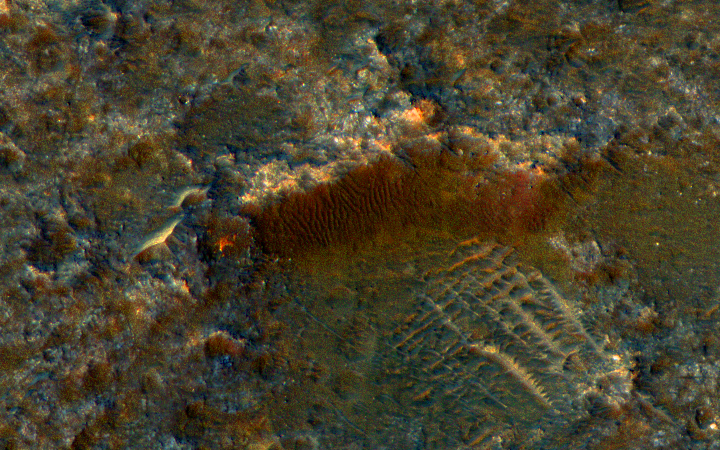
Strange terrain

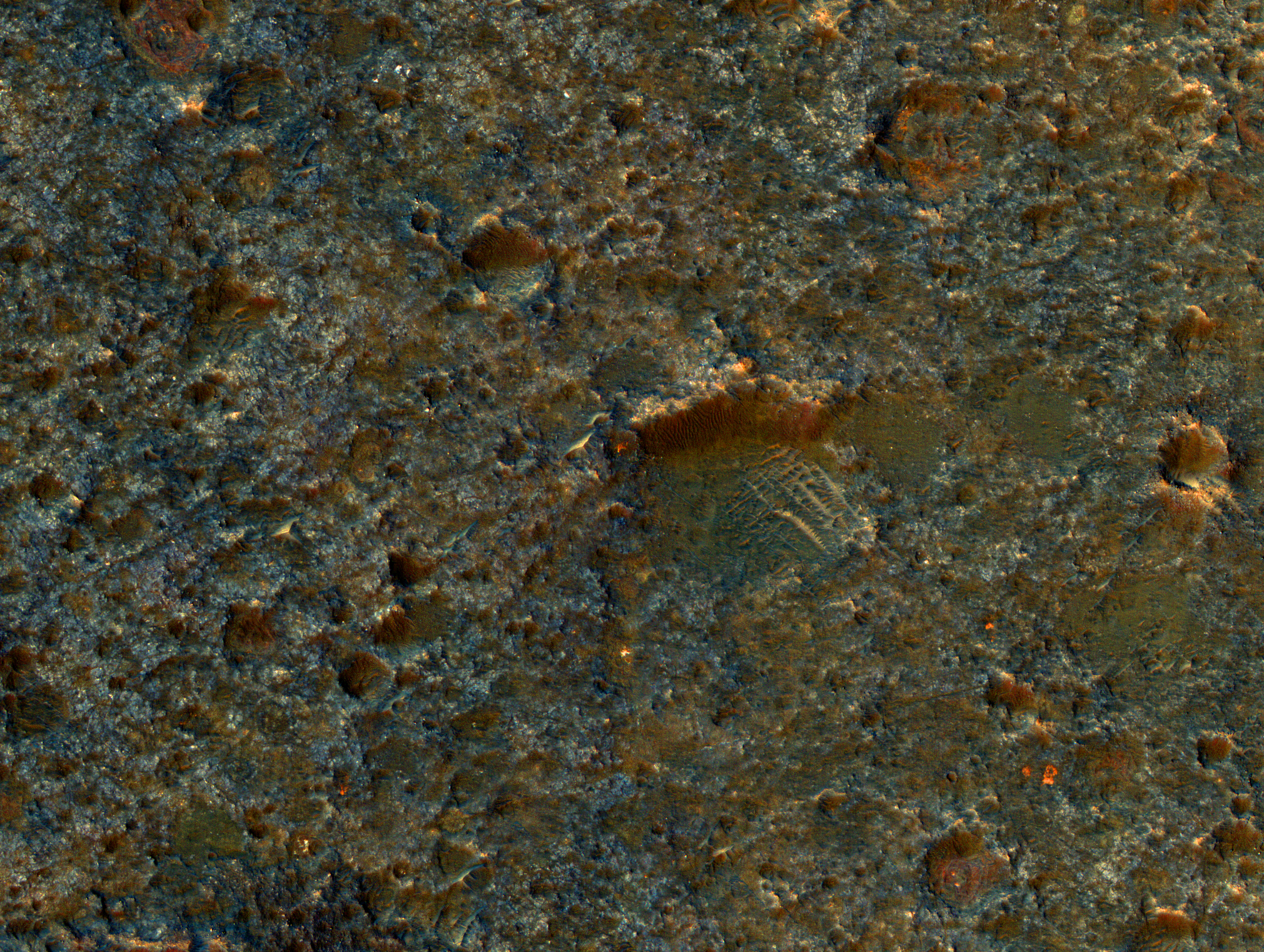
Cool image time! The image above, taken by Mars Reconnaissance Orbiter and cropped to show here, reveals some very strange terrain, pounded by numerous impacts. The full color-enhanced image, which only covers a small area of the much larger strip image, shows a rough surface that on Earth would definitely be labeled “badlands.”

The very tiny cropped section above especially intrigued me because of the pronounced cliff that appears to be the north wall of a crater in which the east, west, and south walls have eroded away. The riverlet-like flows down the cliff-face are also intriguing, as are the cross-crossing features in the crater floor.

Make sure you look at the full images. Quite strange and fascinating. Even though the complete image strip isn’t color enhanced. it is filled with many interesting geological forms. I haven’t yet been able to find the spot shown by the color-enhanced section, but it is there nonetheless. I wonder if any of my readers can locate it.

2 comments

UAE considers initiating its own manned space program

The competition heats up: At a space conference this week in Abu Dhabi, a UAE official said that his country might begin work on a manned space program.

He also said that they plan a follow-up to their Hope Mars mission, which now has a July 2020 launch date.

The UAE’s prime goal right now with their space effort is to promote the development of a new aerospace industry. Thus, I do not expect them to accomplish much in the near future. Even their Mars mission is I think mostly being built and launched by others (India is helping with the spacecraft and Japan is launching it). In the long term, however, this effort is wise, and will eventually produce for them a real industry.

2 comments

Curiosity’s drill remains out of commission

Ireson Hill

In a science update on Curiosity’s research in Gale Crater, this Science journal article today gives a good overall update on Curiosity’s technical condition.

Since early December 2016, Curiosity hasn’t been able to drill. The problem, likely a stuck brake on the mechanism for extending the drill bit, is serious. “There is apprehension,” says Ashwin Vasavada, Curiosity’s project scientist at the Jet Propulsion Laboratory in Pasadena, California. But the drill still responds intermittently. “We’re not in a situation where it’s completely dead.”

Still, the clock is ticking for the aging rover, and some outside scientists regret not having used a wet chemistry cup. Rocks have punctured its wheels, and the output of its decaying radioactive power source has dropped by 15%. Jack Mustard, a planetary scientist at Brown University, says he understands the team’s hesitancy. But he wished the “mission had moved more quickly with the wet chemistry experiments,” he says. “I am eager to see what we can learn.”

The wet chemistry cup, designed to look for organic life, is an experiment that requires use of the drill but the science team has held off doing. Now it might be too late.

At the moment Curiosity is approaching [see Sol 1598-1599] the small hill that had been to its southwest in my January 18, 2017 update and shown in the image above. I had thought they might make a side trip there on their way up Mount Sharp, and they have, with their actual route taking them around the backside of the hill.

1 comment

U.S. 2020 Mars rover faces delays

A new inspector general report has pinpointed a number of issues that could cause a delay in the 2020 launch of the next American Mars rover mission.

The biggest risk to the mission, according to NASA OIG, is the sampling system that will be used to collect and store samples of Martian rock and soil that a future mission will gather for return to Earth. That system, an essential part of the mission, has several key technologies that are less mature than planned at this phase of the mission’s development. “The immaturity of the critical technologies related to the Sampling System is concerning because, according to Mars 2020 Project managers, the Sampling System is the rover’s most complex new development component with delays likely to eat into the Project’s schedule reserve and, in the worst case scenario, could delay launch,” OIG stated.

I find it puzzling that the sampling system is an issue. This rover is essentially based on Curiosity, which has very sophisticated equipment for grabbing and even storing samples for periods of time. I don’t understand why such systems could not be quickly revised for future retrieval.

Nonetheless, there are other problems however.

Two instruments on the Mars 2020 mission have also suffered problems. One, called MOXIE, is designed to test the ability to generate oxygen on Mars, saw its estimated increase by more than 50 percent during its development. NASA has taken steps to reduce some of that cost growth by eliminating development of an engineering model and skipping further design improvements in one element of MOXIE.

Another instrument designed to study atmospheric conditions on Mars, MEDA, has suffered delays because of a “financial reorganization” by its developer, Spain’s National Institute for Aerospace Technology. OIG concluded in its report that MEDA is unlikely to be ready for delivery to NASA in April 2018, as currently scheduled. That could require adding MEDA to the rover later in the overall assembly process, or flying the mission without the instrument.

One of the reasons the Obama administration decided to make this 2020 rover mission a reboot of Curiosity was to save cost and development time. Thus, it does not speak well for NASA’s planetary program that they are having these problems.

5 comments
1 162 163 164 165 166 212