
Mars rover update: January 18, 2017

Curiosity
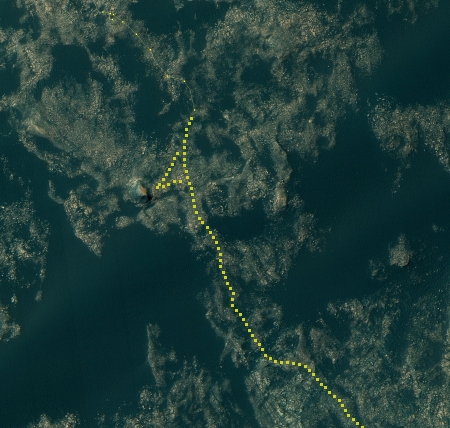
Curiosity's location, Sol 1582

For the overall context of Curiosity’s travels, see Pinpointing Curiosity’s location in Gale Crater.

In the past month, since my last rover update on December 22, 2016, Curiosity has begun moving again, carefully picking its way through the dune-filled flats in the foothills at the base of Mount Sharp. The route taken, shown on the image on the right, corresponds to the easternmost of the possible routes I noted in my November 14, 2016 update. This route is also the most direct route, which I think is smart considering that the rover’s life on Mars certainly uncertain and the higher they can climb the more geological information they will get.

I have also annotated the likely route into the near future, including a possible side trip to the base of the mesa up ahead. It appears to me that they are now a little more than halfway through the flats, with Mt. Sharp directly ahead, as shown by the panorama below, taken near the end of December. The goal is a canyon just out of view to the right of this panorama.
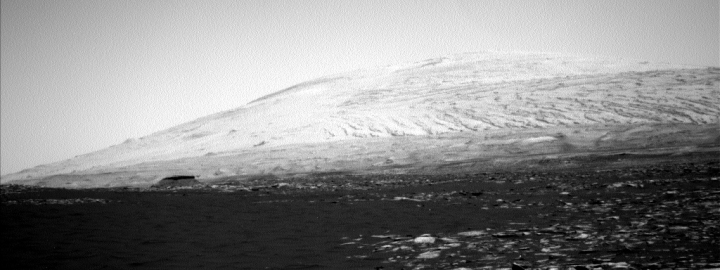
Looking at Mount Sharp

The flats the rover is presently traversing, and visible in the foreground of the panorama above, is strewn with dark sand that often piled into large sand dunes. Where the ground is exposed, it is made up of a scattering of pavement-like rocks. As noted in a press release yesterday, many of these flat rocks have polygonal cracks and boxwork similar to that seen in dried mud here on Earth, suggesting that this area was once wet and then dried. This geology helps confirm the theory of planetary scientists that Gale Crater was once filled with water that slowly evaporated away. As the rover climbs, it leaves the lakebed and begins to move through the lake’s various shores, each one older than the last.

Opportunity

For the overall context of Opportunity’s travels at Endeavour Crater, see Opportunity’s future travels on Mars.
» Read more
0 comments

Curiosity spots cracks formed from drying mud

mud cracks on Mars?

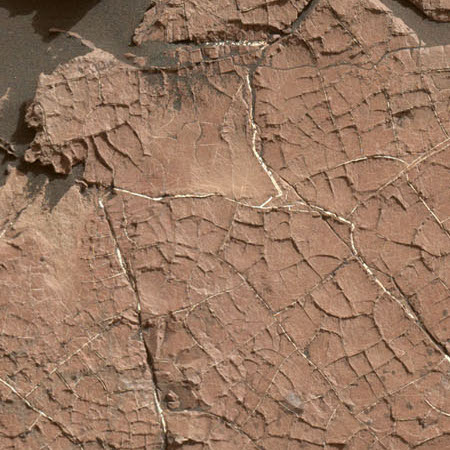
As Curiosity moves across the dust-shrewn dune-filled flats at the base of Mt. Sharp it has recently taken images of surface rocks that have cracks resembling those found from drying mud.

Scientists used NASA’s Curiosity Mars rover in recent weeks to examine slabs of rock cross-hatched with shallow ridges that likely originated as cracks in drying mud. “Mud cracks are the most likely scenario here,” said Curiosity science team member Nathan Stein. He is a graduate student at Caltech in Pasadena, California, who led the investigation of a site called “Old Soaker,” on lower Mount Sharp, Mars.

If this interpretation holds up, these would be the first mud cracks — technically called desiccation cracks — confirmed by the Curiosity mission. They would be evidence that the ancient era when these sediments were deposited included some drying after wetter conditions. Curiosity has found evidence of ancient lakes in older, lower-lying rock layers and also in younger mudstone that is above Old Soaker.

The rover is no longer on the floor the crater, but in the foothills at the base of Mt. Sharp. Thus, what we are likely looking at is evidence of the slow disappearance of the giant lake that scientists think once filled Gale Crater. These mud cracks suggest that the rover is now moving up out of the lake and through its margins.

I plan to do a rover update for both Curiosity and Opportunity tomorrow, so stay tuned.

0 comments

Curiosity looks at Mount Sharp

Looking at Mount Sharp

Cool image time! During the ten day holiday period, during which the Curiosity science and engineering teams generally got a break, they programmed the rover to take a variety of observations over the entire period. Some of those observations included repeated snapshots of the view ahead, using the rover’s navigation camera. The image above, reduced slightly from the full resolution image to show here, is one example of that view.

You can see the dark sandy dune region in the foreground, and the increasing steepness of the slope in the background. What I find most interesting are what look like canyon washes flowing downhill on the right, in what appear to be diagonally parallel cuts. That they do not flow directly downhill suggest to me that they were not created by water flow but by wind erosion, though it is possible that the geology of different bedding plains could have forced the flows in a diagonal direction down the slope. If wind erosion is the cause, however, it suggests a process that took a very long time to occur, as the atmosphere of Mars is so thin.

The route the rover will take is through a much larger canyon slightly off camera to the right. While the slope up the mountain on the left of the image appears to be an easier route, the geology there is not as interesting. Note also that we are not looking at the peak of Mount Sharp, which is much farther south and far higher.

7 comments

An igloo on Mars?

This igloo-like design is one of the concepts being considered at NASA for the first habitats on Mars.

Normally I don’t waste time promoting these NASA concept studies, since the odds of them getting built is less than zero. However, this idea is intriguing, and probably contains within it many concepts that will be used by the first Martian habitats.

6 comments

Debris inside Curiosity drill might be cause of problem

Engineers now suspect that a piece of debris inside Curiosity’s drill might be the cause of the recent intermittent problems with the drill’s feed motor, the equipment that extends the drill for drilling.

Experts believe they found a pattern in the way the drill feed motor behaves over time, Eriskson said, and the pattern observed so far matches what engineers would expect to see if a piece of foreign object debris, or FOD, was embedded somewhere inside the drill.

Erickson said the ground team is not sure of the source of the potential debris. It could be a piece of Martian soil or a pebble that somehow got into the mechanism and is gumming up the drill feed motor, or it might be something carried from Earth. “It some sense, it probably doesn’t matter,” Erickson said, detailing how engineers are focused, for now, on recovering use of the drill, one of the rover’s primary tools.

0 comments

A rover review of 2016

Link here. While my rover updates are focused entirely on where the rovers are, where they will be heading in the immediate future, and the present condition of the rovers themselves, this update provides a very good summary of the entire year’s events for both rovers, focused especially on the science learned by Curiosity. Definitely worth a read.

0 comments

ESA signs contract for construction of its part of ExoMars 2020

On Friday the European Space Agency signed a contract with Thales Alenia Space for the construction of the European portion of the ExoMars 2020 lander/rover mission.

The contract signed in Rome, Italy, secures the completion of the European elements and the rigorous tests to prove they are ready for launch. These include the rover itself, which will be accommodated within the Russian descent module, along with the carrier module for cruise and delivery to Mars. ESA is also contributing important elements of the descent module, such as the parachute, radar, inertial measurement unit, UHF radio elements, and the onboard computer and software. The science instruments for the rover and surface platform are funded by national agencies of ESA member states, Roscosmos and NASA following calls to the scientific community.

I had missed this last week. The Thales Alenia press release has more information.

I wish them luck, especially the Russians, whose luck with missions to Mars has been truly terrible. I suspect that the Russians will use some variation of their bouncing balloon technology for the lander, which worked on their 1960s lunar rover missions and was successfully copied by NASA for its 1997 Pathfinder/Sojourner rover mission.

0 comments

Mars rover update: December 22, 2016

Curiosity

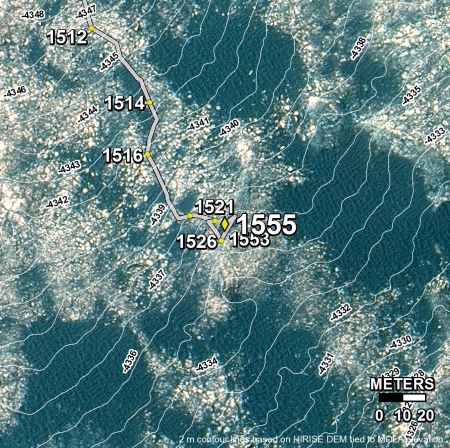
Curiosity's location, Sol 1555

For the overall context of Curiosity’s travels, see Pinpointing Curiosity’s location in Gale Crater.

After weeks of drill diagnostics and enforced lack of travel while those diagnostics were on-going, Curiosity finally moved last weekend (Sol 1553). The traverse map to the right, cropped and reduced in resolution to show here, indicates where they went, which wasn’t far and doesn’t really tell us yet which route they plan to take to pick their way through the surrounding dune fields. Thus, the options I indicated in my November 14, 2016 rover update all remain possible. If you go to that update you can see a much better Mars Reconnaissance Orbiter (MRO) overhead image showing the upcoming terrain.

In the meantime, the Curiosity science team is preparing to take a well deserved Christmas-New Year’s break (see update for sols 1566-1568). So that Curiosity doesn’t sit idle during that time, they have uploaded to it an 8-sol plan to cover December 22 to December 30 followed by a 3-sol plan from December 31 to January 2. The rover will not move during this period, but will take lots of different observations in situ.

As they note rightly at the link above, “It’s been quite the year for our rover: we have drilled six holes, performed two scoops, driven 3 km, and climbed 85 vertical meters!” What is more significant is that the best is yet to come!

Opportunity

For the overall context of Opportunity’s travels at Endeavour Crater, see Opportunity’s future travels on Mars.
» Read more
6 comments

Lace on Mars

Lace on Mars

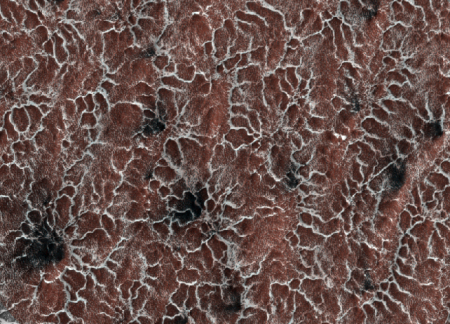
Cool image time! The image on the right, cropped and reduced in resolution to show here, was taken by Mars Reconnaissance Orbiter June 21, 2016. It shows a region in the high northern latitudes, 80 degrees.

Some seasonal ice on Mars is transparent so that the sunlight penetrates to the bottom of the ice. Heat from this sunlight can turn the ice directly into a gas in a process called sublimation and this gas can scour channels in the loose dirt under the ice. Channels formed by sublimation of a layer of seasonal dry ice are so dense in this area that they look like lace. Gas flow erodes channels as it escapes to the surface of the overlying seasonal ice layer seeking the path of least resistance.

The resolution of the full image is 9.7 feet per pixel. This means that if Curiosity was driving across this surface we would see it. I guarantee however that Curiosity would not find driving here very easy. The ice surface is likely very delicate, and would likely cause any vehicle to bog down. The surface is also likely very alien-looking, which makes me very much want to see what it looks like, up close. This look will unfortunately have to wait, as we as yet do not have the right technology to do it. We would need I think a drone, capable of flying in Mars’s thin atmosphere.

0 comments

NASA begs out of first SpaceX’s Mars mission

NASA has decided to hold off contributing any science instruments for SpaceX’s first Dragon mission to Mars.

NASA wants to wait until SpaceX proves it can pull off a soft landing on the Red Planet before committing millions of dollars’ worth of equipment to the spaceflight company’s “Red Dragon” effort, said Jim Green, head of the agency’s Planetary Science Division. “Landing on Mars is hard,” Green said during a talk Tuesday (Dec. 13) here at the annual fall meeting of the American Geophysical Union (AGU). “I want to wait this one out.”

15 comments

Curiosity cleared to move but not drill

Engineers have cleared Curiosity to move once again, but have not yet cleared the rover to use its balky drill.

This morning we received downlink that indicated operation of the drill feed using standard commands. This is great news, and the anomaly response team has cleared the rover for use of the arm and driving (but not yet drilling).

It is not known when they will drill again, but the news suggests that they will do so eventually, once they get a full understanding of what prevented normal operations this last time. For moment, at least, they no longer have a need to keep the rover motionless so they could assess the situation.

0 comments
1 163 164 165 166 167 212