New images from Opportunity

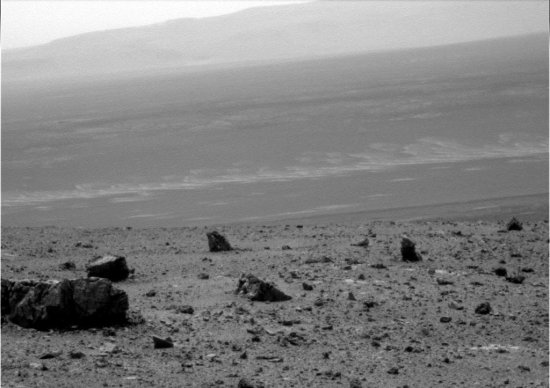
Opportunity begins exploring the rim of Endeavour Crater, taking a bunch of new images . I especially like this one, of which I’ve posted a cropped scaled-down version below. The image looks across the 13-mile-wide Endeavour Crater to its far rim on the horizon. Note the haze. Mars very clearly has an atmosphere, even though it is far thinner than Earth’s. In the foreground are scattered rocks, ejecta produced from the impact that formed a smaller nearby crater now named Opportunity Crater.

Endeavour Crater as seen by Opportunity

1 comment

Endeavour Crater at last!

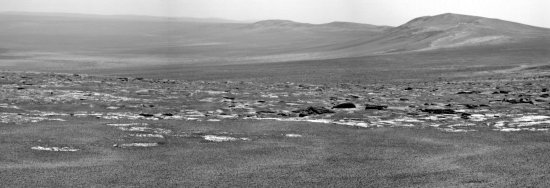
The science team for the rover Opportunity have released their first image taken from the rim of Endeavour Crater.

Since this picture looks south from Spirit Point less than a football field’s distance from the rim, it appears to look into the crater, the mountains on the right being the crater’s rim. What looks like a debris field running across the center of the image looks to me to be a combination of exposed patches of bedrock and boulders on the plateau above the rim. For the scientists, those boulders will be the prime research targets, as they are possibly ejecta produced at crater impact and could therefore be material thrown out from deep within the Martian crust.

a view of Endeavour Crater

0 comments

More evidence that there are active flows of water on Mars

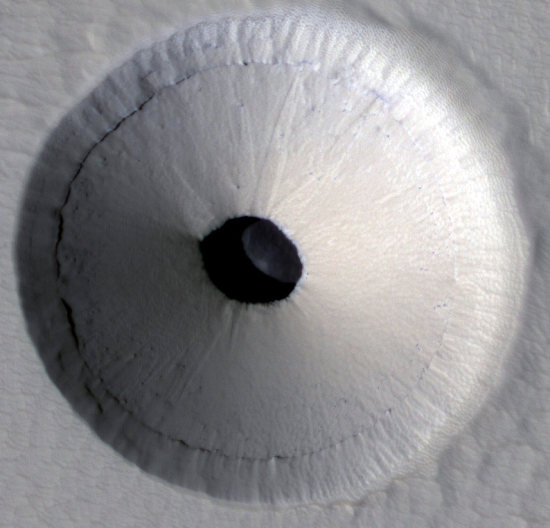
flow features on Mars

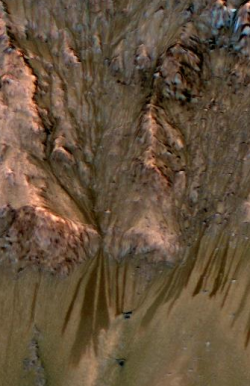
More evidence that there are active flows of water on Mars.

Dark, finger-like features appear and extend down some Martian slopes during late spring through summer, fade in winter, and return during the next spring. Repeated observations have tracked the seasonal changes in these recurring features on several steep slopes in the middle latitudes of Mars’ southern hemisphere.

Though there are a number of unsolved issues about these features, the best explanation appears to be a liquid brine.

Saltiness lowers the freezing temperature of water. Sites with active flows get warm enough, even in the shallow subsurface, to sustain liquid water that is about as salty as Earth’s oceans, while pure water would freeze at the observed temperatures.

Go here to see the full image.

0 comments

The Painted Desert of Mars

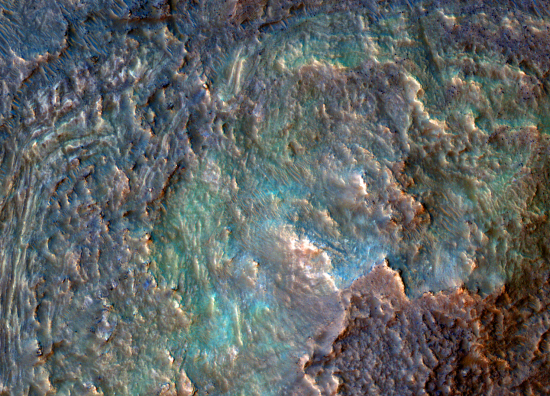
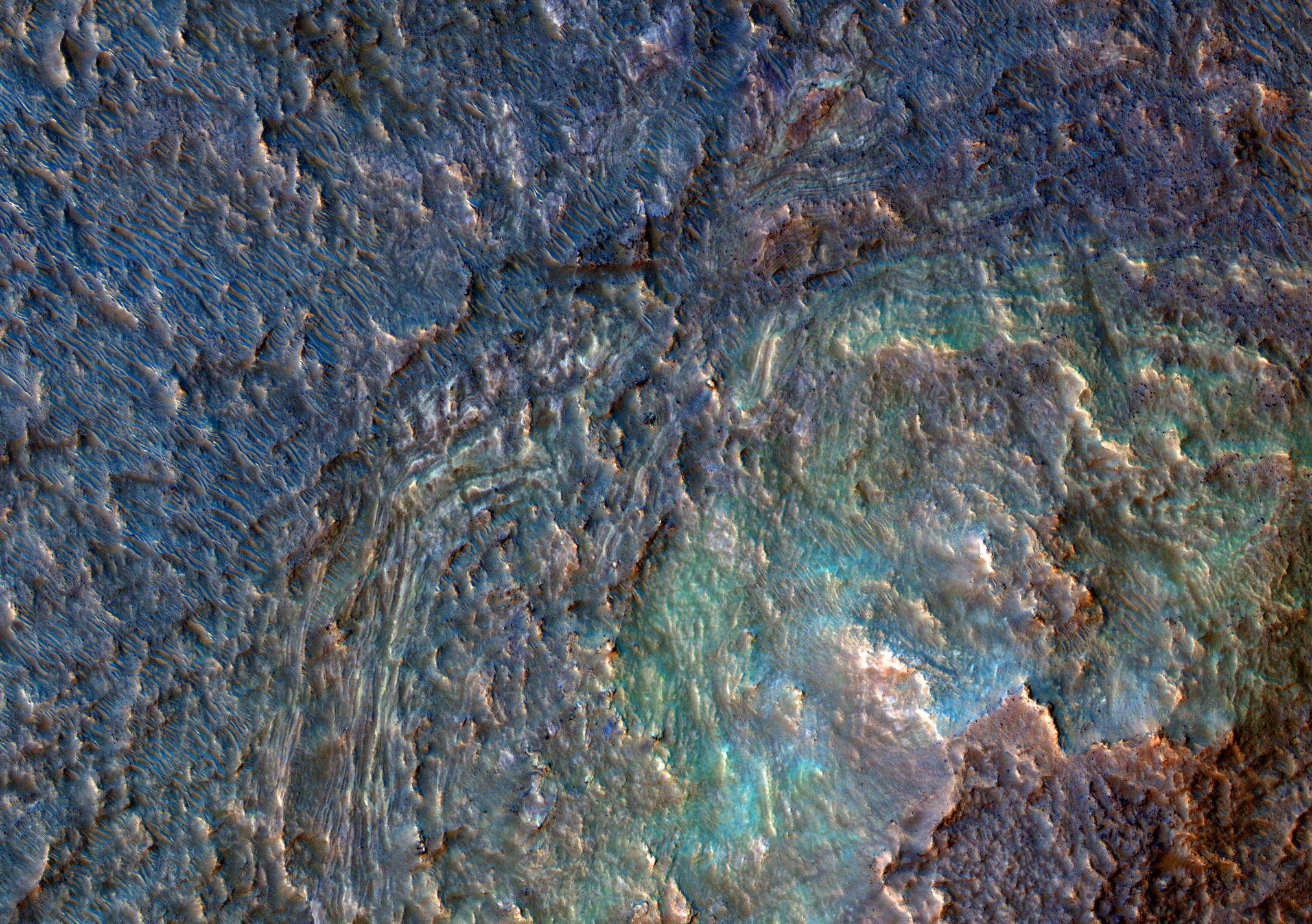
Mars Reconnaissance Orbiter released this picture yesterday of what the Orbiter’s scientists have labeled “The crazy floor of Hellas Basin.” Below you can see a cropped image of only one part of the large higher resolution image. The NASA caption says that the wild colors probably “indicate that diverse minerals are present,” meaning that any settlers of the red planet will probably take a close look at this location with the reasonable hope of finding the resources they need to colonize a planet.

To me, these colors also indicate that this place on Mars would probably one of its most popular tourist spots. As I look at the image my eye instinctively wants to trace out the best trail route along the ridges and down into the gullies in order to give hikers the best view of this colorful terrain.

Hellas Basin

0 comments

The next Mars rover will land at Gale Crater

The next Mars rover will land at Gale Crater.

The car-sized Mars Science Laboratory, or Curiosity, is scheduled to launch late this year and land in August 2012. The target crater spans 96 miles (154 kilometers) in diameter and holds a mountain rising higher from the crater floor than Mount Rainier rises above Seattle. Gale is about the combined area of Connecticut and Rhode Island. Layering in the mound suggests it is the surviving remnant of an extensive sequence of deposits. The crater is named for Australian astronomer Walter F. Gale. . . . The portion of the crater where Curiosity will land has an alluvial fan likely formed by water-carried sediments. The layers at the base of the mountain contain clays and sulfates, both known to form in water.

More here, including images of landing site.

0 comments
1 203 204 205 206 207 212