Sailing to Mars

With the end of the Mar500 simulated mission this coming Friday, the Russians are now proposing an eighteen month simulated Mars mission on board the International Space Station.

The Russians have been pushing to do this on ISS for years. Unfortunately, NASA has always resisted.

Yet, as I wrote in Leaving Earth, we will never be able to send humans to any other planets until we have flown at least one simulated mission, in zero gravity in Earth orbit, beforehand. Wernher von Braun pointed out this reality out back in the 1950s, and that reality has not changed in the ensuing half century. Not only will such a mission tell us a great deal about the medical issues of living in weightlessness for years at a time — issues that are far from trivial — it will give us the opportunity to find out the engineering problems of building a vessel capable of keeping humans alive during interplanetary flight, far from Earth.
» Read more
1 comment

Catching an avalanche on Mars, as it happens

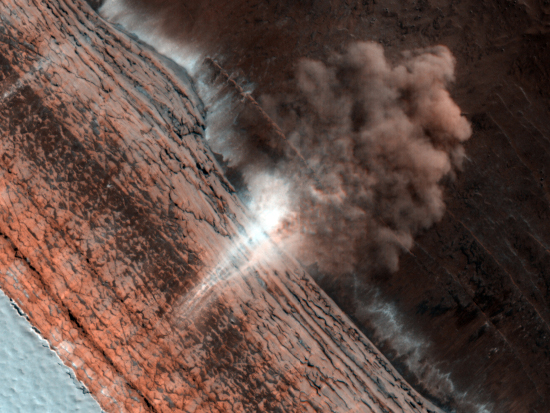
The Mars Reconnaissance Orbiter team today released this really cool image from Mars, showing an avalanche near the North Pole, in progress. The image looks directly down the cliff face from above. At the base of the cliff we can see the dust cloud from the crash of material billowing out away from the scarp.

What impresses me most about this image is that it was taken by an orbiting spacecraft approximately 200 miles above the planet’s surface, moving at thousands of miles an hour. Yet, the camera not only had the resolution to see the cloud of dust, it could snap the image fast enough to capture the actual fall of material (the white wisps down the side of the cliff that are reminiscent of a waterfall).

Also intriguing is the visible steep face of the cliff face itself. I know a lot of rock climbers who would love to literally get their hands (and chocks) on that rock face. And in Mars’s one-third gravity, rock climbing would surely be different.

avalanche on Mars

1 comment

The red cliffs of Mars

Red cliffs on Mars

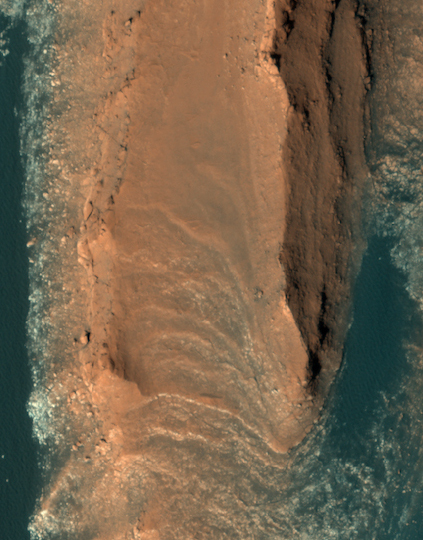
Last week the Mars Reconnaissance Orbiter team released this beautiful image of what they call “layered yardangs” on Mars.

What creates these sharp ridges? This layered terrain has been sculpted by the wind. The aligned ridges are called yardangs, which are formed in areas where the dominant erosional force is the wind. Yardangs are also found on Earth, usually in very dry areas.

What I see are majestic red cliffs rising out of a aqua-colored sand desert. What a place to visit!

0 comments

Mars atmosphere has more water vapor than predicted

Data from Mars Express has found that the Martian upper atmosphere has far more water vapor than predicted.

“The vertical distribution of water vapour is a key factor in the study of Mars’ hydrological cycle, and the old paradigm that it is mainly controlled by saturation physics now needs to be revised,” said Luca Maltagliati [of the Laboratoire AtmosphΓ¨res, Milieux, Observations Spatiales (LATMOS) in Guyancourt, France]. “Our finding has major implications for understanding the planet’s global climate and the transport of water from one hemisphere to the other.”

“The data suggest that much more water vapour is being carried high enough in the atmosphere to be affected by photodissociation,” added Franck Montmessin, also from LATMOS, who is the Principal Investigator for SPICAM and a co-author of the paper. “Solar radiation can split the water molecules into oxygen and hydrogen atoms, which can then escape into space. This has implications for the rate at which water has been lost from the planet and for the long-term evolution of the Martian surface and atmosphere.”

0 comments

The rover Opportunity as seen from Mars orbit

Opportunity on Endeavour Crater rim

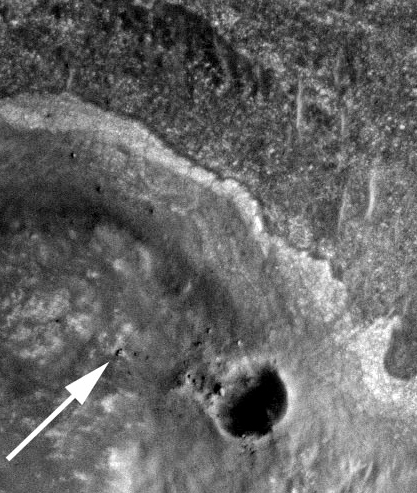
The image to the right was taken by Mars Reconnaissance Orbiter, with the white arrow showing the Mars rover Opportunity perched on the rim of Endeavour Crater.

The rover’s scientists hope that the rocks found on the crater rim, dredged up from deep below when the crater impact occurred, will be the oldest rocks so far touched on the Martian surface, and thus give them a peek at ancient Martian geology.

0 comments
1 202 203 204 205 206 212